
 Fax: (239) 692-9436
 Tel: 239-430-3668
Instead of repeatedly calling your doctor, insurer, and specialist about a Medicare referral podiatry visit, use one sequence: identify your coverage, verify the specialist, secure any required referral or authorization, and confirm the visit’s purpose. Original Medicare generally does not require a specialist referral; Medicare Advantage requirements depend on your plan, and neither a referral nor an appointment guarantees coverage.
- Original Medicare generally needs no specialist referral; Medicare Advantage rules depend on your plan.
- A Medicare referral podiatry visit requires separate checks for referral requirements, provider participation, and covered services.
- Naples Podiatrist offers specialist foot and ankle care; confirm your exact insurance plan before scheduling.
- Routine nail trimming is generally excluded unless Medicare’s medical coverage requirements are met.
Why this matters
A referral directs your care. It does not establish insurance coverage. Medicare distinguishes treatment of a medical foot problem from routine foot care, such as uncomplicated nail trimming or callus removal.
For 2026, use the Centers for Medicare & Medicaid Services’ Medicare & You 2026 handbook for general Original Medicare rules and your plan’s current Evidence of Coverage for Medicare Advantage requirements. The handbook explains national benefits; your plan documents explain plan-specific access rules.
Naples Podiatrist is best for Southwest Florida patients seeking specialist foot and ankle care. Start with the Medicare podiatrist guide for Naples, then verify participation for your exact plan, clinician, and location rather than treating a website description as confirmation.
Before you start
- Gather your coverage information. Have your Medicare card, any Medicare Advantage or supplemental insurance card, photo identification, and the member-services telephone number. Use the coverage effective on your appointment date.
- Prepare your medical information. Bring your medication list, referring clinician’s details, relevant records, and a plain-language description of the problem. Identify wounds, numbness, recent injury, diabetes, and changes in walking.
- Separate referral from authorization. A primary care referral and an insurer’s prior authorization are different requirements. When either applies, confirm the receiving clinician, dates, and approved services before treatment.
Do not delay urgent assessment while assembling paperwork. A suddenly cold or discolored foot, rapidly spreading redness, fever with a foot wound, or a serious injury requires prompt medical attention; use emergency care for severe or rapidly worsening symptoms.
Coverage identification
Establish your insurance route
- Read your current insurance cards. Determine whether you use Original Medicare or receive Medicare benefits through a Medicare Advantage plan. A Medicare card alone does not tell the scheduling team which coverage handles your current claims.
- Call the appropriate benefits contact. For Medicare Advantage, use the member-services number on your plan card. Ask whether an office podiatry consultation requires a primary care referral, prior authorization, or both.
- Write down the answer. Record the representative’s name, call date, and reference number if supplied. Ask where the requirement appears in your 2026 plan documents.
- Identify the proposed service. Explain whether you need evaluation of pain, an injury, a wound, or nail and skin care. Ask about the service, not simply whether the plan covers podiatrists.
Expected result: You know which coverage applies and whether your planned consultation has a referral or authorization requirement.
Compare the access routes
These are verification routes, not recommendations to change insurance. Each has an advantage and a limitation.
| Verification route | Best for | Access advantage | Limitation to check |
|---|---|---|---|
| Original Medicare | Patients using Original Medicare for the appointment | Specialist referrals are generally not required | The clinician must accept Medicare, and the service must meet coverage requirements |
| Medicare Advantage | Patients whose private plan administers Medicare benefits | Member services can identify the plan’s specialist access rules | Network, referral, and authorization requirements vary by plan |
Original Medicare does not cover every service a Medicare-participating clinician offers. Medicare Advantage also requires you to distinguish covered medical benefits from any additional routine-foot-care benefit described in the plan documents.
Provider and service verification
Confirm the clinician and location
- Give the practice your exact plan name. Include the plan type and identifying information requested by the scheduling team. Saying only that you have Medicare leaves an important question unanswered.
- Verify the individual clinician and office. For Medicare Advantage, ask the insurer whether that clinician at that location is in network. Confirm with the practice as well, especially when you spend part of the year outside Florida.
- Ask about Medicare participation. With Original Medicare, confirm whether the clinician accepts Medicare and accepts assignment for the proposed service. These questions are separate from whether an appointment can be scheduled.
- Describe your symptoms accurately. Explain when the problem began, which foot is affected, and what walking or daily activities it limits. Do not substitute a diagnosis you have not received.
Expected result: You have checked the clinician and location against your coverage and identified the reason for the appointment.
For Naples Podiatrist foot and ankle care, describe the activity you want to regain: walking the golf course, playing pickleball, running, or moving safely around your home. That detail helps the clinical team understand the problem; it does not establish insurance eligibility.
Distinguish medical evaluation from routine care
Medicare Part B covers medically necessary diagnosis and treatment of foot injuries and diseases, subject to its rules. Routine foot care is generally excluded, although exceptions apply when qualifying medical conditions make that care medically necessary.
Diabetes alone does not automatically make every nail-care visit covered. The clinician must document the findings and circumstances supporting the applicable benefit. Report reduced sensation, circulation problems, wounds, painful nails, and previous complications without assuming which coverage rule applies.
Referral and authorization records
Complete the required handoff
- Request the referral when your plan requires it. Give your primary care office the specialist’s name, location, and appointment purpose. Ask the office to send relevant clinical records along with the referral.
- Confirm who handles authorization. Ask the practice and insurer which office must submit the request. Do not assume that sending a referral also starts an authorization request.
- Check 3 checkpoints: clinician, dates, and services. Confirm that any required approval matches the treating clinician, includes the appointment date, and covers the intended service. Ask about visit limits when applicable.
- Verify receipt with the specialist. Ask whether the required records and approvals have arrived. Keep your own copy or confirmation details rather than relying only on a message that paperwork was sent.
Expected result: Every required referral or authorization is documented and available to the receiving practice before the applicable service.
The benefit of this sequence is a clear handoff. Its limitation is equally important: verification and authorization do not guarantee claim payment. Eligibility, benefit exclusions, documentation, and the service actually delivered still matter.
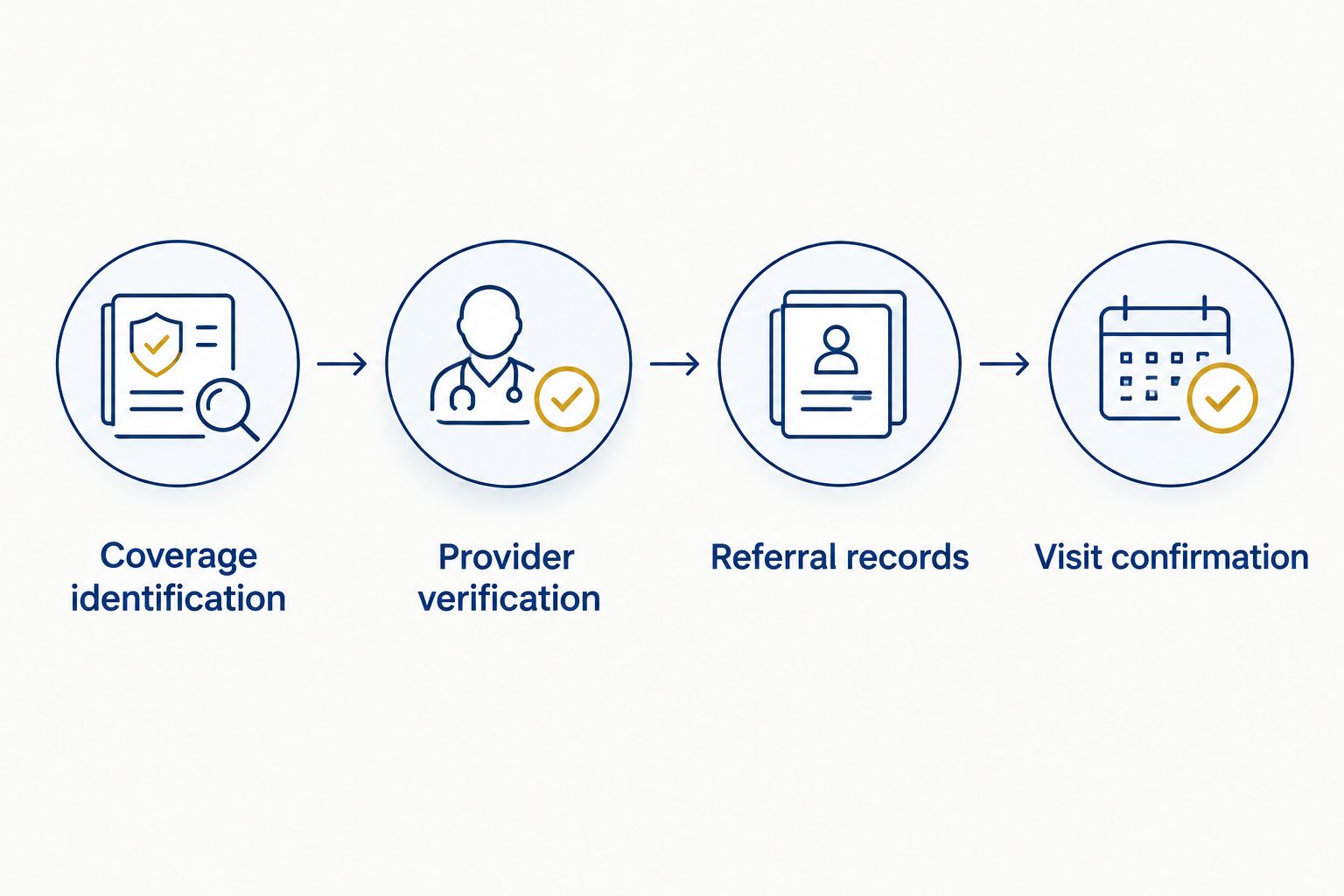
Visit confirmation
Prepare for the appointment and claim
- Confirm the appointment details. Recheck the clinician, office address, date, and reason for the visit. Tell the practice about any insurance change since scheduling.
- Bring your records. Include insurance cards, medications, referral information, and relevant test reports. If another office sent imaging, confirm whether the actual images are accessible, not just the written report.
- Discuss additional services before proceeding. A consultation does not automatically establish coverage for imaging, procedures, orthotics, or later treatment. Ask whether a proposed service needs a separate coverage check.
- Read notices before signing. Under Original Medicare, an Advance Beneficiary Notice of Noncoverage, or ABN, applies in certain situations when payment is expected to be denied. Ask what service the notice concerns and what your choices mean; Medicare Advantage follows different notice and determination procedures.
- Compare the claim documents afterward. Under Original Medicare, review your Medicare Summary Notice; under Medicare Advantage, review the plan’s Explanation of Benefits. These are not bills. Match the service date and description against the practice’s statement.
Expected result: You arrive prepared, understand any additional coverage questions, and know which claim document to review afterward.
In 2026, keep benefits confirmations with your appointment records. If the insurer’s explanation conflicts with a practice statement, ask both parties to identify the specific claim issue before assuming the referral caused it.
Repeat this workflow when care changes
An established patient still needs a new check when insurance, symptoms, or planned treatment changes. A previous covered appointment is not approval for a different service.
Use this shorter repeat workflow:
- Identify the change. Tell the practice about a new insurance card, new wound, different foot problem, or proposed procedure.
- Recheck the applicable requirement. Ask whether an existing referral remains valid and whether the new service needs authorization. Confirm remaining approved visits when your plan limits them.
- Update the clinical record. Provide new medication information, relevant primary care records, and changes in symptoms or function.
- Confirm the next appointment. Verify that the paperwork matches the care now planned, not just the original consultation.
Expected result: The repeat appointment has its own current coverage and documentation check.
For a new 2026 plan year, do not assume last year’s network or referral rules remain unchanged. Use the documents effective for the upcoming service date.
Troubleshooting
The referral was sent, but the specialist cannot find it
Ask the sending office to verify the destination and resend the document through the receiving practice’s accepted channel. Then confirm receipt with the specialist. Check that your name and date of birth match the appointment record.
The insurer lists the practice, but not your clinician
Ask about the individual clinician and the specific location. For Medicare Advantage, request direct confirmation from the plan rather than assuming that participation by another clinician establishes your clinician’s network status.
Nail care is described as noncovered
Ask which coverage requirement is not met and whether the appointment is for routine grooming or treatment of a documented medical problem. Do not ask anyone to change a diagnosis to obtain payment; accurate examination findings determine the clinical record.
Authorization covers the consultation but not a procedure
Ask the treating office whether the proposed procedure requires its own submission. Confirm the insurer’s decision before elective treatment when authorization is required, without delaying medically urgent evaluation.
The claim is denied despite a referral
Read the stated denial reason first. Missing records, benefit exclusions, network rules, and authorization issues require different responses. Ask whether the next step is a corrected claim, additional documentation, or an appeal, and follow the deadline on the notice.
Customize your workflow
Keep 1 checklist for each appointment rather than mixing records from several clinicians. Include the visit purpose, coverage route, clinician and location, referral status, authorization status, and the person responsible for each unresolved item.
If surgery becomes part of treatment, use the deeper insurance pre-authorization to surgery day workflow. An office-visit check is not a substitute for confirming the requirements associated with a planned operation.
Naples Podiatrist provides specialist podiatry care for medical and surgical foot and ankle conditions. Confirm your insurance details with the practice and plan before treating an appointment confirmation as a coverage decision.
FAQ
Do I need a Medicare referral for a podiatry visit in 2026?
Original Medicare generally does not require a referral for a podiatry visit. Medicare Advantage referral requirements depend on your plan, so confirm the rule for the clinician and service before the appointment.
Does a referral guarantee that Medicare covers my foot appointment?
No. A referral does not guarantee coverage or payment. The service must satisfy applicable benefit, medical-necessity, documentation, and plan requirements.
Does Medicare cover routine toenail cutting if I have diabetes?
Diabetes alone does not automatically establish coverage for routine toenail cutting. Medicare has exceptions to its routine-foot-care exclusion, and the clinician must document the qualifying circumstances.
Is prior authorization the same thing as a podiatry referral?
No. A referral directs you to a specialist, while prior authorization is an insurer review required for certain services. Your plan determines whether either requirement applies.
Can I see a Southwest Florida podiatrist while visiting from another state?
Your access depends on your coverage and the clinician’s participation. Original Medicare and Medicare Advantage have different access rules; confirm the clinician, location, and any out-of-area plan requirements before scheduling nonemergency care.
What should I bring to a Medicare podiatry appointment?
Bring your current insurance cards, identification, medication list, relevant records, and any required referral or authorization information. Include the referring clinician’s contact details and describe how the foot problem affects walking or other activities.
Should I wait for a referral if I have a diabetic foot wound?
Do not delay clinical assessment of a new diabetic foot wound while sorting out routine referral paperwork. Contact a clinician promptly, and seek emergency care for severe or rapidly worsening symptoms such as spreading infection or a suddenly cold, discolored foot.
One last thing
Describe the problem before naming the appointment. Nail trimming, painful nail treatment, wound evaluation, and a neuropathy examination are not interchangeable services, even when they involve the same foot.
Tell Naples Podiatrist what hurts, what changed, and what you can no longer do comfortably. Accurate symptoms support appropriate clinical assessment; neither a referral nor an insurance checklist replaces that examination.
Related guides
- Primary care referral to podiatry treatment workflow
- New patient guide: what to bring to your podiatry visit
- How often should you see a podiatrist for routine foot care?

