
 Fax: (239) 692-9436
 Tel: 239-430-3668
Instead of repeatedly calling about insurance pre-authorization for foot surgery, keep one shared checklist that connects your surgeon’s request, your insurer’s decision, and your surgery-day instructions. This 2026 workflow helps you confirm what is approved, resolve missing information, and prepare for the procedure without treating an authorization as a guarantee of payment.
- Insurance pre-authorization for foot surgery requires checking your plan’s rules, the submitted procedure, and the written decision.
- Naples Podiatrist provides specialist foot and ankle care; your insurer determines authorization and coverage under your plan.
- An approved authorization does not replace network verification, medical clearance, or surgery-day preparation.
- Recheck authorization whenever the procedure, facility, surgeon, insurance plan, or surgery date changes.
Why this matters
Insurance approval and readiness for surgery are different checkpoints. Your insurer reviews a proposed service under your plan’s requirements; your surgical team decides whether you are medically ready and provides instructions for the procedure.
Naples Podiatrist is best for Southwest Florida patients seeking specialist foot and ankle care. Start with a clinical evaluation through Naples Podiatrist, then coordinate insurance questions with the practice and your plan. Specialist access helps you address the foot problem, but it does not determine your insurer’s decision.
For a planned operation in 2026, organize 3 separate checks: authorization, coverage, and clinical readiness. Completing one does not complete the others. Keep the status of each visible so a missing referral or unfinished preoperative assessment does not disappear behind an approval letter.
Before you start
- Gather your materials: your current insurance card, identification, surgeon’s proposed procedure, existing referral if required, and records of relevant prior treatment. Include outside imaging or visit records the practice requests.
- Identify 2 contacts: the practice staff member handling surgical insurance questions and your insurer’s member-services contact. Keep 1 folder for decisions, messages, reference numbers, and the current surgery instructions.
- Check the hidden mismatch: authorization can apply to specified services, providers, facilities, or dates. An approval for one arrangement does not automatically apply after a change, and approval alone does not guarantee claim payment.
Use a notebook or secure document you control. You do not need a particular app. Share medical information only through channels the practice or insurer directs you to use, and obtain any required permission before involving a family member.
Coverage and referral verification
Confirm the plan requirements
- Verify your current coverage. Give the practice the insurance information that will apply on the proposed surgery date. Report a new employer plan, Medicare plan change, or other coverage change immediately.
- Ask whether authorization is required. Use the procedure information supplied by the practice rather than a general label such as bunion surgery. Ask whether your plan also requires a referral or other preliminary review.
- Verify the planned care setting. Ask your insurer about the surgeon and facility separately. Ask how to verify the anesthesia provider’s network status as well; the surgeon’s participation does not establish everyone else’s participation.
- Record the answer. Save the date, representative’s name when provided, call reference number, and any written explanation. If authorization is not required, ask the practice how it documents that determination.
Expected result: you know whether authorization and a referral are required, which providers need verification, and who handles unresolved questions.
Separate authorization from coverage
Pre-authorization, also called prior authorization or precertification, is an insurer’s advance review when your plan requires it. Coverage also depends on the plan’s benefits, exclusions, eligibility, and claim rules. Ask the insurer to explain both rather than treating those words as interchangeable.
Do not assume that a policy you used previously has identical requirements in 2026. Check the current plan documents and the proposed service. A referral authorizes a route to specialist care under some plans; it is not automatically authorization for an operation.
Authorization request and decision tracking
Assemble the request
- Confirm who submits it. Ask the practice which office or facility is responsible for the request. Avoid submitting a separate request yourself unless the insurer or surgical team instructs you to do so.
- Supply missing records. Provide records of relevant symptoms, previous treatments, imaging, and outside consultations when requested. Let the clinical team determine which documentation supports the proposed surgery.
- Check the procedure description. Confirm the affected foot, proposed operation, surgeon, facility, and planned date with the practice. Ask the staff to resolve any discrepancy in the insurer’s request information.
- Get the tracking details. Record the submission date and request identifier if available. Ask who will contact you with the decision and when you should check again under your plan’s process.
Expected result: the responsible team has submitted the request or identified exactly what is still needed.
Track a decision, not an assumption
Ask for the actual status: not submitted, under review, awaiting information, approved, or denied. A scheduled procedure is not proof of insurance approval. Likewise, a request identifier confirms tracking, not a favorable decision.
There is no single approval timeline for every foot operation or insurance plan. Ask your insurer for the applicable review timeframe and whether it has everything needed. If your clinical situation becomes urgent, contact your surgeon; the clinician determines whether an expedited review is appropriate.
For your 2026 checklist, write the next action beside the status. For example, an outstanding imaging report belongs beside the request, with the person responsible for supplying it. This prevents repeated calls that establish the status without moving the request forward.
Approval review and scheduling handoff
Match the approval to the operation
- Obtain the decision. Request the written approval or the confirmation details available through the practice and insurer. Keep the authorization identifier with your surgical paperwork.
- Check the scope. Ask the practice to verify that the approved services match the planned procedure. Confirm the provider, facility, date range, and any stated conditions that apply.
- Resolve differences before surgery. Report a changed date or location rather than assuming the approval carries over. Ask whether the existing request needs an update or a new submission.
- Confirm the scheduling handoff. Ask what remains before the surgical team considers the operation ready to proceed, including any required assessment, testing, consent, or facility review.
Expected result: the team has matched the insurance decision to the current operation and identified remaining scheduling requirements.
Keep the status meaningful
The following table compares decision pathways, not insurance plans. Each status has a useful next step and a limit you need to understand.
| Status | Best for | What it establishes | Limitation and next move |
|---|---|---|---|
| Authorization approved | Moving to final verification | The insurer has approved the request within its stated scope | Not a payment guarantee; match the approval to the current procedure |
| Authorization not required | Proceeding without an authorization request when verified | The plan does not require this review for the specified service | Does not establish coverage; verify benefits and other requirements |
| Request pending | Tracking an unresolved review | The request has not reached a final decision | Not approval; identify missing information and the next follow-up |
| Request denied | Choosing the appropriate response | The insurer has issued an unfavorable decision | Read the reason and coordinate correction or appeal before assuming coverage |
Do not turn a pending request into an approved entry on your checklist. Keep insurance verification separate from decisions about whether treatment is medically necessary or time-sensitive.
Clinical preparation and surgery-day instructions
Complete the medical handoff
- Provide your full medication list. Include prescriptions, over-the-counter medicines, supplements, and allergies. Ask for individualized instructions about blood thinners, diabetes medicines, and other drugs; do not stop them on your own.
- Complete only the requested assessments. Follow the surgical team’s instructions for preoperative visits and testing. Insurance approval does not establish that your medical evaluation is complete.
- Report health changes. Tell the team about fever, a new wound, worsening redness, illness, or a medication change before surgery. The clinician decides whether the plan needs adjustment.
- Obtain written preparation instructions. Confirm where to arrive, the arrival time, fasting instructions, permitted medicines, transportation requirements, and whom to contact with questions.
Expected result: you have a current, individualized preparation plan and know which clinical tasks remain unfinished.
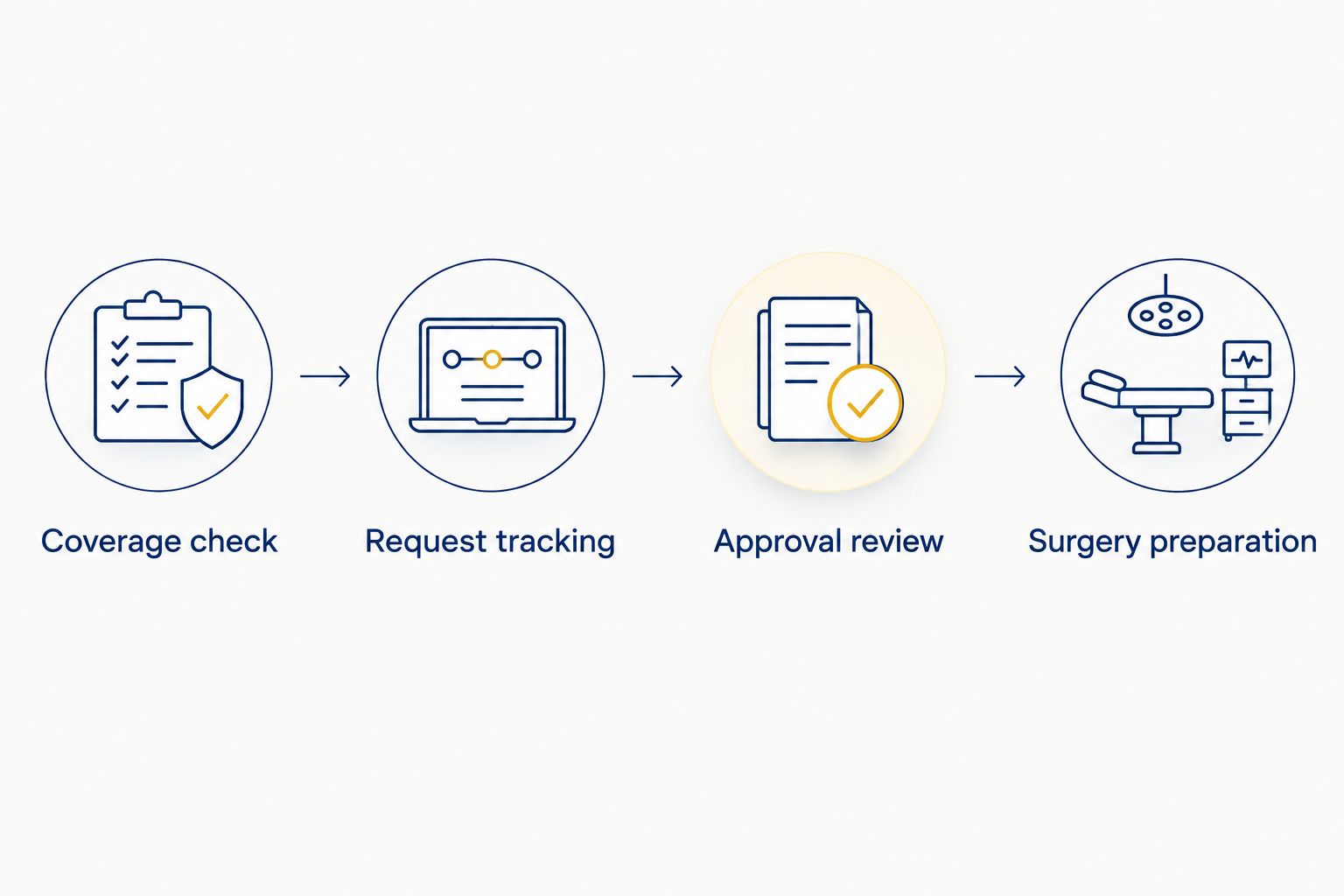
The sequence is simple: Coverage check, Request tracking, Approval review, Surgery preparation. Each handoff answers a different question; none replaces the next.
Prepare for the day and the first trip home
Use the foot or ankle surgery-day preparation guide alongside your own surgical team’s instructions. General education does not replace the directions for your procedure and anesthesia.
Arrange the transportation and adult assistance your facility requires. Ask whether you need a prescribed boot, crutches, walker, or other mobility aid, and how to use it safely. Do not choose a device or begin weight-bearing based on another patient’s experience.
Before leaving home, bring the identification, insurance materials, medication list, and equipment the facility requests. Confirm that your helper understands the discharge plan. In your 2026 folder, keep the latest instruction sheet at the front so an older version does not guide your preparation.
When the date, procedure, or insurance changes
A rescheduled operation needs a fresh check against the existing authorization. This adjacent workflow also applies when the surgeon changes the procedure or your insurance changes after the initial request.
- Notify the practice of the change. Give the new information and ask which team member will update the insurance review.
- Compare the existing approval with the new plan. Ask whether the authorization remains valid for the revised date, service, surgeon, and facility.
- Confirm the insurer’s required action. Let the responsible team establish whether an amendment, extension, or new request is needed. A new insurance plan needs its own verification.
- Replace outdated instructions. Save the revised confirmation and surgery instructions. Clearly mark the previous version as superseded.
Expected result: the insurance record and clinical instructions describe the same planned operation.
This check matters for seasonal Southwest Florida residents who change locations or coverage while arranging care. Tell Naples Podiatrist about relevant travel and insurance changes before final scheduling, not at check-in.
Troubleshooting
The insurer has no record of the request
Ask the submitting office for the submission date, destination, and tracking identifier. Then ask the insurer to search using those details. A request sent to the wrong administrator or filed under mismatched member information needs correction by the responsible team.
The request is waiting for more information
Ask what specific information is missing and who must supply it. Obtain outside records when directed, but leave clinical explanations and procedure coding to the practice. Confirm receipt afterward; sending a document does not establish that the reviewer received it.
The insurer denied the operation
Read the written reason and applicable response deadline. Ask the practice whether the issue is an administrative error, missing documentation, or a medical-necessity decision. Correcting a submission and appealing a decision are different actions; follow your insurer’s instructions for the appropriate route.
The approval does not match the scheduled surgery
Contact the surgical scheduling team with the discrepancy. Ask it to verify the procedure, provider, facility, and approved dates before relying on the letter. Do not change procedure descriptions or codes yourself to make the paperwork match.
A new symptom appears while you wait
Call your clinical team rather than waiting for insurance paperwork. A new wound, spreading redness, or a hot, swollen foot needs prompt assessment, especially with diabetes. Seek emergency care for severe symptoms such as chest pain, shortness of breath, or a suddenly cold, pale foot.
Customize your workflow
Plan recovery support alongside authorization, not after it. Ask how the operation will affect stairs, bathing, driving, work, and follow-up visits. Let the surgeon set activity restrictions and the progression back to walking.
If your goal is returning to pickleball, golf, or running, name that goal at the consultation. Recovery planning should address your actual activities, but an insurance approval does not establish a return-to-sport date. Older adults living alone should discuss safe mobility and available help before surgery.
For a procedure planned in 2026, ask Naples Podiatrist about specialist foot and ankle evaluation and the next clinical step. Your insurer remains the contact for plan-specific coverage decisions.
Arrange specialist foot and ankle care
Start with a clinical evaluation before planning a foot or ankle operation.
FAQ
Do I need insurance pre-authorization for foot surgery?
You need pre-authorization when your insurance plan requires it for the proposed procedure and care setting. Ask the practice and insurer to verify the specific service rather than relying on a general surgery name.
Does approval mean my insurer will pay the claim?
No, pre-authorization is not a guarantee of claim payment. Coverage still depends on eligibility, plan benefits, the services performed, and applicable claim requirements.
Who submits the authorization request for my foot surgery?
The responsible practice or facility typically submits the clinical request. Confirm who owns the submission and provide outside records when that team requests them.
How long does foot surgery authorization take?
The review timeframe depends on your plan, request type, and whether the insurer has the required information. Ask for the applicable timeframe and a specific next follow-up rather than assuming a universal deadline.
What happens if my surgery date changes after approval?
Ask the submitting team to verify whether the existing authorization covers the new date. A date change outside the approved scope requires the insurer’s specified update process.
Is authorization the same as medical clearance?
No, authorization is an insurance review, while preoperative medical assessment addresses readiness for surgery. Complete the clinical steps your surgical team requests even when insurance approval is in place.
Can Naples Podiatrist guarantee my insurance approval?
No, the insurer determines authorization under your plan. Naples Podiatrist provides specialist foot and ankle care; ask the practice how to coordinate the documentation needed for your proposed procedure.
One last thing
Ask for the arrival time, not just the operation time. They are different scheduling details, and your facility’s instructions govern when you need to be there. A correct approval letter will not resolve a missed check-in or misunderstood fasting instruction.
Before surgery, read your latest written instructions back to the team if anything conflicts. That final clarification is more useful than another general confirmation that the operation is scheduled.
Related guides
- Choosing a podiatrist for foot surgery
- Physical therapy for foot and ankle recovery
- CAM boot to regular shoes recovery workflow

