
 Fax: (239) 692-9436
 Tel: 239-430-3668
Your ankle surgery cost in 2026 depends on the exact operation, the surgical setting, and your insurance benefits; a written, procedure-specific estimate is the useful figure for planning. The surgeon’s fee alone does not tell you the full cost because facility services, anesthesia, equipment, and rehabilitation need to be accounted for separately.
- Ankle surgery cost requires a procedure-specific estimate, not a general average applied to every operation.
- Compare the surgeon, facility, anesthesia, and recovery services included in each estimate.
- Insurance authorization does not guarantee payment or confirm your final out-of-pocket responsibility.
- Naples Podiatrist provides specialist foot and ankle care for Southwest Florida patients considering treatment.
How much does ankle surgery cost in 2026?
Your personal estimate needs to identify both the planned surgery and what you will owe—not just what a provider bills. Ask the surgical office for the procedure name, billing codes, planned facility, and services included before asking your insurer to calculate your responsibility.
For the administrative steps between approval and treatment, review the insurance pre-authorization to surgery-day workflow. Keep the authorization decision separate from your financial estimate.
Why this matters
A quote that includes only professional services is not directly comparable with an estimate that includes the facility and anesthesia. You need the same scope before you can make a useful comparison.
The same applies to recovery. A plan that leaves out prescribed equipment, follow-up imaging, or physical therapy leaves you with an incomplete budget, even when the operation itself is clearly described.
| Part of care | What to check in the estimate | Question to ask |
|---|---|---|
| Surgeon’s services | The named operation and professional services | Which follow-up visits are included? |
| Surgical facility | Operating room and recovery-area services | Will the facility issue a separate estimate? |
| Anesthesia | The anesthesia professional and related services | Who bills for anesthesia? |
| Implants and supplies | Hardware or other materials used during surgery | Are these included in the facility estimate? |
| Testing and imaging | Required examinations, laboratory work, and imaging | Which services are billed separately? |
| Recovery care | Prescribed equipment, rehabilitation, and follow-up care | What remains outside the surgical estimate? |
Treat this table as an estimate checklist, not a promise that every item applies to your operation. Your surgeon and billing team should identify the services relevant to your treatment plan.
Different ankle operations need different estimates
Ankle surgery is not a single procedure. A camera-assisted joint procedure, ligament reconstruction, fracture repair, and joint replacement address different problems and require different planning.
Compare estimates only after confirming that they describe the same clinical treatment. Choosing an operation because its estimate looks smaller reverses the medical decision: diagnosis and treatment goals come first.
| Procedure | Clinical purpose | Potential benefit | Limitation to discuss |
|---|---|---|---|
| Ankle arthroscopy | Examine and treat selected problems inside the joint using a camera and instruments | Treats certain joint problems through small incisions | Does not address every cause of ankle pain or advanced joint damage |
| Ligament repair or reconstruction | Address mechanical ankle instability | Improves stability in appropriately selected patients | Requires protection and rehabilitation; surgery does not replace strength and balance training |
| Fracture fixation | Stabilize a broken ankle when the fracture requires surgery | Restores alignment and supports healing | Recovery depends on the fracture and surrounding soft tissues |
| Ankle fusion | Join the ankle bones to treat selected cases of severe arthritis | Reduces pain from movement at the damaged joint | Eliminates movement at the fused joint |
| Ankle replacement | Replace damaged joint surfaces in selected patients | Preserves ankle movement | Requires careful patient selection and carries implant-related risks |
These are clinical categories, not interchangeable shopping options. Ask your surgeon which procedure fits your diagnosis, what benefit to expect, and what nonsurgical treatment remains appropriate.
Ankle arthroscopy: clarify the planned treatment
An arthroscopy estimate should describe more than the use of a camera. Ask what the surgeon intends to treat inside the joint and whether additional work is anticipated.
Small incisions do not mean that recovery or billing is identical for every arthroscopic procedure. The work performed inside the ankle matters.
Ligament surgery: identify the full repair plan
Ask whether your operation involves repairing existing tissue, reconstructing a ligament, or treating another problem at the same time. The estimate should reflect that plan.
Discuss the protection and rehabilitation required afterward. A stable ankle and a safe return to activity are the goals, not simply completing the operation.
Fracture surgery: address urgency before comparison shopping
An unstable or displaced ankle fracture requires prompt medical assessment. Do not postpone necessary evaluation while gathering financial paperwork.
Once the treatment plan is established, ask the hospital or surgical team to explain the expected billing components. Emergency treatment and a scheduled elective operation do not follow the same planning process.
Fusion or replacement: compare function as well as billing
Fusion and replacement treat selected cases of ankle arthritis, but their effects on ankle movement differ. Your surgeon should explain the trade-offs for your health, joint condition, and activity goals.
Neither procedure is automatically the right choice for every older adult. Discuss walking, golf, pickleball, and other activities you want to maintain without treating a return to sport as a guaranteed outcome.
Why ankle surgery cost varies
For a useful 2026 estimate, identify the factors that apply to your own treatment rather than relying on an average for unrelated operations.
- Procedure and complexity: Ask whether the plan includes additional repairs, hardware, or treatment of cartilage damage.
- Surgical setting: Confirm the exact hospital or surgery center and whether its services appear in a separate estimate.
- Anesthesia services: Identify the anesthesia billing group and verify its role in your estimate.
- Insurance benefits: Your deductible, copayments, coinsurance, network rules, and coverage terms affect your responsibility.
- Preparation and recovery: Account for required testing, prescribed mobility equipment, follow-up care, and rehabilitation.
- Changes in treatment: Ask how the estimate would be updated if the clinical plan changes before surgery.
Some factors are administrative; others are medical. You can clarify network status and billing scope, but you should not remove medically necessary care simply to make estimates look alike.
How do you get an ankle surgery estimate you can use?
Get the treatment plan first, then confirm the billing details with each organization involved. An insurer cannot meaningfully estimate your responsibility from the phrase ankle surgery alone.
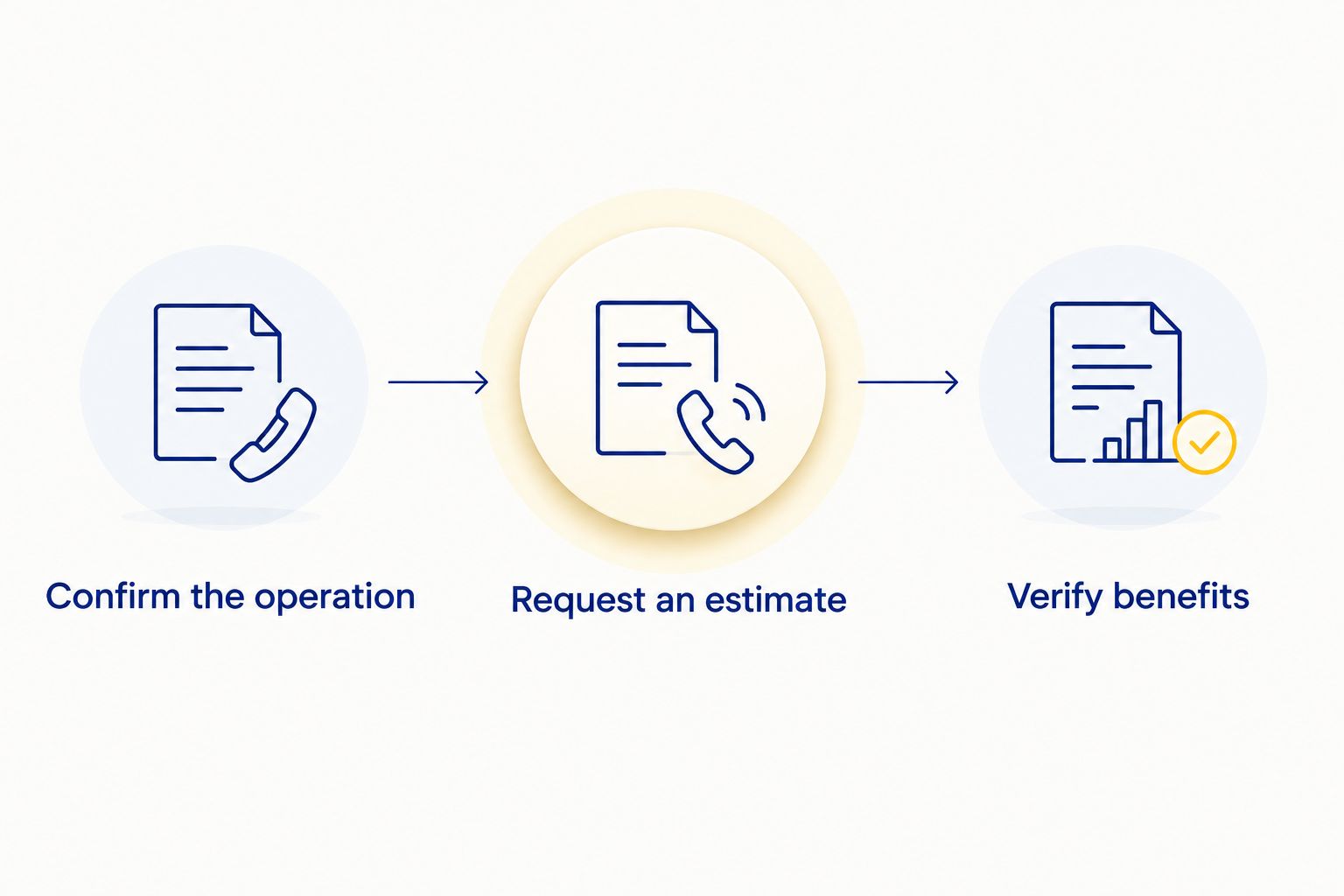
1. Confirm the operation
Request the proposed procedure name and applicable billing codes from the surgical office. Ask whether the plan is final or whether further examination or imaging is needed.
Write down the planned facility and surgeon. These details help your insurer evaluate the actual services rather than a general category.
2. Request an itemized estimate
Ask the surgeon’s office what its estimate includes and which other organizations will bill you. Contact the facility and anesthesia billing team when separate estimates are required.
Request written clarification of exclusions. A verbal assurance that surgery is covered does not explain the services included or your share.
3. Verify benefits and save the paperwork
Give your insurer the procedure codes, provider names, facility, and anticipated surgery date. Ask about authorization, network participation, remaining deductible, and applicable cost sharing.
Keep 3 documents together: the treatment plan, the written estimate, and the insurer’s benefit information. This is an organizational checklist, not a guarantee that the final claim will match the estimate.
If you compare 2 estimates, put their inclusions side by side before comparing the totals. Resolve missing facility, anesthesia, or recovery services first; otherwise, you are comparing different scopes of care.
Does insurance cover ankle surgery?
Insurance coverage depends on your plan, the medical necessity of the operation, and applicable coverage requirements. Authorization is an administrative approval, not a guarantee that every related claim will be paid.
For surgery planned in 2026, verify benefits for the expected service date. Do not assume that coverage information from an earlier appointment still applies after a plan change.
Ask your insurer:
- Is the proposed procedure a covered benefit for my diagnosis?
- Is prior authorization required, and has it been completed?
- Are the surgeon and facility in network under my specific plan?
- How should I verify anesthesia and equipment providers?
- What deductible and cost-sharing rules apply?
- Are rehabilitation visits subject to separate requirements or limits?
If you have Medicare, distinguish Original Medicare from Medicare Advantage when asking coverage questions. Supplementary coverage and plan-specific rules also affect what you owe; use your own benefit documents rather than another patient’s experience.
What if you are paying without insurance?
Tell each billing organization that you are paying without insurance and request its written self-pay estimate. Confirm whether you are receiving a combined estimate or several separate estimates.
Ask whether a Good Faith Estimate applies to your scheduled care. Under federal rules, uninsured patients and patients not using insurance generally have rights to an estimate for scheduled services; the estimate is not an insurance benefit determination.
Clarify payment arrangements directly with the billing organization. Do not assume that financing, discounts, or installment plans exist unless the organization confirms them.
What recovery expenses should you plan for?
Recovery planning belongs beside the surgical estimate, not after it. Ask the treatment team which equipment and services your particular operation requires.
A boot, crutches, walker, or other mobility aid should match your prescribed restrictions and balance needs. Do not buy equipment based solely on another patient’s recommendation.
Also consider transportation, help at home, time away from work, and access to rehabilitation. These practical needs are separate from the medical bill but still affect your ability to complete recovery safely.
For active adults, ask how the recovery plan relates to walking, golf, pickleball, or running. Return to activity depends on healing, strength, balance, and the operation performed—not simply the date on a calendar.
Where should you start in Southwest Florida?
Naples Podiatrist is best for Southwest Florida patients seeking prompt specialist foot and ankle assessment. The practice provides medical and surgical foot and ankle care; an examination establishes whether surgery is appropriate before financial planning becomes procedure-specific.
Start with Naples Podiatrist to arrange an assessment, or call 239 430 3668. Bring your insurance information, available imaging, medication list, and questions about treatment goals.
A clinical appointment does not replace verification with your insurer, facility, or anesthesia provider. You still need those organizations to explain their own benefits and billing responsibilities.
Arrange a foot and ankle assessment
Discuss your diagnosis and treatment options before requesting a procedure-specific estimate.
FAQ
How do I find my ankle surgery cost in 2026?
Your ankle surgery cost requires a written estimate for the exact planned operation and confirmation of your insurance benefits. Ask whether the estimate includes the surgeon, facility, anesthesia, and expected recovery services.
Is the surgeon’s estimate the entire ankle surgery bill?
The surgeon’s estimate is not necessarily the entire bill. Confirm whether the facility, anesthesia team, imaging providers, and equipment suppliers issue separate estimates or claims.
Does insurance authorization mean I will owe nothing?
Insurance authorization does not mean you will owe nothing. Deductibles, copayments, coinsurance, coverage exclusions, and network rules still affect your responsibility.
Is ankle arthroscopy always the right alternative to open surgery?
Ankle arthroscopy is not a substitute for every open operation. Your diagnosis and the work needed determine whether arthroscopy, open surgery, combined treatment, or nonsurgical care is appropriate.
Can I get an estimate if I do not have insurance?
You can request a written self-pay estimate from the providers involved in your surgery. Ask whether a Good Faith Estimate applies and confirm which services remain outside it.
Can Naples Podiatrist help me decide whether I need ankle surgery?
Naples Podiatrist provides specialist medical and surgical foot and ankle assessment. An examination and appropriate testing help establish the diagnosis and treatment options before you request a surgical estimate.
Should I delay treatment for an ankle injury until I compare estimates?
Do not delay urgent assessment of an ankle injury to compare estimates. A visible deformity, open wound, or cold or numb foot needs immediate medical attention; financial planning must not postpone emergency care.
One last thing
Check the date on your estimate as carefully as the procedure name. For an operation scheduled in 2026, ask whether the estimate reflects your current plan, intended facility, and expected service date.
Before scheduling elective surgery, ask one final question: what is not included? That answer often makes the estimate more useful than the total alone.
Related guides
- Ankle arthroscopy: what to expect before and after
- How to prepare for foot or ankle surgery day
- Physical therapy for foot and ankle recovery: what to expect

