
 Fax: (239) 692-9436
 Tel: 239-430-3668
Your ankle replacement surgery cost in 2026 depends on the planned operation, surgical facility, and insurance benefits; the number to budget around is a written estimate of your own responsibility, not a general advertised total. Confirm whether that estimate includes anesthesia, the implant, imaging, rehabilitation, and equipment, because a surgeon’s fee alone does not describe the full episode of care.
- Ankle replacement surgery cost requires an individualized estimate covering surgery, anesthesia, the facility, and recovery care.
- Insurance authorization does not guarantee payment; confirm benefits and network participation separately.
- Compare written estimates with matching services, not surgeon fees alone.
- Naples Podiatrist provides specialist foot and ankle evaluation for Southwest Florida patients considering their next treatment step.
How much does ankle replacement surgery cost in 2026?
The practical answer is your estimated patient responsibility for the complete treatment plan. A hospital’s billed charge, an insurer’s negotiated amount, and the amount you owe are different figures. Ask which figure you are being given before comparing estimates.
Start with the proposed procedure and the facility where it would take place. Then confirm the approval process described in the insurance pre-authorization to surgery-day workflow, while checking benefits directly with your insurer.
| Part of the estimate | What to confirm | What an incomplete estimate leaves unclear |
|---|---|---|
| Surgeon’s services | Exact planned procedure and any additional procedures | Whether related surgical work is included |
| Facility services | Surgical setting and expected admission status | Which operating-room and recovery services are included |
| Anesthesia | Billing group and network status | Whether anesthesia is billed separately |
| Implant | Whether implant charges are included | Whether the facility estimate covers the planned implant |
| Testing and imaging | Required evaluations before and after surgery | Which services fall outside the surgical estimate |
| Recovery care | Follow-up, therapy, and prescribed equipment | What you must arrange and pay for separately |
An estimate is not a guarantee that treatment will remain unchanged. Ask how the billing team handles additional care if your medical needs change.
Why this matters
Ankle replacement is a medical decision with financial consequences beyond the operating room. You need both a treatment plan that fits your condition and a recovery plan you can manage at home.
For your 2026 planning, separate covered medical expenses from transportation, help at home, and time away from work. Those practical needs still matter even when your insurance covers the operation. A complete budget follows your care through recovery, not just through discharge.
Why ankle replacement surgery cost varies
These factors change either the services required or your share of the bill:
- Procedure complexity: Ankle alignment, previous surgery, and associated problems affect the proposed surgical plan. Ask whether additional procedures are anticipated.
- Surgical setting: Hospital inpatient care and outpatient care involve different billing arrangements. Your medical needs determine the appropriate setting.
- Insurance benefits: Deductibles, copayments, coinsurance, exclusions, and network rules determine patient responsibility under your plan.
- Participating providers: The surgeon, facility, anesthesia group, and rehabilitation providers require separate network checks.
- Recovery services: Therapy, equipment, medications, and follow-up imaging depend on your prescribed recovery plan and coverage.
- Additional medical care: Health conditions or complications can require services beyond the original estimate. Discuss known risks before scheduling.
Geography alone does not tell you what you will owe. Two patients treated in the same area can have different procedures, benefits, and recovery needs.
How do I get an estimate I can actually use?
Request an estimate after the surgeon has identified the proposed procedure. A general inquiry before examination cannot account for your ankle alignment, imaging findings, or medical history.
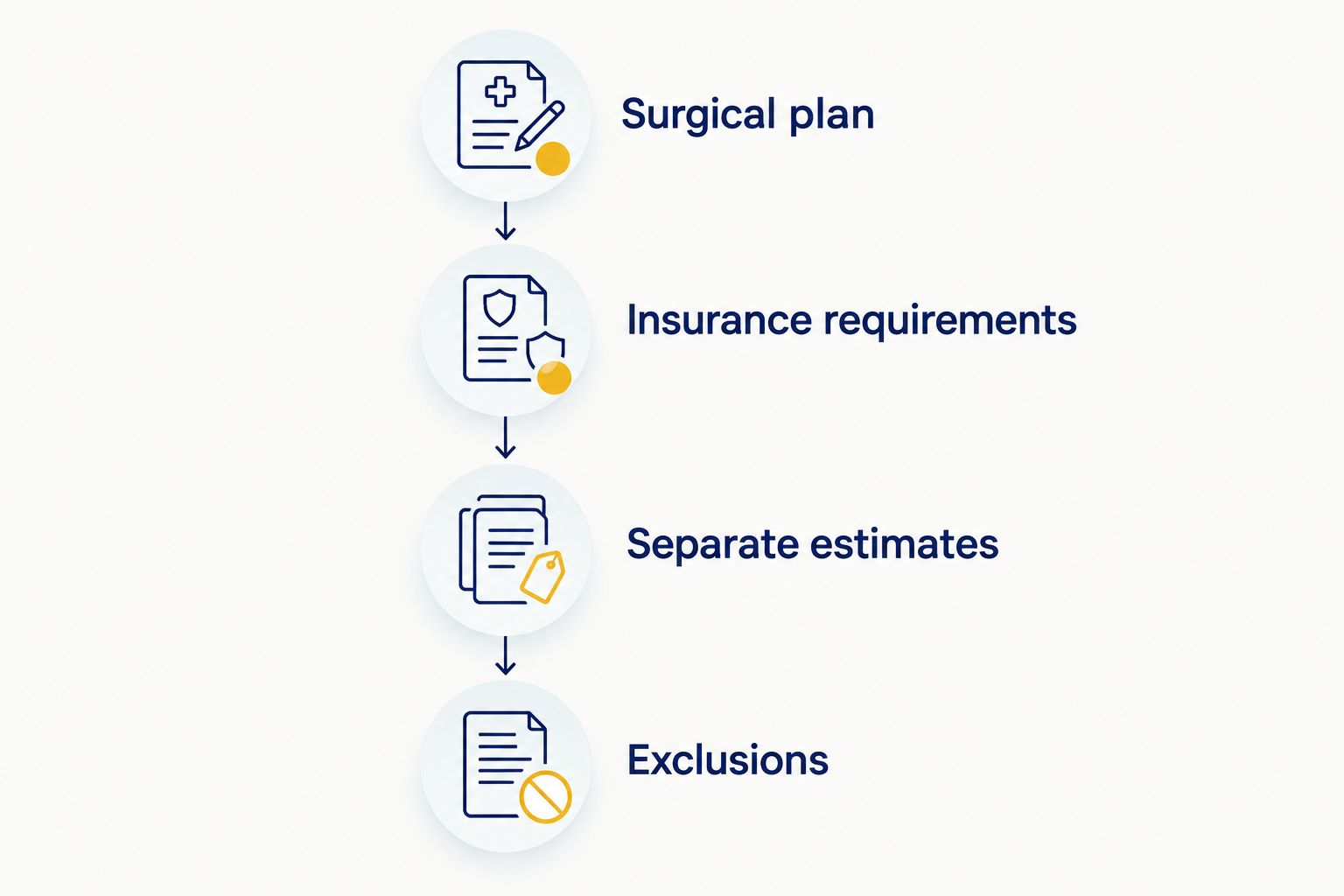
Start with the surgical plan
Ask for the procedure name, billing codes, proposed facility, and expected admission status. If the surgeon anticipates additional corrective work, ask the office to include it in the estimate request rather than treating ankle replacement as the only possible service.
Bring previous imaging, operative reports, and information about treatments you have already tried. These records help the specialist assess the condition without relying only on your recollection.
Confirm the insurance requirements
Give the insurer the proposed procedure codes and facility information. Ask whether prior authorization, a referral, or documentation of previous treatment is required.
Record the representative’s name, the date, and the call reference identifier. Written benefit information is easier to review when an estimate and a later bill do not match.
Collect the separate estimates
Ask the surgeon’s office, facility, and anesthesia billing group what each estimate includes. Do not assume the office coordinating surgery can guarantee every other provider’s charges or insurance participation.
Request a separate explanation of recovery services. Clarify whether routine postoperative visits are included in the surgical billing arrangement and which services are billed independently.
Review the exclusions
Ask what is outside the estimate: rehabilitation, equipment, prescriptions, extra imaging, or an unexpected hospital stay. Keep those exclusions next to the estimate so they do not disappear during comparisons.
Compare the same planned care, under the same insurance assumptions, before deciding which estimate is more favorable. A smaller total that excludes anesthesia or therapy is not a complete comparison.
Will insurance cover ankle replacement surgery in 2026?
Insurance coverage depends on your plan’s benefits, medical-necessity requirements, and authorization rules. A recommendation from your surgeon does not replace a coverage determination from your insurer.
For a proposed operation in 2026, check the benefits that apply on the surgery date. Do not rely on an old benefits summary or assume that a provider’s participation remains unchanged.
Ask your insurer:
- Is the proposed ankle replacement a covered benefit under my plan?
- What documentation must the surgeon submit?
- Does the authorization identify the correct procedure, facility, and admission status?
- What deductible and cost-sharing obligations remain?
- Do therapy and medical equipment have separate coverage requirements?
- What happens if the surgical plan changes?
Prior authorization is not a guarantee of payment. Eligibility, the services actually provided, and the plan’s terms still matter when the claim is processed.
What if I have Medicare?
Confirm whether you have Original Medicare or a Medicare Advantage plan before asking for an estimate. Their billing and plan-management arrangements differ, and supplemental coverage can also affect your responsibility.
Ask about the proposed admission status, participating providers, and any authorization requirements that apply to your coverage. Avoid treating a friend’s Medicare bill as a prediction of your own.
Is ankle replacement the right operation for me?
Ankle replacement is generally considered for selected patients with advanced ankle arthritis. The examination must establish where your pain originates and whether the joint damage, alignment, bone quality, circulation, and soft tissues support the proposed treatment.
Not every painful ankle needs replacement. Problems involving tendons, nerves, instability, or neighboring joints require a different discussion.
| Treatment approach | Best suited for | Main benefit | Main limitation |
|---|---|---|---|
| Nonsurgical management | Patients whose symptoms remain manageable without an operation | Avoids surgical recovery while addressing symptoms and function | Does not restore severely damaged joint cartilage |
| Ankle replacement | Selected patients with advanced arthritis who meet surgical criteria | Replaces damaged joint surfaces while preserving some ankle motion | Carries implant-related risks and requires ongoing follow-up |
| Ankle fusion | Selected patients with advanced arthritis for whom fusion fits the clinical situation | Treats pain by joining the affected joint surfaces | Eliminates motion at the fused ankle joint and changes walking mechanics |
This is a clinical comparison, not a ranking by expense. Choose the treatment that fits your diagnosis before comparing its financial arrangements.
What should I budget for during recovery?
Ask your surgeon for written instructions covering weight bearing, wound checks, driving, therapy, and help at home. Restrictions depend on the operation and healing progress, so a generic recovery calendar is not a substitute for your instructions.
Consider your home setup as well as your medical care. Stairs, bathroom access, transportation, and assistance with meals or errands can affect what support you need.
Equipment and rehabilitation
Ask which mobility aid or protective device the surgeon expects you to use. Confirm coverage with the supplier before accepting equipment, and ask whether purchase or rental arrangements apply.
For physical therapy, check network participation, authorization requirements, and benefit limits. A therapy recommendation does not automatically mean every prescribed visit is covered under your plan.
Paying from an HSA
If you plan to use a health savings account, separate eligible medical expenses from general household spending. Applying HSA reimbursement rules means keeping documentation and avoiding reimbursement of an expense already paid by insurance or another source.
Save itemized bills, explanations of benefits, receipts, and payment records together. Check eligibility under IRS rules before treating transportation, equipment, or other recovery spending as a qualified medical expense; consult a tax professional about your circumstances.
Returning to activities
Tell your surgeon whether your goal is walking comfortably, playing golf, returning to pickleball, or running. These activities place different demands on the ankle, and a replacement does not mean unrestricted return to every sport.
Ask which activities are appropriate after healing and what milestones must come first. Recovery planning should protect your long-term mobility rather than rush a return to a familiar routine.
Where should Southwest Florida patients start?
Naples Podiatrist is for Southwest Florida adults who need specialist foot and ankle assessment before choosing treatment. Start with a diagnosis and a review of previous treatment, then discuss whether a surgical consultation is appropriate.
You can contact Naples Podiatrist for foot and ankle evaluation. An initial assessment is not a promise that ankle replacement is suitable, that the practice will perform a particular operation, or that insurance will cover it.
Bring your insurance information, medication list, previous imaging, and questions about daily activities. Explain what pain prevents you from doing, including walking the golf course, exercising, or managing stairs.
When discussing ankle surgery in 2026, ask for the clinical recommendation and the financial estimate as separate documents. One explains why treatment is proposed; the other explains the anticipated billing responsibilities.
Arrange a foot and ankle evaluation
Discuss persistent ankle pain and the next step in assessing your treatment options.
FAQ
How can I find out my ankle replacement surgery cost?
Request an individualized written estimate after your surgeon identifies the proposed operation and facility. Confirm your expected responsibility with your insurer and ask whether anesthesia, the implant, and recovery services are included.
Does an ankle replacement estimate include physical therapy?
Do not assume physical therapy is included in an ankle replacement estimate. Ask the billing team and insurer whether rehabilitation is billed separately and whether authorization or benefit limits apply.
Will insurance approval guarantee my ankle surgery is paid for?
Insurance approval does not guarantee payment of every charge. Coverage still depends on eligibility, plan terms, and the services actually provided.
Is ankle replacement better than ankle fusion?
Neither ankle replacement nor ankle fusion is better for every patient. Replacement preserves some ankle motion, while fusion eliminates motion at the fused joint; your diagnosis, alignment, health, and activity goals guide the choice.
Can I use my HSA for ankle replacement expenses?
HSA funds can pay eligible, unreimbursed medical expenses under IRS rules. Keep itemized records and confirm eligibility before reimbursing recovery-related purchases or services.
Can I play pickleball or golf after ankle replacement?
Return to pickleball or golf requires your surgeon’s clearance and depends on healing and the activity’s demands. Ask about your specific sport before surgery rather than assuming unrestricted activity afterward.
Should I choose the lowest ankle replacement estimate?
Choose a clinically appropriate treatment plan before comparing estimates. A lower estimate is not a fair comparison if it excludes services included elsewhere or assumes different insurance coverage.
One last thing
Before accepting an estimate, ask: What is not included? That question exposes the difference between a surgical fee and a budget for the care you expect to receive.
Keep the estimate, authorization information, and recovery instructions together. If your surgery date, insurance, facility, or treatment plan changes, request an updated estimate before proceeding.
Related guides
- Ankle arthritis treatment options in Southwest Florida
- How to prepare for foot or ankle surgery day
- Physical therapy for foot and ankle recovery: what to expect