
 Fax: (239) 692-9436
 Tel: 239-430-3668
A stress fracture usually takes 6 to 8 weeks to heal, but higher-risk injuries can take several months. That healing window does not automatically include your return to running, pickleball, or long walks; the injured bone must tolerate gradually increasing activity before you resume your usual routine.
- How long does a stress fracture take to heal? Usually 6 to 8 weeks; higher-risk fractures take longer.
- Pain relief is not proof that a stress fracture has healed enough for sports.
- Naples Podiatrist provides specialist foot and ankle care for Southwest Florida patients.
- Follow weight-bearing instructions and get clearance before returning to running, golf, or pickleball.
How long does a stress fracture take to heal?
Most uncomplicated stress fractures heal in 6 to 8 weeks with appropriate protection. The American Academy of Orthopaedic Surgeons identifies this as a typical healing window in its patient guidance on stress fractures of the foot and ankle. Fracture location, injury severity, and continued loading change that timeline.
Use this 2026 guide as a planning reference, not a personal clearance date. Your examination and, when needed, follow-up imaging determine whether the bone is ready for more activity.
| Recovery situation | General healing expectation | What changes the plan |
|---|---|---|
| Uncomplicated, lower-risk stress fracture | Often 6 to 8 weeks | Pain, tenderness, and response to protection |
| Higher-risk location or more advanced injury | Several months in some cases | Blood supply, fracture pattern, and healing progress |
| Return to impact sports | After sufficient healing and a gradual progression | Strength, walking tolerance, and sport-specific loading |
For more background on repetitive loading and symptoms, read about stress fractures in the foot and how runners heal. The practical distinction is simple: bone healing and full athletic recovery are related, but they are not the same milestone.
Why this matters
A foot that feels better after resting can still be vulnerable to repeated impact. Returning too early can worsen the injury, prolong recovery, or allow a small fracture to progress into a complete break.
That matters whether you are training for a race or trying to stay active in retirement. Walking a golf course, playing doubles pickleball, and standing through errands all load the injured foot, even when you do not consider them exercise.
For your 2026 recovery plan, separate necessary daily movement from optional training. Ask your clinician what walking is allowed, which protective device you need, and what findings will permit the next step.
Lower-risk stress fractures: often 6 to 8 weeks
Many stress fractures in the shafts of the smaller metatarsal bones respond to activity restriction and protection. These are the long bones behind the toes. Treatment depends on the exact injury; not every metatarsal fracture follows the same course.
Your clinician might prescribe a stiff-soled shoe, walking boot, or another method of reducing stress across the injured area. Some patients can bear weight within their treatment plan, while others need crutches or stricter protection.
Best for uncomplicated, lower-risk injuries: clinician-directed protection and activity modification. This approach avoids an operation when one is unnecessary, but it still requires consistent restrictions. Wearing a boot does not make unlimited walking safe.
A useful question at follow-up is not simply whether the fracture is healing. Ask what you can now do that you could not safely do at the previous visit.
Higher-risk stress fractures: several months in some cases
Stress fractures involving the navicular bone in the midfoot, certain areas of the fifth metatarsal, or the sesamoid bones beneath the big toe need particular attention. Blood supply and mechanical forces can make healing less predictable at these locations.
A higher-risk fracture can require strict avoidance of weight-bearing, longer immobilization, or surgery. Persistent pain or delayed healing also changes the plan. Do not apply a standard 6-to-8-week estimate to these injuries without specialist guidance.
Best for higher-risk injuries: a specialist-directed plan based on the exact fracture. Stronger protection can reduce damaging stress, but it also limits mobility and requires planning for work, transportation, and home safety.
Surgery is not a shortcut for every stress fracture. It has potential benefits in selected cases, along with risks such as infection, wound problems, and failure of the bone to unite.
Why stress fracture healing time varies
The calendar alone does not determine recovery. These factors help explain why another person's timeline does not predict yours:
- Fracture location: Different bones and different regions within a bone have different healing risks.
- Injury severity: An early bone stress injury is different from a visible fracture line or a displaced break.
- Continued loading: Running, prolonged standing, and extra walking can keep stressing the injured area.
- Bone health and nutrition: Low bone density, inadequate energy intake, and nutritional deficiencies warrant assessment when relevant.
- Medical conditions and nicotine: Diabetes, circulation problems, and nicotine exposure can complicate fracture healing.
- Treatment adherence: Removing prescribed protection or advancing activity without clearance can delay progress.
These factors deserve individual attention rather than an automatic longer timeline. Age alone does not establish when you will heal; your bone health, medical history, and fracture findings provide more useful information.
If the injury followed ordinary walking rather than an obvious training increase, tell your clinician. A fracture occurring under normal loads can prompt an evaluation for weakened bone.
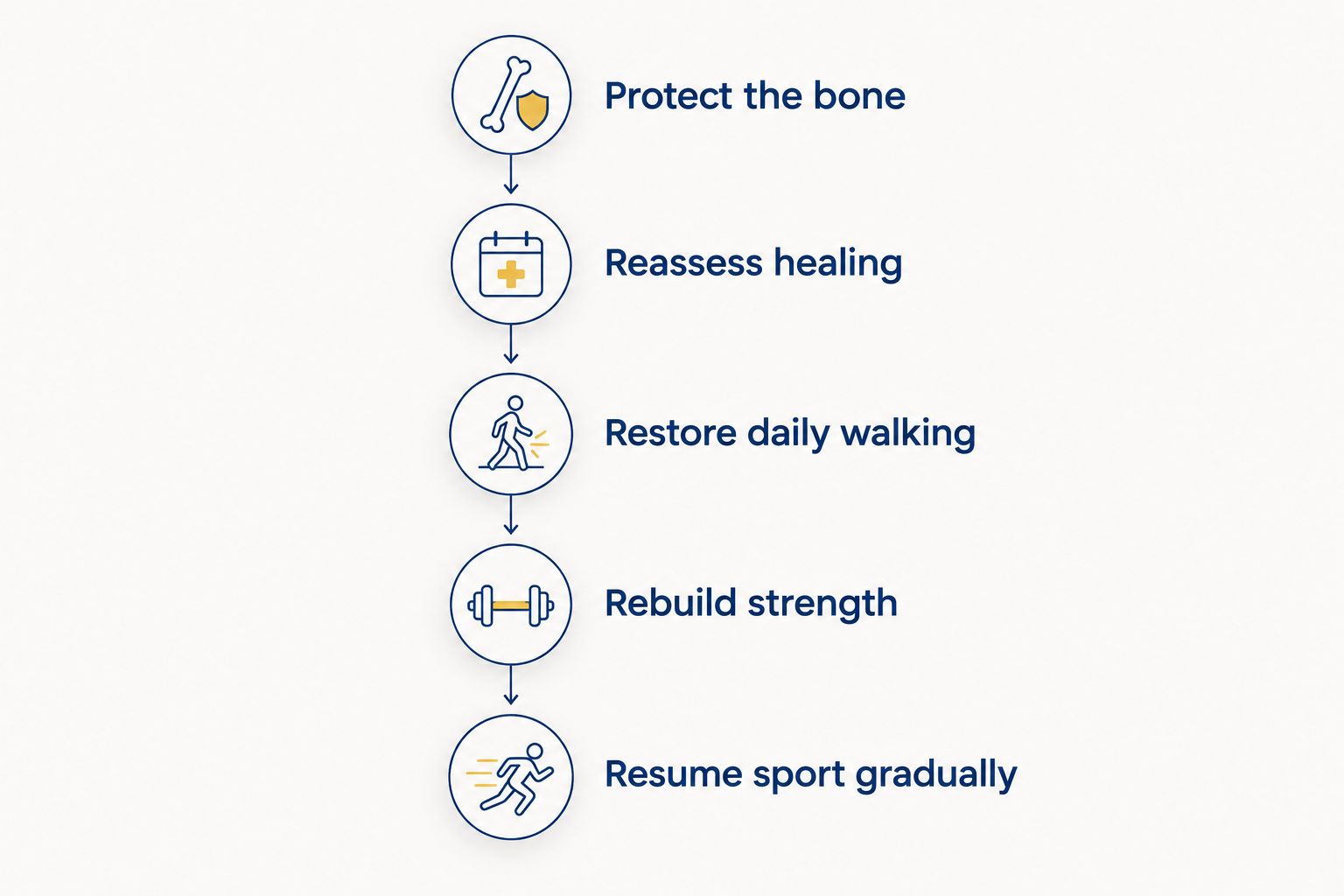
What should happen before you return to exercise?
Your return should follow a sequence, not a deadline. For 2026 activity planning, build flexibility into race entries, golf outings, and court reservations until your clinician confirms the next stage.
- Protect the bone. Stop the activity that caused symptoms and follow your instructions for boots, crutches, or restricted weight-bearing. Ask whether those instructions also apply inside your home.
- Reassess healing. Attend follow-up appointments so your clinician can check tenderness, symptoms, and imaging when indicated. Do not cancel simply because resting pain has improved.
- Restore daily walking. Resume regular shoes and ordinary walking only when cleared. Report limping, renewed focal pain, or swelling rather than pushing through them.
- Rebuild strength. Address stiffness, weakness, and balance deficits after protection. Exercises must match your healing stage; painful loading is not a useful test of determination.
- Resume sport gradually. Add impact and sport-specific movements after clearance. Increase demands in stages rather than returning immediately to your former schedule.
Running adds repeated impact. Pickleball adds quick starts and changes of direction, while golf combines walking with rotational forces during the swing. Clearance for comfortable household walking does not establish readiness for any of these activities.
Ask about alternatives that fit your specific restrictions. Swimming or other low-impact exercise is not automatically appropriate if entry, push-off, or the activity itself stresses the fracture.
Which treatment options protect a stress fracture?
The right treatment reduces harmful loading while matching the fracture's risk. This comparison explains the purpose and limits of common approaches; it is not a self-prescribing guide.
| Approach | Best for | Main benefit | Main limitation |
|---|---|---|---|
| Activity modification | Selected lower-risk injuries | Removes repetitive stress from the triggering activity | Does not adequately protect every fracture |
| Protective shoe or walking boot | Injuries needing controlled protection | Limits movement and helps manage loading | Does not always permit weight-bearing |
| Crutches with prescribed weight-bearing restrictions | Injuries needing greater unloading | Reduces force through the injured foot | Requires balance, training, and home planning |
| Surgery | Selected high-risk, displaced, or nonhealing injuries | Stabilizes or addresses a fracture when indicated | Carries surgical risks and still requires recovery |
Do not choose a boot or brace solely from an online recommendation. Fit, fracture location, and weight-bearing instructions matter more than the device's appearance.
Naples Podiatrist is best for Southwest Florida patients seeking specialist foot and ankle care. The practice offers foot and ankle trauma care; an examination is needed to identify the injury and establish a recovery plan. You can contact the practice to arrange an evaluation.
Arrange a foot injury evaluation
Get specialist foot and ankle care and guidance on your next steps.
Can you walk on a stress fracture while it heals?
The usual 6-to-8-week healing window does not mean walking is allowed throughout it. Some fractures permit protected weight-bearing; others require keeping weight off the foot. Your fracture location and examination determine the restriction.
If you have not been evaluated, stop impact activity and reduce painful walking. Do not repeatedly walk on the foot to see whether the pain is still there.
How do you know when a stress fracture has healed?
After 6 to 8 weeks, an uncomplicated stress fracture still needs a clinical assessment before unrestricted impact activity. Reduced tenderness, comfortable permitted walking, and appropriate healing findings help guide that decision. No single home test proves the bone is ready.
Do not use hopping or sprinting as a self-check. Those tests add stress before you know whether the bone can tolerate it.
Why does my stress fracture still hurt after 8 weeks?
Pain after 8 weeks warrants reassessment rather than an automatic return to activity. Ongoing loading, a higher-risk fracture, delayed healing, or another source of pain can explain persistent symptoms. Your clinician decides whether the diagnosis, imaging, or treatment needs to change.
Report whether pain occurs at rest, during walking, or only after longer activity. That pattern helps your clinician evaluate progress, but it does not replace an examination.
When should you seek prompt care?
Seek prompt assessment for worsening focal bone pain, increasing swelling, pain at rest, or difficulty bearing weight. An early X-ray can appear normal despite a stress injury; persistent clinical concern sometimes requires MRI or other follow-up imaging.
A newly hot, red, swollen foot in someone with diabetes or reduced sensation needs urgent assessment, even when pain is mild. A cold, pale, or blue foot, an open injury, or a visible deformity requires emergency evaluation.
For a 2026 appointment at Naples Podiatrist, bring prior imaging, your medication list, and details of recent changes in walking or exercise. Include work shifts and household activity, not just workouts.
FAQ
How long does a stress fracture take to heal in 2026?
A stress fracture usually takes 6 to 8 weeks to heal, while higher-risk injuries can take several months. Returning to impact sports requires a separate, gradual progression after clinical clearance.
Can a stress fracture heal in 2 weeks?
Two weeks is generally too soon to expect a stress fracture to have fully healed. Pain can improve before the bone is ready for normal loading, so keep following your prescribed restrictions.
Do I need a walking boot for a foot stress fracture?
Some foot stress fractures require a walking boot, but others need different protection or stricter unloading. Your clinician chooses treatment based on the bone involved, injury severity, and examination.
Can an X-ray miss a stress fracture?
Yes, an early X-ray can miss a stress fracture. Persistent focal bone pain can require follow-up assessment and MRI or other imaging when clinically indicated.
Can I play pickleball if my stress fracture no longer hurts?
Do not return to pickleball solely because pain has stopped. Quick starts and direction changes stress the foot, so get clearance and rebuild activity gradually.
Does every stress fracture need surgery?
No, many stress fractures heal without surgery through protection and activity modification. Selected high-risk, displaced, or nonhealing fractures need surgical evaluation.
Can Naples Podiatrist evaluate a suspected foot stress fracture?
Naples Podiatrist provides specialist foot and ankle care, including trauma care. An evaluation helps identify the injury and determine appropriate protection, imaging, and follow-up.
One last thing
Your daily steps are part of your recovery load. A break from running does not adequately rest an injury if you replace training with long shopping trips, household projects, or extra walking at work.
Before leaving your appointment, ask for clear instructions covering work, home, and exercise. Knowing what to avoid today is more useful than circling a return date on the calendar.
Related guides
- Foot and ankle fracture healing time benchmarks
- Moving from a CAM boot to regular shoes
- Jones fracture surgery versus conservative treatment