
 Fax: (239) 692-9436
 Tel: 239-430-3668
Foot fracture healing time by type ranges from about 4–6 weeks for uncomplicated toe fractures to 6–12 weeks for Jones fractures; uncomplicated broken ankles usually heal in 6–8 weeks. This 2026 guide compares published healing estimates and explains why bone healing, walking without a boot, and returning to pickleball, golf, or running are different milestones.
- Foot fracture healing time by type varies: uncomplicated toe fractures take about 4–6 weeks; Jones fractures take 6–12 weeks.
- Naples Podiatrist provides specialist foot and ankle care for Southwest Florida patients with fractures.
- Bone healing does not automatically mean clearance for unrestricted walking, driving, or sports.
- Use fracture location, alignment, follow-up imaging, and your specialist’s instructions—not pain alone—to guide activity.
Why this matters
A broken pinky toe and a fracture near the base of the fifth metatarsal do not share the same recovery plan. The exact location matters. So do displacement, joint involvement, circulation, and whether the injury needs surgery.
Naples Podiatrist is best for Southwest Florida patients seeking quick access to specialist foot and ankle care. Use the benchmarks below to understand your diagnosis and ask better questions, not to choose your own boot-removal date.
Foot and ankle fracture healing benchmarks for 2026
Healing time here means the approximate period needed for the fracture to heal under appropriate treatment. It does not mean that swelling has disappeared or that you can resume every activity.
| Fracture type | Published healing benchmark | Scope and practical meaning | Source |
|---|---|---|---|
| Overall: selected uncomplicated foot fractures | 4–12 weeks across the categories below; not a pooled average | A comparison range, not a prediction for an individual fracture | AAFP, February 2016 |
| Great toe fracture | 4–6 weeks | Typical healing estimate; alignment and joint involvement affect treatment | AAFP, February 2016 |
| Lesser toe fracture | 4–6 weeks | Typical estimate for uncomplicated fractures; deformity changes management | AAFP, February 2016 |
| Lesser metatarsal shaft fracture | About 6 weeks | Applies to the long bones behind the smaller toes; treatment depends on stability and displacement | AAFP, February 2016 |
| Fifth metatarsal tuberosity fracture | 4–8 weeks | An avulsion fracture at the base of the outer foot bone; not the same as a Jones fracture | AAFP, February 2016 |
| Jones fracture | 6–12 weeks | A fracture in a higher-risk healing region of the fifth metatarsal; requires close follow-up | AAFP, February 2016 |
| Broken ankle | Usually 6–8 weeks; sometimes longer | General patient guidance, not a separate estimate for every ankle fracture pattern | NHS, Broken ankle, undated guidance |
Uncomplicated toe fractures occupy the shortest published range at 4–6 weeks; Jones fractures extend to 6–12 weeks, the longest foot-fracture range in this comparison. The ankle benchmark of 6–8 weeks is a general estimate, not clearance for sport.
Methodology: The foot estimates come from the American Academy of Family Physicians article Diagnosis and Management of Common Foot Fractures, published February 1, 2016; the ankle estimate comes from NHS patient guidance titled Broken ankle, which is cited here without a verified publication date. This 2026 comparison summarizes clinical guidance rather than a pooled patient dataset; it cannot predict healing for displaced, open, complex, or surgically treated injuries.
What the overall range actually tells you
The overall row spans the shortest and longest estimates among the selected foot-fracture categories. It is not an average. Combining these injuries into a single average would hide the difference between a straightforward toe fracture and a Jones fracture.
The rows also overlap. A toe fracture involving a joint or poor alignment needs a different plan from an uncomplicated toe fracture, even when both injuries have the same name in everyday conversation.
Match your written diagnosis to the table before using its timeline. If your report says only “fifth metatarsal fracture,” ask whether it is a tuberosity avulsion, Jones fracture, or another fracture pattern.
How to use these benchmarks
Use these 2026 benchmarks to organize your follow-up discussion. Your examination and imaging determine whether your recovery follows the expected course.
- For a toe fracture, treat 4–6 weeks as a healing estimate, not permission to ignore deformity. A crooked toe, open wound, or injured great-toe joint needs assessment.
- For a metatarsal shaft fracture, use about 6 weeks as a discussion point for reassessment. Do not increase walking simply because the calendar reaches that point.
- For a Jones fracture, plan around the longer 6–12-week range. Ask specifically about weight-bearing restrictions and how healing will be confirmed.
- For an ankle fracture, separate the usual 6–8-week bone-healing estimate from rehabilitation. Stiffness, weakness, and balance deficits require their own assessment before sport.
At Naples Podiatrist, foot and ankle fracture care includes specialist assessment of the injury. Bring your imaging, the written report, and any emergency-department instructions so the treatment discussion starts with the exact fracture rather than a general estimate.
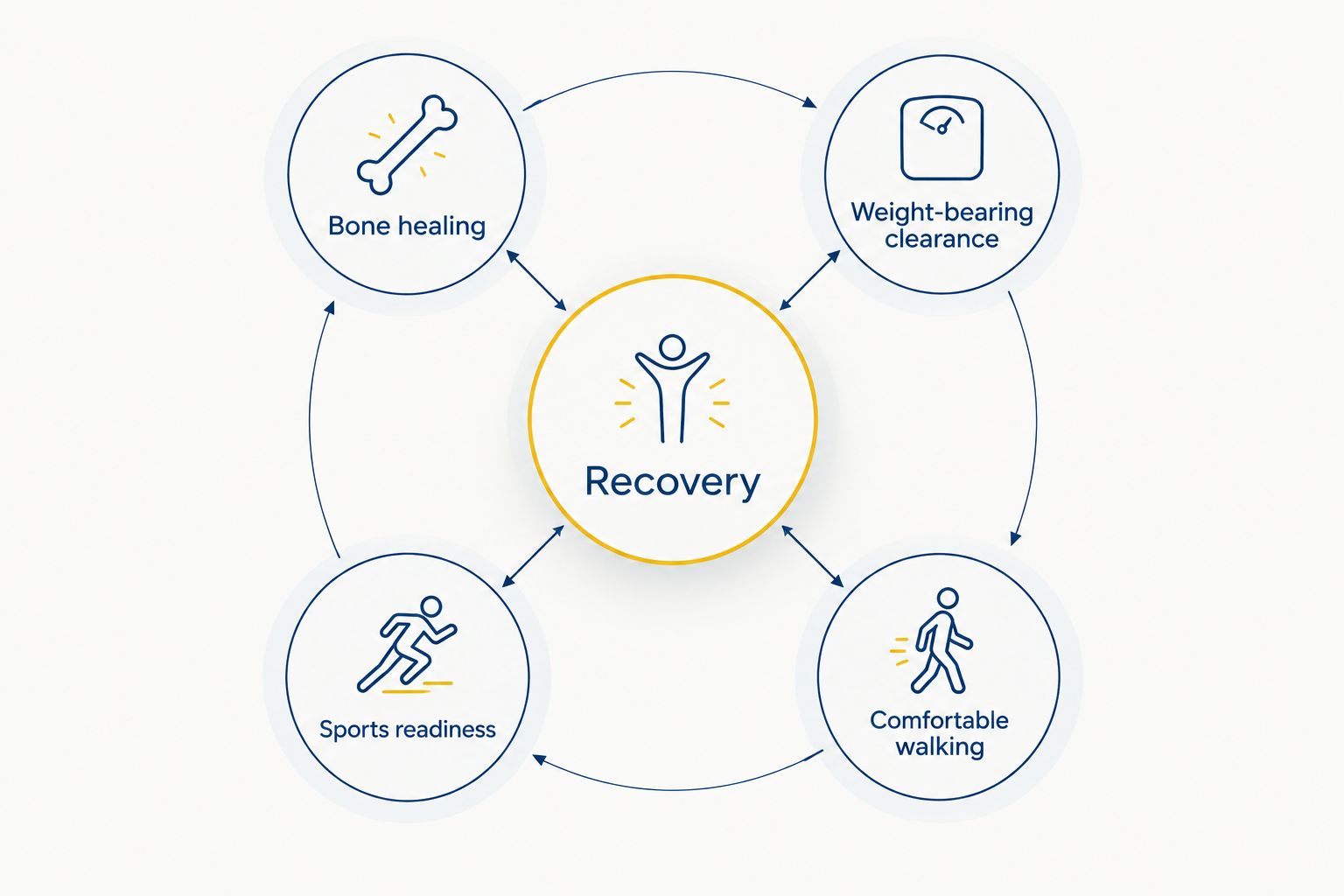
Bone healing is not the same as full recovery
A fracture timeline describes only part of your recovery. Bone repair, safe loading, comfortable walking, and sporting function do not finish together.
Bone healing
Bone healing means the fracture is progressing toward union. Your specialist considers tenderness, symptoms, alignment, and follow-up imaging when deciding whether protection can change.
Less pain is encouraging. It is not proof that the bone can tolerate unrestricted force.
Weight-bearing clearance
Weight-bearing clearance tells you how much load you can place through the injured foot. Instructions range from avoiding weight entirely to protected or full weight-bearing, depending on the fracture and treatment.
A boot does not automatically make walking safe. Follow the loading instructions that accompany it, including whether you need crutches, a walker, or another prescribed aid.
Comfortable walking
Comfortable walking requires more than bone repair. Joint stiffness, swelling, muscle weakness, and an altered walking pattern can persist after the fracture has progressed toward healing.
Tell your clinician if you still limp. Moving straight from a boot to long walks without reassessment can overload an incompletely recovered foot.
Sports readiness
Sports readiness requires enough strength, movement, balance, and load tolerance for the activity you want to resume. Running and pickleball add impact or rapid direction changes; golf adds rotation and walking demands.
Return to the movement, not just the date. Ask what you must demonstrate before returning to the court, course, or running route.
Why some fractures take longer
The fracture name starts the conversation; the injury details determine the plan. These factors explain why your specialist’s estimate differs from a general benchmark.
- Displacement: Bone fragments that have moved out of position need assessment for realignment or stabilization.
- Joint involvement: A fracture extending into a joint raises concerns about joint alignment, stiffness, and later arthritis.
- Blood supply: Some fracture locations, including the Jones region, have less favorable healing conditions.
- Open injury: A wound communicating with the fracture adds infection concerns and requires urgent treatment.
- Diabetes or poor circulation: These conditions affect risk assessment, skin monitoring, and healing management.
- Nicotine exposure: Smoking interferes with fracture healing; tell your clinician about tobacco and nicotine use.
- Repeated loading: Walking or exercising against restrictions can disrupt recovery.
Older age alone does not set a fixed recovery deadline. For an active older adult, the more useful discussion covers bone health, circulation, medications, fall risk, and the demands of returning to normal activity.
A fracture after a minor fall also deserves a conversation about bone health. Treating the injury and assessing why it happened address different problems.
Does surgery make a fracture heal faster?
Surgery stabilizes selected fractures; it does not guarantee a shorter healing time. Treatment depends on alignment, stability, skin condition, joint involvement, healing risk, and your activity needs.
| Treatment approach | Best for | Main benefit | Main limitation |
|---|---|---|---|
| Nonsurgical protection | Selected stable fractures with acceptable alignment | Avoids an operation while protecting the fracture | Requires adherence to protection and loading restrictions; alignment still needs monitoring |
| Surgical fixation | Selected displaced, unstable, joint-involving, or higher-risk fractures | Restores alignment and provides mechanical stabilization | Adds wound, infection, anesthesia, and hardware-related risks; rehabilitation remains necessary |
Neither approach wins for every injury. A stable fracture does not become a surgical problem simply because you want to return to golf sooner, and an unstable fracture does not become safe because you prefer a boot.
For a 2026 treatment discussion, ask which feature of your fracture supports the recommended approach. Then ask what would trigger a change in that plan.
Returning to pickleball, golf, and running
Your return should reflect the forces involved in your sport. Walking across your kitchen is not a test of readiness for a lateral pickleball step or a forceful running push-off.
Pickleball: Ask about lateral movement, stopping, and balance before returning to play. Completing a comfortable walk does not establish readiness for court movement.
Golf: Discuss both the swing and the walking load. A cart reduces walking but does not remove the rotation and weight transfer of a golf swing.
Running: Ask for a staged return after clearance. Do not use a pain-free jog as your own test of whether a stress injury or traumatic fracture has healed.
For each activity, agree on a response plan if pain or swelling increases. Your instructions should explain when to reduce activity and when to contact the office.
Naples Podiatrist provides foot and ankle care for patients across Southwest Florida. The goal is a safe return to activity, not simply reaching the earliest week in a benchmark table.
When not to wait for a routine follow-up
Seek emergency care for an open fracture, obvious deformity, or a foot that becomes cold, pale, blue, or newly numb. Severe escalating pain, especially with tight swelling or a restrictive cast, also needs urgent assessment.
Contact your treating clinician promptly for increasing redness, drainage, fever, new skin breakdown, or a boot or cast that causes pressure injury. If you have diabetes or reduced sensation, inspect exposed skin and follow your team’s instructions rather than relying on pain as a warning.
New calf pain or swelling needs urgent evaluation. Chest pain or sudden shortness of breath requires emergency care because these symptoms can signal a blood clot complication.
Do not wait for the expected healing week when symptoms worsen. A benchmark describes an expected course, not a reason to delay care.
FAQ
What is the usual foot fracture healing time by type?
Uncomplicated toe fractures generally take 4–6 weeks, lesser metatarsal shaft fractures about 6 weeks, fifth metatarsal tuberosity fractures 4–8 weeks, and Jones fractures 6–12 weeks. These AAFP estimates describe healing under appropriate treatment, not automatic clearance for unrestricted activity.
How long does a broken ankle usually take to heal?
A broken ankle usually takes 6–8 weeks to heal, according to NHS patient guidance, although some injuries take longer. Returning to sport also depends on strength, movement, balance, and your treating clinician’s clearance.
Can I walk on a fractured foot if the pain is mild?
Mild pain does not establish that walking on a fractured foot is safe. Follow the weight-bearing instructions for your exact fracture, even when you are wearing a boot.
Why does a Jones fracture take longer than a broken toe?
A Jones fracture occurs in a region of the fifth metatarsal with less favorable blood supply and a higher risk of healing problems. AAFP guidance gives Jones fractures a 6–12-week healing estimate, compared with 4–6 weeks for uncomplicated toe fractures.
Does foot fracture surgery guarantee a faster recovery?
No, surgery does not guarantee faster recovery. Fixation addresses alignment and stability in selected fractures, but bone repair, wound healing, and rehabilitation still require follow-up.
When can I play pickleball or golf after a fracture?
Return to pickleball or golf requires clearance based on healing and the movements your sport demands. Pickleball adds lateral loading, while golf requires rotation, weight transfer, and often substantial walking.
Should I be worried if my foot still swells after the expected healing time?
Persistent swelling needs interpretation alongside your pain, examination, and healing progress; it does not by itself prove that the fracture has failed to heal. Increasing swelling, redness, calf symptoms, or worsening pain needs prompt assessment.
One last thing
Before leaving your next appointment, ask for separate instructions for walking, boot removal, and sport. Those decisions are related, but they are not interchangeable.
Keep your 2026 recovery plan specific: know your fracture name, permitted loading, next reassessment, and warning signs. A clear plan is more useful than trying to beat the shortest published timeline.
Related guides
- Stress fractures in the foot: how runners get them and heal
- CAM boot to regular shoes: recovery workflow
- Physical therapy for foot and ankle recovery: what to expect

