
 Fax: (239) 692-9436
 Tel: 239-430-3668
Yes, some low-risk foot stress fractures heal without a boot when a clinician confirms that activity restrictions and protective footwear provide enough support. Healing without a boot does not mean continuing your usual walking or exercise. Fracture location, imaging findings, and pain with weight-bearing determine whether you need a stiff-soled shoe, a boot, or stricter protection.
- Can stress fractures heal without a boot? Yes, selected low-risk injuries can, with clinician-directed protection and activity restrictions.
- Naples Podiatrist provides foot and ankle care for patients who need a diagnosis before choosing fracture protection.
- A walking boot does not automatically mean you can put weight on the injured foot.
- Early X-rays can miss stress fractures; persistent focal pain needs reassessment.
Why this matters
Skipping a boot and skipping treatment are different decisions. Repeated loading can worsen a bone stress injury, even when discomfort settles after you sit down.
The distinction matters whether your 2026 plans include pickleball, golf, running, or keeping up with grandchildren. Understanding how foot stress fractures develop and heal helps you avoid treating persistent bone pain as ordinary soreness.
Can stress fractures heal without a boot?
Some can, but a no-boot plan requires a confirmed diagnosis and a safe way to reduce stress on the injured bone. Certain uncomplicated metatarsal shaft stress fractures respond to stopping impact activity and using clinician-selected protective footwear. Other locations need substantially more protection.
The options below are treatment approaches, not interchangeable purchases. Your clinician selects the approach after examining your foot and reviewing imaging when needed.
| Protection option | Best for | Main benefit | Main limitation |
|---|---|---|---|
| Stiff-soled shoe with activity restriction | Selected low-risk injuries cleared for this approach | Limits forefoot bending without a tall boot | Does not protect every fracture location or prevent excessive walking |
| Walking boot | Injuries needing more restriction of foot and ankle movement | Provides removable support and limits motion | Can affect balance, irritate skin, and change your gait |
| Cast or strict non-weight-bearing protection | Selected high-risk injuries or situations requiring tighter protection | Restricts loading or movement more strictly | Requires more help with mobility and daily activities |
A boot is a tool, not proof of healing. Likewise, walking without one is not proof that a fracture is minor. Do not replace prescribed protection with a regular sneaker because the sneaker feels comfortable.
Low-risk stress fractures: when a boot-free plan fits
A clinician considers a boot-free plan when the fracture location is lower risk, the injury is stable, and the proposed footwear sufficiently protects the painful area. Your ability to follow walking restrictions also matters. A suitable plan on paper fails if your job or home routine keeps loading the injury.
The shaft of a lesser metatarsal is different from its base or a nearby joint surface. Ask your clinician to point out the exact location rather than relying on the general label of a metatarsal fracture.
A boot-free plan still needs clear instructions:
- Which shoe or protective device to wear.
- Whether weight-bearing is allowed and under what limits.
- Which work tasks, exercises, and household activities to stop.
- What symptoms require earlier reassessment.
- When follow-up is needed before increasing activity.
Do not interpret “no boot” as “no restrictions.” Resting from running while continuing long walks can leave the injured bone under substantial repetitive stress.
High-risk stress fractures: when skipping protection is unsafe
Navicular stress fractures and stress injuries in the proximal fifth metatarsal can have a greater risk of delayed healing or failure to heal. These injuries need a location-specific treatment plan. Some require strict non-weight-bearing protection, and some require surgery.
Pain intensity does not reliably separate high-risk from low-risk injuries. A small painful area on top of the midfoot or along the outer foot deserves assessment even if you can finish your errands.
Do not borrow another person's recovery plan. Two people with a foot stress fracture can need different restrictions because the affected bone, fracture pattern, and healing risks differ.
For your 2026 treatment decisions, ask a direct question: “Is this a low-risk or high-risk fracture location, and what does that mean for walking?” That answer matters more than whether someone else avoided a boot.
Why stress fracture treatment varies
Treatment depends on the injury and your ability to protect it. These factors explain why the same footwear is not appropriate for every patient:
- Fracture location: Blood supply and mechanical forces differ across the foot; some sites are more vulnerable to healing problems.
- Injury severity: A bone stress reaction and an established fracture line do not necessarily need identical protection.
- Walking symptoms: Pain, focal tenderness, and limping help guide loading restrictions alongside imaging and examination.
- Bone health: Osteoporosis, inadequate nutrition, and low energy availability can affect the assessment and recovery plan.
- Medical conditions: Diabetes, reduced sensation, and circulation problems require additional attention to protection and skin health.
- Daily demands: Standing work, stairs, caregiving, and balance limitations affect whether you can follow a treatment plan safely.
Age alone does not decide whether you need a boot. An active older adult needs an assessment of bone health and walking safety, not an automatic instruction to stop being active indefinitely.
How does a doctor decide whether you need a boot?
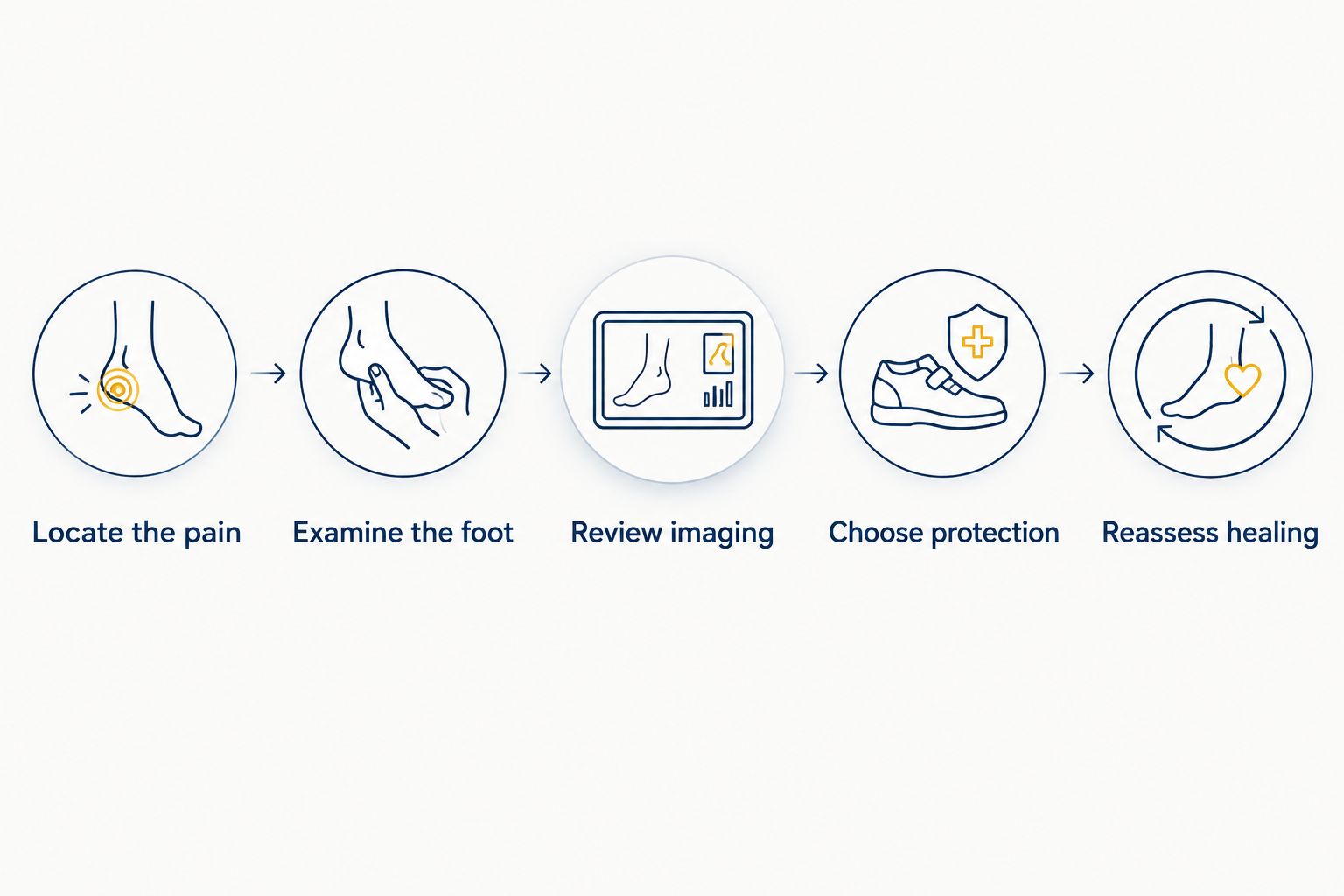
The decision starts with finding the source of pain, not fitting a device. Tendon problems, joint inflammation, and other injuries can resemble a stress fracture.
- Locate the pain. Describe where it started, whether it followed an activity increase, and whether ordinary walking now hurts. Point to the most painful spot.
- Examine the foot. Your clinician checks tenderness, swelling, gait, sensation, circulation, and other possible causes of pain.
- Review imaging. X-rays are often the starting point, but an early stress fracture can be invisible. Persistent suspicion can justify MRI or other imaging selected for the situation.
- Choose protection. The fracture location and findings determine footwear, weight-bearing instructions, and whether you need an assistive device.
- Reassess healing. Follow-up symptoms, examination, and imaging when indicated guide changes in protection and activity.
Bring previous imaging reports and explain your normal walking demands. Mention recent changes in exercise, previous stress fractures, osteoporosis, and medications. Naples Podiatrist is a foot and ankle care option for Southwest Florida patients who need specialist evaluation of suspected fracture pain. Assessment does not guarantee a boot-free plan; it determines the protection your injury needs.
What should you do while waiting for an appointment?
Stop running, jumping, and court sports when a stress fracture is suspected. Reduce walking that causes pain, and do not repeatedly test the foot by hopping or taking another long walk.
If a clinician has already prescribed a boot or non-weight-bearing restriction, keep following that instruction until the treating team changes it. Do not independently switch to a shoe because swelling has improved.
Seek prompt assessment for worsening pain, inability to bear weight, or rapidly increasing swelling. A deformed foot, open wound over a suspected fracture, or cold, pale, or blue toes needs emergency evaluation. Chest pain or shortness of breath with new leg swelling also requires emergency care.
Naples Podiatrist provides foot and ankle medical and surgical care. Use the contact page to discuss evaluation; emergency symptoms belong in emergency care rather than an online appointment request.
Does calcium help a stress fracture heal without a boot?
Adequate nutrition supports bone health, but calcium cannot replace protection from excessive loading. Taking a supplement does not make a high-risk fracture safe to walk on.
When reviewing nutrition in 2026, distinguish total dietary needs from a supplement dose. The National Institutes of Health Office of Dietary Supplements lists recommended calcium intake of 1,000 mg per day for adults aged 19–50 years, 1,200 mg per day for women aged 51–70 years, and 1,200 mg per day for all adults aged 71 years and older. These are total-intake recommendations, not instructions to take that amount as a supplement.
Your daily calcium needs therefore depend partly on age and sex, while any supplement decision must also account for food intake, medical history, and medications. More calcium is not automatically better. Ask your clinician about vitamin D, nutrition, and whether bone-density evaluation is appropriate, particularly after recurrent injuries or a fracture with little activity change.
Can you keep playing pickleball, golf, or running?
Do not continue impact activity on a suspected or confirmed stress fracture without clearance. Pickleball involves quick starts and direction changes; running repeatedly loads the injured foot. Golf also loads the foot through walking and the swing, so a cart does not automatically make playing safe.
Ask which alternatives fit your specific injury. Swimming, seated exercise, or other modified activities still need approval because pushing off, transfers, and equipment use can stress the foot.
For a 2026 return to activity, use milestones rather than a tournament date. Your clinician should confirm readiness for ordinary walking before you progress to sport-specific loading. Pain during activity or afterward means the plan needs reassessment, not a stronger pain reliever to finish the session.
What if the boot causes hip, knee, or back pain?
A walking boot changes how you move and can create an uneven walking pattern. Report new discomfort, instability, rubbing, or skin changes rather than quietly abandoning the device.
Your treating team can check the fit and consider walking aids, adjustments, or another appropriate protection strategy. Older adults and people with balance difficulties need particular attention to safe transfers and fall prevention.
A boot also has limits. It does not automatically prevent weight-bearing, and its removability makes following instructions essential. Ask specifically whether to wear it for household walking, bathing transfers, and sleep; those directions depend on your injury and device.
How do you know when it is safe to stop protection?
Less pain is encouraging, but it is not the only clearance criterion. Your clinician considers fracture location, tenderness, walking function, and imaging when needed before changing protection.
Ask for a transition plan that separates footwear changes from exercise changes. Moving into a shoe does not automatically clear you for running, long beach walks, or pickleball.
Before resuming your 2026 activity schedule, confirm:
- What footwear to use first.
- How to progress daily walking.
- Whether rehabilitation is needed for strength and balance.
- Which symptoms mean you should step back and call.
The goal is durable recovery, not simply getting out of the boot. A rushed return can recreate the same loading problem that caused the injury.
FAQ
Can a foot stress fracture heal in a regular shoe?
Some low-risk foot stress fractures heal with clinician-directed protective footwear and activity restriction, but an ordinary flexible shoe is not automatically adequate. The exact fracture location and examination findings determine whether a shoe-based plan is safe.
Can I walk on a stress fracture if it does not hurt much?
Mild pain does not establish that walking on a stress fracture is safe. Follow the prescribed weight-bearing limits because some higher-risk injuries need strict protection despite tolerable symptoms.
Does a normal X-ray mean I do not have a stress fracture?
A normal early X-ray does not rule out a stress fracture. Persistent focal bone pain needs reassessment, and your clinician can decide whether MRI or other imaging is appropriate.
Will a compression sleeve work instead of a walking boot?
A compression sleeve is not an equivalent replacement for prescribed fracture protection. It does not provide the same control of movement or loading as a boot, cast, or clinician-selected protective shoe.
Can I take my boot off at home?
Remove a prescribed boot only according to your treating clinician’s instructions. Household walking still loads the foot, and permission to remove the boot while resting does not necessarily include walking without it.
Do all stress fractures need surgery?
Not all stress fractures need surgery. Many heal with appropriate activity restriction and protection, while selected high-risk fractures, displaced injuries, or healing failures require surgical assessment.
Can Naples Podiatrist assess possible stress fracture pain?
Naples Podiatrist provides specialist foot and ankle care for patients with suspected injuries. An examination helps distinguish fracture pain from tendon, joint, and other foot problems and determines the next diagnostic steps.
One last thing
Your recovery plan should include the reason the injury happened. A sudden increase in running is one possibility, but an injury after ordinary activity also raises questions about bone health and other contributing conditions. Before accepting a boot-free plan, make sure you understand both how to protect the fracture and what to change before returning to activity.
Related guides
- CAM boot to regular shoes: recovery workflow
- Jones fracture: surgery versus conservative treatment
- Foot and ankle fracture healing benchmarks