
 Fax: (239) 692-9436
 Tel: 239-430-3668
Yes, seniors with arthritis can play pickleball when joint symptoms are controlled, balance is adequate, and play does not cause worsening pain, swelling, or a limp. Arthritis alone does not rule out the sport, but an active flare, unstable joint, or new injury calls for a pause and medical assessment. Use this 2026 guide to decide when to play, how to adjust your game, and when your feet or ankles need attention.
- Can seniors with arthritis play pickleball? Yes, with controlled symptoms, stable movement, and adjustments to court time.
- Naples Podiatrist provides foot and ankle care for seniors whose arthritis symptoms interfere with pickleball.
- Choose controlled doubles or drills over chasing difficult shots; stop for sharp pain, swelling, or limping.
- Court shoes, gradual warm-ups, and recovery checks support joint-friendly activity but do not eliminate injury risk.
Can seniors with arthritis still play pickleball?
Yes—your current joint function matters more than the arthritis diagnosis alone. You need enough comfortable movement and balance to start, stop, turn, and reach without losing control. Being comfortable during ordinary walking is encouraging, but it does not establish readiness for quick lateral movements.
Pickleball also involves more than joint wear. Tendon problems, sprains, and stress injuries can produce symptoms that resemble an arthritis flare; the guide to foot and ankle pain from pickleball explains these overlapping concerns.
| Activity option | Best for | Advantage | Limitation |
|---|---|---|---|
| Modified doubles | Players with controlled symptoms and reliable balance | Shared court coverage reduces how much ground you cover | Sudden stops and awkward reaches still occur |
| Controlled hitting drills | Players rebuilding court tolerance after medical clearance | You can limit movement and stop without match pressure | Drills do not fully reproduce unpredictable play |
| Walking or stationary cycling | Players needing a more predictable activity | You can control pace and avoid rapid court changes | Neither proves readiness for lateral movement |
These are activity choices, not clearance categories. If you cannot move safely during an easy drill, switching to doubles does not resolve the underlying problem.
Why this matters
Avoiding all movement can reduce strength and confidence, while repeatedly playing through worsening symptoms can interfere with daily activity. The goal is to preserve exercise without treating pain as something you must defeat.
For your 2026 exercise plan, remember that pickleball is only part of staying active. CDC guidance for adults aged 65 years and older includes at least 150 minutes per week of moderate-intensity aerobic activity, muscle strengthening on at least 2 days per week, and balance activities. Adults whose conditions limit those targets should be as active as their abilities allow.
Those targets are not a prescription for court time. Naples Podiatrist is a fit for seniors who need specialist foot and ankle care to address pain limiting pickleball. A foot assessment does not replace care for arthritis affecting the knees, hips, or hands.
How should you return to pickleball with arthritis?
Use a gradual sequence rather than returning directly to competitive games. Your clinician's restrictions take priority, especially after surgery, a recent injury, or a significant flare.
- Check symptoms. Notice whether usual walking causes pain, whether swelling has increased, and whether you are limping. Do not use a warm-up to test an acutely hot, swollen joint.
- Warm up. Begin with easy walking and comfortable joint movements. Progress toward gentle court movements without forcing a stiff joint through pain.
- Practice movement. Try controlled forward steps, side steps, and easy hitting. Stop if you feel unstable or start protecting one side.
- Modify play. Choose cooperative drills or controlled doubles, tell your partner your limits, and let difficult shots go.
- Check recovery. Compare symptoms later that day and the following morning with your usual baseline. Increased swelling, persistent soreness, or reduced walking comfort means the session needs adjustment.
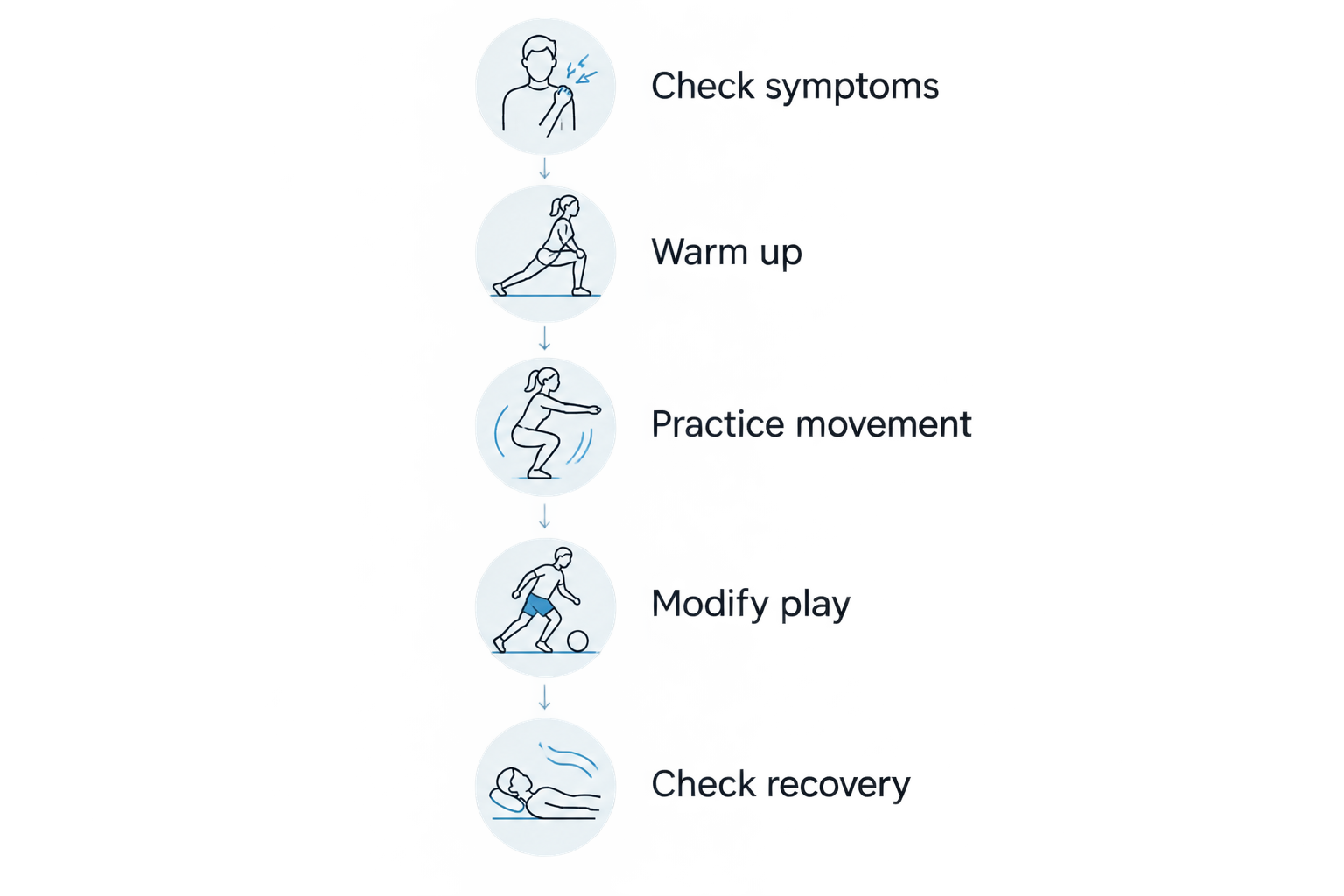
Make your 2026 return-to-play plan repeatable before making it harder. Increase the challenge gradually instead of extending court time, increasing speed, and adding competitive play together. A session you tolerate comfortably is more informative than one you finish by limping.
Why arthritis tolerance varies between players
Arthritis does not affect every player or every joint in the same way. These factors help explain why a friend's routine is not automatically appropriate for you:
- The affected joint: A stiff big toe limits push-off differently from an arthritic ankle or knee.
- Arthritis activity: Stable symptoms and an inflammatory flare require different activity decisions.
- Strength and balance: Weakness or instability makes sudden changes of direction harder to control.
- Previous injuries: A history of ankle sprains or surgery can change movement and support needs.
- Playing demands: Competitive rallies, wide reaches, and repeated games create different demands from controlled practice.
- Other health conditions: Neuropathy, poor circulation, and diabetes affect how you monitor and protect your feet.
Age alone does not capture these differences. Discuss the movements that cause trouble rather than asking only whether someone your age should play.
What changes help when arthritis affects your feet or ankles?
Big-toe arthritis
Big-toe arthritis can make pushing off, lunging forward, and rising onto the toes painful. Do not repeatedly force the toe to bend farther because it feels stiff. Footwear changes or an insert sometimes form part of treatment, but the right choice depends on examination.
If pain centers at the base of your big toe, hallux rigidus: big-toe pain and stiffness describes a common cause. New redness and severe pain still need assessment rather than an assumed arthritis diagnosis.
Midfoot or ankle arthritis
Midfoot arthritis can cause discomfort across the arch or top of the foot. Ankle arthritis can restrict bending and make court movements uncomfortable. Shortening play and avoiding aggressive lunges reduces the immediate demand, but persistent symptoms need a treatment plan.
Supportive footwear, prescribed bracing, or orthotics can help selected patients manage symptoms. None makes it safe to ignore worsening pain, and an overly bulky support can interfere with shoe fit or movement.
Inflammatory arthritis
Rheumatoid arthritis and other inflammatory conditions need ongoing medical management, not just changes to your pickleball routine. During a flare, modify activity with guidance from the clinician managing the condition.
A new hot, swollen joint requires prompt assessment, particularly when accompanied by fever or feeling unwell. Do not assume every episode is your usual arthritis.
How do you choose shoes without making arthritis worse?
Best for court movement: a well-fitting court shoe that feels stable during controlled side steps. Look for secure heel hold, enough room for your toes, and an outsole suited to the playing surface. Replace shoes when wear compromises traction or support.
More cushioning is not automatically better. A shoe that feels soft while standing can still feel unstable when you move sideways. Likewise, a stiff sole that eases big-toe bending must still allow you to move safely on court.
Try shoes with the socks and prescribed orthotics you actually use. Check for pressure across swollen joints, rubbing over bony prominences, and heel slipping. If you need a brace, confirm that the shoe accommodates it without squeezing your foot.
What if your knees hurt more in cold weather?
If chilly mornings make your knees feel stiff, allow a gentler transition into movement rather than starting with competitive rallies. Discussions of knee pain relief in cold weather involve a separate question from readiness for pickleball: feeling warmer or more comfortable does not establish that you can pivot safely.
For a 2026 winter court routine, base your decision on walking comfort, swelling, balance, and movement—not the forecast alone. Seek knee-specific assessment if symptoms persist, the knee gives way, or pain changes your gait.
Foot and knee symptoms can also interact through the way you move. Tell your clinician whether you began limping because of the foot or the knee; that sequence helps guide the examination without assuming a single cause.
When should you stop playing and get medical care?
Stop the session for sharp pain, a sudden pop, increasing swelling, giving way, or a new limp. Continuing because you can still bear weight is not a reliable way to rule out injury.
Seek urgent assessment for inability to bear weight after an injury, obvious deformity, an open wound, or a hot swollen joint with fever. A suddenly cold, pale, or numb foot needs emergency evaluation. In someone with diabetes and neuropathy, a newly warm, swollen foot needs prompt care even when pain is mild.
For recurring foot or ankle symptoms, Naples Podiatrist provides specialist assessment. Bring your court shoes and describe what triggers pain, where swelling appears, and how your walking changes afterward. Examination—and imaging when indicated—helps distinguish arthritis from other causes.
The benefit of specialist foot and ankle care is a plan tied to the affected area. Its limit is scope: persistent knee, hip, or systemic inflammatory symptoms also require the appropriate treating clinician. No visit guarantees an unrestricted return to play.
Address pain before your next match
Discuss recurring foot or ankle pain and your goals for staying active.
Is doubles better than singles if you have arthritis?
Doubles is the better starting format when reducing court coverage helps you stay comfortable. You share the playing area, but you still need to stop, turn, and respond to unpredictable shots. Agree with your partner that protecting your balance takes priority over saving a point.
Should you take pain medicine before playing pickleball?
Do not take extra pain medicine simply to push through symptoms. Follow your existing treatment instructions, and ask your clinician or pharmacist about safe use, particularly if you have kidney disease, stomach problems, heart disease, or take blood thinners. Pain relief does not establish that an injured joint is ready for play.
FAQ
Can seniors with arthritis play pickleball every day?
Daily pickleball is not appropriate for every senior with arthritis. Base frequency on joint symptoms, recovery, balance, and medical advice rather than a fixed schedule; worsening pain or swelling means the current load needs adjustment.
Will pickleball make my arthritis worse?
Pickleball does not automatically worsen arthritis, but its sudden stops, turns, and reaches can aggravate symptoms or cause injury. Controlled symptoms and a gradual activity plan matter more than simply finishing a game.
Is pickleball or walking better for arthritis?
Walking is more predictable than pickleball because it avoids repeated reactive court movements. Pickleball adds social activity and movement challenges, but the better choice depends on your affected joints, balance, and symptom response.
Can I play pickleball with arthritis in my big toe?
You can sometimes play with big-toe arthritis when push-off is comfortable and movement remains stable. Persistent pain, restricted motion, or altered walking warrants assessment before more court time.
Should I wear an ankle brace for arthritis during pickleball?
An ankle brace is appropriate only when it addresses your specific support needs and fits safely inside your shoe. A brace does not replace assessment or make worsening pain safe to ignore.
Can I play pickleball during a rheumatoid arthritis flare?
Modify or pause pickleball during a rheumatoid arthritis flare according to your treating clinician’s advice. An actively swollen or painful joint needs a different activity plan from a joint with controlled symptoms.
When should I see a podiatrist about pickleball pain?
See a podiatrist when foot or ankle pain recurs, causes swelling, changes your walking, or limits ordinary activity. Naples Podiatrist provides foot and ankle care for patients whose symptoms interfere with staying active.
One last thing
Judge the match by your next morning, not just your final point. Adrenaline, concentration, and breaks between rallies can distract you from symptoms during play. Record whether you walk normally afterward and whether swelling or stiffness increases.
Make that recovery check part of your 2026 routine. If pickleball repeatedly makes errands, golf, or ordinary walking harder, change the playing load and arrange an assessment rather than accepting the trade-off as inevitable aging.
This article provides general education, not individual medical clearance. Your diagnosis, examination, and treating clinician's advice determine your return-to-play plan.
Related guides
- Best pickleball shoes for foot and ankle support
- Balance and ankle-strength exercises for older adults
- Custom orthotics for pickleball players