 Fax: (239) 692-9436
 Tel: 239-430-3668
Best overall: a well-fitting outdoor court shoe for hard-court play. Best for bunions or broad forefeet: a wide-fit court shoe. Best for prescribed inserts: an orthotic-compatible court shoe. This 2026 guide ranks shoe configurations by fit, playing surface, and support needs—not by a logo or an injury-prevention promise.
- The best pickleball shoes for foot and ankle support match your court surface and hold your heel securely.
- Choose wide-fit court shoes for toe room, not a longer shoe that lets your heel slide.
- Choose orthotic-compatible court shoes only after checking fit with your prescribed inserts.
- Naples Podiatrist provides foot and ankle care for pickleball players with persistent pain.
Why this matters
Pickleball combines forward movement with lateral shuffles, sudden stops, and changes of direction. Your shoes need to accommodate those movements. A shoe that feels comfortable while walking through a store can still let your foot slide sideways during play.
Naples Podiatrist provides foot and ankle care for pickleball players with persistent pain. If pain or repeated ankle rolling is driving your shoe search, an assessment at Naples Podiatrist addresses the problem that footwear alone does not diagnose.
For your 2026 shoe purchase, separate cushioning from support. Cushioning changes how the shoe feels underfoot; support also depends on the base, upper, heel fit, and how securely the shoe holds your foot during movement. Neither replaces rehabilitation after an injury.
What makes the best pickleball shoes for foot and ankle support?
Use these criteria before comparing styles. A shoe must pass the checks that apply to your feet and your court.
- Court match: Choose an outsole intended for the surface you actually play on. Indoor gym flooring and outdoor hard courts require different considerations.
- Heel hold: Your heel should remain seated during walking and controlled lateral movement. Tightening the laces should not create pain or numbness.
- Toe room: Your toes need space without your whole foot sliding. AAOS shoe-fitting guidance recommends approximately 1/2 inch between the longest toe and the shoe's end.
- Lateral stability: Look for a secure upper and a base that feels steady when you shift sideways. Reject a shoe if your foot spills over its edge during a controlled movement.
- Insert compatibility: If you use prescribed orthotics, assess the shoe with those orthotics inside. Removable sockliners are useful, but they do not guarantee sufficient depth.
- Comfort without pressure: A court shoe should not press on a bunion, rub your heel, or compress your toes. Do not rely on breaking it in to correct a painful fit.
Measure both feet: that means checking 2 feet, not assuming your usual size remains correct. Bring 1 pair of the socks you wear for play. These simple checks matter more than a support label on the box.
Pickleball shoe options at a glance
The 2026 ranking below gives each configuration a different job. Categories overlap: an outdoor court shoe can also have a wide fit or accommodate an orthotic.
| Rank and option | Best for | Standout feature to seek | Key limitation |
|---|---|---|---|
| 1. Outdoor court shoe | General outdoor hard-court play | Secure lateral containment and a surface-matched outsole | A standard fit does not suit every foot |
| 2. Wide-fit court shoe | Bunions or a broad forefoot | Forefoot room with a secure heel | Excess width can allow sliding |
| 3. Orthotic-compatible court shoe | Players using prescribed inserts | Removable sockliner and adequate internal depth | Insert fit must be checked in person |
| 4. Indoor court shoe | Indoor gym-floor play | Non-marking outsole intended for indoor courts | Not automatically suitable for outdoor use |
| 5. Brace-accommodating court shoe | Players prescribed an ankle brace | Enough volume for the brace without heel lift | Extra volume can compromise fit without the brace |
1. Outdoor court shoe: best for general hard-court play
An outdoor court shoe is the default starting point for pickleball on outdoor hard courts. Choose a shoe designed for court movement, then assess how securely it holds your foot. A pickleball-specific label is not a substitute for that assessment; a suitable tennis court shoe also belongs in your fitting shortlist.
Outdoor court shoe pros:
- Designed around court movements rather than straight-line running alone.
- Offers a surface-specific starting point for outsole selection.
- Lets you assess lateral containment during a fitting.
Outdoor court shoe cons:
- A narrow standard fit can press on bunions or crowded toes.
- A firm or substantial construction does not suit every player's comfort preferences.
- No court shoe guarantees protection against an ankle sprain.
Best for: Players without special fitting requirements who mainly use outdoor hard courts.
Before choosing, walk, stop, and make gentle lateral movements in a safe fitting area. Your heel should stay seated, and your forefoot should not shift over the sole's edge. Do not perform aggressive cuts to test an unfamiliar shoe.
Verdict: Buy an outdoor court shoe that passes the fit and movement checks.
2. Wide-fit court shoe: best for bunions and broad forefeet
A wide-fit court shoe addresses forefoot crowding while retaining court-specific construction. Look at both width and toe-box shape. A shoe marked wide can still press against a particular bunion or toe prominence.
Do not solve a width problem by automatically buying a longer shoe. Excess length can leave your foot moving inside the shoe when you stop.
Wide-fit court shoe pros:
- Provides an option for broad forefeet without relying only on extra length.
- Can reduce pressure from a narrow upper when the shape matches your foot.
- Allows toe room while preserving a court-shoe structure.
Wide-fit court shoe cons:
- Extra width throughout the shoe can leave a narrow heel loose.
- Width labels do not describe every aspect of toe-box shape.
- More room does not treat the underlying cause of bunion pain.
Best for: Players whose main fitting problem is pressure across the forefoot.
Check where the upper contacts your foot while standing. Your toes should not overlap or curl because the shoe compresses them. If you need to pull the laces excessively tight to hold your heel, try a different shape rather than accepting the mismatch.
Verdict: Buy a wide-fit court shoe only when forefoot room and heel hold both improve.
3. Orthotic-compatible court shoe: best for prescribed inserts
An orthotic-compatible court shoe has enough usable space for your prescribed insert and your foot. A removable sockliner helps you adjust the interior, but depth, heel seating, and upper pressure still determine whether the combination works.
Naples Podiatrist offers custom orthotics as part of foot and ankle care. An orthotic is a treatment option selected for a clinical need, not an automatic upgrade for every pickleball player.
Orthotic-compatible court shoe pros:
- Allows fitting with the insert you actually use.
- A removable sockliner helps avoid unnecessary layering.
- Adequate depth can preserve heel seating with an insert in place.
Orthotic-compatible court shoe cons:
- An insert can raise your heel and change how the collar fits.
- Stacking inserts can crowd your toes or increase upper pressure.
- An orthotic does not turn an unsuitable shoe into a court shoe.
Best for: Players already prescribed orthotics or advised to use a specific insert.
For a 2026 replacement pair, bring your existing orthotics to the fitting. Follow the prescribing clinician's instructions about replacing the original sockliner. Check for arch pressure, heel lift, and toe compression before committing to the combination.
Verdict: Buy only after the court shoe passes its fit checks with your prescribed orthotic inside.
4. Indoor court shoe: best for indoor gym-floor play
An indoor court shoe is the starting point when you play on a gym floor. Confirm the facility's footwear requirements, including whether it requires non-marking soles. An indoor location with a hard-court surface is not the same as a wooden gym floor.
Indoor court shoe pros:
- Provides a surface-specific option for gym-floor play.
- Can meet non-marking requirements when the shoe is identified accordingly.
- Retains court-movement considerations missing from casual footwear.
Indoor court shoe cons:
- An indoor outsole is not automatically appropriate for outdoor hard courts.
- Dust, moisture, and floor condition affect traction regardless of the shoe.
- An indoor designation says nothing about whether the shoe fits your foot.
Best for: Players whose regular court is an indoor gym floor.
Check the surface before buying, not just whether the court is inside a building. Keep the outsole clean, and avoid playing on a wet or contaminated floor. If you divide your 2026 season between different surfaces, assess each setting separately.
Verdict: Buy for the indoor surface you use; skip it as an assumed all-surface solution.
5. Brace-accommodating court shoe: best for prescribed ankle support
A brace-accommodating court shoe provides enough room for the ankle brace your clinician recommends. The brace and shoe must work together. A higher collar alone is not equivalent to a prescribed brace or a rehabilitation program.
Brace-accommodating court shoe pros:
- Lets you assess the complete shoe-and-brace combination.
- Adequate volume can reduce pressure from brace straps or edges.
- Secure lacing helps retain the foot when the brace is in place.
Brace-accommodating court shoe cons:
- Extra space can create a loose fit when you remove the brace.
- A bulky brace can alter heel seating or produce rubbing.
- A brace does not establish that an injured ankle is ready for play.
Best for: Players cleared for court activity who have been advised to wear an ankle brace.
Try the shoe with your prescribed brace and playing socks. Check the skin after wearing the combination, especially around the ankle bones and heel. Stop if you develop numbness, painful pressure, or rubbing.
Verdict: Hold until your clinician confirms return-to-play readiness and the complete setup fits.
How to check your shoes before playing
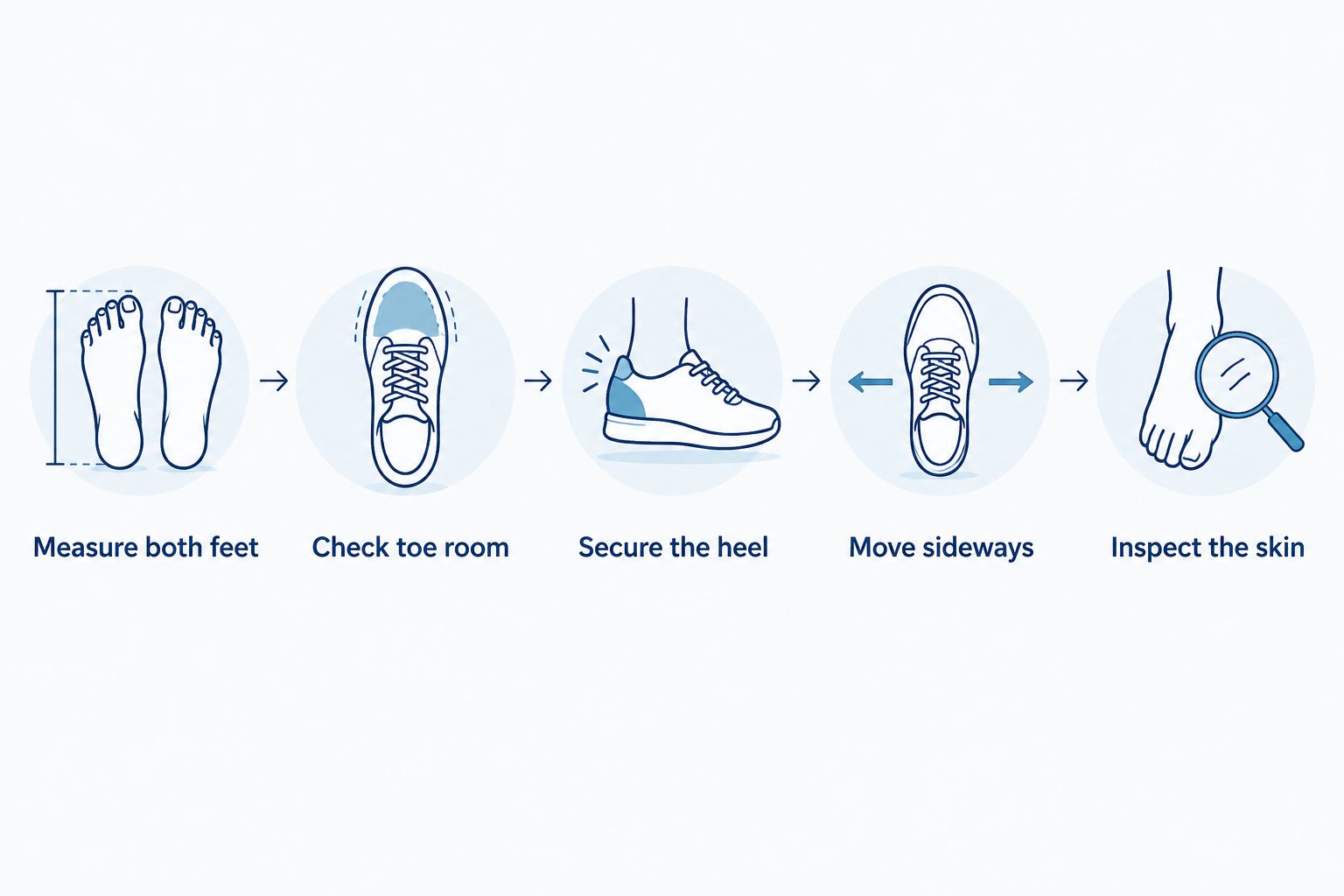
Use this sequence when trying a new pair. Do not use an active injury as an opportunity to test the shoe's support.
- Measure both feet: Check length and width while standing. Fit the larger foot without leaving the other foot insecure.
- Check toe room: Confirm space beyond the longest toe and around the forefoot. Toe-box height matters when toes are raised or bent.
- Secure the heel: Lace the shoe normally. Reject persistent heel lift or pressure that requires painful tightening.
- Move sideways: Make controlled lateral steps in a safe area. Your foot should remain contained within the shoe.
- Inspect the skin: Look for redness, rubbing, or pressure after the fitting. Reduced sensation makes this inspection especially important.
If walking looks uneven or one foot repeatedly shifts inside the shoe, a fitting alone does not explain why. A clinical gait analysis examines movement and helps distinguish a footwear problem from a foot or ankle problem.
When better shoes are not enough
Stop playing after a sudden injury with significant pain, swelling, or difficulty bearing weight. A sprain, fracture, or tendon injury cannot be distinguished by how supportive a new shoe feels. Deformity, an open wound, or a cold or numb foot requires urgent medical attention.
Persistent heel pain, recurring ankle giving-way, and burning or numb toes also deserve assessment. Bring your playing shoes, inserts, and brace to the visit. The wear pattern and fit are useful information, but they do not establish a diagnosis by themselves.
Naples Podiatrist provides specialist foot and ankle medical and surgical care. For your 2026 return to pickleball, the priority is identifying the condition and establishing safe activity—not finding a shoe that lets you ignore symptoms.
Get your foot pain assessed
Discuss persistent pain, recurring ankle rolling, and the fit of your playing shoes.
How we ranked these shoe configurations
The ranking prioritizes court match, heel hold, toe room, lateral stability, insert compatibility, and pressure-free comfort. Outdoor court shoes come first as the general hard-court choice; the remaining configurations address distinct fitting or surface needs.
These are buying categories, not claims that a particular model prevents injuries. Choose by your foot and playing conditions. A lower-ranked configuration becomes your first choice when its use case matches your needs.
Which pickleball shoes should you choose?
Start with a well-fitting outdoor court shoe if you play on outdoor hard courts and have no special fitting requirements. Choose a wide-fit configuration for forefoot crowding, an orthotic-compatible configuration for prescribed inserts, or an indoor configuration for gym flooring.
If you need a brace, fit the entire setup and follow your clinician's return-to-play advice. If you have persistent pain, get assessed before treating another shoe purchase as the answer. That is the practical 2026 buying decision: match the surface first, then resolve your specific fit requirement.
FAQ
What are the best pickleball shoes for foot and ankle support?
The best pickleball shoes for foot and ankle support are court shoes matched to your playing surface, with secure heel hold, adequate toe room, and stable lateral containment. Choose a wide-fit, orthotic-compatible, or brace-accommodating configuration when your fitting needs require it.
Can I wear running shoes for pickleball?
Court shoes are the better starting point for pickleball because the sport includes repeated lateral movement. Running-shoe comfort during forward movement does not establish that your foot will remain securely contained during court changes of direction.
Are tennis shoes suitable for pickleball?
A tennis court shoe can be suitable for pickleball when its outsole matches the court and its fit meets your needs. A casual sneaker described as a tennis shoe is not necessarily designed for court play.
Do high-top shoes prevent pickleball ankle sprains?
A high collar does not guarantee prevention of an ankle sprain. Players with recurring ankle instability need assessment and advice about rehabilitation, bracing, and return to play.
What should I look for if I have bunions?
Choose a court shoe with enough forefoot width and a toe-box shape that does not press on the bunion. Keep the heel secure rather than buying excess length to create more width.
Should I put custom orthotics in my pickleball shoes?
Use custom orthotics when prescribed for your clinical needs, and check the shoe with the orthotics inside. Follow your clinician’s instructions about the original sockliner and reject a combination that causes heel lift or toe compression.
When should I replace my pickleball shoes?
Replace pickleball shoes when worn traction, damaged uppers, uneven sole wear, or loss of secure fit makes them unsuitable for play. A calendar alone does not account for different surfaces, playing frequency, and wear patterns.
Should I keep playing if my new shoes still hurt?
No—do not keep playing through persistent pain because the shoes are new. Stop the activity and seek assessment for ongoing pain, swelling, numbness, or repeated ankle giving-way.
One last thing
A larger shoe is not automatically a more accommodating shoe. Extra length does not reliably solve a narrow toe box, insufficient depth, or the wrong heel shape.
Change the shape before accepting a loose fit. Bring your actual socks and prescribed devices to the fitting, and reject any pair that needs painful tightening to feel secure.
Related guides
- Foot and ankle pain from pickleball: causes and prevention
- Custom orthotics for pickleball players
- Ankle sprains in pickleball: what Naples players should know