
 Fax: (239) 692-9436
 Tel: 239-430-3668
A mild ingrown toenail can improve without a procedure, but leaving it alone is not a reliable treatment. Gentle care and less shoe pressure can help an early case; an embedded nail edge, pus, spreading redness, or worsening pain needs medical attention. If you have diabetes, poor circulation, or reduced feeling in your feet, contact a clinician rather than trying to treat the nail yourself.
- Can ingrown toenails go away on their own? Mild cases sometimes improve with gentle care and reduced pressure.
- Pus, spreading redness, or worsening pain needs medical assessment, not continued waiting.
- Diabetes, poor circulation, and numbness make home treatment unsafe without clinical guidance.
- An embedded or repeatedly ingrown nail often needs treatment directed at the nail edge.
Why this matters
Waiting makes sense only when symptoms are mild and improving. Less pain after removing a tight shoe does not prove that the nail edge has stopped pressing into the skin.
For your 2026 foot-care plan, separate temporary comfort from actual healing. If diabetes affects your feet, this guide to diabetic nail care explains why a small nail problem deserves attention before it becomes a wound.
Can ingrown toenails go away on their own?
Some early ingrown toenails settle with conservative care; a nail edge lodged in the skin is less likely to resolve without treatment. The deciding factors are your symptoms, whether the skin is broken, and whether you have conditions that affect healing.
Use this comparison to choose your next step. It is a guide to seeking care, not a way to diagnose infection at home.
| Situation | Best for | Benefit of this approach | Limitation or concern |
|---|---|---|---|
| Mild tenderness, limited redness, no drainage | Gentle home care in otherwise healthy people | Reduces pressure and irritation without a procedure | Does not reliably release a deeply embedded edge |
| Persistent pain or repeated episodes | Podiatric assessment | Identifies the offending edge and discusses treatment | An examination is needed to select an appropriate approach |
| Pus, increasing warmth, or worsening swelling | Prompt medical assessment | Checks for infection and the need to treat the nail | Soaking alone does not address the underlying problem |
| Diabetes, poor circulation, or numbness | Clinician-guided care from the outset | Avoids injury from self-trimming or unnoticed skin damage | Mild pain does not reliably indicate a mild problem |
There is no single waiting period that makes every ingrown toenail safe. Improvement means decreasing tenderness, redness, and swelling—not simply tolerating the pain.
Mild irritation: when gentle care is reasonable
Home care is best for an early, mildly tender nail without drainage, significant swelling, or spreading redness in someone without high-risk medical conditions. You should still be able to protect the toe without digging into the nail fold.
Start by removing pressure from the sore area. Choose footwear with enough toe room, keep the skin clean, and leave the painful corner alone rather than trying to uncover it with clippers.
A mildly irritated toe should become more comfortable as pressure and inflammation decrease. If it stays painful, worsens, or repeatedly flares in the same place, arrange an examination instead of extending home treatment indefinitely.
An embedded or recurring nail: when waiting is not enough
A sharp nail corner can keep injuring the surrounding skin with each step. Soaking can soften the area and ease discomfort, but it does not reliably remove that mechanical irritation.
A podiatrist checks the nail edge, surrounding tissue, circulation, and sensation. Depending on the findings, treatment can include conservative measures or removal of the offending portion under local anesthesia; recurrent cases sometimes need treatment of the corresponding nail-growth area.
Read about the ingrown toenail removal procedure to understand what an office assessment and treatment can involve. Partial removal preserves the rest of the nail, but it still creates a healing area that needs aftercare; treatment intended to prevent regrowth also changes the nail's width permanently.
Possible infection: when to seek prompt care
Drainage, pus, increasing warmth, worsening swelling, or redness extending beyond the nail fold needs medical assessment. Redness alone can come from irritation, so a clinician must interpret the overall picture.
Seek urgent medical care for fever, rapidly spreading redness, red streaking, or feeling unwell with a worsening toe problem. Do not wait for an appointment if symptoms are progressing rapidly.
Antibiotics are not a substitute for addressing an embedded nail edge, and they are not necessary for every ingrown toenail. A clinician decides whether infection requires medication and whether the nail itself needs treatment.
Why an ingrown toenail's course varies
The same home-care routine will not work for every toe. These factors explain why some cases settle while others persist:
- Depth of the nail edge: A corner pressing against intact skin differs from one that has broken through it.
- Nail shape: A strongly curved nail can repeatedly press into the surrounding tissue.
- Trimming habits: Cutting too short or rounding deeply into the corners encourages problems as the nail grows.
- Footwear pressure: A narrow toe box keeps squeezing an already irritated nail fold.
- Repeated trauma: Running, court sports, and stubbing the toe can aggravate the area.
- Healing and sensation: Diabetes, poor blood flow, and neuropathy change how safely you can monitor and treat the toe.
Age alone does not determine whether a procedure is needed. For an older adult, the practical questions are whether you can see and reach the nail safely, whether you feel injuries normally, and whether your circulation supports healing.
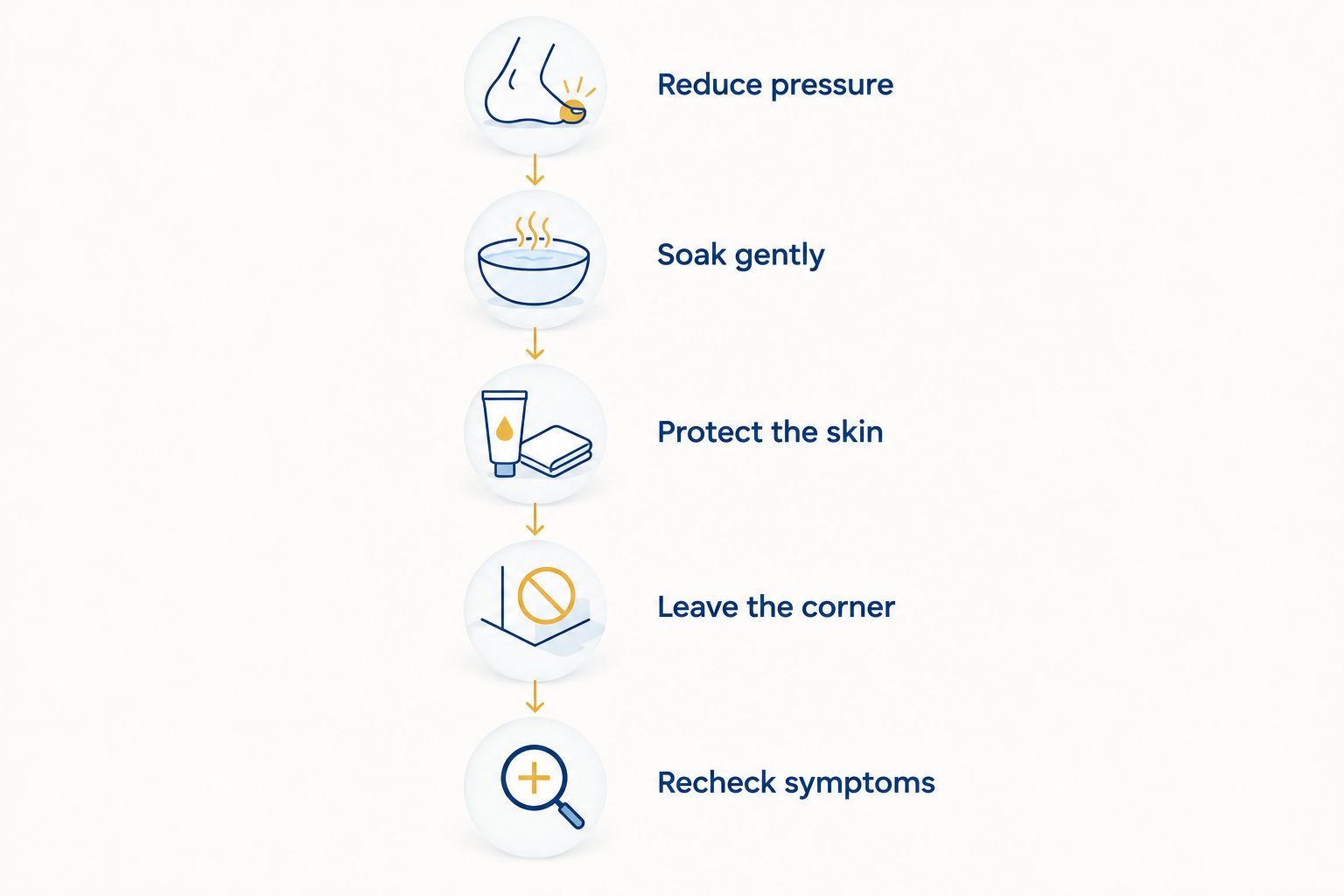
How to care for a mild ingrown toenail in 2026
Use these steps only if symptoms are mild and you do not have diabetes, poor circulation, reduced sensation, or another condition that makes foot wounds higher risk. Stop home treatment and seek advice if symptoms worsen.
- Reduce pressure. Wear roomy footwear that does not rub the sore nail fold. Avoid shoes that feel comfortable at the heel but squeeze the toes.
- Soak gently. Mayo Clinic's patient guidance describes warm-water soaks for 15–20 minutes, 3–4 times a day. Use comfortably warm—not hot—water, and dry the toe carefully afterward.
- Protect the skin. Keep the area clean. If superficial broken skin needs covering, use a clean, nonstick dressing and replace it when wet or dirty.
- Leave the corner. Do not cut down the painful side, pull out the corner, or push tools underneath it. Avoid lifting the nail with cotton or floss unless a clinician has shown you an appropriate technique.
- Recheck symptoms. Look at the toe at least once a day while monitoring a mild case. Increasing pain, redness, swelling, or drainage means it is time for medical advice.
Soaking is a comfort measure, not proof that the nail has healed. You should also be able to wear appropriate shoes and walk without repeatedly irritating the same spot.
What should you avoid doing?
Do not cut a V into the middle of the nail. It does not redirect growth away from the sides, and it leaves you with an unnecessarily damaged nail edge.
Avoid bathroom surgery with scissors, needles, or pointed grooming tools. Tearing off a corner can leave a small nail spike behind and injure the surrounding skin.
A pedicure is not a substitute for medical treatment of a painful, draining, or infected nail. Covering the toe cosmetically also makes changes in the skin harder to monitor.
When should I see a podiatrist instead of waiting?
Arrange an assessment when pain persists despite reducing pressure, the same corner repeatedly becomes inflamed, or walking and ordinary footwear remain uncomfortable. You do not need to wait until pus appears.
Naples Podiatrist is a practical choice for Southwest Florida patients who need specialist foot and ankle care for a painful or recurring toenail problem. An examination determines whether gentle care is enough; specialist care does not automatically mean nail removal.
For your 2026 appointment, bring a medication list and explain when symptoms began, whether the toe has drained, and what you have tried. Tell the clinician about diabetes, circulation problems, numbness, previous nail procedures, and any medication allergies.
Naples Podiatrist foot and ankle care includes assessment of the toe in the context of your broader foot health. The trade-off is that professional treatment can require wound care afterward, so discuss footwear, activity, and follow-up before choosing a procedure.
Get your painful toenail assessed
Discuss persistent pain, drainage, or a recurring ingrown nail with a foot and ankle specialist.
Can I keep playing pickleball, golf, or running?
A painful ingrown toenail is a reason to reduce activities that repeatedly press on the toe. Running impact, pickleball stops and turns, and tight golf shoes can all keep the nail fold irritated.
Choose activity that does not increase pain or rub the area. Do not use pain relief as permission to continue through worsening symptoms, particularly if your skin is broken or draining.
If you have a procedure, follow the treating clinician's return-to-activity instructions rather than a general online timeline. Naples Podiatrist can discuss how your planned activity fits your examination findings and aftercare needs.
How can I prevent another ingrown toenail in 2026?
Trim toenails straight across without cutting them very short, and do not dig into the corners. Let the nail edge remain visible rather than cutting it flush with the surrounding skin.
Check shoe fit while standing, and make sure your toes are not compressed from the sides or above. A shoe's listed size does not tell you whether its toe box suits your foot.
If thick nails, poor vision, limited flexibility, or hand weakness make trimming unsafe, ask for professional nail-care advice. Repeatedly injuring the same corner is not a necessary part of grooming.
Does less pain mean my ingrown toenail has healed?
Less pain does not necessarily mean the ingrown toenail has healed. Taking off tight shoes can reduce pressure while the nail edge remains against the skin.
Look for an overall improvement in tenderness, swelling, redness, and skin condition. Persistent drainage or a recurring sore spot needs assessment even if resting makes it feel better.
Will I need my entire toenail removed?
Entire toenail removal is not necessary for every ingrown toenail. A clinician can often treat only the affected border, depending on the nail and surrounding tissue.
Ask whether the proposed treatment allows that border to regrow or aims to prevent its return. These approaches have different implications for recurrence, nail appearance, and aftercare.
FAQ
Can ingrown toenails go away on their own without treatment?
Some mild ingrown toenails improve with gentle care and less pressure, but waiting alone is not reliable treatment. An embedded edge, worsening symptoms, or repeated episodes needs assessment.
How long should I wait for an ingrown toenail to improve?
There is no single safe waiting period for every ingrown toenail. Seek advice when symptoms persist or worsen, and do not wait with pus, spreading redness, diabetes, poor circulation, or reduced sensation.
How long should I soak a mildly ingrown toenail?
Mayo Clinic describes warm-water soaks for 15–20 minutes, 3–4 times a day as a home-care measure. Dry the toe afterward, and seek clinical guidance instead of soaking if you have diabetes, poor circulation, or reduced sensation.
Can an ingrown toenail heal if there is pus?
Pus needs prompt medical assessment rather than continued home treatment. A clinician checks for infection and whether the embedded nail edge needs treatment.
Should I cut out the painful corner myself?
Do not cut out or tear away the painful corner yourself. You can injure the skin or leave a sharp nail fragment that continues to irritate the toe.
Do I need antibiotics for an ingrown toenail?
Not every ingrown toenail needs antibiotics. A clinician decides whether there is an infection requiring medication; antibiotics alone do not remove an embedded nail edge.
Is it safe to treat an ingrown toenail at home if I have diabetes?
Contact a clinician before treating an ingrown toenail at home if you have diabetes. Reduced sensation or circulation problems can make an injury harder to detect and slower to heal.
What should I tell a podiatrist at my 2026 toenail appointment?
Tell your podiatrist when pain began, whether there is drainage, and whether the same corner has caused problems before. Mention diabetes, numbness, circulation problems, medications, allergies, and previous nail treatment.
One last thing
A tiny nail spike left behind after an aggressive trim can keep causing pain even when the visible corner looks shorter. If the same spot keeps hurting, stop trimming deeper and have the edge examined.
Make that your practical rule in 2026: judge progress by healthier skin and decreasing symptoms, not by how much nail you can remove.
Related guides
- How to prevent ingrown toenails from coming back
- How long an ingrown toenail takes to heal after removal
- Proper nail hygiene for foot health