
 Fax: (239) 692-9436
 Tel: 239-430-3668
Instead of repeatedly calling about a podiatrist prescription for walking boot, organize the process around a confirmed order, a supplier handoff, and a supervised fitting. This 2026 workflow explains how to move from examination to durable medical equipment delivery without confusing insurance approval, receipt of the boot, or permission to walk.
- A podiatrist prescription for walking boot needs a clear treatment plan, supplier confirmation, and fitting instructions.
- Naples Podiatrist provides specialist foot and ankle care; confirm walking boot arrangements directly with the practice.
- DME delivery does not give you permission to bear weight or change your activity level.
- Confirm insurance requirements before fulfillment, and arrange help if you cannot safely fit or use the boot.
Why this matters
A walking boot, also called a controlled ankle motion or CAM boot, protects or limits movement of an injured foot or ankle. The prescription starts treatment coordination; it does not replace instructions about weight-bearing, skin checks, or follow-up.
Naples Podiatrist is best for Southwest Florida patients seeking specialist foot and ankle assessment before walking boot treatment. Contact Naples Podiatrist to discuss an evaluation rather than choosing a boot solely from your symptoms.
The advantage of specialist assessment is a treatment decision based on your examination. The limitation is equally important: this guide cannot establish whether you need a boot, which device is appropriate, or how your particular order will be fulfilled.
For your 2026 care plan, keep the clinical decision separate from the administrative process. A supplier confirms fulfillment; your treating clinician determines how you use the device.
Before you start
- Gather your records: Bring identification, insurance information, relevant imaging or reports you already have, and your current medication list. Tell the clinician about diabetes, reduced sensation, circulation problems, wounds, and previous falls.
- Identify the people handling the order: Confirm 2 contacts—the prescribing office and the dispensing supplier, if separate. Ask who receives questions about fitting, paperwork, and treatment instructions.
- Resolve the hidden safety issue: A boot does not automatically permit walking. Obtain explicit weight-bearing instructions and ask how to move safely while the order is being processed, especially if you need help with balance or stairs.
Durable medical equipment is often shortened to DME. Ask whether the office dispenses the prescribed device or sends the order to another supplier; do not assume either arrangement applies.
Prescription and treatment instructions
Establish the clinical plan
- Describe the injury and your daily demands. Explain when symptoms began, where you hurt, and whether you can bear weight. Mention running, pickleball, golf, work duties, and any difficulty getting around your home.
- Complete the recommended evaluation. Your podiatrist determines whether imaging or other assessment is needed before selecting treatment. Do not use the boot-order process as a substitute for evaluating a possible fracture, tendon injury, or worsening diabetic foot problem.
- Confirm the prescribed device. Ask the office to clarify the intended boot type, injured side, and any required positioning or accessories. Do not substitute a different boot or add heel wedges yourself.
- Review 4 instructions: weight-bearing status, wear schedule, permitted removal, and follow-up. Ask specifically about sleeping, bathing, skin inspection, and exercises rather than filling gaps with general online advice.
Expected result: You understand what the boot is intended to do and have written instructions for using it. If an instruction is missing, request clarification before relying on the device.
Create your handoff record
Keep 3 records together: the prescription or order copy, the written treatment instructions, and the supplier's receipt or delivery confirmation when issued. Store them somewhere you and a caregiver can find them.
Use Prescriber, Supplier, and Next action as headings in your personal checklist. Record who is responsible for the next task and the date of your last contact; this prevents you from repeating the entire history during every call.
Ask the office how records should be transferred. Use the communication method the office or supplier provides for medical documents rather than sending personal health information to an unverified address.
Expected result: You can identify the next responsible person and explain exactly what is still outstanding. You do not need to interpret clinical documentation or choose a billing code yourself.
Supplier handoff and insurance review
Confirm receipt and requirements
- Verify that the supplier received the order. Ask whether the prescription is readable and complete for processing. Sending an order and receiving it are separate events.
- Ask what supporting documents are required. If the supplier needs clinical notes or clarification, ask the supplier to identify the specific missing item and contact the prescribing office through its established process.
- Check your own insurance requirements. Ask your plan and supplier about network participation, coverage criteria, authorization requirements, and your financial responsibility. A prescription alone does not guarantee coverage.
- Identify the next action before ending the call. Establish whether the office must send information, the insurer must review a request, or you must arrange fitting or receipt. Request a reference number when one is issued.
Expected result: The supplier can explain the order's status and the remaining requirements. You know whom to contact rather than treating every delay as a problem for the podiatrist alone.
For a 2026 insurance review, use information specific to your current plan and prescribed device. Do not assume that another patient's experience, a previous claim, or the word DME establishes coverage for this order.
Choose a fitting and receipt arrangement
Ask which arrangements the dispensing provider supports and which meet your clinical needs. Choose the arrangement that provides safe fitting and clear instruction, not simply the fewest errands.
| Arrangement | Best for | Advantage | Limitation |
|---|---|---|---|
| In-person fitting and pickup | Patients needing hands-on sizing, strap instruction, or mobility assessment | You can ask questions and demonstrate use before leaving | Requires travel and a safe transportation plan |
| Delivery with arranged fitting instruction | Patients whose travel is difficult and whose provider supports this approach | Avoids a separate pickup trip | Receipt alone does not establish correct fit or safe use |
Do not accept an unapproved device substitution just to finish the handoff. If the proposed boot differs from the prescription, have the supplier obtain the prescriber's approval before proceeding.
Fitting, receipt, and home use
Check the device with the dispensing team
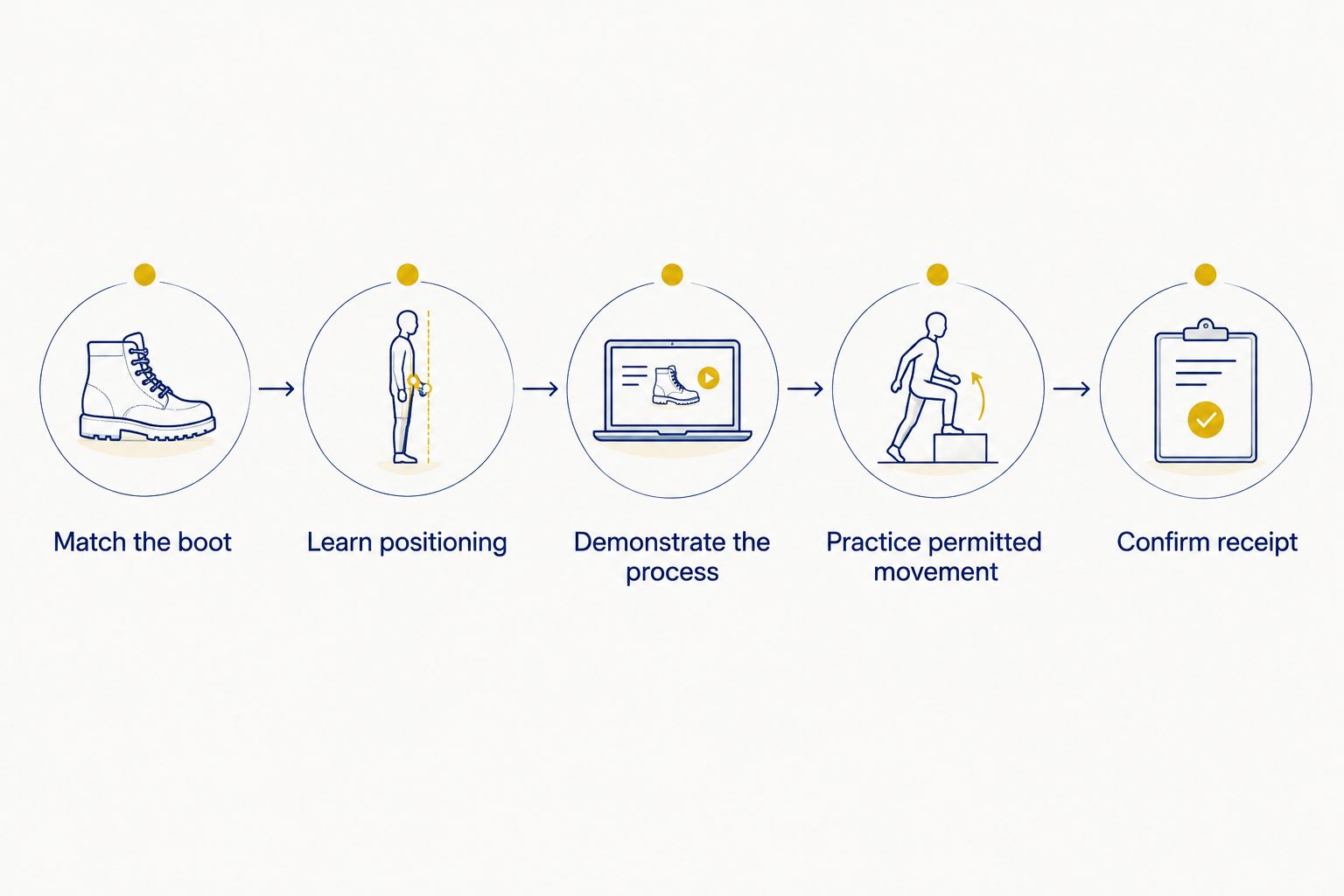
- Match the boot to the order. Confirm the intended side, model or device type, size, and any prescribed accessories with the dispensing professional. Follow the device-specific instructions rather than a generic strap sequence.
- Learn positioning and fastening. Ask for a demonstration of heel placement, liner positioning, strap adjustment, and inflation controls if the prescribed device has them. Do not assume that tighter always means safer.
- Demonstrate the process yourself. Put the boot on and remove it only as permitted by your treatment plan. If reaching your foot, vision, or hand strength makes this difficult, involve a caregiver before leaving or completing instruction.
- Practice permitted movement. Demonstrate transfers and walking only within your prescribed weight-bearing limits. Ask whether you need a walking aid and instruction in its use.
- Confirm receipt accurately. Check the device and documentation before acknowledging receipt. Report a missing component, damaged item, or fitting concern to the dispensing team.
Expected result: You or your caregiver can explain and demonstrate the prescribed routine. You know whom to contact if the boot shifts, rubs, or becomes difficult to use.
Make home use practical
Before moving around your home, clear loose rugs, cords, and clutter from your route. Arrange help with carrying items if you need a walking aid; carrying groceries or a grandchild while using crutches adds a separate balance challenge.
Ask the clinician about footwear on the other foot. A boot changes how you move, and a footwear adjustment needs to fit your balance, injury, and treatment restrictions rather than follow a general recommendation.
For your 2026 home routine, keep written instructions near the boot supplies. Record new rubbing, skin changes, or difficulty following the plan so the treating team can address the actual problem.
Do not use pain relief as permission to return to golf, running, or pickleball. Activity clearance comes from your treating clinician, not from how comfortable the boot feels.
When the walking boot prescription changes
A revised prescription needs another handoff, even when you already have a boot. A change in positioning, accessories, or weight-bearing instructions is a clinical update, not an invitation to adjust the device by trial and error.
- Obtain the revised instructions. Confirm what changed and when the new plan begins. Ask whether the existing device remains appropriate.
- Notify the dispensing provider when needed. Have the office send the revised order if the device, fitting, or accessories must change. Confirm that the supplier received it.
- Request updated fitting instruction. Have the dispensing team demonstrate any clinician-approved changes. Do not transfer wedges or other components from an old setup without direction.
- Replace your earlier home instructions. Keep the previous record for reference, but clearly identify the current plan for everyone helping with your care.
Expected result: Your boot setup and home instructions match the latest prescription. A delivery receipt or an old instruction sheet no longer drives decisions after the treatment plan changes.
Troubleshooting common handoff problems
The supplier cannot find the prescription
Confirm the supplier's identity and the method used to send the order. Ask the prescribing office to resend it through the agreed channel, then verify receipt with the supplier. Avoid creating competing orders with multiple suppliers without telling the office.
Insurance processing stops
Ask for the exact reason: missing documentation, a network issue, an authorization requirement, or a coverage decision. Send clinical questions back to the prescriber and plan questions to the insurer. Do not delay needed medical reassessment while an administrative issue remains unresolved.
The boot slips or creates pressure
Stop and contact the dispensing team or clinician for fitting advice; do not improvise padding, cut the liner, or change prescribed components. New numbness, persistent redness, a blister, or a wound needs prompt clinical advice, especially with diabetes or reduced sensation.
You cannot move safely at home
Tell the treating team immediately if you cannot follow weight-bearing restrictions, manage stairs, or transfer safely. Ask for a mobility assessment, walking-aid instruction, or caregiver training rather than continuing an unsafe routine.
Symptoms worsen despite the boot
Seek urgent assessment for severe or increasing pain, a cold or discolored foot, new loss of sensation, or concerning wound changes. New calf pain or swelling also needs prompt evaluation. Chest pain, sudden shortness of breath, or fainting requires emergency care; call 911 rather than waiting for a fitting callback.
Customize your workflow
For a 2026 follow-up visit, bring your boot, written instructions, and questions about daily function. Tell the clinician about falls, skin irritation, new pain elsewhere, and any difficulty following restrictions.
Ask what findings will determine the next stage of treatment. Do not choose a fixed boot-removal date from someone else's recovery story or start exercises that conflict with your restrictions.
Naples Podiatrist provides foot and ankle medical and surgical care, including trauma and diabetic foot care. Ask the practice about assessment and the arrangements relevant to your prescription; do not assume the practice follows a particular supplier or delivery process.
FAQ
Can a podiatrist prescribe a walking boot?
Yes. A podiatrist can prescribe a walking boot when the examination and treatment plan support its use. The prescription should be accompanied by instructions specific to your injury and permitted activity.
Do I need a podiatrist prescription for walking boot insurance coverage?
A prescription alone does not establish insurance coverage for a walking boot. Ask your insurer and dispensing supplier which order, documentation, network, and authorization requirements apply to your plan.
Does a walking boot mean I can walk on my injured foot?
No. Your clinician’s weight-bearing instructions determine whether and how you can walk on the injured foot. The name walking boot does not override those restrictions.
Can my walking boot be delivered to my home?
Ask the dispensing provider whether home delivery is supported for your order. Confirm how fitting, device instruction, and any mobility concerns will be addressed before relying on the delivered boot.
Should I sleep in my walking boot?
Follow your prescriber’s instructions about sleeping in the boot. Removal rules depend on the injury and treatment plan, so request clarification rather than using a general wear schedule.
What should I do if my walking boot causes numbness or blisters?
Contact your clinician promptly about new numbness, blisters, wounds, or persistent pressure marks. Seek urgent assessment for a cold or discolored foot, severe pain, or new loss of sensation rather than waiting for routine follow-up.
When can I return to pickleball or golf after wearing a boot?
Return when your treating clinician clears the activity. Reduced pain or receiving the boot does not establish that the injured tissue is ready for sport.
Can Naples Podiatrist assess whether I need a walking boot?
Naples Podiatrist provides specialist foot and ankle assessment. Contact the practice to discuss your symptoms and ask about evaluation, treatment instructions, and arrangements for any prescribed device.
One last thing
Test the handoff by explaining the plan back to the person teaching you. State whether you can bear weight, when removal is allowed, and whom you will contact about a problem. A boot that reaches your home without those answers leaves the treatment handoff unfinished.
Related guides
- CAM boot to regular shoes: complete recovery workflow
- How a CAM walker boot affects foot and leg pain
- How to check your feet daily with diabetes
- Gait analysis: what a podiatrist checks and why it matters

