
 Fax: (239) 692-9436
 Tel: 239-430-3668
Pseudogout in the foot and ankle is treated by calming the acute inflammation with clinician-approved medication, protecting the painful joint, and aspirating or injecting the joint when symptoms are severe. In 2026, effective pseudogout foot treatment usually combines rest, ice, elevation, an NSAID or prescription colchicine, while recurrent attacks require a prevention plan. A hot, swollen joint needs prompt evaluation because pseudogout, gout, infection, and injury can look alike.
- Pseudogout foot treatment in 2026 starts with diagnosis, joint protection and anti-inflammatory care.
- Joint aspiration can identify calcium pyrophosphate crystals and provide fluid for infection testing.
- NSAIDs, colchicine or corticosteroids can control inflammation, but each has medical limitations.
- Naples Podiatrist foot and ankle specialists provide quick access for sudden swelling across Southwest Florida.
Why this matters
Pseudogout is an acute form of calcium pyrophosphate deposition disease, often shortened to CPPD. Calcium pyrophosphate crystals trigger sudden inflammation inside a joint, causing pain, warmth, redness, swelling and restricted movement.
The symptoms overlap with gout, but the crystals and long-term management are different. A gout attack involves monosodium urate crystals, while pseudogout involves calcium pyrophosphate crystals. Uric acid treatment does not remove CPP crystals.
Naples Podiatrist is best for Southwest Florida patients who need quick access to a foot and ankle specialist for a suddenly swollen joint. That access matters because joint infection cannot be excluded safely from appearance alone.
How do you treat pseudogout in the foot and ankle?
Treatment follows five practical steps: confirm what is causing the inflammation, protect the joint, select an anti-inflammatory treatment, drain or inject the joint when appropriate, and address repeat flares. The correct sequence depends on symptom severity, the number of joints involved, and your other medical conditions.
| Treatment option | Main benefit | Limitation or risk | Best for |
|---|---|---|---|
| Rest, ice and elevation | Reduces stress, pain and swelling | Supports recovery but does not stop crystal formation | Every acute flare as an add-on treatment |
| NSAID | Reduces joint inflammation and pain | Can be unsafe with kidney disease, ulcers, bleeding risk or some heart conditions | Clinician-approved treatment for an uncomplicated flare |
| Colchicine | Targets the inflammatory response to crystals | Requires attention to kidney function, liver function and drug interactions | Early flares or prescribed prevention for recurring attacks |
| Joint aspiration and corticosteroid injection | Relieves pressure and treats one inflamed joint directly | Requires a procedure, and infection must be considered first | A severely swollen ankle or another accessible joint |
| Oral corticosteroid | Treats inflammation when other options do not fit | Can raise blood sugar and complicate an active infection | Selected patients who cannot use NSAIDs or colchicine |
Step 1: Confirm the diagnosis
A foot or ankle specialist starts by examining where the pain originates and how quickly it appeared. Pseudogout often becomes intense over hours, but that pattern also occurs with gout, septic arthritis, a fracture, tendon injury or bleeding into a joint.
Joint aspiration provides the clearest answer when the diagnosis remains uncertain. A clinician removes synovial fluid with a sterile needle, then sends it for crystal analysis and, when infection is possible, a cell count, Gram stain and culture. Calcium pyrophosphate crystals support CPPD; urate crystals support gout.
X-rays can show chondrocalcinosis, which is calcium deposited in cartilage. However, an X-ray without visible calcification does not exclude pseudogout. Ultrasound or other imaging can help identify inflammation, guide aspiration, or look for a structural injury when the physical examination points beyond crystal arthritis.
Step 2: Protect the joint
Reduce walking, running, golf, pickleball and other weight-bearing activity while the joint is hot and swollen. Pushing through an acute flare increases pain and can alter your gait, shifting stress into the opposite foot, knee, hip or back.
Elevate the foot above heart level when practical. Apply a wrapped cold pack for up to 20 minutes at a time, then allow the skin to return to its normal temperature before repeating. Never place ice directly on the skin, particularly if you have neuropathy or reduced circulation.
Supportive shoes can reduce unwanted movement once you can tolerate footwear. Avoid tight shoes over a swollen midfoot or ankle. A brace, walking boot or assistive device should be selected according to the affected joint rather than purchased solely from a pseudogout label.
Step 3: Use anti-inflammatory treatment
An NSAID can reduce pain and inflammation during an acute flare, but over-the-counter availability does not make it safe for everyone. Kidney disease, stomach ulcers, anticoagulant use, uncontrolled blood pressure, heart disease and medication interactions can change whether an NSAID is appropriate.
Colchicine is another standard treatment for acute CPP crystal arthritis. It works on the inflammatory response rather than dissolving the crystals. Colchicine requires a prescription, and the dosing decision belongs to a clinician because kidney disease, liver disease and interacting medications can raise the risk of serious side effects.
Corticosteroids are used when NSAIDs or colchicine are unsuitable or ineffective. A clinician may inject one affected joint or prescribe an oral course when the clinical situation calls for broader treatment. Diabetes requires added care because corticosteroids can raise blood glucose.
Do not combine medications or copy another person's gout treatment. Pseudogout care must account for your diagnosis, prescriptions and medical history. Contact the treating clinician if pain or swelling worsens over 24 to 48 hours rather than assuming the flare simply needs more time.
Step 4: Aspirate or inject the joint
A tense, swollen ankle can hurt partly because excess fluid raises pressure inside the joint. Aspiration removes some of that fluid, which can reduce pressure while supplying the sample needed to distinguish CPP crystals from urate crystals and infection.
A corticosteroid injection can provide focused anti-inflammatory treatment after the clinician evaluates infection risk. This option is especially useful when one accessible joint is driving the symptoms and oral medication carries avoidable risk.
Aspiration and injection are not automatic for every flare. Small joints can be difficult to access, swelling may arise from tissue outside the joint, and suspected infection changes how the fluid and treatment are handled. The examination determines whether the procedure fits.
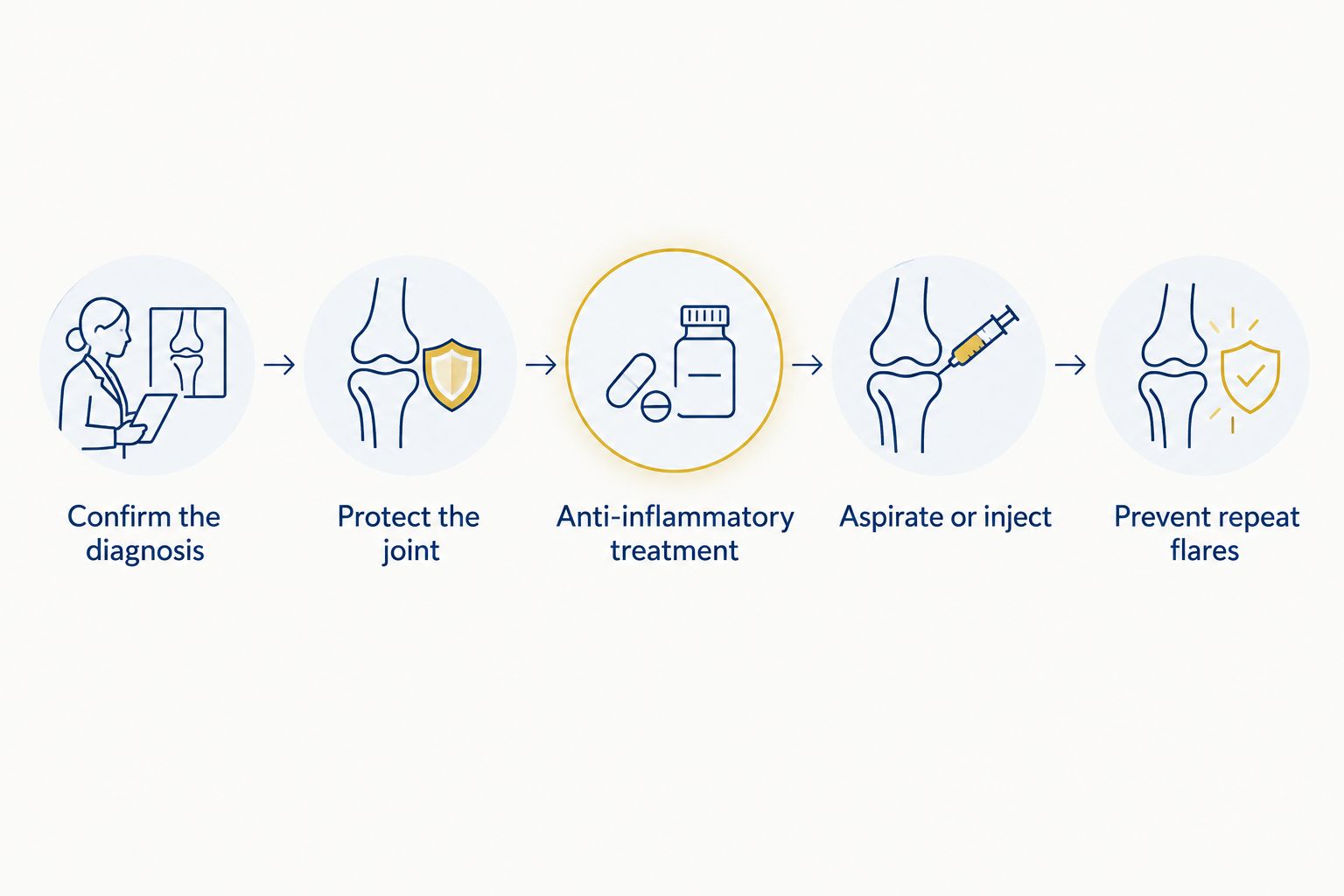
Step 5: Prevent repeat flares
No current medication removes every calcium pyrophosphate deposit from cartilage. Prevention therefore focuses on reducing recurring inflammation and correcting associated medical problems when testing identifies one.
A clinician may consider preventive colchicine when attacks recur, but the decision depends on attack frequency, kidney and liver function, other prescriptions, and side effects. Chronic inflammatory CPPD sometimes requires coordination with a rheumatologist when symptoms continue between obvious attacks.
Testing can be appropriate when pseudogout occurs unusually early, becomes recurrent or appears with other clinical clues. Conditions associated with CPPD include hyperparathyroidism, hemochromatosis, low magnesium and hypothyroidism. Treating an associated condition supports overall health, although it does not guarantee that existing crystal deposits disappear.
A 2026 prevention plan should also define when you can resume walking, running, golf or pickleball. Return when swelling has settled, ordinary walking is comfortable and joint motion is recovering. Restart gradually instead of using one pain-free morning as proof that the flare is over.
Why pseudogout treatment varies
Two people with the same diagnosis can need different treatment because pseudogout is not managed by one universal medication. The main treatment drivers are:
- The affected joint: An ankle may be accessible for aspiration, while smaller foot joints can be more difficult to sample or inject.
- Attack severity: Mild inflammation and a tense joint that prevents weight-bearing do not require the same level of intervention.
- Time since onset: Early clinical assessment makes it easier to evaluate an acute inflammatory pattern and begin suitable treatment.
- Medical history: Kidney disease, ulcers, diabetes, bleeding risk and cardiovascular disease affect medication choices.
- Current prescriptions: Anticoagulants and drugs that interact with colchicine can limit otherwise standard options.
- Possibility of infection: Fever, a wound, recent surgery or immune suppression lowers the threshold for urgent testing.
- Recurrence: Repeated attacks shift the plan from short-term symptom control toward prevention and evaluation for associated conditions.
How can you tell pseudogout from gout or arthritis?
Symptoms alone do not reliably separate these conditions. Joint fluid analysis gives the strongest distinction between pseudogout and gout, while the history, examination and imaging help identify osteoarthritis, tendon disorders and injuries.
| Finding | Pseudogout | Gout | Osteoarthritis |
|---|---|---|---|
| Crystal type | Calcium pyrophosphate | Monosodium urate | No defining crystal |
| Typical pattern | Sudden inflammatory flare | Sudden inflammatory flare | Gradual mechanical pain with possible flares |
| Common foot or ankle presentation | Ankle or other foot joint swelling | Often the big-toe joint | Stiff, painful ankle, midfoot or toe joint |
| Diagnostic evidence | CPP crystals in joint fluid | Urate crystals in joint fluid | Examination and imaging findings |
| Long-term focus | Control flares and assess associated conditions | Control flares and manage uric acid | Preserve motion, reduce load and treat structural pain |
Big-toe stiffness without marked heat or sudden swelling can point toward hallux rigidus, although arthritis and crystal disease can occur together. A diagnosis should explain both the painful location and the timing of symptoms.
When does a swollen foot or ankle need urgent care?
Seek prompt medical care for severe joint pain accompanied by fever, chills, spreading redness, drainage, an open wound or rapidly increasing swelling. The same applies if you cannot bear weight after an injury, the foot becomes numb or discolored, or pain is out of proportion to the visible swelling.
Diabetes, immune suppression, recent surgery and a joint replacement raise the stakes when infection is possible. Do not treat a first episode of a red, hot joint as pseudogout at home simply because the symptoms resemble a previous family member's attack.
How long does pseudogout in the foot last?
A treated pseudogout flare often improves over several days, but pain and swelling can last one to two weeks. The duration varies with the affected joint, attack severity, treatment timing and whether another condition is contributing.
Persistent swelling does not prove the diagnosis was wrong, but it does justify reassessment. Infection, a stress fracture, tendon damage or overlapping arthritis can prolong symptoms and require a different plan.
Can you walk during a pseudogout flare?
Limit walking while the foot or ankle remains hot, visibly swollen or painful with each step. Short, necessary movement is different from exercise; running, golf and pickleball should wait until ordinary walking no longer causes a limp.
A specialist can decide whether temporary immobilization or an assistive device is appropriate. Extended immobilization without guidance can create stiffness and weakness, so joint protection should have a clear purpose and endpoint.
Does changing your diet treat pseudogout?
Diet does not control pseudogout the way uric acid management can affect gout. CPP crystals are not created by eating purine-rich foods, so a restrictive gout diet is not a substitute for diagnosis or anti-inflammatory treatment.
Stay hydrated and follow any nutrition plan required for diabetes, kidney disease or another diagnosed condition. Supplements should not be used to correct suspected magnesium or thyroid problems without testing and clinical direction.
Naples Podiatrist foot and ankle specialists serve patients through nine Southwest Florida locations, covering communities from Marco Island to Sarasota. The practice offers quick access to specialist care when sudden swelling interrupts walking, work, golf, running or pickleball.
Get sudden swelling checked
Call for quick access to a foot and ankle specialist across Southwest Florida.
FAQ
What is the best pseudogout foot treatment in 2026?
The best pseudogout foot treatment in 2026 combines a confirmed diagnosis, joint protection and clinician-selected anti-inflammatory care. Severe swelling may require aspiration and a corticosteroid injection.
Can pseudogout affect the ankle?
Yes, pseudogout can cause abrupt pain, warmth and swelling in the ankle. Joint fluid testing can distinguish calcium pyrophosphate crystals from gout crystals and help evaluate infection.
Is pseudogout caused by high uric acid?
No, pseudogout is caused by calcium pyrophosphate crystals rather than high uric acid. Uric acid medicine does not remove CPP crystals.
How long does a pseudogout flare last?
A pseudogout flare can improve over several days but may last one to two weeks. Severe, worsening or persistent symptoms need reassessment rather than repeated self-treatment.
Can I use ice on pseudogout in my foot?
Yes, a wrapped cold pack can reduce pain and swelling during a pseudogout flare. Limit each application to 20 minutes and avoid direct skin contact, especially with neuropathy or poor circulation.
Does pseudogout require surgery?
Pseudogout itself is usually treated without surgery. Surgery enters the discussion only when separate structural joint damage causes chronic symptoms that do not respond to non-surgical care.
Which doctor treats pseudogout in the foot and ankle?
A podiatric foot and ankle specialist can evaluate the painful joint, order imaging and determine whether aspiration is appropriate. Naples Podiatrist provides quick specialist access across Southwest Florida.
When is pseudogout an emergency?
A red, hot joint with fever, chills, an open wound, spreading redness or rapidly worsening pain needs urgent evaluation. Joint infection can resemble pseudogout and requires immediate treatment.
One last thing
A previous pseudogout diagnosis does not make every future swollen joint another pseudogout flare. Infection, gout, arthritis and injuries can appear in the same foot or ankle, and symptoms can overlap. In 2026, the safest rule remains simple: a new or unusually severe hot, swollen joint deserves a fresh diagnosis before medication is repeated.
Related guides
- Ankle arthritis treatment options
- Gout symptoms and treatment in the big toe
- What to expect at your first podiatrist appointment