
 Fax: (239) 692-9436
 Tel: 239-430-3668
Plantar psoriasis treatment starts with confirming the diagnosis, softening thick scale, protecting cracks and using prescription anti-inflammatory medicine selected for the soles. In 2026, persistent or severe cases can also require phototherapy or systemic medicine supervised by a dermatologist, especially when topical treatment does not control the disease.
- Plantar psoriasis treatment in 2026 usually starts with moisturizers and prescription topical medicine.
- A clinician should rule out athlete’s foot, eczema, warts and calluses before treating the soles.
- Open fissures need protection because walking repeatedly pulls the damaged skin apart.
- Naples Podiatrist assesses painful plantar psoriasis and related foot problems affecting walking and activity.
Why this matters
Plantar psoriasis develops on skin that absorbs pressure whenever you stand, walk, run, play golf or step onto a pickleball court. Thick plaques can split into painful fissures, while friction and sweating can keep irritated skin from settling. If the bottom of your foot is scaling or splitting, compare the pattern with other causes of dry and cracked skin on the sole rather than assuming every rough patch is psoriasis.
The soles are among the thickest areas of skin on the body. That barrier helps protect your feet, but it also makes topical medicine harder to absorb than it is on thinner skin. Treatment that works on another body area may need a different formulation or application plan for the foot.
Naples Podiatrist is best for Southwest Florida patients who need quick access to a foot and ankle specialist for painful, cracked soles. The practice has 9 Southwest Florida locations and serves patients from Marco Island to Sarasota.
How do you treat plantar psoriasis on the soles of your feet?
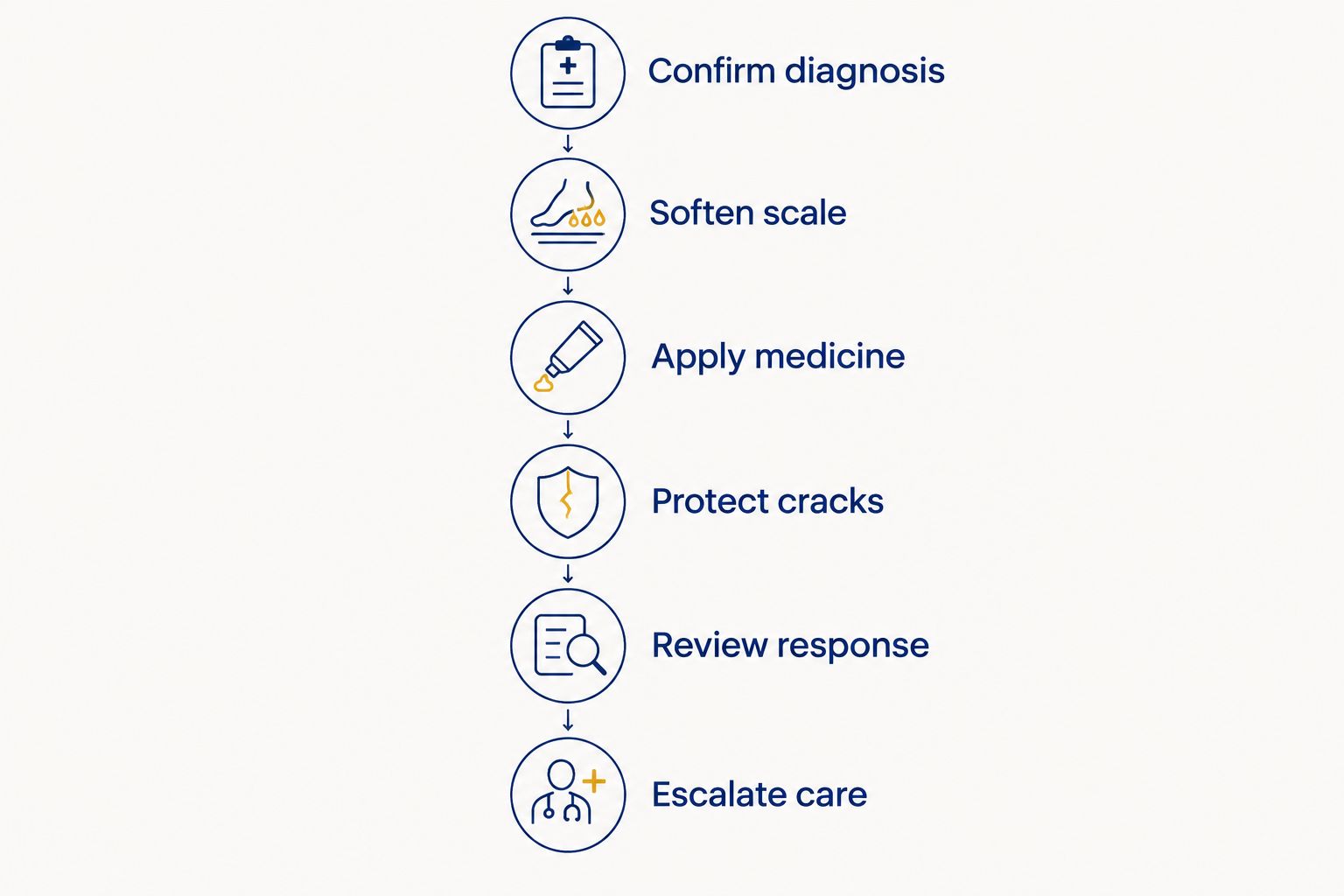
Effective plantar psoriasis treatment follows a clear sequence: confirm that the rash is psoriasis, remove excess scale safely, suppress inflammation, protect fissures and reassess the response. Do not start by cutting, peeling or aggressively filing the plaque. Damaging inflamed skin can worsen pain and create another route for infection.
1. Confirm the diagnosis
A podiatrist or dermatologist examines the distribution, borders, scale, toenails and skin between the toes. Psoriasis often affects both feet in a similar pattern, but appearance alone is not always enough. A skin scraping can check for fungus, and a biopsy can clarify an uncertain diagnosis.
Bring a list of treatments you have already tried. Also report psoriasis elsewhere on your body, nail pitting, swollen toes, morning stiffness or a history of joint pain. These details help separate isolated plantar psoriasis from disease involving the nails or joints.
2. Soften scale
A thick fragrance-free moisturizer reduces dryness and makes hard plaques more flexible. Keratolytic products containing ingredients such as salicylic acid or urea can loosen excess scale, allowing prescribed medicine to reach the inflamed skin more effectively.
Do not apply strong scale-removing products to bleeding fissures without medical direction. People with diabetes, neuropathy or poor circulation should avoid self-treating thick skin with acids or sharp tools because an unnoticed injury can become a wound.
3. Apply prescription medicine
A potent topical corticosteroid is a common first prescription for thick psoriasis on the soles. A vitamin D analog may be used with it or during maintenance, depending on the condition of the skin and the clinician's plan. The exact formulation matters because ointments are generally more occlusive than creams.
Follow the prescribed amount, frequency and duration. High-potency steroids are not indefinite daily moisturizers; prolonged or incorrect use can thin skin and cause other adverse effects. A clinician commonly reviews the response after a short course rather than allowing repeated unsupervised use.
4. Protect painful cracks
Cover clean fissures with a dressing recommended for cracked skin, then choose socks and shoes that reduce rubbing. A cushioned shoe with enough width for the forefoot can make walking more tolerable while the skin heals. Avoid footwear with an internal seam that repeatedly crosses the plaque.
Do not seal medication under plastic wrap unless your clinician specifically instructs you to do so. Occlusion increases absorption, which can make treatment more effective but also increases the risk of side effects from potent topical medicine.
5. Review the response
Take a clear photograph before treatment and compare the same area under similar lighting during follow-up. Look for less scale, fewer new cracks, reduced redness and improved comfort while standing. Improvement is not the same as a cure; psoriasis is a chronic inflammatory condition that can flare again.
In 2026, treatment review also needs to account for daily activity. A medication plan can appear ineffective when pickleball, running, long walks or golf repeatedly places friction across an unprotected plaque.
6. Escalate care when needed
If correctly used topical therapy does not control the soles, a dermatologist may consider phototherapy, oral medicine or an injectable biologic. The choice depends on severity, other affected body areas, joint symptoms, previous treatment and personal health risks. These options require medical supervision rather than trial-and-error use at home.
Plantar psoriasis treatment options compared
The right option depends on how much of the sole is affected, whether fissures are open and what previous treatment has failed. The table summarizes the main roles and trade-offs of treatments used in 2026.
| Option | Best for | Main benefit | Main limitation |
|---|---|---|---|
| Thick moisturizer | Dry, rigid plaques | Softens skin and supports the barrier | Does not control immune-driven inflammation alone |
| Keratolytic treatment | Heavy surface scale | Helps remove scale so other medicine can penetrate | Can sting or irritate open fissures |
| Prescription topical steroid | Inflamed, thick plaques | Directly suppresses inflammation | Potent products need limits and medical review |
| Vitamin D analog | Combination or maintenance treatment | Provides a nonsteroid topical option | Can irritate skin and may act more slowly |
| Phototherapy | Disease not controlled by topicals | Treats affected skin without an oral drug | Requires repeated scheduled treatment sessions |
| Systemic or biologic medicine | Severe, resistant or widespread disease | Treats the immune process beyond one plaque | Requires screening, monitoring and specialist management |
For localized plantar psoriasis, prescription topical treatment is usually the first medical step; systemic treatment is reserved for disease that justifies whole-body therapy. That decision changes if psoriasis also affects several body areas or produces inflammatory joint symptoms.
Topical treatment for localized plantar psoriasis
Topical therapy works best when each product has a defined job. Moisturizer supports the skin barrier, a keratolytic reduces scale and the prescription medicine controls inflammation. Applying several products randomly can increase irritation without improving the result.
Ask the prescriber which product goes on first and whether the medicines should be separated by time. In 2026, the safest instruction is still the one written for your specific prescription, not a routine copied from another person's psoriasis treatment.
Topical treatment has clear advantages: it targets the affected area and avoids the broader exposure associated with systemic medicine. Its main drawback is practical. The sole is difficult to treat consistently, medication can rub off inside socks, and thick plaques limit penetration.
Phototherapy for persistent plantar psoriasis
Phototherapy exposes affected skin to controlled ultraviolet light in a medical setting. It is considered when properly used topical treatment does not provide enough control or when repeated topical courses are not appropriate. A treatment schedule can involve 2 to 3 sessions per week, but the exact frequency and duration are set by the treating clinician.
Phototherapy avoids taking an oral medicine, but it requires repeated visits and consistent attendance. It also is not the right option for every skin type, medication list or history of skin cancer. Tell the treating clinician about previous skin cancers, unusual moles and medicines that increase light sensitivity.
Systemic and biologic treatment for severe disease
Oral systemic medicine and injectable biologics act on inflammation beyond the treated patch of skin. A dermatologist considers them when plantar psoriasis is severe, disabling, widespread or resistant to other treatment. Joint symptoms can also move this conversation forward because skin-only care does not address inflammatory arthritis.
These medicines have different screening and monitoring requirements. Infection history, liver health, pregnancy considerations, other medicines and vaccination status can affect selection. The benefit is stronger control of difficult disease; the disadvantage is that whole-body treatment carries risks that a moisturizer or localized topical does not.
Painful feet plus swollen joints, prolonged morning stiffness or a toe that becomes diffusely swollen deserves evaluation for foot pain associated with psoriatic arthritis. Skin improvement does not automatically confirm that joint inflammation is controlled.
Why plantar psoriasis treatment varies
Several factors determine how quickly the soles respond and whether the first plan works:
- Diagnostic accuracy: Antifungal medicine will not control psoriasis, while a steroid can mask or worsen an untreated fungal infection.
- Plaque thickness: Heavy scale blocks topical medicine from reaching inflamed skin efficiently.
- Open fissures: Cracks increase pain, limit which products are tolerable and create a wound-care concern.
- Daily pressure: Standing, walking and sports repeatedly stress the same weight-bearing skin.
- Sweat and friction: Damp socks and tight footwear can irritate plaques and soften damaged skin excessively.
- Treatment consistency: Topicals cannot work as prescribed when they are skipped or rubbed off immediately.
- Other psoriasis involvement: Nail changes, widespread plaques or joint symptoms can justify a broader treatment plan.
In Southwest Florida, heat, perspiration and year-round activity make footwear management part of plantar psoriasis treatment. Change damp socks, let shoes dry between uses and check the sole after golf, running or pickleball. Stop an activity when a fissure begins bleeding rather than pushing through it.
Naples Podiatrist evaluates plantar psoriasis in the context of how the foot bears weight. That matters when pain comes from both inflamed skin and a separate mechanical problem, such as pressure concentrated beneath the heel or forefoot.
Have painful soles examined
Get quick access to a foot and ankle specialist at a Southwest Florida location.
Is plantar psoriasis the same as athlete's foot?
No. Plantar psoriasis is an inflammatory disease, while athlete's foot is a fungal infection. Both can produce redness, scaling and itching, so a clinician may perform a scraping before prescribing treatment.
Athlete's foot commonly affects the spaces between the toes or creates a powdery scale along the sole, but its appearance varies. Psoriasis can produce sharply bordered plaques and may occur with psoriasis elsewhere, nail pitting or joint symptoms. Do not use appearance as the only test; review the differences between home and prescription athlete's foot treatment if an antifungal has already failed.
Can plantar psoriasis be mistaken for a callus or wart?
Yes. A callus forms from repeated pressure, a plantar wart is caused by a virus, and plantar psoriasis results from immune-driven inflammation. All 3 can create thick skin on the sole, but they require different treatment.
Avoid shaving the area or applying wart-removal acid until the diagnosis is clear. Wart products can injure inflamed or fissured skin, while filing a psoriasis plaque can trigger bleeding and additional irritation.
When does plantar psoriasis require urgent care?
Plantar psoriasis requires prompt medical care when a crack becomes increasingly red, warm, swollen, draining or painful, or when redness spreads beyond the original plaque. Fever or rapidly worsening symptoms also require immediate assessment because they can indicate infection rather than a routine psoriasis flare.
The threshold is lower if you have diabetes, neuropathy, poor circulation or an immune-suppressing condition. In 2026, any new open foot wound in a high-risk patient should be examined rather than managed solely with moisturizer and a bandage.
FAQ
What is the best plantar psoriasis treatment?
The best plantar psoriasis treatment for localized disease usually combines skin-barrier care with prescription topical anti-inflammatory medicine. Phototherapy or systemic medicine is considered when the soles remain severe or resistant.
Can plantar psoriasis go away permanently?
Plantar psoriasis can clear, but treatment does not guarantee a permanent cure. Maintenance skin care and early treatment of new flares help limit cracking and pain.
Should I peel thick psoriasis skin from my feet?
No, you should not peel or cut thick psoriasis plaques from your feet. Pulling attached scale can cause bleeding, worsen inflammation and create an opening for infection.
Can I put moisturizer on plantar psoriasis?
Yes, a thick fragrance-free moisturizer can soften plaques and support the damaged skin barrier. Moisturizer helps dryness but usually does not replace prescription treatment for active inflammation.
Can a podiatrist diagnose plantar psoriasis?
A podiatrist can evaluate plantar psoriasis and rule out common foot conditions that resemble it. Dermatology involvement may be needed for biopsy, phototherapy or systemic treatment.
Does plantar psoriasis cause foot pain?
Yes, plantar psoriasis can cause pain when thick plaques split or when inflamed skin bears weight. Pain can become worse during walking, running, golf or pickleball.
Is it safe to exercise with plantar psoriasis?
Exercise is reasonable when the skin is intact and activity does not increase pain or cracking. Stop and have the foot checked if a fissure bleeds, drains or becomes increasingly red.
How do I know whether a cracked sole is infected?
Increasing redness, warmth, swelling, drainage, odor or worsening pain can indicate infection. Spreading redness, fever or an open wound in a person with diabetes requires prompt medical assessment.
One last thing
Do not judge plantar psoriasis treatment only by how the plaque looks. A useful 2026 treatment plan also reduces cracking, restores comfortable walking and lets you return to normal activity without reopening the skin. Naples Podiatrist offers 24/7 phone access for appointment scheduling at 239-430-3668 when painful fissures or an uncertain rash need specialist attention.
Related guides
- How to tell whether a diabetic foot wound is infected
- What to expect at your first podiatrist appointment
- Plantar warts versus calluses