
 Fax: (239) 692-9436
 Tel: 239-430-3668
Kohler's disease treatment in children is nonsurgical in almost every case: a short-leg cast or CAM boot for 4 to 8 weeks, followed by an arch-supporting shoe or custom orthotic while the navicular bone reshapes itself over 6 to 24 months. The catch parents miss: the limp can linger for weeks after the cast comes off, and pulling a child back into sports too early is the most common reason the pain flares a second time.
- Kohler’s disease treatment is conservative in nearly every child: casting for 4-8 weeks, then orthotic support for months.
- The navicular bone typically re-ossifies and returns to normal shape within 6 to 24 months without surgery.
- Boys are affected roughly four to five times more often than girls, usually between ages 3 and 7.
- Surgery is reserved for the rare child whose pain and bone collapse don’t respond to casting and orthotics.
- A limping toddler with midfoot tenderness and no injury history is the classic presentation podiatrists look for.
Why this matters
Kohler's disease is avascular necrosis of the navicular, the small bone on top of the midfoot that connects the ankle to the arch. Blood supply to that bone temporarily drops in young children, the bone softens and flattens on X-ray, and the child develops a limp or refuses to bear weight normally on one side.
Parents often assume a limp with no fall or injury means growing pains or a sprain that will pass in a few days. Kohler's disease doesn't work that way — untreated, the limp and midfoot tenderness can persist for months, and a child who keeps running on an unprotected navicular risks a slower recovery. A board-certified podiatrist who sees the limp early can confirm the diagnosis on X-ray and start immobilization before the bone collapses further.
How is Kohler's disease treated in children?
Treatment follows the severity of the collapse seen on X-ray and how long the limp has been present. Most kids move through two phases: protected immobilization, then a transition period in supportive footwear while the bone rebuilds.
| Approach | What it involves | Typical duration | Best for |
|---|---|---|---|
| Short-leg cast or CAM boot | Immobilization to take pressure off the navicular | 4 to 8 weeks | Children with a limp, midfoot tenderness, or visible flattening on X-ray |
| Custom orthotic or arch support | Rigid or semi-rigid insert worn inside regular shoes | 6 to 24 months while the bone reforms | Milder cases, or the phase right after cast removal |
| Surgery | Bone grafting or fixation (uncommon) | Case by case | Persistent collapse or pain that doesn't respond after extended conservative care |
Most children never reach the surgery row. A short course of casting followed by months in supportive shoes resolves Kohler's disease in the overwhelming majority of cases, and the navicular typically returns to a normal shape as the child grows.
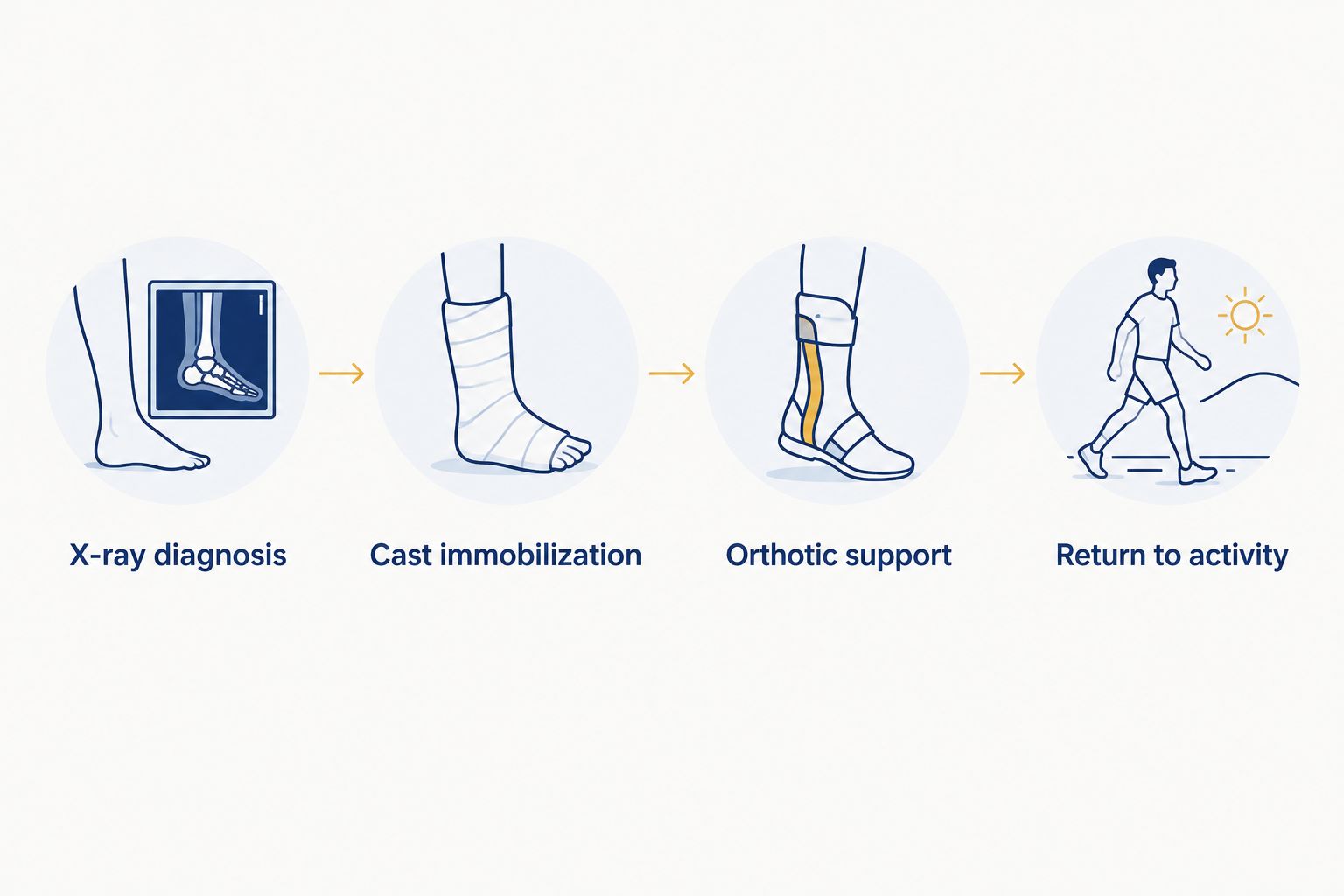
Cast immobilization: 4 to 8 weeks
A short-leg walking cast or a removable CAM boot is the first step once X-rays confirm navicular flattening. The goal is simple: take repetitive pressure off the bone so blood flow can recover and the navicular can reform without further collapse.
Most podiatrists re-check the foot at the 4-week mark and extend to 6 or 8 weeks if the child still limps when weight-bearing. Kids tolerate this phase well — the boot version lets them shower and sleep without the cast, though compliance matters more with a removable device than a fixed cast.
Orthotic and shoe support: 6 to 24 months
Once the cast comes off, a custom orthotic or a firm arch-supporting shoe insert protects the healing bone during the longer remodeling window. This phase runs anywhere from 6 months to 2 years depending on how advanced the collapse was at diagnosis.
Parents frequently stop here too soon because the limp is gone. The bone is still remodeling on X-ray well after the visible limp resolves, and a custom orthotic built for a growing foot keeps pressure evenly distributed while that finishes.
Surgery: rarely needed
Surgical intervention for Kohler's disease is uncommon and reserved for the child whose pain and functional limp persist well past the expected remodeling window, or whose imaging shows the navicular isn't reforming with conservative care. Surgery is not the standard first move for Kohler's disease — it's the fallback when casting and orthotics genuinely fail, which is unusual in a condition that's self-limiting by nature.
Why Kohler's disease treatment length varies
- Stage at diagnosis — a child caught early with mild flattening heals faster than one diagnosed after months of unexplained limping.
- Age at onset — younger children (ages 3-5) generally have more remodeling potential left than kids diagnosed closer to age 7-8.
- Compliance with immobilization — a child who stays off the cast or removes the boot early risks a longer overall course.
- Activity level — kids who return to running, soccer, or gymnastics before the orthotic phase is complete are more likely to see symptoms return.
- Coexisting flatfoot — a child with an already-flexible or flat arch may need orthotic support longer than one with a neutral arch structure.
- How the limp is initially misread — cases mistaken for a sprain or growing pains lose weeks before immobilization even starts.
Get the Limp Checked This Week
Same-day pediatric foot appointments across Southwest Florida, ages toddler through teen.
Does Kohler's disease go away on its own?
Kohler's disease resolves on its own in the sense that the navicular bone naturally re-ossifies as the child grows, typically within 6 to 24 months, but "on its own" doesn't mean untreated. Skipping the cast phase lets the child keep loading a softened bone, which can prolong the limp and the pain well past that window. Treatment shortens the painful, limping phase — it doesn't replace the body's own healing process, it protects it.
Is Kohler's disease the same as Freiberg's disease?
No — Kohler's disease affects the navicular bone in the midfoot of young children (ages 3-7, mostly boys), while Freiberg's disease affects the second metatarsal head in the ball of the foot and typically shows up in adolescent girls. Both are forms of osteonecrosis affecting a growing bone, and both respond primarily to activity modification and offloading rather than surgery.
Can a child still walk with Kohler's disease?
Yes, most children with Kohler's disease can still walk, just with a visible limp and a tendency to favor the outer edge of the foot to avoid pressure on the navicular. That limp — without a clear injury, fall, or fever — is usually the first sign parents notice, and it's the reason an X-ray gets ordered in the first place.
FAQ
What age does Kohler’s disease usually affect?
Kohler’s disease usually affects children between ages 3 and 7, with boys diagnosed roughly four to five times more often than girls. Symptoms outside that age range are less common but not impossible.
How long does Kohler’s disease last?
Kohler’s disease typically resolves within 6 to 24 months from diagnosis to full bone remodeling, though the painful limping phase is usually much shorter once casting starts. The exact timeline depends on how advanced the navicular collapse was at diagnosis.
Does Kohler’s disease require an X-ray to diagnose?
Yes, an X-ray showing a flattened or fragmented navicular bone is how Kohler’s disease is confirmed in 2026, since the limp alone looks like several other pediatric foot conditions. A podiatrist compares the shape and density of the bone to what’s expected for the child’s age.
Is Kohler’s disease painful?
Kohler’s disease causes tenderness and swelling over the top of the midfoot, along with a limp, though pain intensity varies from mild to significant depending on the stage of bone collapse. Direct pressure on the navicular during a physical exam is a key diagnostic clue.
Can Kohler’s disease come back after treatment?
Kohler’s disease itself doesn’t typically recur once the navicular has fully remodeled, but symptoms can flare again if a child returns to high-impact activity before the orthotic support phase is finished. That’s why the 6-to-24-month follow-through matters as much as the initial cast.
Does Kohler’s disease affect both feet?
Kohler’s disease is usually unilateral, affecting one foot rather than both, though bilateral cases do occur. A limp that’s clearly one-sided is one of the details that points a podiatrist toward this diagnosis over a bilateral condition like flat feet.
What happens if Kohler’s disease is left untreated?
Left untreated, Kohler’s disease can prolong the limping phase and increase the risk of the navicular collapsing further before it has a chance to reform. Most children still recover long-term, but the painful window and the chance of lasting midfoot discomfort both increase without immobilization.
One last thing
Kohler's disease was first described by German radiologist Alban Köhler in 1908, and more than a century later the treatment hasn't fundamentally changed: protect the bone, let it remodel, don't rush the return to sports. The detail that trips up most parents in 2026 isn't the cast — it's stopping the orthotic phase the moment the limp disappears, when the X-ray often shows the navicular is still mid-repair for months afterward.
Related guides
- Sever's disease: heel pain in active kids and teens
- Flat feet in children: when to see a podiatrist
- Freiberg's disease: ball of foot pain in young women
- Custom orthotics for children with flat feet

