
 Fax: (239) 692-9436
 Tel: 239-430-3668
Cellulitis of the foot and lower leg is a bacterial skin infection that spreads fast, and the right cellulitis of the foot treatment depends on how far it has already traveled by the time you're seen.
- Cellulitis of the foot treatment is oral antibiotics for 5 to 10 days when caught early and uncomplicated.
- Fever, rapid spread, or diabetes move treatment to IV antibiotics and possible hospital admission.
- Improvement should start within 48 hours on the right antibiotic, or the drug needs to change.
- Naples Podiatrist sees foot and ankle infections same-day across Naples, Fort Myers, and Sarasota.
Why this matters
Cellulitis doesn't stay put. The bacteria involved, usually Staphylococcus or Streptococcus, enter through a cut, blister, crack, or an infected diabetic foot wound, and the skin turns red, warm, swollen, and tender within a day.
In 2026, primary care offices and urgent care clinics are still the first stop for most patients, but a foot or lower leg infection is a podiatric problem first: the drainage patterns, nerve involvement, and swelling in that part of the body behave differently than cellulitis on an arm or torso. Waiting to see whether it clears on its own is the single biggest reason mild cases turn into hospital admissions.
Mid-life and senior patients carry the highest stakes here. A blister from new pickleball shoes, a scrape from yard work, or a crack that develops after months of daily walking on Naples beaches all count as entry points, and diabetes or reduced circulation becomes more common with age. That combination, an active lifestyle plus slower healing, is exactly why cellulitis shows up disproportionately in patients over 50.
Most mild cases of foot or lower leg cellulitis clear up with a 5 to 10 day course of oral antibiotics such as cephalexin, along with elevation and marking the edge of the redness so you can track whether it's spreading. Cellulitis with fever, chills, redness that outpaces the marked line, or that shows up in someone with diabetes, poor circulation, or a weakened immune system needs IV antibiotics and often admission until the infection is clearly retreating. Ice, rest, and over-the-counter pain relievers ease the discomfort but do nothing to clear the bacteria itself. The catch most people miss: cellulitis can look stable on the surface while spreading underneath, especially in a foot with reduced sensation from neuropathy, so a follow-up exam matters as much as the first antibiotic dose.
How is cellulitis of the foot and lower leg treated?
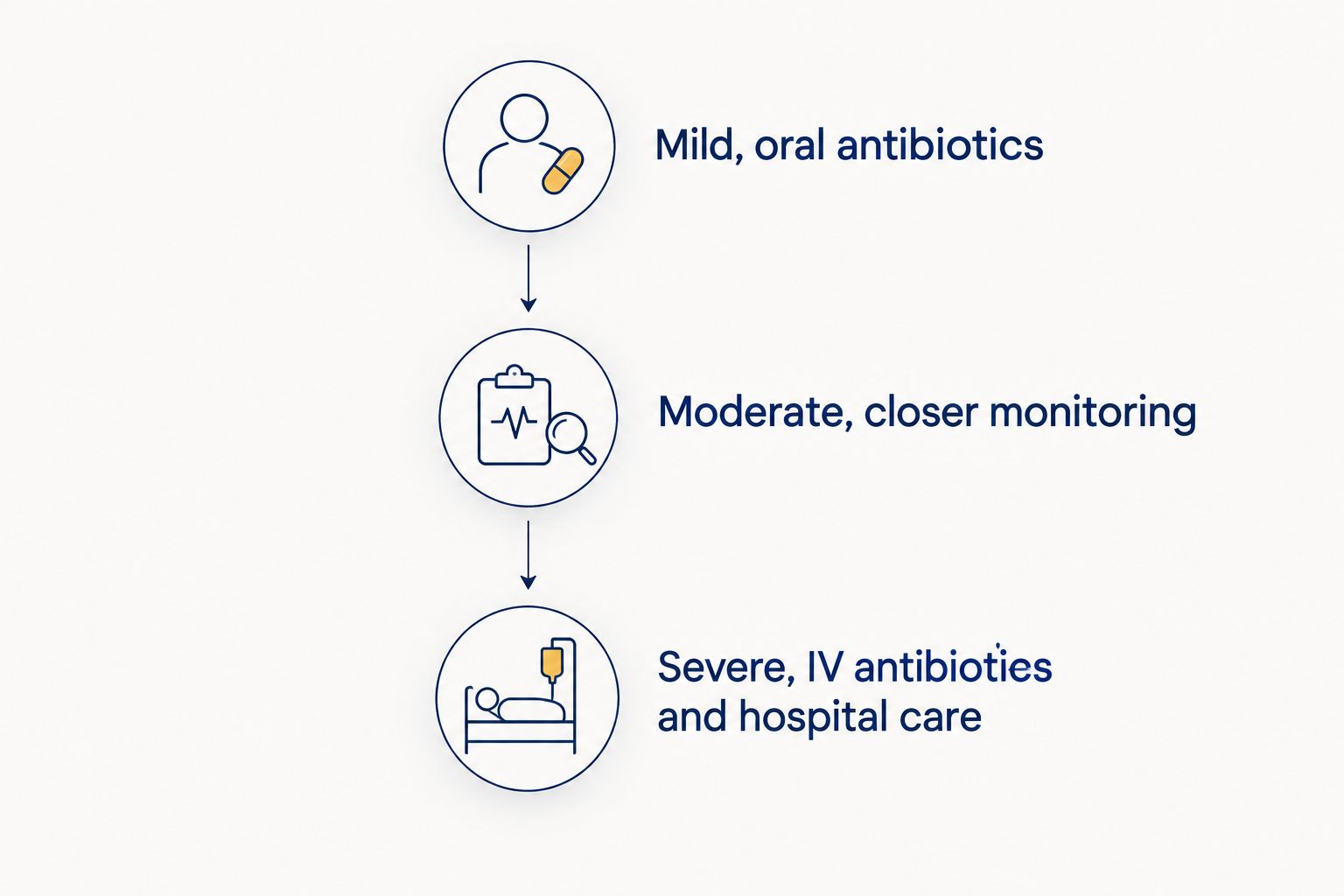
Treatment scales with severity, and getting placed in the right tier on day one is what keeps a foot infection from becoming a hospital stay.
| Severity | Typical treatment | Setting | Duration |
|---|---|---|---|
| Mild | Oral antibiotics (cephalexin or similar) | Outpatient | 5-10 days |
| Moderate | Oral or IV antibiotics, close monitoring | Outpatient or short admission | 7-14 days |
| Severe, diabetic, or PAD | IV antibiotics plus wound care | Hospital admission | 10-14 days or longer |
The table shows the general pattern. An individual case can move between tiers within 24 hours if the redness spreads or a fever develops, which is why a same-day exam matters more for cellulitis than for almost any other foot condition. Naples Podiatrist schedules a recheck at the midpoint of each antibiotic course specifically to catch a case that needs to move up a tier before it becomes an emergency.
Mild cellulitis: 5 to 10 days of oral antibiotics
A mild case, redness confined to one area, no fever, no red streaking, responds to a 5 to 10 day course of an oral antibiotic like cephalexin or clindamycin. Elevating the leg above heart level for stretches through the day reduces swelling and helps the antibiotic work faster, and marking the border of the redness with a pen lets you and your doctor see at a glance whether it's shrinking or growing.
Picture a pickleball player who nicks a toe sliding for a ball and skips cleaning it for a day; by evening the toe and forefoot are red, warm, and mildly swollen. That's a textbook mild case, and a same-day exam confirms it needs nothing beyond the oral course above.
Improvement should be visible within 48 hours. If the redness is still spreading past the mark at that point, the antibiotic isn't working and needs to change, not just continue.
Moderate cellulitis: closer monitoring, sometimes a short hospital stay
Moderate cases sit between the two extremes: redness spreading despite antibiotics, swelling tight enough to shine the skin, or drainage from the original wound. These get a longer oral course of 7 to 14 days or a switch to IV antibiotics given at a clinic or during a short hospital stay, with a recheck every 24 to 48 hours until the trend is clearly downward.
A cracked heel that's been ignored through Florida's dry season is a common moderate-tier starting point: swelling climbs the ankle overnight, and the redness border moves noticeably between morning and evening checks. Patients over 65 or on blood thinners tend to get watched more closely at this stage, since skin healing slows with age and bruising can mask how far the infection has actually moved.
Severe cellulitis with diabetes or poor circulation: IV antibiotics until it turns around
Cellulitis in a foot affected by diabetes or peripheral arterial disease gets treated more aggressively, because reduced blood flow means antibiotics reach the infection slower even when the drug is working. IV antibiotics run for 10 to 14 days in these cases, sometimes longer, with hospital staff tracking the leg's circumference and the border of redness daily to confirm it's shrinking rather than just changing color.
In 2026, Southwest Florida podiatry practices increasingly co-manage these cases with primary care and vascular specialists from day one instead of waiting for a plateau. A foot with poor circulation that doesn't respond to IV antibiotics within 48 to 72 hours is a candidate for tissue loss, and that window is why diabetic patients get watched harder than anyone else.
What happens at a same-day cellulitis exam
A same-day exam for a red, warm foot or leg starts with tracing the exact border of the redness with a pen so any spread over the next 24 hours is obvious. The doctor checks pulses at the ankle and foot to rule out reduced circulation, looks for the entry wound, and takes your temperature and heart rate to screen for a systemic infection.
In a diabetic or higher-risk patient, that same visit often includes bloodwork or imaging to check whether the infection has reached bone or a deep space in the foot. The antibiotic, oral or IV, typically starts before you leave, because every hour cellulitis goes untreated makes the eventual course longer.
Why cellulitis treatment varies
A handful of factors decide which tier a case lands in, and they matter more than how bad the redness looks on day one:
- How far the redness has spread past the marked line before antibiotics start
- Fever, chills, or a rapid heart rate signaling the infection has reached the bloodstream
- Diabetes or peripheral arterial disease slowing blood flow to the infected area
- A weakened immune system from chemotherapy, steroids, or another chronic condition
- Whether the entry wound, cut, blister, crack, or ulcer, is still open and draining
- How the skin responds to the first antibiotic within the first 48 hours
For patients already managing diabetes or a slow-healing wound, cellulitis rarely shows up alone. Naples Podiatrist treats the infection and the underlying wound at the same visit, coordinating wound care for diabetic foot ulcers so redness from cellulitis doesn't get mistaken for a wound that's simply healing slowly. That combined approach cuts the back-and-forth between a primary care office and a specialist while the infection clock is running.
Is cellulitis of the foot and lower leg an emergency?
Cellulitis becomes an emergency when it comes with a fever, red streaking running up the leg, confusion, or swelling that visibly worsens within a few hours, all signs the infection has reached the bloodstream. Without those signs, urgent same-day care rather than an ER visit is usually the right call, and getting seen within that first day is what keeps the case in the mild tier.
How do you tell cellulitis from a blood clot in the leg?
Cellulitis causes warm, red, tender skin that spreads outward from a visible entry point, while a blood clot in the leg usually causes one-sided swelling and deep aching pain without that spreading redness pattern. The two can look similar in the first few hours, which is why a same-day exam, not a guess based on symptoms alone, decides the right treatment.
Can cellulitis come back after treatment clears it?
Yes, cellulitis can return in the same leg, most often because the original entry wound reopens or chronic swelling left over from the first infection never fully drains. Compression, daily foot checks, and treating cracked skin or athlete's foot promptly are the practical ways to cut that risk, and lingering swelling after a first episode is worth mentioning at the next visit.
Get same-day care for foot cellulitis
Same-day 2026 scheduling for foot and ankle infections across Southwest Florida.
FAQ
What is the fastest way to treat cellulitis of the foot?
Starting oral antibiotics within 24 hours of the first red, warm patch is the fastest path to clearing cellulitis of the foot, usually within 5 to 10 days. Waiting past the first day of visible spread is what pushes mild cases into IV antibiotics.
Can you treat cellulitis of the foot without antibiotics?
No, cellulitis of the foot is a bacterial infection and needs antibiotics; soaking, elevation, and rest only support the antibiotic, they don’t replace it. Untreated cellulitis can progress to a deeper infection of muscle or bone within days.
How long does cellulitis of the lower leg take to heal?
Cellulitis of the lower leg typically shows noticeable improvement within 48 hours of the right antibiotic and clears fully in 5 to 10 days for mild cases, or 10 to 14 days for severe cases treated with IV antibiotics. In 2026, standard antibiotic protocols remain consistent with prior years, so these timelines still hold.
Is cellulitis of the foot contagious?
Cellulitis itself isn’t contagious since the bacteria are already inside the skin, but the entry wound, a cut, blister, or crack, can carry bacteria that spread to others through direct contact. Standard wound hygiene is enough to prevent spread to family members.
When should you go to the ER for cellulitis of the foot?
Go to the ER for cellulitis of the foot if you have a fever above 101 degrees, red streaking moving up the leg, confusion, or swelling that doubles within a few hours. These signs point to the infection moving into the bloodstream or deeper tissue.
Does cellulitis of the foot leave permanent damage?
Most cellulitis of the foot resolves without permanent damage when treated within the first few days, but delayed treatment in diabetic feet or feet with poor circulation can lead to skin thickening, lymphedema, or tissue loss. Recurrent cellulitis in the same leg is the strongest predictor of long-term swelling.
What’s the difference between cellulitis and a plain skin infection?
Cellulitis specifically means the infection has moved past the skin’s surface into the deeper dermis and tissue below, causing spreading redness and warmth rather than a localized pimple or boil. A localized infection stays contained; cellulitis expands outward from the entry point.
One last thing
Pickleball, golf, and running keep Southwest Florida seniors moving through their 60s, 70s, and beyond, but each sport comes with its own blister and skin-break risk: a new court shoe, a wet golf glove rubbing against a heel, a running shoe that's gone soft in the humidity. None of that is a reason to stop playing. It's a reason to treat a break in the skin the same day it appears instead of waiting to see if it heals on its own.
Southwest Florida's heat and humidity in 2026 keep skin softer and cracks more common, which is exactly the opening cellulitis bacteria need. Warm coastal water adds another wrinkle: cuts exposed to brackish water or saltwater carry a small risk of picking up more aggressive organisms, including the flesh-eating bacteria that occasionally turn up in Florida waters. That's a different, faster-moving infection than standard cellulitis, and it's why any foot wound that reddens and spreads after time in the water gets checked the same day rather than watched overnight.

