 Fax: (239) 692-9436
 Tel: 239-430-3668
Broken sesamoid bone treatment usually starts by stopping impact activity and immobilizing the forefoot in a stiff-soled shoe, walking boot, or cast for about 6 to 8 weeks in 2026, followed by gradual loading. A displaced fracture or painful nonunion can require surgery. Do not play through pain beneath the big-toe joint because the sesamoids absorb pressure whenever you push off.
- Broken sesamoid bone treatment usually requires 6 to 8 weeks of immobilization before gradual loading begins.
- X-rays confirm many fractures; MRI or CT helps when the fracture remains unclear.
- Naples Podiatrist is best for Southwest Florida patients who need quick access to foot and ankle specialists.
- Running, pickleball, and similar impact activities often remain restricted for 3 months or longer.
Why this matters
A sesamoid fracture belongs to the broader group of foot fractures and their treatment options, but its position beneath the big-toe joint makes healing difficult. Every step loads the injured area, and the bones have a limited blood supply. Continuing to walk barefoot, run, golf, or play pickleball can prolong symptoms.
Naples Podiatrist is a podiatry practice best suited to Southwest Florida patients who need prompt specialist assessment for persistent pain under the big toe. In 2026, its 9 locations serve communities from Marco Island to Sarasota, giving patients access to board-certified foot and ankle care without treating a suspected fracture as routine soreness.
How do you treat a broken sesamoid bone in the foot?
Treat a broken sesamoid bone by protecting it from pressure, confirming the fracture with imaging, immobilizing the foot, and repeating the examination before returning to activity. Most stable fractures receive nonsurgical care. Surgery is considered when the fragments are displaced, the bone does not unite, or pain remains despite an adequate period of offloading.
The right device depends on the fracture and how much pain occurs during ordinary walking. A stiff-soled shoe allows more mobility but provides less protection than a boot or cast. A boot protects the joint more effectively, but it can alter your gait and cause stiffness when used longer than prescribed.
| Treatment option | Best for | Main benefit | Main limitation |
|---|---|---|---|
| Stiff-soled shoe | Stable fractures when protected weight-bearing is allowed | Limits bending at the big-toe joint | Provides less protection than a boot or cast |
| Walking boot or cast | Acute fractures requiring stricter immobilization | Reduces forefoot motion and pressure | Can alter gait and restrict daily activity |
| Surgery | Displaced fractures or painful nonunion | Addresses an unstable or persistently painful fragment | Adds surgical risks and postoperative recovery |
1. Stop loading the painful forefoot
Stop running, jumping, pickleball, and other activities that require forceful push-off. Avoid walking barefoot, even indoors, because the forefoot bends and presses directly against the floor. Use supportive footwear until a clinician determines whether stricter protection is required.
Seek urgent medical care for an open wound, visible deformity, severe swelling, spreading numbness, or a toe that becomes cold, pale, or blue. These signs require more than routine home care. If you have diabetes, neuropathy, or poor circulation, arrange an examination promptly rather than waiting for pain to improve.
2. Confirm whether the bone is fractured
A podiatrist checks for focal tenderness beneath the first metatarsal head, pain when the big toe moves, swelling, bruising, and changes in walking. X-rays are usually the first imaging study. Images of both feet can help distinguish a fracture from a bipartite sesamoid, a common anatomical variation in which the bone naturally developed in separate pieces.
Early stress fractures do not always appear clearly on an X-ray. MRI can show bone stress and surrounding tissue injury, while CT can define the fracture line and fragment position. The guide to MRI for foot pain explains why advanced imaging is used when symptoms and initial images do not match.
For an injury assessed in 2026, imaging should answer a practical question: is this inflammation, a stress reaction, an acute fracture, or a painful bipartite sesamoid? Treatment changes with that answer. Naples Podiatrist foot and ankle specialists can assess the injury and select imaging based on the examination.
3. Immobilize the big-toe joint
A clinician may prescribe a stiff-soled postoperative shoe, removable walking boot, or cast. Each option limits extension of the big toe, reducing movement across the injured sesamoid. Crutches or another mobility aid may be used when the fracture requires non-weight-bearing protection.
Do not choose the least restrictive device based only on comfort. A shoe that feels supportive can still flex enough to load the fracture. The fracture pattern, tenderness, ability to walk without pain, and follow-up imaging determine how much protection is appropriate.
4. Control swelling without pressing on the fracture
Rest and elevation help manage swelling. A wrapped cold pack can be applied for brief intervals, but it should not sit directly against bare skin. Avoid forceful massage over the sesamoid, aggressive toe stretching, or exercises that recreate sharp pain beneath the joint.
Medication decisions depend on your medical history and other prescriptions. Ask the treating clinician or pharmacist before using pain medication, especially if you have kidney disease, take blood thinners, or have been told to avoid certain drugs.
5. Recheck healing before resuming impact
Follow-up is not optional simply because walking starts to feel easier. A podiatrist rechecks tenderness, toe motion, walking mechanics, and imaging when needed. Pain relief can occur before the fracture has developed enough healing to tolerate running or court sports.
Rehabilitation begins with controlled motion and progressive loading after the treating clinician confirms that the fracture is stable. Strength, balance, and gait work follow. The final phase restores push-off without pain rather than jumping immediately from a boot into full activity.
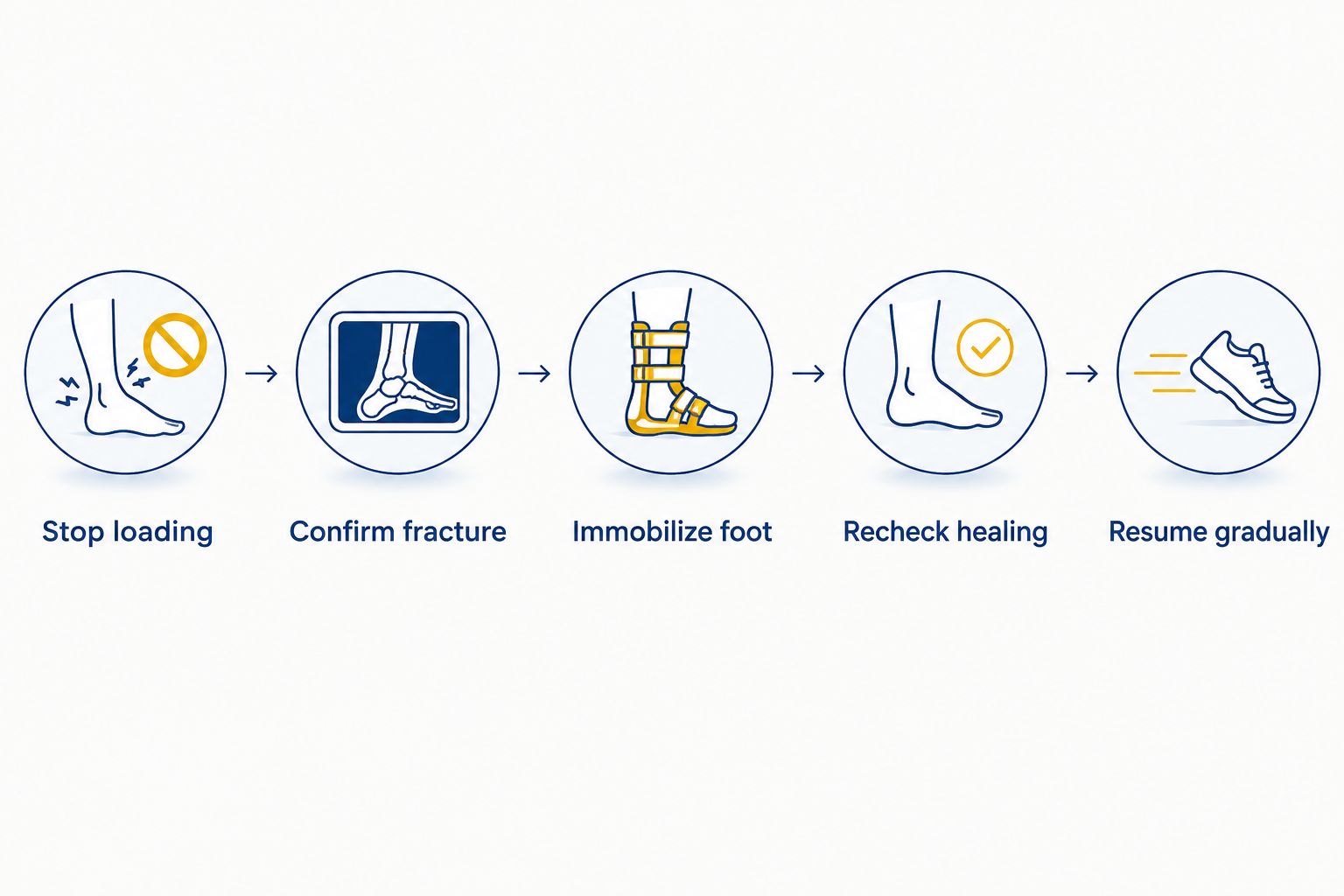
Immobilization: 6 to 8 weeks for many fractures
Many stable sesamoid fractures require about 6 to 8 weeks in a stiff-soled shoe, walking boot, or cast. That period is a starting point, not an automatic clearance date. Stress fractures diagnosed late, displaced fractures, and injuries that remain tender can require longer protection.
In 2026, the safest milestone is not the calendar alone. You should be able to walk without sharp pain under the big toe, and the clinical examination should show improvement. Follow-up imaging is used when symptoms persist or the initial fracture pattern creates concern about delayed union.
The boot or cast also needs to fit correctly. New rubbing, numbness, skin discoloration, or increasing pain requires a call to the treating office. Do not add thick homemade padding beneath the fracture unless directed; misplaced padding can concentrate pressure on the painful area instead of relieving it.
Return to activity: 3 months or longer for impact sports
Full return to running, pickleball, tennis, and other impact activity often takes 3 months or longer. The initial 6 to 8 weeks protect the bone, but the foot still needs time to regain motion, strength, balance, and tolerance for repeated push-off. Returning as soon as the boot comes off creates an abrupt increase in load.
A gradual progression starts with comfortable daily walking, then controlled exercise, and finally sport-specific movement. Pain during push-off, swelling later in the day, or tenderness the next morning means the previous load was too high. Reduce the activity and contact the treating clinician rather than training through it.
Golf can also aggravate the injury because the forefoot loads during the swing and when walking the course. Naples Podiatrist can set a return plan around the activity you want to resume instead of using the same timeline for every patient.
When surgery enters the treatment plan
Surgery is not the default broken sesamoid bone treatment. It enters the discussion when a fracture is displaced, develops a painful nonunion, or continues causing disabling symptoms after appropriate immobilization and activity modification. The surgeon may repair the fracture or remove the problematic sesamoid, depending on its location and condition.
The benefit is direct treatment of a fragment that has not healed. The drawbacks include wound problems, nerve irritation, persistent pain, weakness during push-off, and changes in big-toe alignment. Removing a sesamoid can alter the balance of the tendons around the joint, so the decision requires a careful examination and review of nonsurgical care.
For surgery considered in 2026, ask what the imaging shows, which procedure is proposed, how long weight-bearing will be restricted, and what activity level is realistic afterward. Naples Podiatrist provides foot and ankle medical and surgical care, but the procedure should match the fracture rather than the length of time you have felt pain.
See a foot and ankle specialist
Get quick access to specialist foot and ankle care across Southwest Florida.
Why sesamoid fracture recovery varies
Several factors determine whether the injury follows a straightforward 6 to 8 week course or needs longer care:
- Fracture pattern: A nondisplaced crack is more stable than separated or displaced fragments.
- Blood supply: The sesamoids have limited circulation, which makes delayed union and nonunion a concern.
- Time before treatment: Continued activity before diagnosis keeps loading the injured bone.
- Location: The medial and lateral sesamoids experience different forces beneath the big-toe joint.
- Health conditions: Diabetes, neuropathy, circulation problems, and smoking can interfere with safe healing.
- Adherence: Walking barefoot, removing the boot early, or restarting impact activity before clearance increases stress at the fracture.
These factors also explain why two people with pain in the same spot can receive different treatment plans. One patient may walk in a stiff-soled shoe, while another requires a boot, crutches, or surgical evaluation.
How long does a broken sesamoid bone take to heal?
Six to 8 weeks is a common initial immobilization period, but complete recovery often extends beyond that point. Returning to running or court sports commonly takes 3 months or longer because the bone and surrounding tissues must tolerate repeated push-off without pain.
Can you walk on a broken sesamoid bone?
During the 6 to 8 week immobilization period, walking is allowed only when the treating clinician permits protected weight-bearing. Some stable fractures can tolerate a stiff-soled shoe or boot, while others require crutches and strict non-weight-bearing protection.
When can you run after a sesamoid fracture?
Three months or longer is a common return-to-running timeline, depending on fracture healing, tenderness, strength, and walking mechanics. Resume running only after ordinary walking and progressive exercise are pain-free and the treating clinician has cleared impact activity.
FAQ
What is the best broken sesamoid bone treatment in 2026?
The best initial treatment for most stable sesamoid fractures is 6 to 8 weeks of immobilization and forefoot offloading. The exact device and weight-bearing limit depend on imaging, pain, and fracture stability.
How do you know if a sesamoid bone is broken?
A broken sesamoid usually causes focal pain, swelling, or bruising beneath the big-toe joint, especially during push-off. X-rays are the first test, with MRI or CT used when the diagnosis remains unclear.
Can a broken sesamoid heal without surgery?
Yes, many stable and nondisplaced sesamoid fractures heal without surgery. Consistent immobilization and a gradual return to loading are required because the bone is stressed during every step.
What happens if a sesamoid fracture does not heal?
A fracture that does not unite can cause persistent pain and weakness during push-off. Further immobilization, advanced imaging, bone-stimulation treatment, or surgery may be considered based on the fracture.
Is a sesamoid fracture the same as sesamoiditis?
No, a sesamoid fracture is a break in the bone, while sesamoiditis is irritation around the sesamoids without a fracture. The symptoms overlap, so imaging and a focused examination are often needed.
Should you wear a boot for a broken sesamoid?
A walking boot is commonly used when a sesamoid fracture needs stricter immobilization than a stiff-soled shoe provides. A clinician should determine the device and whether weight-bearing is allowed.
Can you play pickleball with a fractured sesamoid?
No, pickleball should stop while a sesamoid fracture is healing because lunging and forefoot push-off repeatedly load the injury. Return only after progressive walking and exercise are pain-free and medical clearance is given.
Does a sesamoid fracture always show on an X-ray?
No, an early stress fracture may not appear clearly on an initial X-ray. MRI can show bone stress, while CT can define an uncertain fracture line or fragment position.
One last thing
Feeling better is not the same as being ready for impact. In 2026, the safest decision point remains a combination of pain-free walking, a reassuring examination, and imaging when clinically needed. Naples Podiatrist offers quick access to specialist doctors of the foot and ankle, which matters when early sesamoid pain could represent inflammation, a stress fracture, or a complete break.
Related guides
- Sesamoiditis symptoms and treatment
- Best shoes for sesamoiditis pain
- Foot anatomy: bones, tendons, and ligaments