
 Fax: (239) 692-9436
 Tel: 239-430-3668
Chronic exertional compartment syndrome (CECS) treatment starts conservative and only escalates to surgery when a real trial of rest, gait changes, and stretching fails to bring lower-leg pressure down. This page breaks down what actually works, what the pressure numbers behind a CECS diagnosis mean, and when a podiatrist who checks gait mechanics should get involved before another training block gets wrecked by calf and shin pain that keeps coming back.
- Conservative chronic exertional compartment syndrome treatment (activity changes, stretching, gait retraining) gets a 3 to 6 month trial first.
- Fasciotomy is the definitive fix once pressure testing confirms CECS and conservative care has failed.
- Anterior compartment CECS is the pattern seen most often in runners with recurring shin and calf tightness.
- Naples Podiatrist runs gait analysis to separate CECS from shin splints and stress fractures before picking a treatment path.
Why this matters
Runners tend to lump every lower-leg pain into "shin splints" and keep running through it. That works for shin splints. It does not work for CECS, where the muscle compartment swells against its own fascia during exercise, cuts blood flow, and forces the runner to stop every single time until pressure drops.
The pattern that separates CECS from almost everything else on this list is timing. Pain that builds predictably at the same distance or pace, fades within minutes of stopping, and returns the moment the same effort resumes is the clearest signal you are dealing with CECS and not a stress fracture or shin splints. That single detail is worth more than any home remedy, and it's the reason a runner who keeps training through the same recurring pain instead of getting it checked usually loses a full season, not a few weeks.
“Pain that fades within minutes of stopping and returns at the exact same pace every time is the clearest sign you’re dealing with CECS, not shin splints.”
How chronic exertional compartment syndrome treatment works
Treatment splits into two tracks, and which one a runner ends up on depends almost entirely on how early the diagnosis happens.
| Approach | What it involves | Best for | Verdict |
|---|---|---|---|
| Conservative care | Activity modification, calf and ankle stretching, cadence and gait retraining, sometimes orthotics | Cases caught within weeks of onset, milder pressure elevations | Try first |
| Fasciotomy | Surgical release of the fascia surrounding the affected compartment | Confirmed CECS after a genuine 3 to 6 month conservative trial fails | Definitive fix |
A real conservative trial means actual changes, not just "running less for a couple weeks." Cadence work, calf loading, and a documented gait check tend to matter more than rest alone, since rest without changing the mechanics that caused the pressure buildup usually just delays the next flare.
The three compartments, and why the pattern matters
CECS can hit any of four lower-leg compartments, but three patterns show up most in runners walking into a podiatry office. Knowing which one is involved changes both the exam and what conservative care targets first.
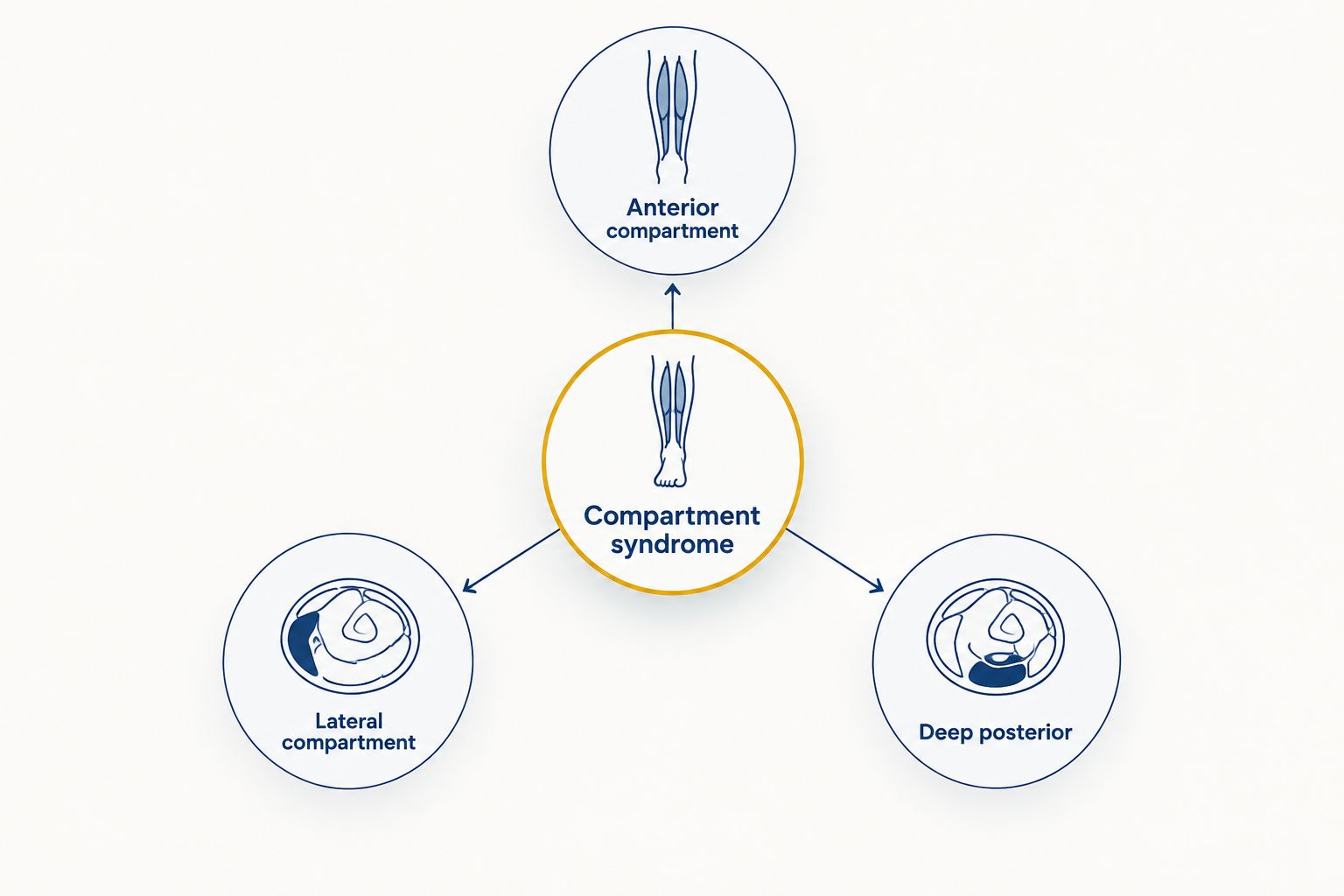
Anterior compartment CECS: the most common pattern
Anterior compartment involvement, along the front of the shin, is the presentation podiatrists see most often in distance runners and shows up as a tight, aching band on the outer front of the lower leg that builds with mileage. This is the pattern most conservative protocols are built around, and it responds best to cadence and calf-strength changes before surgery gets discussed.
Lateral compartment CECS: less common, easy to miss
Lateral compartment pain sits slightly to the outer side of the shin and gets mistaken for peroneal tendon irritation more often than the anterior pattern does. Getting this one right depends on a careful exam, since treating it like a tendon problem wastes weeks of the conservative window.
Deep posterior compartment CECS: the hardest to diagnose
Deep posterior involvement sits under the calf muscles and is notoriously difficult to pin down with a standard exam alone, which is why pressure testing carries more weight here than in the other two patterns. Runners with this pattern are the most likely to end up needing fasciotomy, simply because the diagnosis takes longer to confirm.
Why compartment pressure builds in the first place
- A rapid jump in running volume or intensity without a proper build-up
- Tight or non-compliant fascia surrounding the muscle compartment
- A naturally smaller compartment size in some runners, leaving less room for the muscle to swell during exercise
- Repetitive impact on hard, unforgiving surfaces without enough recovery between sessions
- Poor foot and ankle mechanics that force the anterior or lateral compartment to overwork with every stride
- Returning to full mileage after time off without a real taper back in
A gait analysis checks most of these mechanical drivers directly, which is why it belongs early in the workup rather than after months of guessing.
Get lower-leg pain checked before it costs a season
Same-day access to a foot and ankle specialist across Southwest Florida.
Is chronic exertional compartment syndrome treatment ever non-surgical?
Yes, chronic exertional compartment syndrome treatment stays non-surgical in cases caught early, when activity modification, calf stretching, and gait changes bring symptoms under control during the initial 3 to 6 month trial. Waiting longer than that on a confirmed diagnosis rarely changes the outcome and usually just extends the time spent limited on runs.
What compartment pressure confirms chronic exertional compartment syndrome?
A resting pressure above 15 mmHg, combined with a 1-minute post-exercise reading above 30 mmHg or a 5-minute reading above 20 mmHg, is the pressure pattern used to confirm CECS. These are the benchmarks a sports medicine or podiatry workup checks before recommending fasciotomy over more conservative options.
Can custom orthotics fix chronic exertional compartment syndrome?
Orthotics alone rarely resolve confirmed CECS, but they can support the gait changes made during the conservative trial by correcting mechanics that force the anterior or lateral compartment to overwork. They work best paired with cadence changes and calf strengthening, not as a standalone fix.
FAQ
What is chronic exertional compartment syndrome treatment for runners?
Chronic exertional compartment syndrome treatment for runners starts with activity modification, calf stretching, and gait retraining for 3 to 6 months, then moves to fasciotomy if a confirmed diagnosis doesn’t respond. Getting the diagnosis right first matters more than which treatment gets tried.
How is chronic exertional compartment syndrome diagnosed?
Chronic exertional compartment syndrome is diagnosed with intramuscular pressure testing, using a resting threshold above 15 mmHg and post-exercise readings above 30 mmHg at 1 minute or 20 mmHg at 5 minutes. A gait and mechanics exam usually happens alongside the pressure test.
Is chronic exertional compartment syndrome the same as shin splints?
No, chronic exertional compartment syndrome is not the same as shin splints, even though both cause shin and calf pain during running. Shin splint pain lingers after stopping, while CECS pain typically fades within minutes of rest and returns at the same effort level.
Does chronic exertional compartment syndrome ever go away without surgery?
Chronic exertional compartment syndrome can resolve without surgery when it’s caught early and a real conservative trial of gait changes and activity modification is followed for several months. Cases confirmed by pressure testing after months of symptoms are less likely to resolve without a fasciotomy.
How successful is fasciotomy surgery for CECS?
Fasciotomy is considered the definitive treatment for confirmed chronic exertional compartment syndrome once conservative care has failed. It’s reserved for cases where pressure testing has already confirmed the diagnosis, since surgery on an unconfirmed case doesn’t reliably fix the pain.
What sports besides running cause chronic exertional compartment syndrome?
Chronic exertional compartment syndrome shows up in cycling, soccer, and military training in addition to running, since all of these involve repetitive lower-leg loading. Any sport with sustained, repetitive muscle contraction in the lower leg can trigger the same pressure buildup.
When should a runner see a podiatrist for lower leg pain?
A runner should see a podiatrist for lower leg pain once it starts recurring at the same distance or pace across multiple runs, rather than waiting for it to become constant. Early gait analysis and exam findings narrow down whether it’s CECS, shin splints, or something else long before pressure testing becomes necessary.
One last thing
The detail most runners miss: CECS pain almost never shows up on an X-ray or a standard MRI, which is exactly why it gets misdiagnosed as shin splints for months. If lower-leg pain keeps returning at the same distance in every single run and clears within minutes of stopping, that pattern alone is worth a workup at Naples Podiatrist before another training cycle gets built around a guess. A podiatrist who checks gait mechanics first, rather than jumping straight to imaging, is the fastest route to the right diagnosis in 2026.
Related guides
- Custom orthotics for runners and athletes
- How to treat shin splints before they become a fracture
- Stress fractures in the foot: how runners get them and heal

