
 Fax: (239) 692-9436
 Tel: 239-430-3668
Your shockwave therapy cost in 2026 depends on the treatment plan and your insurance benefits; get a written, patient-specific estimate before committing to a course of care. Confirm whether that estimate includes the examination, any necessary imaging, treatment visits, and follow-up—not just the procedure itself.
- Compare shockwave therapy cost using the full treatment plan, not an isolated visit quote.
- Naples Podiatrist offers shockwave therapy and specialist foot and ankle care in Southwest Florida.
- Verify insurance coverage for the exact procedure; coverage for a podiatry examination does not establish treatment coverage.
- Ask what is included, when treatment will be reassessed, and what happens if symptoms persist.
How much does shockwave therapy cost in 2026?
The useful estimate is your expected out-of-pocket responsibility for the recommended course of care. A quote for an individual appointment does not answer that question unless it also explains the planned treatment schedule and any separate services.
Before comparing estimates, understand how shockwave therapy works for chronic foot pain. The treatment needs to match a diagnosed condition, rather than heel pain in general.
Ask the office to separate the estimate into the following components. These are items to clarify, not services every patient necessarily needs.
| Estimate component | What to ask | Why it matters |
|---|---|---|
| Initial examination | Is the diagnostic visit included or separate? | The evaluation establishes whether treatment is appropriate. |
| Imaging, if indicated | Is imaging needed, and is it included? | Testing should answer a clinical question, not be assumed. |
| Treatment visits | Does the estimate cover an individual visit or the planned course? | Different scopes make quotes difficult to compare. |
| Reassessment | When will the doctor review progress, and is that visit included? | Continuing treatment needs a clinical reason. |
| Additional care | Are exercises, orthotics, or other services part of the recommendation? | Separate recommendations need separate explanations. |
| Insurance responsibility | What is the expected patient responsibility after benefit verification? | The treatment estimate and your insurance benefit are different questions. |
Request the estimate in writing so you can review it without trying to remember a telephone conversation. Keep the proposed treatment plan alongside it.
Why this matters
Persistent foot pain interrupts more than exercise. It can limit grocery shopping, walking with family, playing pickleball, or completing a round of golf.
That makes a quick treatment decision tempting. But a procedure is not a substitute for identifying the painful structure and understanding why earlier care has not helped.
Do not choose shockwave therapy solely because an appointment quote looks attractive. Choose a plan that explains the diagnosis, the reason for treatment, its limitations, and the point at which your doctor will reassess the approach.
What should a complete shockwave estimate include?
A useful estimate connects the financial details to the medical recommendation. You should understand what the clinician intends to treat and what you are being asked to authorize.
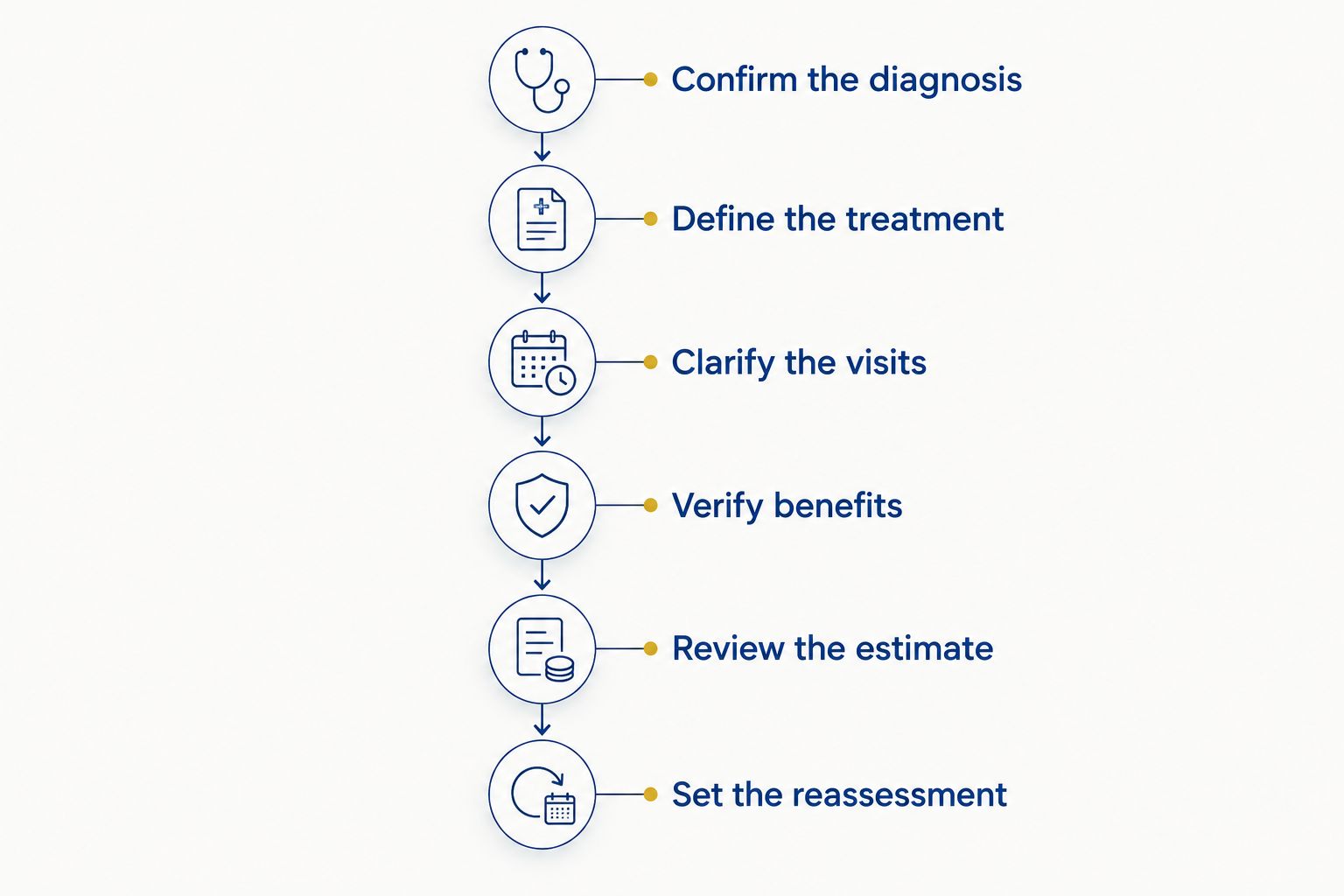
Use this sequence before scheduling a treatment course:
- Confirm the diagnosis. Ask which tissue is causing pain and whether the examination supports shockwave therapy for that condition.
- Define the treatment. Ask which type of shockwave treatment is proposed and which area will be treated.
- Clarify the visits. Get the proposed schedule and distinguish treatment appointments from evaluation or follow-up visits.
- Verify benefits. Ask your insurer about the exact procedure and diagnosis rather than general podiatry coverage.
- Review the estimate. Check what is included, what is separate, and when your responsibility changes.
- Set the reassessment. Agree on how the doctor will judge progress and decide whether to continue.
This sequence keeps the estimate tied to a medical decision. If the diagnosis or proposed treatment changes, ask for an updated explanation before proceeding.
Why shockwave therapy cost varies
For your 2026 estimate, focus on the details that define the proposed care. Ask the office to explain any difference between estimates rather than assuming every service called shockwave therapy is identical.
- Treatment scope: Clarify the condition, treatment area, and whether the recommendation concerns a single foot or both feet.
- Treatment method: Ask whether the proposed treatment uses focused shockwaves or radial pressure waves; these are different technologies.
- Planned visits: Establish the proposed course and the clinical checkpoint for deciding whether additional treatment is appropriate.
- Diagnostic needs: Ask whether the examination identifies a reason for imaging or other testing before treatment.
- Included services: Separate the procedure from consultations, reassessment, rehabilitation, and any recommended devices.
- Insurance benefits: Verify exclusions, applicable patient responsibility, and any authorization requirements for your specific plan.
These questions identify what you are comparing. They do not establish that a particular method, longer course, or larger treatment area is automatically the better choice.
Ask what each difference means for your diagnosis. An explanation centered only on equipment names leaves the treatment decision unfinished.
Does insurance cover shockwave therapy?
Do not assume shockwave therapy is covered because your insurance covers an office visit. Ask your insurer to check the proposed procedure for your diagnosis under your current benefits.
For a 2026 treatment plan, use current plan documents and benefit information. A previous examination, another patient's experience, or an earlier authorization does not establish coverage for your proposed procedure.
Ask the practice for the procedure description and billing information your insurer needs. Then clarify:
- Is this exact treatment a covered benefit for the proposed diagnosis?
- Does the plan exclude the procedure or require a medical-necessity review?
- Is prior authorization required before treatment?
- Does the provider's network status affect your responsibility?
- What patient responsibility applies if the service is covered?
- What documentation explains a denial or exclusion?
Keep the insurer's reference number and written explanation when available. Ask the office how it handles a difference between the benefit estimate and the insurer's eventual claim decision.
Is Medicare coverage the same as coverage for a podiatry visit?
No. Coverage for a medically necessary podiatry examination does not establish coverage for every treatment discussed during that visit.
If you have Medicare or a Medicare Advantage plan, ask about the exact proposed service before proceeding. Request an explanation of any noncoverage notice or financial-responsibility form before signing it.
Is shockwave therapy worth considering for persistent heel pain?
Shockwave therapy is a nonsurgical option used for selected musculoskeletal conditions, including persistent plantar fasciitis. Whether it fits your situation depends on the diagnosis, previous treatment, medical history, and examination.
The advantage is that treatment does not require a surgical incision. The limitations include discomfort during treatment, temporary soreness or bruising, and the possibility that symptoms will not improve enough to meet your goals.
A treatment recommendation should include both the expected benefit and the reasons it might not help you. Ask whether your symptoms suggest a different problem, such as a nerve condition, tendon injury, or stress fracture.
Before treatment, tell the clinician about blood-thinning medication, bleeding problems, reduced sensation, wounds, and other relevant medical conditions. Do not stop prescribed medication on your own.
How does shockwave therapy compare with other care?
These options address different problems and are not interchangeable. The table explains their roles and limitations; it does not rank them for every patient.
| Option | Best for | Potential advantage | Limitation |
|---|---|---|---|
| Clinician-directed rehabilitation | Patients whose diagnosis calls for progressive loading, flexibility work, or movement changes | Builds a plan around function and activity | Requires participation and adjustment to symptoms |
| Orthotics or footwear changes | Patients who need pressure redistribution or mechanical support | Changes how the foot is supported during activity | Does not address every cause of heel pain |
| Shockwave therapy | Selected patients with persistent conditions after clinical evaluation | Provides a nonsurgical treatment option | Causes discomfort in some patients and does not guarantee improvement |
| Surgical evaluation | Patients with a defined problem for which surgery warrants consideration | Allows discussion of a structural treatment when appropriate | Requires a separate discussion of risks and recovery |
Ask why the recommended approach fits your examination. Do not treat this list as a sequence that every patient must complete.
How many shockwave appointments will I need?
Your clinician should recommend the treatment schedule after evaluating the condition; a schedule cannot be determined from heel pain alone. Ask when progress will be reviewed and what findings would justify changing the plan.
An individual-session estimate and a course-of-care estimate answer different questions. Clarify which one you have before agreeing to treatment.
Can I keep playing pickleball, golfing, or running?
Your activity plan should follow your diagnosis and response to treatment. Ask specifically about court movement, walking the golf course, running mileage, and exercises rather than requesting a general clearance to stay active.
For older adults, maintaining safe mobility matters alongside returning to sport. Report limping, balance difficulties, or symptoms that worsen with the proposed activity plan.
When should foot pain be evaluated before discussing shockwave?
Seek prompt medical assessment for a sudden injury with difficulty bearing weight, an open wound, spreading redness, fever, or a newly hot and swollen foot. A cold, pale foot or sudden loss of sensation needs urgent assessment, not a routine treatment inquiry.
People with diabetes or reduced sensation should not use pain intensity alone to judge the seriousness of a foot problem. Get a diagnosis before choosing a procedure.
Get specialist advice before committing to treatment
Naples Podiatrist is best for Southwest Florida patients seeking specialist foot and ankle evaluation before choosing shockwave therapy. The practice offers shockwave therapy alongside medical and surgical foot and ankle care; that breadth does not make shockwave appropriate for every patient.
Bring details of previous treatment, your medication list, and the activities pain prevents you from doing. The Naples Podiatrist team provides access to specialist doctors who can assess the condition and discuss the next step.
For shockwave therapy, ask about suitability, alternatives, potential side effects, and the full estimate. Quick access to an assessment is useful; it is not a reason to skip those questions.
Discuss persistent foot pain
Ask a foot and ankle specialist whether shockwave therapy fits your diagnosis.
FAQ
What’s included in a shockwave therapy cost estimate?
A shockwave therapy cost estimate should identify the proposed treatment visits and explain whether evaluation, imaging, and follow-up are included or separate. Ask for the expected patient responsibility in writing.
Does insurance covering my podiatrist mean shockwave therapy is covered?
No, coverage for a podiatry visit does not establish coverage for shockwave therapy. Verify the exact proposed procedure and diagnosis with your insurer before treatment.
Is shockwave therapy a guaranteed fix for plantar fasciitis?
No, shockwave therapy does not guarantee relief from plantar fasciitis. A specialist should explain why it fits your diagnosis, its limitations, and when progress will be reassessed.
Should I choose treatment based on the lowest individual-visit estimate?
No, compare estimates for the same proposed scope of care rather than an isolated appointment. Confirm the treatment method, planned visits, included services, and reassessment arrangements.
Will I need imaging before shockwave therapy?
Imaging is not something to assume from a shockwave inquiry alone. Your clinician should explain whether your history and examination identify a reason for testing.
Can shockwave therapy replace rehabilitation exercises?
Shockwave therapy does not automatically replace rehabilitation exercises. Ask your clinician how each part of the treatment plan addresses your diagnosed condition.
Can Naples Podiatrist assess whether shockwave therapy is appropriate?
Naples Podiatrist offers specialist foot and ankle care and shockwave therapy. An evaluation helps determine whether that treatment or another approach fits your condition.
One last thing
Before approving a 2026 treatment plan, ask: What finding would make you stop shockwave therapy and reconsider the diagnosis? A clear answer establishes a clinical checkpoint instead of leaving treatment open-ended.
Also choose a practical goal: walking comfortably through the grocery store, returning to golf, or tolerating your usual exercise. Discuss progress toward that goal at reassessment, not just how the foot feels immediately after an appointment.
Related guides
- Shockwave therapy for plantar fasciitis in Naples
- Shockwave therapy for Achilles tendinitis in Naples
- What insurance plans cover a podiatrist visit?

