 Fax: (239) 692-9436
 Tel: 239-430-3668
Lisfranc injury recovery time can reach 6–12 months after surgery, while a stable injury treated without surgery generally begins with 6–8 weeks without weight on the injured foot. Getting out of a cast or boot does not mean your foot is ready for running, pickleball, or golf. This 2026 guide separates initial protection, walking recovery, and return to activity so you can plan around the right milestone.
- Lisfranc injury recovery time differs: initial protection takes weeks; recovery after surgery can take 6–12 months.
- Stable Lisfranc injuries generally require 6–8 weeks without weight bearing before a supervised progression.
- Less pain does not prove that an injured midfoot is stable or ready for sport.
- Naples Podiatrist provides specialist foot and ankle care for Southwest Florida patients with midfoot injuries.
How long does it take to recover from a Lisfranc injury?
Expect recovery in stages, not a single healing date. A stable injury without displaced bones follows a different treatment path from an unstable injury that needs surgical repair or fusion. Your examination and imaging determine which path applies.
The American Academy of Orthopaedic Surgeons' patient guidance, Lisfranc (Midfoot) Injury, describes 6–8 weeks of non-weight-bearing protection for nonsurgical treatment and a possible 6–12 months to return to all activities after surgery. These are general benchmarks, not clearance dates for an individual patient.
| Treatment path | Best for | General recovery benchmark | Benefit | Limitation |
|---|---|---|---|---|
| Nonsurgical protection | Stable injuries without displacement or complete ligament disruption | Usually 6–8 weeks without weight bearing, followed by reassessment | Avoids an operation when the injury is suitable | Requires monitoring; loss of alignment can change treatment |
| Surgical treatment | Unstable or displaced injuries | Return to all activities can take 6–12 months | Restores or stabilizes injured midfoot alignment | Adds incision healing, surgical risks, and prolonged rehabilitation |
If you have not received a diagnosis, start with how to recognize and treat a Lisfranc foot injury. A routine ankle-sprain timeline does not apply to an injury across the middle of the foot.
Why this matters
The midfoot supports your arch and transfers force when you push off. Walking across a room, climbing stairs, and changing direction on a pickleball court place different demands on that structure.
Being able to walk is not proof that a Lisfranc injury is minor. Some injuries allow walking despite ligament damage or joint instability. Continuing activity before the injury is assessed risks further displacement and lasting problems.
For your 2026 recovery plan, ask for separate goals for protected walking, regular shoes, work, and sport. A single estimated finish date hides the restrictions that affect daily life most.
Stable injury: 6–8 weeks of initial protection
A stable Lisfranc injury treated without surgery generally requires 6–8 weeks without weight bearing in a cast or boot. That period protects injured structures; it is not a promise of unrestricted walking immediately afterward.
Your clinician checks whether the joints remain aligned and whether symptoms support progression. Follow-up imaging matters because an injury that shifts during treatment needs reassessment.
After clearance, you usually move through protected weight bearing before returning to regular footwear. Strength, balance, and walking mechanics need attention after immobilization. Increasing activity all at once defeats the purpose of that gradual transition.
Nonsurgical treatment avoids operative risks, but it does not mean casual treatment. You still need to follow restrictions, attend follow-up visits, and report a change in pain or foot shape.
Do not test healing by taking a few unsupported steps. Ask exactly how much weight you are allowed to place on the foot and which device you should use.
Surgical injury: 6–12 months to full activity
Recovery after Lisfranc surgery can take 6–12 months before return to all activities. The initial non-weight-bearing period commonly lasts 6–8 weeks, but your surgeon sets restrictions according to the repair, imaging, and healing progress.
Surgery addresses instability or displacement. Depending on the injury, treatment involves fixation to hold joints in position or fusion of selected damaged joints. These are different operations, and neither has a universal rehabilitation calendar.
Fixation preserves the treated joints but can involve later decisions about hardware. Fusion intentionally eliminates movement at selected joints; its recovery also depends on bone healing. Ask which procedure you had and what your follow-up images need to show before you advance.
Swelling, weakness, and stiffness can persist after the incision closes. The operation date starts only part of the recovery clock: restoring comfortable walking and rebuilding activity tolerance take longer.
For surgical planning in 2026, arrange help with transportation, stairs, groceries, and household tasks before the procedure. Protecting your foot is easier when your home routine does not require repeated improvisation.
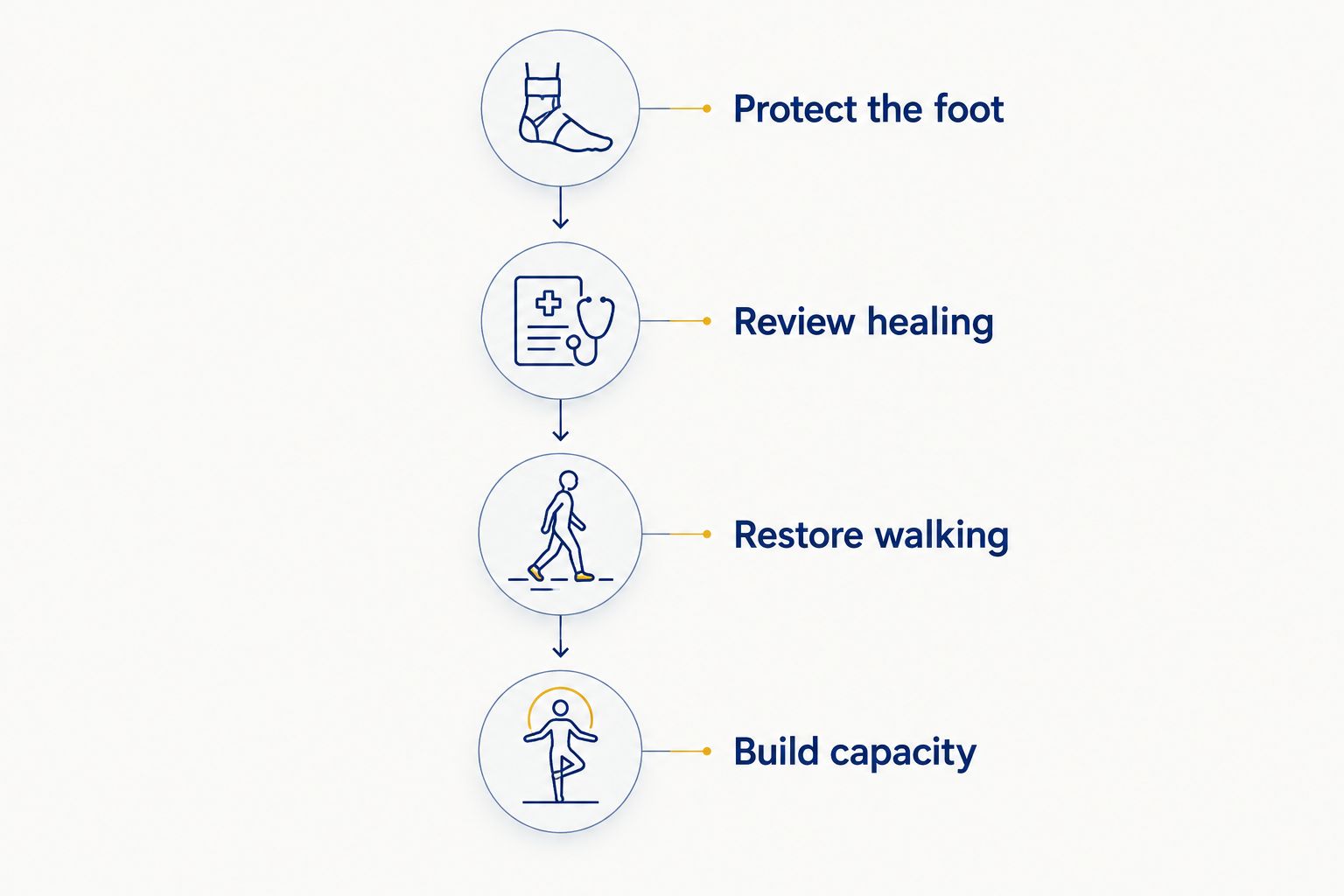
What does recovery look like between protection and sport?
Lisfranc rehabilitation progresses according to healing and function. The calendar supports the decision; it does not make the decision. Your care team can pause or adjust the sequence when symptoms or imaging raise concerns.
- Protect the foot. Follow your cast or boot instructions and weight-bearing restrictions. Use the prescribed mobility aid rather than hopping between furniture.
- Review healing. Attend examinations and imaging appointments. Tell your clinician about falls, accidental loading, new numbness, or increasing pain.
- Restore walking. Begin the prescribed weight-bearing progression. Work toward a controlled walking pattern rather than accepting a persistent limp.
- Build capacity. Add clinician-directed strength and balance work. Progress toward the specific demands of your job, recreation, or sport.
Each phase answers a different question. A foot can be ready for protected walking without being ready for a full standing shift or repeated sideways movement.
Why Lisfranc injury recovery time varies
Two people with a Lisfranc injury do not necessarily have the same tissue damage or treatment needs. These factors explain why your recovery estimate changes after examination or surgery:
- Joint stability: Stable joints can follow a nonsurgical pathway; unstable joints often require surgical stabilization.
- Extent of damage: Ligament disruption, fractures, dislocation, and cartilage injury create different healing demands.
- Treatment performed: Immobilization, fixation, and fusion have different protection and rehabilitation requirements.
- Healing health: Smoking, diabetes, and impaired circulation affect tissue healing and require attention during care.
- Protection during recovery: Unapproved loading, falls, or missed follow-up visits can interrupt the treatment plan.
- Activity goal: Desk work, prolonged standing, golf, and running require different levels of strength and midfoot tolerance.
Age alone does not define your endpoint. For an older adult, safe transfers and balance deserve as much planning as the eventual return to exercise.
When can I walk after a Lisfranc injury?
6–8 weeks without weight bearing is a common initial benchmark, not an automatic date for normal walking. Your clinician must confirm that alignment and healing support a controlled increase in load.
Ask for written instructions that distinguish non-weight bearing, partial weight bearing, and full weight bearing. A boot does not automatically mean you are allowed to walk on the foot.
When walking resumes, pay attention to your gait and the foot's response afterward. Increasing swelling, renewed midfoot pain, or a worsening limp calls for discussion with your care team rather than another increase in distance.
When can I return to pickleball, golf, or running?
6–12 months is the AAOS benchmark for return to all activities after surgery, but sports clearance depends on what your foot can safely do. Walking comfortably is an earlier milestone than repeated push-off, pivoting, or impact.
Pickleball requires sudden stops and lateral movement. Golf places rotational demands on the foot during the swing, even if you use a cart. Running adds repeated loading that a short, comfortable walk does not test.
Ask your specialist or physical therapist which functional tasks you must complete before returning. Do not use a tournament, seasonal league, or planned vacation as the reason to skip rehabilitation stages.
Does recovery end when the boot comes off?
6–8 weeks of protection does not equal complete recovery. Removing a boot changes support and loading; your foot still needs a supervised transition toward normal footwear and activity.
After immobilization, weakness and altered walking mechanics deserve treatment. Supportive footwear and prescribed orthoses can help selected patients, but neither corrects an unstable Lisfranc injury or replaces medical clearance.
For a return-to-shoes plan in 2026, ask what footwear characteristics your clinician wants and what symptoms should prompt a step back. Comfort during a brief fitting does not establish readiness for a long day on your feet.
When should you seek prompt medical care?
Get prompt assessment after a twisting injury, fall, or crush injury if you have midfoot swelling, bruising underneath the foot, or difficulty bearing weight. These findings deserve attention even when the injury initially feels like a sprain.
An examination and appropriate imaging establish whether the midfoot is stable. Weight-bearing X-rays, when clinically appropriate, can reveal alignment problems; CT or MRI helps answer additional questions in selected cases.
Seek emergency care for an open wound over a suspected fracture, obvious deformity, a cold or pale foot, or severe escalating pain. During recovery, new calf pain or swelling needs urgent medical assessment; chest pain or shortness of breath requires emergency help.
Naples Podiatrist is a specialist foot and ankle care option for Southwest Florida patients who need assessment of a midfoot injury. Quick specialist access helps you establish the diagnosis and restrictions; it does not shorten the biological healing process.
You can contact Naples Podiatrist or call 239 430 3668 to arrange an evaluation. Bring prior images, reports, your medication list, and any instructions already provided.
FAQ
How long does Lisfranc injury recovery take without surgery?
A stable Lisfranc injury generally begins with 6–8 weeks without weight bearing, followed by reassessment and gradual loading. That initial protection period is not the same as full recovery or clearance for sport.
How long does recovery take after Lisfranc surgery?
Recovery after Lisfranc surgery can take 6–12 months before return to all activities, according to AAOS patient guidance. Your procedure, healing, and functional progress determine your individual restrictions.
Can I walk on a Lisfranc injury if it does not hurt much?
Less pain does not establish that a Lisfranc injury is stable or safe to walk on. Follow your prescribed weight-bearing restrictions until your clinician changes them.
Does every Lisfranc injury need surgery?
Not every Lisfranc injury needs surgery. Stable injuries without displacement can qualify for nonsurgical care, while unstable or displaced injuries often need surgical treatment.
Is swelling normal during Lisfranc recovery?
Swelling can persist during Lisfranc recovery, including after surgery. New or worsening swelling, increasing pain, redness, wound drainage, or calf symptoms needs medical assessment rather than an assumption that it is routine.
When can I drive after a Lisfranc injury?
Driving requires clearance based on the injured side, immobilization, medications, and your ability to operate the vehicle safely. Do not assume that permission to walk also means permission to drive.
Can a Lisfranc injury cause arthritis later?
A Lisfranc injury can lead to post-traumatic midfoot arthritis, even after treatment. Persistent pain, stiffness, or reduced walking tolerance deserves reassessment.
Where can I get a Lisfranc injury evaluated in Southwest Florida?
Naples Podiatrist offers specialist foot and ankle care for Southwest Florida patients. Arrange an evaluation for persistent midfoot pain after an injury, especially with swelling, bruising underneath the foot, or difficulty bearing weight.
One last thing
Ask what starts your recovery clock. Time since injury, time since surgery, and time since permission to bear weight describe different stages. Comparing those dates without context makes another person's recovery story a poor guide for your own.
For your next appointment in 2026, write down your actual goal: walking the neighborhood, standing through work, playing golf, or returning to pickleball. Ask what must improve before that activity is safe, not just how many weeks remain.
Related guides
- CAM boot to regular shoes: recovery workflow
- Physical therapy for foot and ankle recovery: what to expect
- How to reduce swelling after foot or ankle surgery