
 Fax: (239) 692-9436
 Tel: 239-430-3668
Foot surgery recovery time by procedure ranges from several months for routine activity to about 12 months for full recovery after Achilles tendon repair. This 2026 guide compares published recovery milestones for bunion surgery, ankle fracture surgery, Lisfranc surgery, and Achilles repair; Naples Podiatrist provides specialist foot and ankle medical and surgical care in Southwest Florida.
- Foot surgery recovery time by procedure depends on the operation and the milestone—not just incision healing.
- AAOS describes bunion surgery recovery as taking up to six months, with swelling sometimes lasting longer.
- Lisfranc surgery recovery takes six to twelve months; Achilles tendon rupture recovery takes about twelve months.
- Naples Podiatrist provides foot surgery care for Southwest Florida patients seeking specialist evaluation.
Why this matters
A foot that fits into a shoe is not necessarily ready for a standing shift, a golf swing, or a pickleball match. Skin healing, bone healing, tendon strength, and balance follow different timelines.
Compare the same milestone before comparing recovery times. Permission to walk in a protective boot does not mean permission to walk barefoot, drive, or run. For your 2026 surgery plan, separate essential daily activities from the activities you ultimately want to resume.
Foot surgery recovery time by procedure: comparison table
Recovery time means the endpoint named in each row—not simply the time until stitches come out. The table preserves those distinctions because published patient guidance does not use one identical definition of recovery across all operations.
| Procedure | Published recovery benchmark | What that benchmark means | Source and scope |
|---|---|---|---|
| Overall planning yardstick | Plan in months for these operations | Daily function can return before full recovery; use the procedure-specific endpoint below | Summary of the AAOS patient guidance listed here, not a pooled average |
| Ankle fracture surgery | Most people return to normal activities within 3–4 months | A broad ankle-fracture recovery benchmark; some patients take longer, particularly after severe injuries | AAOS OrthoInfo, Ankle Fractures (Broken Ankle); includes surgical and nonsurgical treatment |
| Bunion surgery | Complete recovery can take up to 6 months | Recovery after correction; persistent swelling can outlast other milestones | AAOS OrthoInfo, Bunion Surgery; general surgical patient guidance |
| Lisfranc surgery | Overall recovery takes 6–12 months | Recovery after a significant midfoot injury; return to demanding activity requires individual assessment | AAOS OrthoInfo, Lisfranc (Midfoot) Injury; surgical recovery guidance |
| Achilles tendon surgery | Full recovery takes about 12 months | Recovery after Achilles tendon rupture, including rebuilding function; not a boot-removal date | AAOS OrthoInfo, Achilles Tendon Rupture (Tear); rupture treatment guidance |
Ankle-fracture guidance gives the earliest usual-activity benchmark in this comparison at 3–4 months; Achilles rupture guidance places full recovery at about 12 months, while Lisfranc recovery spans 6–12 months. These endpoints differ, so the table does not establish that one operation heals a fixed amount faster than another.
Source scope and limitation: This 2026 comparison summarizes American Academy of Orthopaedic Surgeons OrthoInfo patient-education guidance, not a clinical dataset or practice-specific outcomes report; source publication dates are not assigned here. The ankle-fracture benchmark includes nonsurgical cases, and the Achilles benchmark covers rupture recovery rather than an isolated surgical cohort, so neither is a surgery-only average.
What the procedure benchmarks mean for you
Bunion surgery: correction type changes the restrictions
Bunion surgery is not one operation. A surgeon can realign bone, address soft tissue, or fuse a joint, depending on the deformity and arthritis present.
The AAOS benchmark of up to 6 months describes overall recovery, not a universal period without walking. Some corrections allow protected weight-bearing; others require stricter protection. Your discharge instructions—not the size of the incision—determine which applies.
The benefit of appropriate bunion correction is addressing painful deformity when nonsurgical treatment has not provided adequate relief. The trade-offs include swelling, stiffness, wound problems, and the possibility of persistent or recurrent symptoms. Ask which joint will move afterward and which activities will need adjustment.
Ankle fracture surgery: injury severity matters
Ankle fracture surgery stabilizes broken bones so they can heal in alignment. The injury can also damage cartilage, ligaments, and surrounding soft tissue, which helps explain why a healed fracture does not always feel normal immediately.
AAOS describes return to normal activities within 3–4 months for most ankle-fracture patients, but that is not a promise for every surgically treated fracture. Severe injuries and complications require a different plan. Standing work also places different demands on the ankle than seated work.
Fixation offers stability when the fracture requires it. Its limitations include surgical risks, hardware irritation, and the possibility of lasting stiffness or post-traumatic arthritis. Ask your surgeon what imaging must show before you increase weight-bearing.
Lisfranc surgery: protect the middle of the foot
A Lisfranc injury affects the joints and supporting structures across the midfoot. Surgical treatment can involve fixation or fusion, and the recovery plan depends on the injury pattern and procedure.
The published 6–12-month recovery window reflects a substantial injury, not simply a larger incision. Walking comfortably around the house is a different task from pushing off during running or changing direction on a court.
Surgery aims to restore or maintain alignment and stability. The trade-offs include prolonged rehabilitation, stiffness, hardware-related symptoms, and arthritis risk after the original injury. Ask whether another procedure to remove hardware is anticipated rather than assuming every implant stays permanently.
Achilles repair: walking returns before full strength
Achilles tendon repair reconnects a ruptured tendon, followed by protection and progressive rehabilitation. Getting out of a boot does not finish that rehabilitation.
AAOS describes full Achilles rupture recovery as taking about 12 months. Calf strength, endurance, and push-off function need rebuilding even after walking becomes easier. Running and jumping demand more from the tendon than ordinary household movement.
Surgical repair is one treatment option for selected ruptures; nonsurgical treatment is also appropriate for some patients. Surgery carries wound, infection, and nerve-injury risks, while both treatment pathways require rehabilitation. A specialist should explain the choice using your injury, health, and activity goals—not a calendar alone.
How to use these benchmarks
Use the 2026 comparison to organize questions and practical support, not to set your own clearance date. Your surgeon's restrictions take priority over every recovery range on this page.
- Match the endpoint. The ankle-fracture figure of 3–4 months concerns normal activities; the Achilles figure of about 12 months concerns full recovery. Do not treat them as equivalent measurements.
- Plan beyond the first comfortable walk. Bunion recovery can take up to 6 months, and Lisfranc recovery takes 6–12 months. Arrange work duties and household help around your actual restrictions.
- Separate exercise from sport. Permission for rehabilitation exercise is not permission for running, golf, or pickleball. Ask for activity-specific clearance.
- Update the plan after examinations. Wound appearance, imaging when needed, strength, and walking mechanics provide more useful guidance than reaching a date on the calendar.
Use separate milestones for each decision
Ask your surgical team to document the following milestones in plain language. They answer different questions and prevent a common mistake: treating less pain as proof that every tissue has healed.
- Wound healing: When can the incision get wet, and what dressing care remains necessary?
- Protected walking: How much weight is allowed, and which device must you use?
- Regular shoes: What examination findings support leaving the boot or surgical shoe?
- Sport clearance: Which strength, balance, and movement goals must you meet?
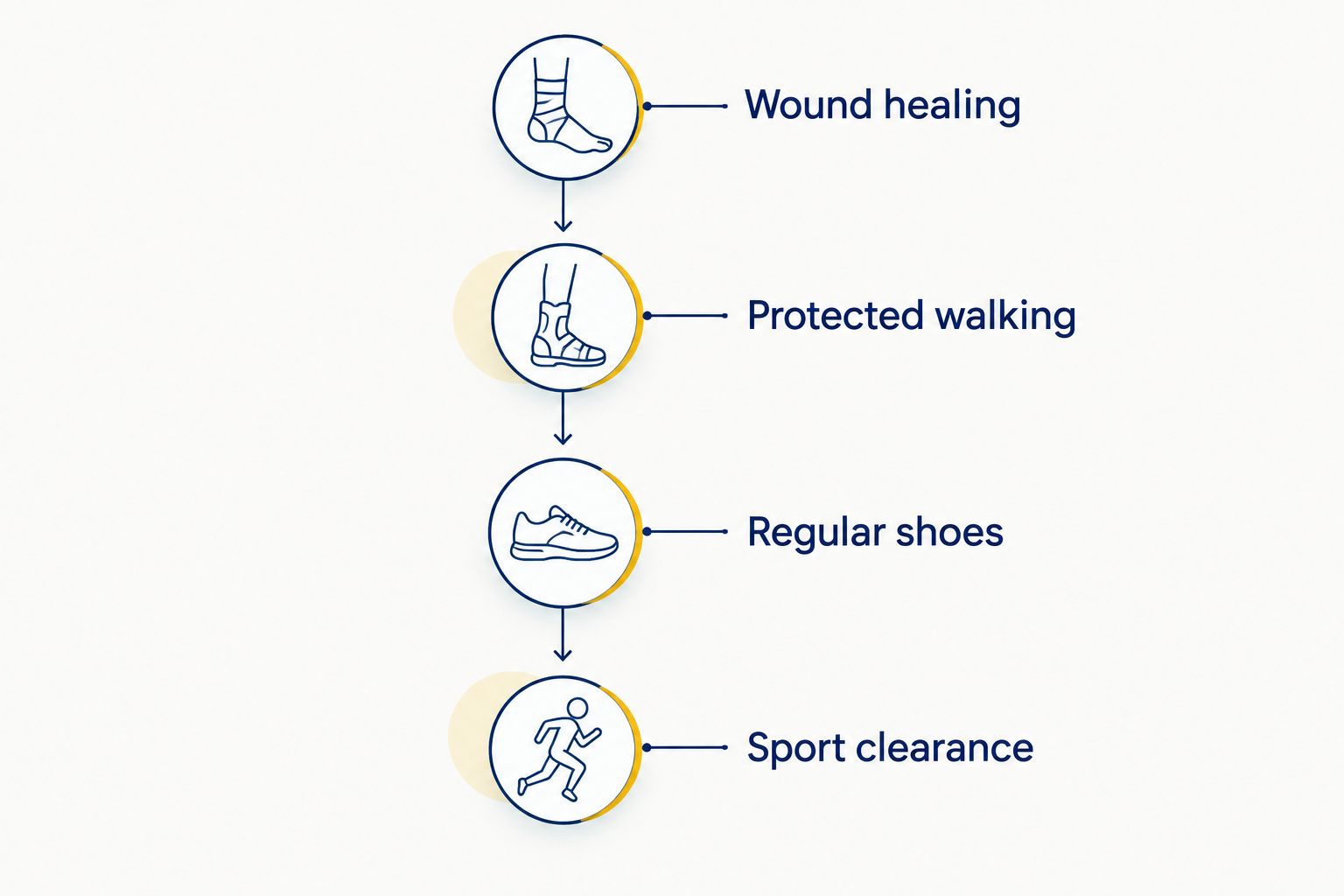
These checkpoints are not interchangeable. If your paperwork says non-weight-bearing, standing briefly on the operated foot still places weight through it; ask for help with transfers rather than improvising.
Plan work, driving, and Southwest Florida activities
Work and driving need separate clearance
A desk job still requires transportation, safe bathroom access, and a way to follow elevation instructions. A standing job adds sustained loading. Tell the surgeon what your work actually involves, including stairs, lifting, uneven ground, and required footwear.
Driving depends on the operated side, immobilization, medication effects, and your ability to control the vehicle safely. Do not drive while impaired by pain medication or while your surgeon prohibits it. Arrange transportation before surgery instead of testing your braking ability during recovery.
Golf, pickleball, and running stress different functions
Golf requires balance and rotation through the foot even when you use a cart. Pickleball adds sudden starts, stops, and lateral movement. Running repeatedly loads the foot and ankle during push-off.
Ask for clearance for the activity itself, not simply for exercise. A comfortable walk does not establish readiness for a pickleball lunge, and a tolerable golf swing does not establish readiness to walk the course.
Older adults should also discuss baseline balance and safe use of mobility aids. The aim is to protect the repair without creating a preventable fall during everyday movement.
What changes an individual recovery timeline?
The procedure name is only part of the answer. Blood supply, diabetes management, nicotine exposure, wound condition, injury severity, and adherence to restrictions all affect surgical planning and healing.
Neuropathy deserves particular attention because reduced sensation can hide pressure damage. Less pain does not necessarily mean the foot is tolerating more activity safely. Patients with diabetes or circulation concerns need an individualized wound and follow-up plan.
Combined procedures also change the comparison. If an operation includes both bone correction and tendon work, the most restrictive component can determine the early recovery instructions. Ask the surgeon to name every planned procedure and explain which one controls walking restrictions.
Naples Podiatrist provides foot surgery care for Southwest Florida patients seeking specialist evaluation. An assessment can establish the diagnosis and treatment options, but it cannot guarantee a recovery date or eliminate the risks of surgery.
Discuss your foot surgery recovery
Get specialist evaluation for your foot or ankle condition and discuss procedure-specific recovery.
Know when recovery needs urgent attention
Some postoperative swelling is expected, but a sudden change needs assessment. Contact your surgical team promptly for increasing redness, drainage, fever, wound separation, or pain that is worsening rather than following the expected course.
New calf pain or one-sided leg swelling needs urgent medical assessment because a blood clot is a possible cause. Call emergency services for chest pain, sudden shortness of breath, or coughing blood. Do not wait for a routine postoperative visit.
A newly cold, pale, blue, or markedly numb foot also requires immediate medical advice. Follow your discharge instructions for urgent contact and do not remove or alter a cast yourself unless the treating team directs you.
FAQ
What is the average foot surgery recovery time by procedure?
There is no single meaningful average across all foot operations and recovery milestones. AAOS guidance describes bunion recovery as taking up to 6 months, Lisfranc recovery as taking 6–12 months, and full Achilles rupture recovery as taking about 12 months.
Which foot surgery has the shortest recovery?
The shortest recovery depends on the procedure and what you mean by recovered. Ankle-fracture guidance describes normal activities within 3–4 months for most patients, but this includes nonsurgical cases and cannot rank all foot surgeries.
When can I walk after bunion surgery?
Your bunion procedure and surgeon’s weight-bearing instructions determine when you can walk. Protected walking in a surgical shoe or boot is not the same as unrestricted walking in regular shoes.
Is minimally invasive foot surgery always faster to recover from?
A smaller incision does not guarantee faster bone or tendon healing. Recovery restrictions depend on the correction performed, fixation, tissue healing, and your individual health.
Can I play pickleball as soon as I can walk comfortably?
Comfortable walking alone does not clear you for pickleball. Your surgeon or rehabilitation clinician needs to assess readiness for push-off, balance, and rapid changes of direction.
Does diabetes mean I cannot have foot surgery?
Diabetes does not automatically rule out foot surgery. Blood sugar management, circulation, sensation, skin condition, and the reason for surgery all affect the assessment and recovery plan.
Can Naples Podiatrist give me a personal recovery timeline?
Naples Podiatrist provides specialist evaluation for foot and ankle conditions. A procedure-specific recovery discussion requires assessment of your diagnosis, health, treatment options, and activity goals.
One last thing
Ask for restrictions in writing, not just a recovery estimate. For a 2026 operation, the most useful instructions explain what you can load, which device you must use, what changes require a call, and what must happen before the next activity milestone.
Keep that plan accessible to anyone helping you at home. A recovery calendar tells you where you hope to be; clear restrictions tell you how to protect the operation today.
Related guides