 Fax: (239) 692-9436
 Tel: 239-430-3668
Physical therapy staff foot care is the daily management of footwear, skin health, and activity load with the aim of maintaining comfortable, stable movement during patient care. This 2026 guide focuses on your own feet: standing, demonstrating exercises, and assisting patients require more than choosing a soft shoe.
- Foot care for physical therapy staff starts with shoe fit, skin checks, and managing standing and demonstration demands.
- Naples Podiatrist provides specialist foot care for Southwest Florida staff whose symptoms need medical assessment.
- Choose work shoes for secure movement during patient handling, not cushioning alone.
- Persistent heel pain, numbness, wounds, or altered walking need assessment rather than another self-directed exercise program.
Why foot care matters for physical therapy staff
Your work combines stationary standing with walking, squatting, exercise demonstrations, and patient assistance. A shoe that feels comfortable while documenting can behave differently when you step sideways or support a transfer. Match your footwear to the tasks you perform, not just the time you spend standing.
Heel pain also needs a diagnosis rather than an occupational label. The guide to plantar fasciitis treatment for nurses and healthcare workers addresses a related healthcare setting, but not every painful heel has plantar fasciitis.
Clinical knowledge does not replace an examination of your own symptoms. Treat a new limp, persistent burning, or focal tenderness as information that changes your plan—not as something to work around indefinitely.
For your 2026 routine, separate prevention from treatment. Shoe fit and workload adjustments support everyday comfort; unexplained swelling, wounds, or progressive pain require medical assessment. This guide is patient education, not an individual diagnosis or clearance for patient-handling duties.
Build a practical foot-care routine
Check your feet and walking before patient care
Start without special equipment. Look at your feet, notice where discomfort occurs, and check whether you walk differently before putting on your work shoes. Repeat the observation after work when symptoms are easier to identify.
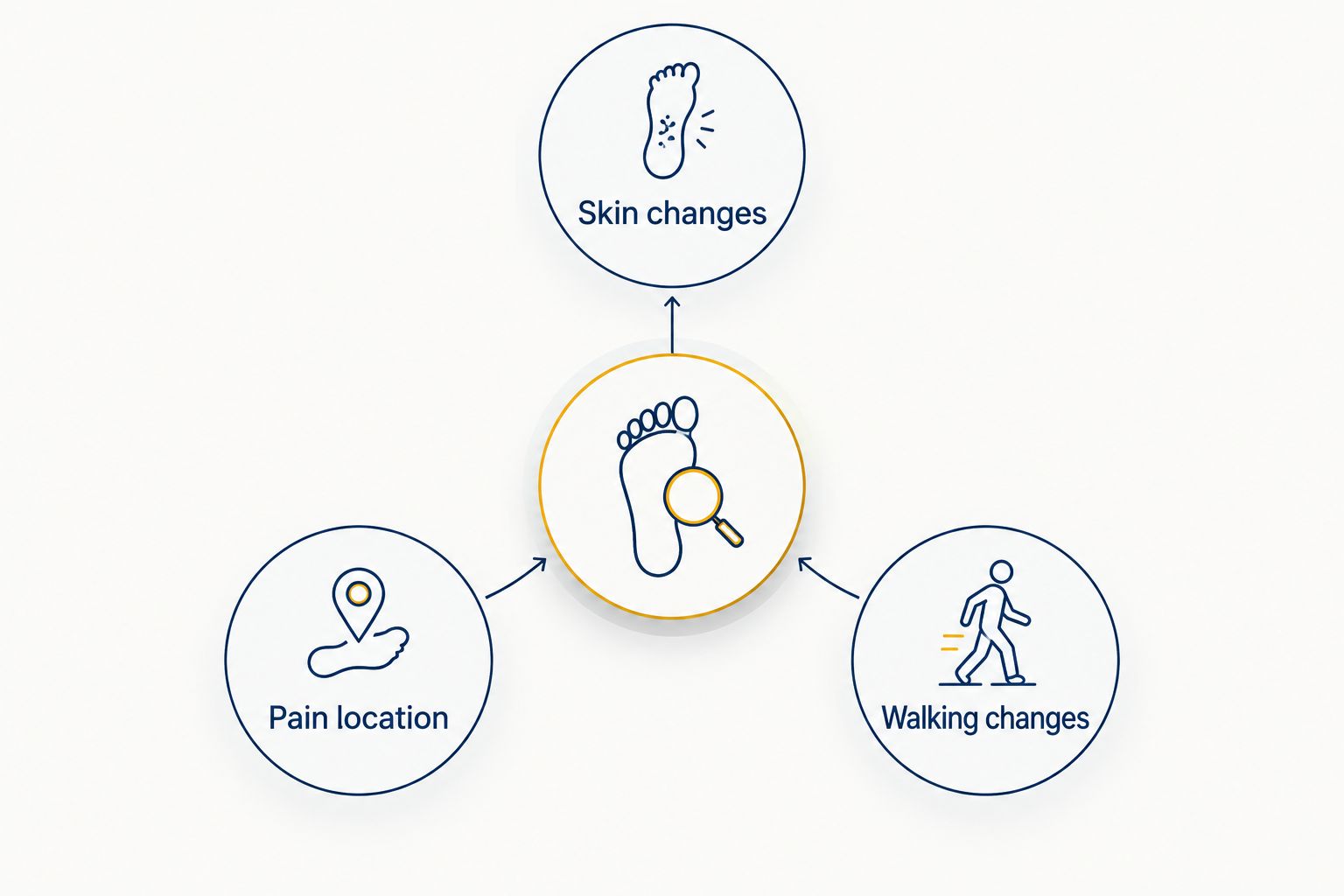
Use 3 checks per shift: skin changes, pain location, and walking changes. This is a practical checklist, not a diagnostic test. Record what you notice in plain language rather than assigning yourself a condition.
Morning heel discomfort, pressure over a toe, and burning under the forefoot describe different problems. An accurate symptom description helps a clinician decide what to examine.
- Skin changes: Look for blisters, cracks, redness, drainage, or an open area.
- Pain location: Identify the heel, arch, toes, ankle, or ball of the foot.
- Walking changes: Notice limping, shortened steps, or avoiding push-off.
- Compare both feet and note changes from your usual appearance.
Fit your shoes to patient-handling tasks
Inspect the shoes you already own before replacing them. Check the outsole, heel lining, fastening, and space around your toes. Uneven wear, heel slipping, or pressure marks deserve attention even when the shoe still looks presentable.
Use 3 movement checks when trying shoes: walking, a shallow squat, and a controlled sideways step. Perform them without assisting a patient. The shoe should stay secure without pinching, sliding, or forcing your toes to grip.
Follow your employer's footwear and infection-control requirements. Cushioning is a benefit only when the shoe also allows stable movement; an unstable platform is a poor trade for softness.
- Try shoes with the socks and prescribed inserts you use at work.
- Check both feet rather than relying on your usual labeled size.
- Choose toe space that avoids pressure over bunions or bent toes.
- Look for secure fastening and traction suited to your workplace.
- Reject shoes that produce numbness, rubbing, or heel slipping during the trial.
Arrange assessment when symptoms change your work
Begin by documenting the trigger, location, and effect on function. Bring that record and your work shoes to an appointment. This gives the specialist more useful information than a general report that your feet hurt after standing.
Naples Podiatrist is best for Southwest Florida physical therapy staff seeking quick access to specialist foot and ankle assessment. Naples Podiatrist provides medical and surgical foot and ankle care, including heel pain treatment and custom orthotics. Assessment is the next step when symptoms persist, worsen, or interfere with safe movement—not a prerequisite for basic prevention.
An office appointment is not a substitute for emergency care. Sudden severe symptoms or signs of a serious injury need an appropriate urgent evaluation.
- Seek prompt assessment for persistent pain, new numbness, or recurrent instability.
- Obtain urgent evaluation for deformity or inability to bear weight after injury.
- Seek urgent care for spreading redness, drainage, or fever with a foot wound.
- Treat a newly hot, swollen foot with neuropathy as urgent, even without pain.
- Seek emergency care for a suddenly cold, pale foot or calf swelling with chest pain or breathlessness.
Adjust standing and demonstration demands
First identify which tasks reproduce symptoms. Standing beside a treatment table, repeated calf-raise demonstrations, and walking between rooms place different demands on your feet. Change the provoking task where practical rather than simply adding stretches afterward.
Your 2026 work plan should account for both patient safety and your own capacity. Discuss temporary duty changes with your supervisor when discomfort affects balance, push-off, or your ability to assist someone reliably.
An anti-fatigue mat is not automatically suitable for a treatment area. Its edge, cleaning requirements, and effect on mobility equipment need review before placement.
- Sit for documentation when the task and workstation allow it.
- Reposition equipment to reduce unnecessary walking and awkward reaching.
- Use verbal instruction instead of repeated demonstrations when appropriate.
- Ask a colleague for assistance when pain compromises safe patient handling.
- Keep mats and other comfort measures outside walking and transfer hazards.
Protect your skin and toenails after work
Remove your shoes and inspect areas that rubbed during the day. Wash your feet, dry carefully between the toes, and change damp socks. These steps address moisture and friction without requiring a complicated product routine.
Moisturizer helps dry intact skin, but avoid leaving moisture between your toes. Do not cut calluses with blades or use chemical corn removers when you have diabetes, poor circulation, or reduced sensation.
A blister or nail problem needs a different approach when healing or sensation is impaired. Do not use the absence of pain as proof that skin damage is harmless.
- Keep toenails trimmed straight across without digging into the corners.
- Cover a rubbed area with an appropriate clean protective dressing.
- Avoid deliberately opening an intact blister, especially with diabetes or neuropathy.
- Change socks when they become damp rather than waiting until home.
- Seek assessment for recurrent cracks, nail-fold inflammation, or skin that does not heal.
Choose exercises and inserts for the actual problem
Begin with comfortable movement rather than a demanding generic foot-strengthening program. Gentle ankle motion is different from loading an injured tendon or stretching an undiagnosed painful heel. Stop an exercise that causes sharp pain, new tingling, or worsening symptoms.
Your professional familiarity with rehabilitation does not establish your diagnosis. A suspected stress fracture, acute tendon injury, or neuropathic foot problem needs assessment before adding load.
Naples Podiatrist foot care includes custom orthotics, but an insert is not a substitute for diagnosis. Custom devices need a clinical purpose, adequate shoe space, and follow-up if they create pressure or fail to help.
- Match exercise selection to an assessed condition when symptoms persist.
- Avoid repeatedly testing a painful movement throughout the workday.
- Check that an insert does not crowd your toes or lift your heel excessively.
- Do not stack inserts unless your treating clinician directs it.
- Report new pressure marks or altered symptoms after an orthotic change.
Plan recovery around work and recreation
Review work and recreation together. A demanding clinic day followed by running, pickleball, or a long golf outing adds loading rather than providing recovery. Choose activities according to symptoms and your clinician's advice when an injury is present.
For midlife and older staff, preserving activity means adjusting the provoking demand—not abandoning movement entirely. A comfortable alternative is useful only if it does not worsen the underlying problem.
Keep your 2026 symptom notes focused on function. Being able to walk normally, manage stairs, and complete necessary duties matters more than temporary relief while resting.
- Record which work tasks and leisure activities reproduce discomfort.
- Reduce the activity that causes limping rather than pushing through it.
- Choose a comfortable alternative when your treatment plan permits it.
- Reassess symptoms after returning to a full workload.
- Ask for return-to-activity guidance after an injury or procedure.
Compare your foot-care options
The best option depends on whether you need prevention, pressure relief, rehabilitation, or a diagnosis. These approaches serve different purposes; combining them does not automatically improve the result. Choose the next step according to symptoms and function, not the number of products you can add.
| Option | Best for | Main benefit | Key limitation |
|---|---|---|---|
| Shoe-fit and workload changes | Staff with task-related discomfort and no warning signs | Addresses identifiable pressure and work demands | Does not diagnose persistent pain or injury |
| Over-the-counter insoles | Staff considering general cushioning or support | Offers a simple way to trial comfort in suitable shoes | Fit varies; added volume creates pressure in some shoes |
| Custom orthotics | Staff with an assessed need for individualized support or pressure management | Allows a prescribed device to address a specific clinical purpose | Requires fitting, compatible footwear, and reassessment |
| Condition-specific rehabilitation | Staff with a diagnosed problem suited to exercise treatment | Targets strength, mobility, and return to function | Loading is inappropriate for some undiagnosed or acute conditions |
| Naples Podiatrist specialist assessment | Southwest Florida staff with persistent symptoms, injury, or warning signs | Provides access to medical and surgical foot and ankle care | Requires an examination; emergency symptoms need emergency care |
Bring previous inserts and the shoes you actually wear to an assessment. A device that fits one pair does not necessarily fit another. Keep the treatment goal specific: improving comfortable walking or reducing pressure at an identified site is more useful than asking for the strongest support.
Arrange specialist foot and ankle care
Discuss persistent pain, work-shoe concerns, or an injury affecting your movement.
Common mistakes physical therapy staff make
Treating your own heel pain as an established diagnosis
Knowing the typical pattern of plantar fasciitis does not rule out another cause. Focal tenderness, unusual swelling, burning, or worsening pain deserves assessment before you repeat the same treatment plan.
Choosing softness over control during transfers
A highly cushioned shoe is not useful if your heel slips or your foot shifts during lateral movement. Test work-specific movements before using new footwear for patient assistance.
Adding exercises without changing the provoking workload
Extra strengthening does not remove repetitive loading from demonstrations and standing. Identify the aggravating task and address it alongside any prescribed rehabilitation.
Applying a patient's treatment plan to yourself
Your patient's diagnosis, circulation, sensation, and surgical history differ from yours. Taping, bracing, and exercise choices need their own rationale rather than familiarity alone.
Ignoring numbness because you can still finish the day
Reduced sensation makes shoe pressure and skin injury harder to detect. Inspect your feet and seek evaluation; completing a shift does not establish that the problem is safe to ignore.
FAQ
What’s the best foot-care routine for physical therapy staff?
The best routine combines skin inspection, task-appropriate shoe fit, moisture control, and workload adjustments. Persistent pain, numbness, wounds, or altered walking require assessment rather than a more elaborate home routine.
What shoes should I wear when helping patients transfer?
Wear securely fastened shoes that provide suitable traction and remain stable during controlled sideways movement. Follow your employer’s footwear rules and check that your heel does not slip or your toes become crowded.
Should I stretch my feet if they hurt after work?
Do not assume stretching is appropriate for unexplained foot pain. Comfortable movement differs from loading an injury, and persistent or worsening symptoms need a diagnosis before a condition-specific exercise program.
Are custom orthotics better than regular insoles for clinic staff?
Custom orthotics are not automatically better for every staff member. They serve an assessed clinical purpose; a general insole serves a different role and still needs to fit without causing pressure.
Can I keep working with heel pain?
Your ability to work safely depends on the cause of heel pain and its effect on walking and patient handling. If pain changes your gait or stability, arrange assessment and discuss appropriate duty changes.
When does foot swelling need urgent care?
New swelling with marked warmth, redness, a wound, significant injury, or reduced sensation needs prompt medical evaluation. Calf swelling with chest pain or breathlessness requires emergency care.
What should I bring to a podiatry appointment?
Bring your work shoes, current inserts, relevant medication information, and a description of when symptoms occur. Explain whether pain changes your walking, patient-assistance duties, or recreational activity.
One last thing
Check your shoes during the movement that bothers you, not only while sitting. Toe pressure during a squat or heel slipping during a sideways step is useful information that a seated fit check misses.
For your next 2026 appointment, bring the pair you wore when symptoms appeared. That gives the clinician a concrete starting point for discussing fit, pressure, and your work demands.
Related guides
- Custom orthotics versus over-the-counter insoles
- Gait analysis: what a podiatrist checks
- How to check your feet daily with diabetes