
 Fax: (239) 692-9436
 Tel: 239-430-3668
Yes, you can sometimes walk on a broken toe, but being able to walk does not rule out a fracture or mean that walking is safe. A stable, straight smaller-toe fracture often allows short, protected walks as pain permits; a big-toe injury, crooked toe, open wound, or severe pain needs medical assessment before you keep putting weight on it.
- Can you walk on a broken toe? Sometimes, but walking ability does not rule out a toe fracture.
- Protect a suspected broken toe; do not walk through pain or continue sports.
- A crooked, cold, numb, or wounded toe needs urgent medical assessment.
- Naples Podiatrist provides specialist foot and ankle care for patients with toe injuries.
Can you walk on a broken toe?
You can sometimes bear weight on a broken toe, especially a smaller toe that remains properly aligned. The decision depends on the injury, not on whether you can force yourself across the room. Pain, alignment, skin damage, and circulation all matter.
| Injury situation | What walking ability tells you | What to do |
|---|---|---|
| Straight smaller toe with manageable pain | A fracture is still possible | Limit walking and get advice about protection |
| Suspected broken big toe | Walking does not establish that the injury is stable | Arrange prompt assessment |
| Crooked or rotated toe | A displaced fracture or dislocation is possible | Avoid weight-bearing and seek urgent assessment |
| Open wound or exposed bone | Walking ability is irrelevant to urgency | Seek emergency care |
| Cold, pale, blue, or newly numb toe | Circulation or nerve injury is possible | Seek emergency assessment |
A bruised toe and a fractured toe can both swell, discolor, and hurt when you push off. The guide to how to tell if you broke your toe explains those overlapping signs. An examination, with X-rays when indicated, is more reliable than a walking test.
Why this matters
A toe injury can interrupt your daily walk, golf round, or pickleball game without making you completely unable to move. Continuing the activity can repeatedly load an injured bone or joint. Protecting the toe early helps you avoid turning necessary household walking into unnecessary stress.
This 2026 patient guide separates three decisions: whether you need urgent care, how to protect the toe, and when to increase activity. Do not use pain tolerance as proof that a fracture is minor. This is especially important if diabetes or neuropathy reduces what you feel.
When should you stop walking and get urgent care?
Stop putting weight on the foot and seek urgent assessment if the toe looks crooked, points in an unusual direction, or has severe pain after an injury. Do not pull it straight yourself. A dislocation and a displaced fracture need different handling from a simple bruise.
Seek emergency care for:
- Exposed bone or a deep wound: A fracture involving broken skin needs prompt treatment to reduce infection risk.
- Circulation changes: A cold, pale, blue, or newly numb toe needs immediate assessment.
- A major crush injury: A heavy object can damage bone, skin, and the nail bed together.
- Uncontrolled bleeding: Apply gentle pressure with a clean dressing while getting help.
Arrange prompt medical advice for a suspected big-toe fracture, inability to bear weight, or pain that remains severe despite rest. A child with a suspected fracture also needs assessment because an injury can involve the growth plate.
If you have diabetes, poor circulation, or reduced sensation, contact a clinician promptly after a toe injury. Do not wait for intense pain or obvious deformity. Redness, drainage, a wound, or increasing warmth adds urgency.
What should you do before walking again?
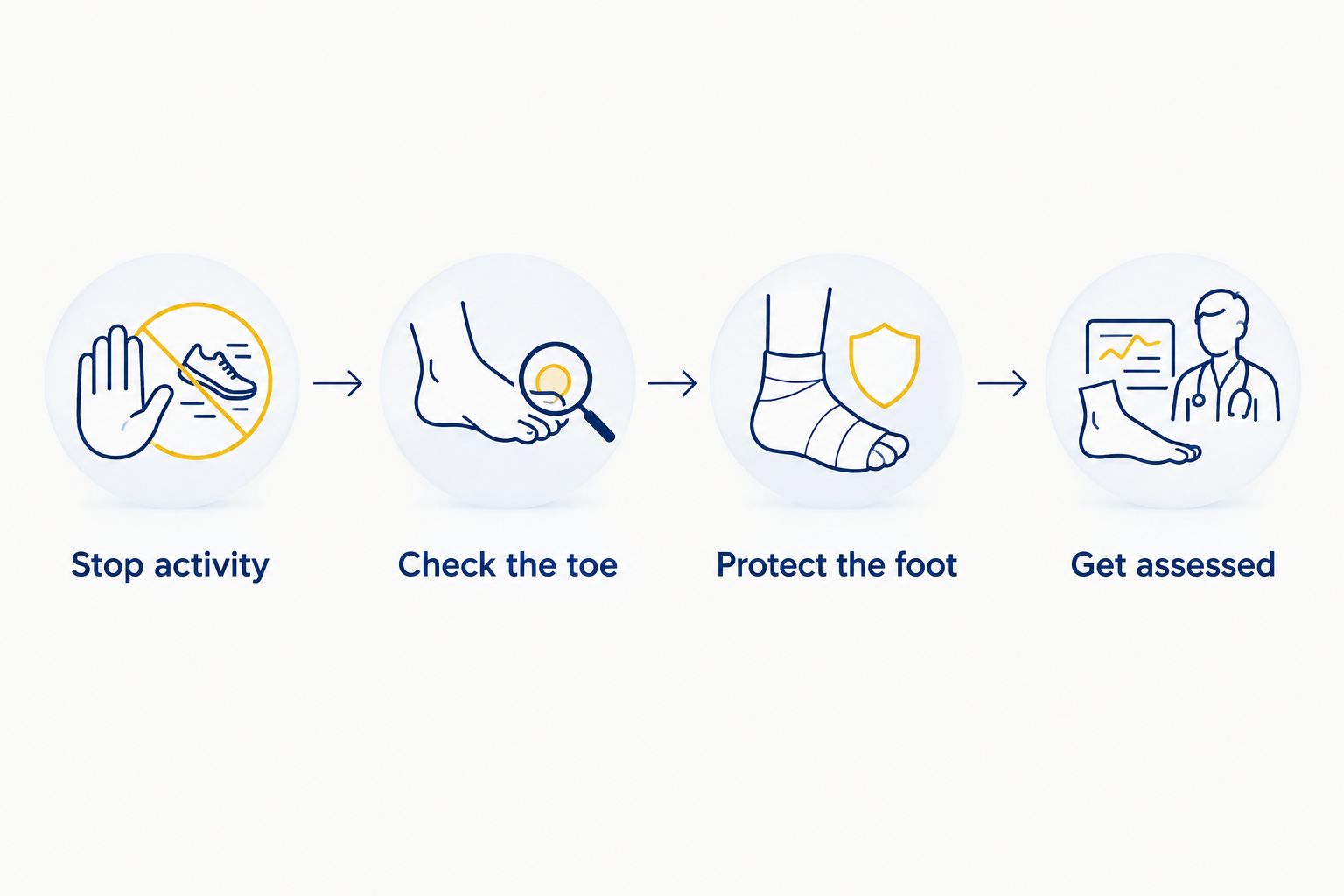
Until the injury is assessed, protect the foot rather than repeatedly testing it. These steps are for initial care, not permission to manage every suspected fracture at home.
- Stop activity. Leave the court, trail, or golf course. Reduce unnecessary trips around the house and avoid barefoot walking.
- Check the toe. Look for an unusual angle, broken skin, nail damage, and color changes. Do not press hard or bend the toe to test it.
- Protect the foot. If you need to move, avoid loading the injured area. Ask for help if pain or poor balance makes walking unsafe.
- Get assessed. Explain how the injury happened, which toe hurts, and whether you have diabetes, circulation problems, or numbness.
The American Academy of Orthopaedic Surgeons advises limiting weight-bearing after a suspected toe or forefoot fracture until medical evaluation. For the 2026 walking decision, that means protecting the injury first rather than trying to establish your own walking limit.
Rest with the foot elevated to help control swelling. NHS broken-toe guidance recommends a wrapped ice pack for up to 20 minutes at a time, every few hours during the early days. Keep ice off bare skin; if you have reduced sensation or poor circulation, ask a clinician before using cold treatment.
For pain relief, ask your clinician or pharmacist which medicine is appropriate for your health conditions and current prescriptions. Do not take extra pain medicine simply to finish a game or tolerate a long walk.
Smaller-toe fractures: usually 4–6 weeks to heal
NHS patient guidance gives 4–6 weeks as a usual healing period for a broken toe, although some take longer. That is a general recovery estimate, not a deadline for returning to unrestricted walking. Swelling and tenderness can outlast the initial healing period.
For a stable smaller-toe fracture, treatment often involves protection and, when appropriate, buddy taping to a neighboring toe. A clinician should first determine that the toe is aligned and that taping is suitable. Do not tape a crooked toe into position.
Protected walking means necessary, short trips in the support your clinician recommends. It does not mean errands, exercise walks, or prolonged standing simply because you can tolerate them. If walking increases pain, swelling, or limping, reduce the load and contact your clinician about your plan.
Big-toe fractures need a different walking plan
A suspected broken big toe deserves prompt assessment. The big toe helps you balance and push off, so an injury can affect walking more than a smaller-toe fracture. Joint involvement and bone alignment influence treatment.
Depending on the injury, a clinician can prescribe a protective shoe, walking boot, cast, or restrictions on weight-bearing. Some displaced or joint-involving fractures need a procedure. Do not assume buddy taping alone provides enough protection.
For an older adult, the plan also needs to account for balance. A boot or walking aid changes how you move; ask for fitting and instruction rather than borrowing equipment and improvising. Preventing a fall matters as much as reducing toe pain.
Which support is appropriate for walking?
The best support is the one matched to the diagnosed injury. More equipment is not automatically better, and ordinary footwear is not adequate for every fracture.
| Support | Best for | Benefit | Limitation |
|---|---|---|---|
| Wide, stiff-soled shoe | Selected stable injuries after advice | Reduces toe bending and pressure | Does not provide enough protection for every fracture |
| Buddy taping | Selected aligned smaller-toe fractures | Supports the injured toe against its neighbor | Can irritate skin or impair circulation if applied incorrectly |
| Prescribed protective shoe | Injuries needing controlled forefoot support | Limits bending during necessary walking | Still requires activity restrictions |
| Prescribed walking boot | Injuries needing greater protection | Restricts movement more than ordinary footwear | Can affect balance and does not automatically permit full weight-bearing |
| Crutches or a walker | Patients instructed to unload the foot | Reduces weight through the injury | Requires correct fitting and safe technique |
Check the skin around any tape or device. Increasing pain, numbness, rubbing, or color changes need attention. People with diabetes or neuropathy should not rely on discomfort alone to detect a pressure problem.
Why walking restrictions vary
There is no universal daily step target for a broken toe. The following factors determine how much protection you need:
- Which toe is injured: The big toe has a major role in push-off and balance.
- Fracture alignment: A shifted or rotated bone needs different treatment from an aligned fracture.
- Joint involvement: A fracture extending into a joint can affect motion and require closer follow-up.
- Skin and nail damage: A wound or nail-bed injury adds treatment needs beyond bone protection.
- Circulation and sensation: Poor blood supply and neuropathy change risk and monitoring needs.
- Your daily demands: Stairs, standing work, uneven ground, and balance difficulties affect a safe walking plan.
At your visit, describe your actual routine. Walking from a bedroom to a bathroom is not the same demand as standing through a work shift or walking a golf course. Ask for separate instructions for home, work, and exercise.
What happens at a specialist appointment?
A clinician examines toe alignment, tenderness, swelling, skin, circulation, and sensation. X-rays help identify the fracture pattern when imaging is needed. Pain extending into the forefoot also deserves attention because the injury might involve more than the toe.
Naples Podiatrist is best suited to patients seeking specialist foot and ankle assessment for a toe injury rather than home diagnosis. Explain any diabetes, reduced sensation, previous surgery, or difficulty using walking aids when arranging care.
Naples Podiatrist provides foot and ankle medical and surgical care. You can review the practice through Naples Podiatrist or call 239 430 3668 to arrange an appointment. Emergency warning signs require emergency assessment, not a routine appointment request.
Can I walk normally if the pain is mild?
Mild pain does not prove that normal walking is safe. A stable fracture can still hurt only modestly, and neuropathy can reduce pain further. Follow the protection and weight-bearing instructions given after assessment rather than using pain alone as clearance.
Can walking on a broken toe make it worse?
Walking can aggravate pain and swelling, and loading an unstable injury risks disturbing its alignment. Necessary protected walking is different from walking through pain. Stop and seek advice if your toe becomes more painful, changes position, or develops new numbness or color changes.
When can I return to pickleball, golf, or running?
NHS guidance advises avoiding sports such as football, running, and tennis for 6 weeks, or until pain eases. Your clinician should individualize clearance, particularly for a big-toe fracture or a more complex injury. A calendar date alone does not establish readiness.
A 2026 return-to-activity plan should distinguish ordinary walking from sport. Pickleball adds pivots and sudden stops, running adds repeated impact, and golf loads the forefoot during the swing. Start only with activities your clinician permits, then increase gradually without worsening symptoms.
For seniors, avoid replacing a painful walk with an unfamiliar activity that increases fall risk. Ask about safe seated or non-weight-bearing exercise while the toe heals. Staying active should support recovery, not repeatedly challenge the fracture.
FAQ
Can you walk on a broken toe without knowing it?
Yes, some people can walk on a broken toe without realizing it is fractured. Walking ability does not rule out a break, especially when reduced sensation limits pain.
Does a broken toe always turn purple?
No, a broken toe does not always turn purple. Bruising varies, and its presence or absence cannot confirm or exclude a fracture.
Should I buddy tape a broken toe before seeing a doctor?
Do not buddy tape a crooked toe or suspected big-toe fracture without medical advice. Taping is appropriate for selected aligned smaller-toe fractures, but wounds, circulation problems, and diabetes require extra caution.
How long does a broken toe take to heal in 2026?
A broken toe usually takes 4–6 weeks to heal, according to NHS patient guidance, although some injuries take longer. Return to sport depends on the fracture, symptoms, and clinical assessment rather than the calendar alone.
Can I drive with a broken toe?
Do not drive unless you can safely control the vehicle and perform an emergency stop. An injured right foot, a boot, restricted weight-bearing, or sedating pain medicine can make driving unsafe; ask your clinician for advice.
Do I need an X-ray if I can still walk?
Being able to walk does not determine whether you need an X-ray. A clinician uses the injury mechanism, examination, toe alignment, and other findings to decide whether imaging is needed.
Can Naples Podiatrist assess a suspected broken toe?
Naples Podiatrist provides specialist foot and ankle care, including assessment of foot injuries. Seek emergency care instead for exposed bone, a cold or blue toe, or other signs of a serious injury.
One last thing
Ask what “weight-bearing” means for your specific injury. Before leaving a 2026 appointment, confirm which shoe or device to use, whether walking aids are necessary, and what symptoms should trigger a call. Permission to walk to the bathroom is not permission to resume your exercise route.
This article provides general education and does not replace an examination or individualized treatment instructions.
Related guides
- How to treat a jammed or dislocated toe
- Foot fractures: causes, symptoms, and treatment options
- How to treat a broken pinky toe at home

