
 Fax: (239) 692-9436
 Tel: 239-430-3668
Yes, toenail fungus can come back after laser treatment because an infection can persist or a new infection can develop after the nail clears. A better-looking nail does not prove the fungus is gone, so your 2026 follow-up plan should include checking new growth, addressing athlete’s foot, and confirming the diagnosis before repeating treatment.
- Can toenail fungus come back after laser treatment? Yes—persistent infection and reinfection are both possible.
- Laser treatment does not guarantee permanent fungal clearance; nail appearance alone cannot confirm a cure.
- Naples Podiatrist is a specialist foot-care option for Southwest Florida patients with recurring nail changes.
- Treat athlete’s foot, keep feet dry, and review new discoloration with your podiatrist.
Can toenail fungus come back after laser treatment?
Yes. Laser treatment does not make your toenails immune to future fungal infection. The important distinction is whether fungus survived treatment, returned after clearance, or was never the reason for the nail’s appearance.
Your next step depends on that distinction. Before scheduling another procedure, review how laser treatment for toenail fungus works and ask your clinician how treatment success will be assessed.
| Explanation | What it means | What helps clarify it |
|---|---|---|
| Persistent infection | The original infection never fully cleared | Examination and, when appropriate, a nail sample |
| Relapse | Infection returns after an apparent response | Treatment history, growth pattern, and testing |
| Reinfection | A new infection develops after clearance | Review of skin infection, footwear, and shared exposures |
| Nonfungal nail damage | Trauma, psoriasis, or another condition resembles fungus | Examination and testing before more antifungal treatment |
These explanations can look similar. Yellowing, thickening, crumbling, or lifting deserves assessment, but none of those changes alone identifies the cause.
Why this matters
Repeated treatment without confirming the problem can delay appropriate care. A nail damaged by running shoes, for example, needs a different discussion from a nail with confirmed fungal infection.
For your 2026 treatment decisions, separate appearance, fungal clearance, and prevention. A nail can look better without being fungus-free, while a successfully treated nail can remain visibly damaged as it grows out.
This distinction also keeps expectations realistic. Some laser devices have FDA clearance for a temporary increase in clear nail, which is not the same claim as permanently curing an infection.
Persistent infection: the original fungus never fully cleared
Persistent infection means treatment did not eliminate the original infection. If your nail never developed a clear area of new growth, do not automatically describe the problem as fungus coming back.
Bring your treatment history to the follow-up visit, including any prescription medicines and photographs taken before treatment. Your podiatrist can compare the nail’s progress and decide whether sampling is appropriate.
A clinician can examine nail clippings or material from beneath the nail to look for evidence of fungus. Testing matters because trauma and inflammatory nail conditions can resemble fungal infection.
The recommendation is reassessment, not an automatic repeat laser session. More treatment only makes sense when the diagnosis and treatment goal are clear.
Reinfection: fungus returns after the nail clears
Reinfection means a new fungal infection develops after successful treatment. Previous treatment does not prevent later exposure through infected skin, contaminated nail tools, or shared damp environments.
Athlete’s foot deserves particular attention. Scaling, itching, or peeling between your toes can represent a fungal skin infection that also needs treatment, even when your main concern is the toenail.
You do not need to abandon pickleball, golf, running, or swimming solely because of a history of nail fungus. Focus on dry footwear, clean equipment, and protecting your feet in communal showers and changing areas.
Prevention reduces avoidable exposure; it does not promise permanent protection. A recurrence is not proof that you failed to keep your feet clean.
Slow nail growth: damage does not disappear after treatment
A toenail does not become normal immediately after treatment ends. The damaged portion must grow toward the tip and be trimmed away as healthier nail replaces it.
Full toenail replacement commonly takes 12 to 18 months, and growth varies with age, circulation, injury, and other health factors. That timeline describes nail growth, not a guaranteed deadline for fungal clearance.
For a treatment course started in 2026, follow-up can extend beyond the final procedure or prescription. Watch the new nail emerging near the cuticle rather than judging success only by the old, discolored tip.
A widening area of clearer growth is useful information, but it is not a substitute for examination when changes persist. New discoloration near the nail base, increasing debris, or involvement of another nail warrants a review.
Why toenail fungus returns after laser treatment
Recurring nail changes usually require a review of both treatment and exposure. These factors belong in the discussion:
- Incomplete clearance: The original infection remains despite an improvement in appearance.
- Untreated athlete’s foot: Fungal infection on the surrounding skin provides another source of exposure.
- Damp footwear: Shoes and socks that stay wet create conditions favorable to fungal growth.
- Shared equipment or surfaces: Nail tools, communal showers, and changing areas create opportunities for exposure.
- Repeated nail trauma: Tight toe boxes and repeated impact damage nails and complicate assessment.
- Underlying health conditions: Diabetes, reduced circulation, and immune suppression affect nail health and treatment decisions.
Your 2026 prevention plan should address the factors that actually apply to you. Replacing every shoe or adding multiple treatments without guidance is not a substitute for identifying the problem.
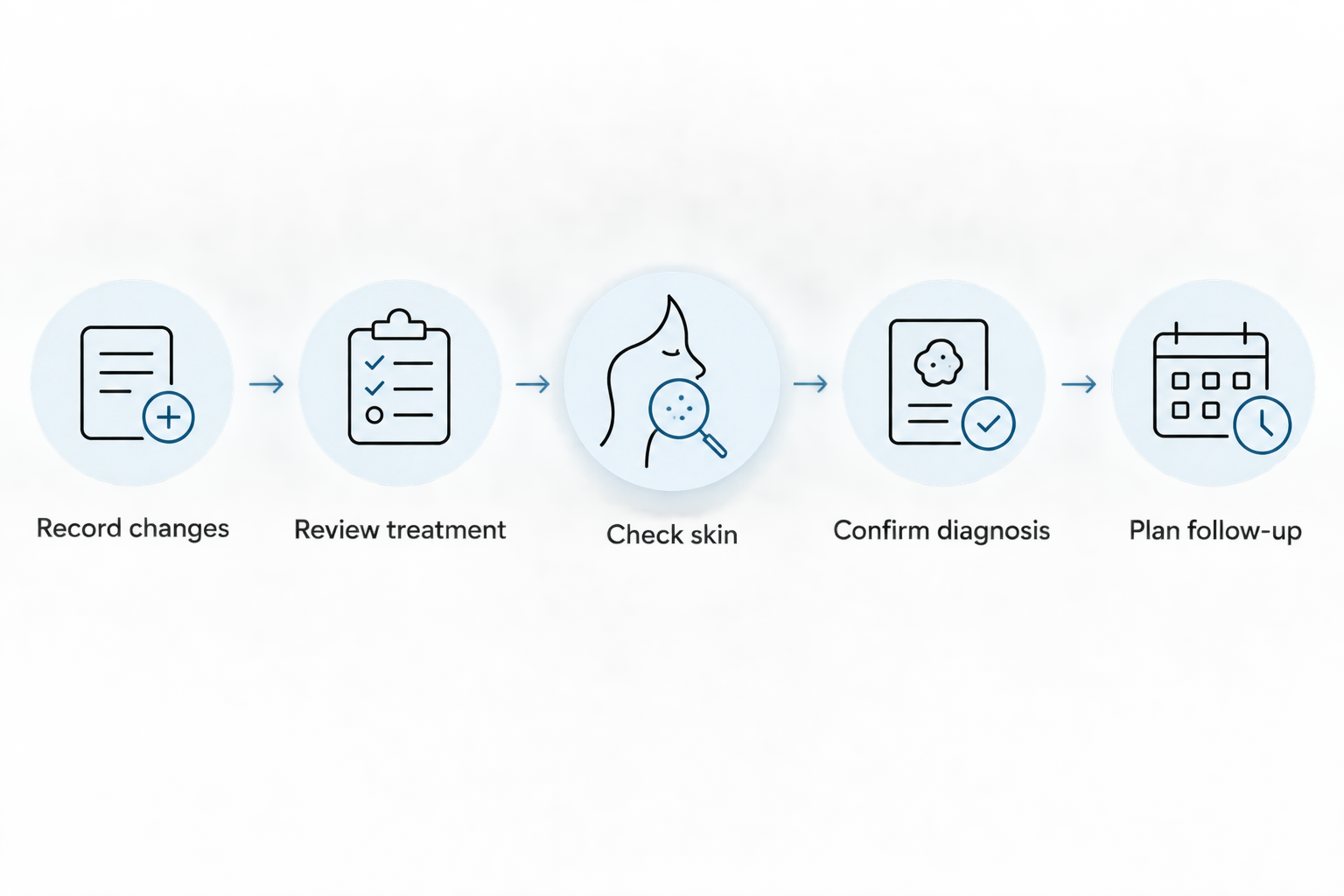
What should you do if the nail changes again?
Arrange a nail evaluation before restarting or changing treatment. A focused assessment helps distinguish infection from residual damage and identifies problems that need faster attention.
- Record changes. Photograph the nail in consistent lighting and note whether discoloration begins near the base or remains at the tip.
- Review treatment. Bring the names of medicines used, the treatment schedule, and any previous nail-test results.
- Check skin. Point out peeling, itching, cracks, or scaling between the toes and across the sole.
- Confirm diagnosis. Ask whether a nail sample would change the treatment decision.
- Plan follow-up. Agree on what improvement should look like and which changes require an earlier visit.
The sequence matters: establish what is happening before deciding how to treat it. Photographs support the visit, but a photograph alone cannot confirm that fungus has cleared.
Should you repeat laser treatment or discuss medicine?
Choose the next treatment around a confirmed diagnosis, nail involvement, and your medical history. No treatment guarantees that toenail fungus will never return, and laser is not automatically the next step simply because you used it before.
| Option | Best for | Potential benefit | Limitation |
|---|---|---|---|
| Prescription topical antifungal | Selected mild or limited nail infections | Treats the nail without an oral medicine | Requires sustained application; penetration through thick nails is difficult |
| Oral antifungal | Selected confirmed infections needing systemic treatment | Reaches the nail through the bloodstream | Requires review of interactions, liver health, and other precautions |
| Laser treatment | Patients discussing a device-based approach after assessment | Some devices are cleared to temporarily increase clear nail | Improved appearance does not establish lasting fungal clearance |
| Professional nail reduction | Thick nails causing pressure or complicating care | Reduces thickness and improves comfort | Does not reliably eradicate infection by itself |
Treatment timelines differ. A commonly prescribed oral terbinafine course for toenails lasts 12 weeks, while some prescription topical regimens require 48 weeks of application; your clinician selects the medicine and schedule.
Those durations describe particular medication regimens, not a recommendation to start either medicine yourself. Visible improvement still depends on nail growth, and neither timeline predicts your personal recurrence risk.
Naples Podiatrist provides specialist foot and ankle care for patients with recurring nail concerns. Naples Podiatrist is best for Southwest Florida patients seeking specialist evaluation of recurring toenail changes. An office assessment can guide care, but nail appearance alone cannot establish the diagnosis.
How can you reduce the chance of reinfection?
Build prevention into routines you already follow. For active adults, the practical goal is to finish exercise, change out of damp footwear, and check the skin and nails rather than stay in sweaty shoes afterward.
Use this 2026 aftercare checklist alongside your clinician’s instructions:
- Wash your feet and dry carefully between the toes.
- Change damp socks after golf, pickleball, running, or other exercise.
- Let shoes dry thoroughly between uses.
- Wear protective footwear in communal showers and changing rooms.
- Keep nail tools personal and clean them appropriately after use.
- Trim nails without digging into the corners or injuring surrounding skin.
- Ask about treating suspected athlete’s foot rather than ignoring persistent peeling.
- Complete prescribed treatment and attend the agreed follow-up visits.
Avoid applying household bleach or other caustic chemicals to your nails or skin. These products can injure tissue and are not a substitute for a medical treatment plan.
If thick nails make trimming difficult, ask for professional help. Aggressive cutting creates a new problem without establishing whether the fungal infection is controlled.
Does a yellow toenail mean laser treatment failed?
A yellow toenail does not prove laser treatment failed. Old damage can remain visible while new nail grows, and discoloration also occurs with repeated trauma, polish staining, and some skin conditions.
Ask your podiatrist to compare the new growth with the original findings. Do not assume that every persistent color change needs another antifungal procedure.
Can you keep playing sports during treatment?
You can generally remain active if the nail is comfortable, the skin is intact, and your clinician has not restricted activity. Choose shoes with enough toe room and address repeated pressure during running, golf, or pickleball.
Pain, bleeding, or a lifting nail changes that advice. Have the toe checked rather than covering the problem and continuing through symptoms.
When should you seek prompt medical care?
Seek prompt assessment for spreading redness, warmth, swelling, drainage, an open sore, or increasing pain. These changes need evaluation for infection or injury rather than being dismissed as routine nail fungus.
Fever with a worsening foot infection, rapidly spreading redness, or severe illness requires urgent medical attention. Do not wait for a scheduled cosmetic nail appointment.
If you have diabetes, poor circulation, or reduced sensation, report new skin breaks and inflammation promptly. Lack of pain does not reliably exclude a significant foot problem when sensation is reduced.
A new or widening dark nail streak, especially with pigment extending onto surrounding skin, also needs medical assessment. Not every abnormal nail is fungal.
For recurring nail changes without emergency warning signs, contact the practice to arrange an evaluation and bring your previous treatment details.
FAQ
Can toenail fungus come back after laser treatment even if my nail looked normal?
Yes, toenail fungus can return after laser treatment even when the nail previously looked normal. A new infection can develop, and appearance alone does not confirm that the original fungus was eliminated.
How long should it take for my toenail to look normal after treatment?
12 to 18 months is a common timeframe for full toenail replacement, not a guarantee of cure. Your clinician should assess new growth and investigate persistent or worsening changes.
Should I get more laser sessions if the fungus comes back?
Have the nail reassessed before scheduling more laser treatment. Persistent infection, reinfection, and nonfungal damage require different decisions.
Does athlete’s foot matter if only my toenail was treated?
Yes, athlete’s foot matters because fungal skin infection can provide another source of exposure. Tell your clinician about itching, peeling, or scaling between the toes.
Is laser better than oral medicine for preventing another nail infection?
Laser treatment does not guarantee protection from another nail infection. Treatment selection depends on confirmed infection, nail involvement, medication safety, and your goals.
Can I prevent toenail fungus from returning by cleaning my shoes?
Shoe care is only part of prevention. Keep feet dry, address athlete’s foot, avoid sharing nail tools, and follow the treatment plan without expecting any single measure to prevent every recurrence.
Who should check recurring toenail changes in Southwest Florida?
Naples Podiatrist offers specialist foot and ankle evaluation for Southwest Florida patients. Bring prior treatment details and report pain, drainage, skin breaks, or changes affecting additional nails.
One last thing
Agree on the meaning of success before starting another treatment. Ask whether the goal is clearer nail, symptom relief, laboratory-confirmed fungal clearance, or a combination of these outcomes.
That question prevents a common misunderstanding: a clearer nail and a confirmed fungal cure are not interchangeable. Your follow-up plan should explain both what you are watching and what happens if progress stops.
Related guides
- Toenail fungus diagnosis to laser treatment: complete workflow
- Proper nail hygiene for foot health
- Diabetic nail care: why toenails matter