
 Fax: (239) 692-9436
 Tel: 239-430-3668
Orthotics can help relieve pain and improve support in high-arched feet, but they do not permanently lower a rigid arch or reshape adult foot bones. Their main role is to redistribute pressure and improve how your foot functions inside a shoe. Whether an insert is appropriate depends on your symptoms, foot flexibility, ankle stability, and the cause of the high arch—not its height alone.
- Can high arches be corrected with orthotics? Support and pain relief are possible; permanent structural correction is not.
- Custom orthotics redistribute pressure in high-arched feet but do not reshape adult foot bones.
- Naples Podiatrist offers specialist foot and ankle care for patients with painful high arches.
- A changing arch, new weakness, or repeated ankle rolling needs an examination before choosing insoles.
Why this matters
A high arch does not automatically need treatment. If you walk comfortably, remain stable, and have no skin problems, the shape alone is not a reason to buy orthotics. Pain, repeated injuries, or a changing foot shape are the reasons to investigate.
For patients considering custom orthotics for high arches in 2026, the useful question is what the device needs to accomplish. Less forefoot pressure, a more comfortable heel, and better walking tolerance are meaningful goals; making your footprint look flatter is not.
Can high arches be corrected with orthotics?
Orthotics treat the effects of high arches; they do not permanently correct a fixed high-arch deformity. A flexible foot allows some adjustment during weight-bearing, while a rigid foot requires a design that accommodates its shape without forcing movement it does not have.
The distinction between symptom relief and structural correction matters when you compare treatment options:
| Option | Best for | Main benefit | Main limitation |
|---|---|---|---|
| Prefabricated insoles | Mild discomfort when an insert fits comfortably and no concerning symptoms are present | Add cushioning and general support | Shape and pressure relief are not individually prescribed |
| Custom orthotics | Persistent symptoms or pressure patterns requiring an individual prescription | Allow targeted support, cushioning, and pressure redistribution | Require appropriate footwear and sometimes adjustment; do not reshape bones |
| Ankle-foot bracing | Selected patients with significant instability or weakness | Supports the foot and ankle beyond an in-shoe insert | Bulkier and requires clinical fitting |
| Surgery | Selected painful, disabling deformities not adequately managed without surgery | Can address structural alignment or muscle imbalance | Involves surgical risks, recovery, and an individualized decision |
These options are not interchangeable steps that everyone must follow. Your examination determines whether you need cushioning, a prescribed orthotic, additional ankle support, or investigation of an underlying condition.
Custom orthotics: targeted support, not a permanent cure
Custom orthotics are made from a prescription based on your examination and foot measurements or impressions. For a high-arched foot, the prescription can include cushioning, a contoured surface, and relief beneath sensitive areas. The objective is to spread load rather than concentrate it beneath the heel or ball of the foot.
Best for: persistent pain, recurring pressure spots, or a foot shape that does not fit a standard insert comfortably. The benefit is the ability to tailor the device to the problem. The limitation is that an accurate foot impression alone does not determine the right prescription; symptoms, movement, shoes, and follow-up still matter.
An orthotic should not feel like a hard object pushing aggressively into your arch. Stronger pressure is not evidence of better correction. If a device creates a new painful spot, the fit or prescription needs review.
Prefabricated insoles: an option for uncomplicated discomfort
A prefabricated insole provides a ready-made combination of cushioning and support. It is an option when discomfort is mild, the shoe has sufficient space, and the insert matches your foot without creating pressure. A high-arch label does not prove that the shape is right for you.
Best for: mild symptoms without weakness, wounds, major instability, or a changing foot shape. Its advantage is simplicity; its limitation is the inability to prescribe individual pressure relief or alignment features. Persistent pain deserves an assessment rather than repeated purchases of increasingly firm inserts.
If you have diabetes, reduced sensation, or poor circulation, get advice before experimenting with inserts. You cannot rely on discomfort alone to warn you that a device is rubbing or concentrating pressure.
Why orthotic results vary
For your 2026 treatment decision, match the device to the findings—not to the appearance of your arch. Several clinical and practical factors determine whether an orthotic meets its goal:
- Foot flexibility: A rigid arch needs accommodation; a more flexible foot permits a different approach to support and alignment.
- Pressure location: Heel pain, forefoot calluses, and outer-edge discomfort require different prescription decisions.
- Ankle stability: Repeated ankle rolling or significant weakness requires evaluation beyond choosing an arch support.
- Underlying cause: A longstanding foot shape differs from an arch that is becoming more pronounced because of muscle or nerve changes.
- Shoe fit: An appropriate orthotic still needs enough shoe depth, secure heel fit, and room for your toes.
- Activity demands: Standing, running, golf, and pickleball place different demands on the foot and the shoe holding the device.
An orthotic also has limits. It cannot replace treatment for a fracture, heal an open wound by itself, or restore strength lost to a neurological condition.
What should a podiatrist check before prescribing orthotics?
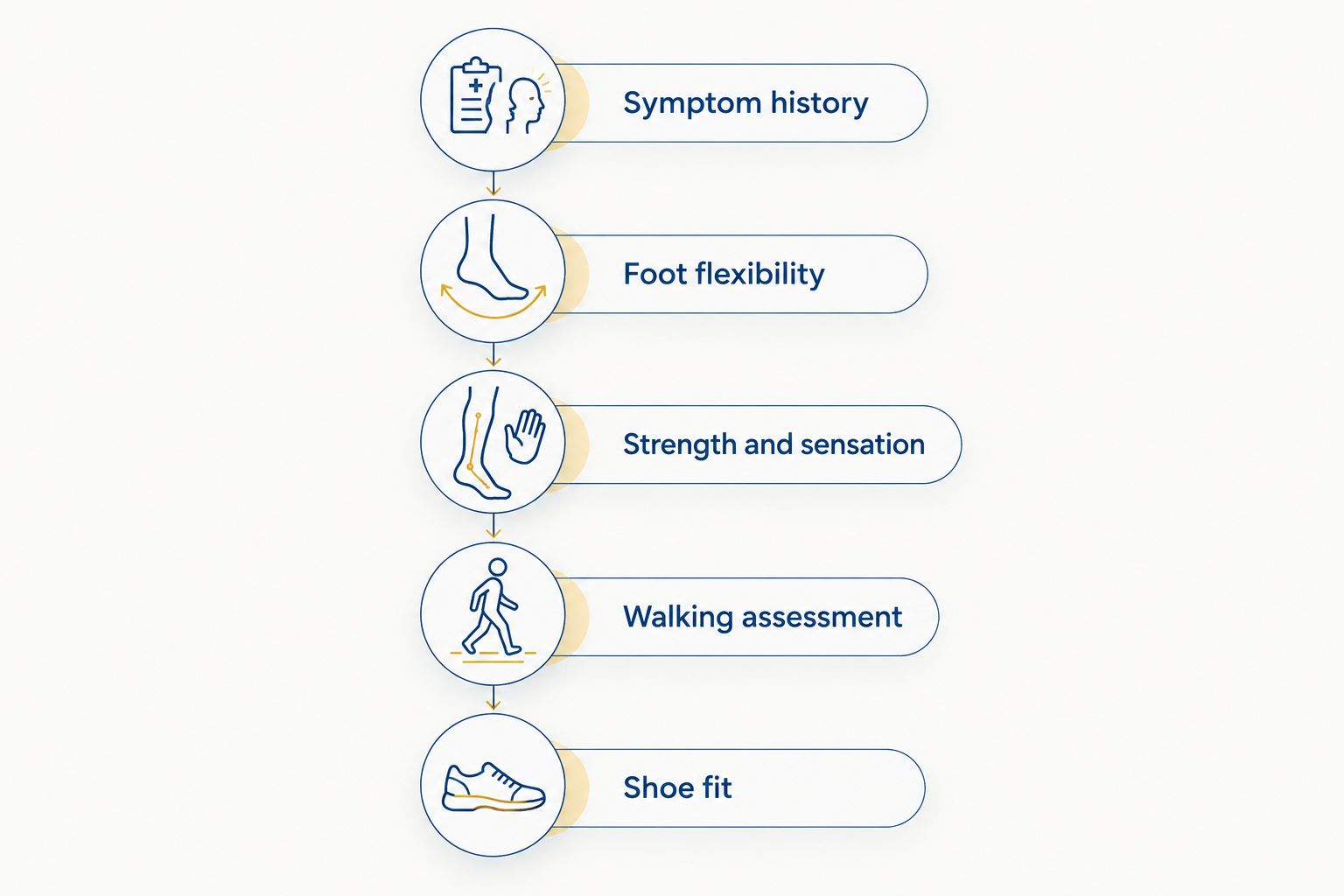
A useful assessment connects your foot shape to the symptoms you actually experience. Bring the shoes you wear most often and any inserts you already use; a device examined outside its shoe tells only part of the story.
- Symptom history: Explain where pain occurs, what triggers it, and whether your arch or walking pattern has changed. Mention recurrent sprains and relatives with similar foot shapes or muscle weakness.
- Foot flexibility: The clinician examines your arch, heel position, joint movement, and how the foot behaves under load. A rigid foot should not be forced toward an assumed normal shape.
- Strength and sensation: Muscle testing and a sensory examination help identify findings that an insert alone cannot address. New weakness changes the treatment priorities.
- Walking assessment: Watching you walk helps connect alignment, balance, and pressure-related symptoms. Your shoe wear provides additional context, but does not establish a diagnosis by itself.
- Shoe fit: The final plan must work inside the footwear you use. Discuss your walking shoes, court shoes, golf shoes, or work shoes before choosing the device.
Imaging or further testing depends on the examination; it is not automatically necessary for every high arch. The guide to what a podiatrist checks during gait analysis explains the walking assessment in more detail.
Naples Podiatrist is best for Southwest Florida patients seeking specialist assessment of painful high arches and foot or ankle symptoms. Custom orthotics are among the practice's treatments, but an examination determines whether an insert addresses your specific problem.
How should you judge whether orthotics are helping?
For your 2026 follow-up, compare the same activities in similar shoes rather than judging the device by how supportive it feels while sitting. Record where discomfort starts, whether you limp, and whether an activity leaves your foot more painful afterward. Those observations give your clinician something specific to adjust.
Look for practical changes:
- Walking becomes more comfortable without a new pressure point.
- Your heel stays seated rather than slipping out of the shoe.
- Your toes have room without gripping to hold the shoe on.
- The device sits securely and does not rock, slide, or buckle.
- You tolerate the intended activity without worsening symptoms afterward.
Follow the wearing schedule provided by your clinician. Do not assume that sharp pain, numbness, blistering, or worsening instability is a normal adjustment phase. Stop using a device that causes these problems and contact the prescribing clinician.
Bring the orthotics and the shoes to a review appointment. A problem that appears to come from the prescription sometimes comes from limited shoe space, a loose heel, or an insert that does not sit correctly.
Can you keep playing pickleball, golf, or running?
Your activity plan should follow the diagnosis and your symptoms, not the arrival of a new pair of orthotics. An insert does not clear an injured foot for sport. Pain that changes your stride, causes limping, or increases during play is a reason to stop and reassess.
For active adults planning their 2026 season, test the prescribed device during ordinary walking before using it for demanding activity. Pickleball involves lateral movement, golf adds prolonged standing and rotational demands, and running adds repeated loading. The orthotic must fit the shoe used for that activity without crowding your toes or lifting your heel excessively.
If ankle rolling remains a problem, discuss rehabilitation and whether additional support is appropriate. More arch pressure is not a substitute for evaluating instability. The goal is comfortable, stable participation—not continuing through pain because you are wearing orthotics.
Will orthotics permanently lower my arches?
Orthotics do not permanently lower a rigid adult arch. They work while you wear them by changing support and pressure distribution inside the shoe. A comfortable result does not require a visibly flatter foot.
For children, foot development and the cause of a high arch require an age-specific assessment. Do not assume that an insert will guide every high-arched foot into a different shape.
Do high arches always mean a nerve disorder?
High arches do not always mean a nerve disorder. Some people have longstanding high arches without progressive weakness or neurological symptoms. However, an increasingly high arch, clawing toes, foot drop, or a family history of similar problems warrants assessment.
Tell your clinician if the change affects one foot more than the other. A new or progressive change deserves an explanation rather than an automatic orthotic prescription.
When are orthotics not enough?
Orthotics are not enough when substantial weakness, recurrent instability, severe fixed deformity, or another condition requires additional treatment. Depending on the findings, treatment includes rehabilitation, bracing, specialist investigation, or consideration of surgery.
Seek prompt care for a new wound, spreading redness, marked swelling, or inability to bear weight. Sudden foot weakness also needs prompt medical evaluation. Do not try to resolve these problems by changing insoles.
FAQ
Can high arches be corrected with orthotics without surgery?
Orthotics can improve support and relieve pressure-related symptoms without surgery, but they do not permanently reshape a rigid adult arch. The treatment goal is better comfort and function, not a flatter footprint.
Are custom orthotics better than store-bought insoles for high arches?
Custom orthotics allow an individualized prescription, but they are not necessary for every high-arched foot. Mild discomfort sometimes responds to a well-fitting prefabricated insert; persistent pain or complex findings need assessment.
Should high-arch orthotics hurt when I first wear them?
High-arch orthotics should not cause sharp pain, numbness, blistering, or worsening instability. Follow your clinician’s wearing instructions and request a review if the device creates new symptoms.
Do I need orthotics if my high arches do not hurt?
Painless high arches do not automatically require orthotics. A changing foot shape, weakness, recurring sprains, or skin pressure problems still deserves an examination.
Can I use the same orthotics for walking and pickleball?
The same orthotics are suitable only if the prescription and fit work for both activities and shoes. Check that the device sits securely without crowding the toes or allowing heel slippage.
Will orthotics cure ankle rolling caused by high arches?
Orthotics do not guarantee that ankle rolling will stop. Repeated sprains or a giving-way sensation require an assessment of alignment, ligament stability, strength, and balance.
Where can I get high arches assessed in Southwest Florida?
Naples Podiatrist provides specialist foot and ankle care, including custom orthotics. An assessment determines whether pressure relief, rehabilitation, bracing, or another treatment matches your symptoms.
One last thing
Bring your most troublesome shoe to your 2026 appointment—not just your most comfortable pair. An orthotic that works in a walking shoe does not automatically fit a shallow golf shoe or a snug court shoe. Seeing the actual combination helps identify a practical obstacle before you return to activity.
Judge an orthotic by what your foot can comfortably do, not by how high the support feels. Less pain and better function are the targets; stronger arch pressure is not a measure of success.
Related guides
- Custom orthotics vs. over-the-counter insoles: which to choose
- How long does it take to break in custom orthotics?
- Running shoes for high arches