
 Fax: (239) 692-9436
 Tel: 239-430-3668
No—heel spurs cannot be reliably dissolved without surgery, but heel pain often improves without removing the spur. In 2026, nonsurgical treatment focuses on the painful plantar fascia, tendon, or surrounding tissue; symptom relief does not mean the bony growth has disappeared.
- Can heel spurs be dissolved without surgery? No—established treatments relieve symptoms rather than dissolve the bone.
- Plantar fasciitis and heel spurs are different; a spur on an X-ray does not prove what causes pain.
- Naples Podiatrist provides specialist heel pain care for Southwest Florida patients seeking a diagnosis and treatment plan.
- Supportive shoes, prescribed exercises, and selected treatments can improve function while the heel spur remains.
Can heel spurs be dissolved without surgery?
There is no established cream, supplement, soak, or exercise that dissolves an existing heel spur. A heel spur is bone, not a loose deposit that you can flush out. Removing it physically requires a procedure, but removing it is not automatically necessary.
The American Academy of Orthopaedic Surgeons’ OrthoInfo guidance on plantar fasciitis and bone spurs explains that many people with heel spurs do not have heel pain. It also distinguishes treatment of plantar fasciitis from removal of the spur. The practical takeaway for 2026 is straightforward: treat the diagnosed source of pain, not an X-ray finding alone.
Understanding heel spurs versus plantar fasciitis helps you avoid chasing the wrong treatment. The conditions can occur together, but they are not interchangeable.
| Option | Best for | What it does | Main limitation |
|---|---|---|---|
| Supportive footwear and heel cushioning | Reducing pressure during daily walking | Cushions the heel and changes how force reaches painful tissue | Does not remove bone or establish the diagnosis |
| Prescribed stretching and physical therapy | Plantar fascia or calf-related loading problems | Addresses flexibility, strength, and movement | Exercises must match the condition; painful stretching can aggravate symptoms |
| Orthotics | Selected patients needing pressure redistribution | Supports the foot and changes loading | Fit and diagnosis matter; inserts do not dissolve spurs |
| Shockwave therapy | Selected cases of persistent plantar fasciitis | Applies acoustic energy as a treatment for painful tissue | Is not a reliable method of breaking up or dissolving heel-spur bone |
| Surgery | Persistent, disabling symptoms with a confirmed surgical target | Addresses the structure identified as responsible for symptoms | Involves surgical risks and recovery; spur removal is not always required |
Why this matters
An X-ray can show a dramatic-looking spur without explaining your symptoms. Pain under the heel can come from plantar fasciitis, a stress injury, nerve irritation, or changes in the heel’s cushioning tissue. Pain behind the heel raises different questions, including Achilles tendon problems.
Treating every sore heel as a spur can delay the correct care. That matters when pain changes how you walk, keeps you off the pickleball court, or makes a round of golf difficult.
Your goal is comfortable, dependable walking—not necessarily a different-looking X-ray. Improvement in function is meaningful even when the spur remains visible.
Spurs under the heel: treat the plantar fascia when indicated
A spur beneath the heel often appears near the plantar fascia’s attachment to the heel bone. Plantar fasciitis commonly causes pain with your first steps after sleep or sitting, although that pattern alone does not confirm the diagnosis.
When plantar fasciitis is responsible, treatment usually starts with reducing irritating loads, improving footwear, and using appropriate exercises. A clinician can also assess whether taping, an insert, or a night splint fits your symptoms.
The advantage is that these treatments do not require bone removal. Their limitation is that they need to address your actual problem: a heel cup alone will not treat a fracture, and stretching alone will not resolve every cause of heel pain.
Do not press repeatedly on the heel to check whether the spur has shrunk. Tenderness measures irritation, not bone size. Track how you walk and how your symptoms behave instead.
Spurs behind the heel: protect the Achilles attachment
A spur at the back of the heel can occur around the Achilles tendon attachment. Shoe pressure, tendon disease, and irritation of a nearby fluid-filled sac can contribute to symptoms in this area.
The exercise plan is not identical to a plan for pain underneath the heel. Do not start deep heel drops off a stair for insertional Achilles pain without professional guidance. Lowering the heel below the step can increase compression at the attachment.
Footwear changes and a clinician-directed rehabilitation plan can reduce irritation without removing the spur. The limitation is that persistent tendon damage or mechanical impingement sometimes requires a different treatment approach.
Tell the clinician exactly where the pain sits. Pointing to the bottom, back, or inner side of the heel gives more useful information than saying you have a heel spur.
Which nonsurgical treatments actually help?
Supportive shoes and pressure relief
Best for: reducing painful loading during everyday activity. Choose shoes that fit securely, cushion the heel, and do not press directly against a painful bump. Avoid continuing in worn footwear simply because it used to feel comfortable.
For an irritated plantar heel, supportive footwear indoors can be more comfortable than barefoot walking on tile. A heel cup or insert can help selected patients, but stop using an insert that creates new pain, skin irritation, or instability.
Stretching and rehabilitation
Best for: a confirmed condition involving tightness, reduced strength, or poor load tolerance. Plantar fascia-specific and calf stretches are established parts of plantar fasciitis care. They improve tissue function; they do not pull the spur off the bone.
For a gentle calf stretch prescribed for plantar heel pain, a common approach is a 20-second hold repeated 3 times. Keep your heel down and avoid bouncing. Stop if you develop sharp pain, and obtain a tailored plan if the pain is behind the heel or you have a recent injury.
Short-term symptom control
Best for: making an irritated heel more comfortable while addressing its cause. A cold pack wrapped in a towel for 10 minutes can provide temporary relief. Do not apply ice directly to the skin or use it on an area with reduced sensation or poor circulation without medical guidance.
Anti-inflammatory medicines can help some patients, but they do not dissolve a spur. Ask a clinician or pharmacist before using them if you have kidney disease, ulcers, heart disease, take blood thinners, or have other medication restrictions.
Orthotics and night splints
Best for: selected mechanical problems or plantar fasciitis patterns. Orthotics redistribute pressure; night splints hold the foot in a position intended to limit overnight shortening of the plantar tissues.
Neither option is a universal fix. Orthotics require suitable shoes, and night splints can be uncomfortable or disrupt sleep. Your symptoms and examination should determine whether either belongs in the plan.
Shockwave therapy
Best for: selected patients with persistent plantar fasciitis after initial treatment. Shockwave therapy uses acoustic energy and is a nonsurgical treatment option for certain chronic soft-tissue conditions.
It is not the same as a procedure that breaks up kidney stones. Temporary discomfort or bruising can occur, and improvement is not guaranteed. In 2026, the useful question remains whether shockwave therapy fits your diagnosis—not whether it will dissolve the spur.
Why heel pain improvement varies
The size of a spur does not tell you how quickly your symptoms will improve. These factors shape the treatment plan:
- Pain location: Pain beneath the heel and pain at the Achilles attachment involve different structures and exercise precautions.
- The actual diagnosis: Plantar fasciitis, nerve irritation, a stress fracture, and tendon disease need different care.
- Daily loading: Long periods standing, running, and repeated court movements can keep irritating painful tissue.
- Footwear and surfaces: Shoe pressure and barefoot walking on hard floors can aggravate symptoms in susceptible feet.
- Calf flexibility and foot mechanics: Restricted ankle motion and loading patterns can influence which exercises or supports are appropriate.
- Other health conditions: Diabetes, neuropathy, circulation problems, and inflammatory disease change treatment precautions and sometimes the urgency of assessment.
Bring your regular walking shoes and sports shoes to the appointment. Explain what changed before the pain began, including a new walking routine, more pickleball, different golf shoes, or additional time on your feet.
What should you do before considering heel-spur surgery?
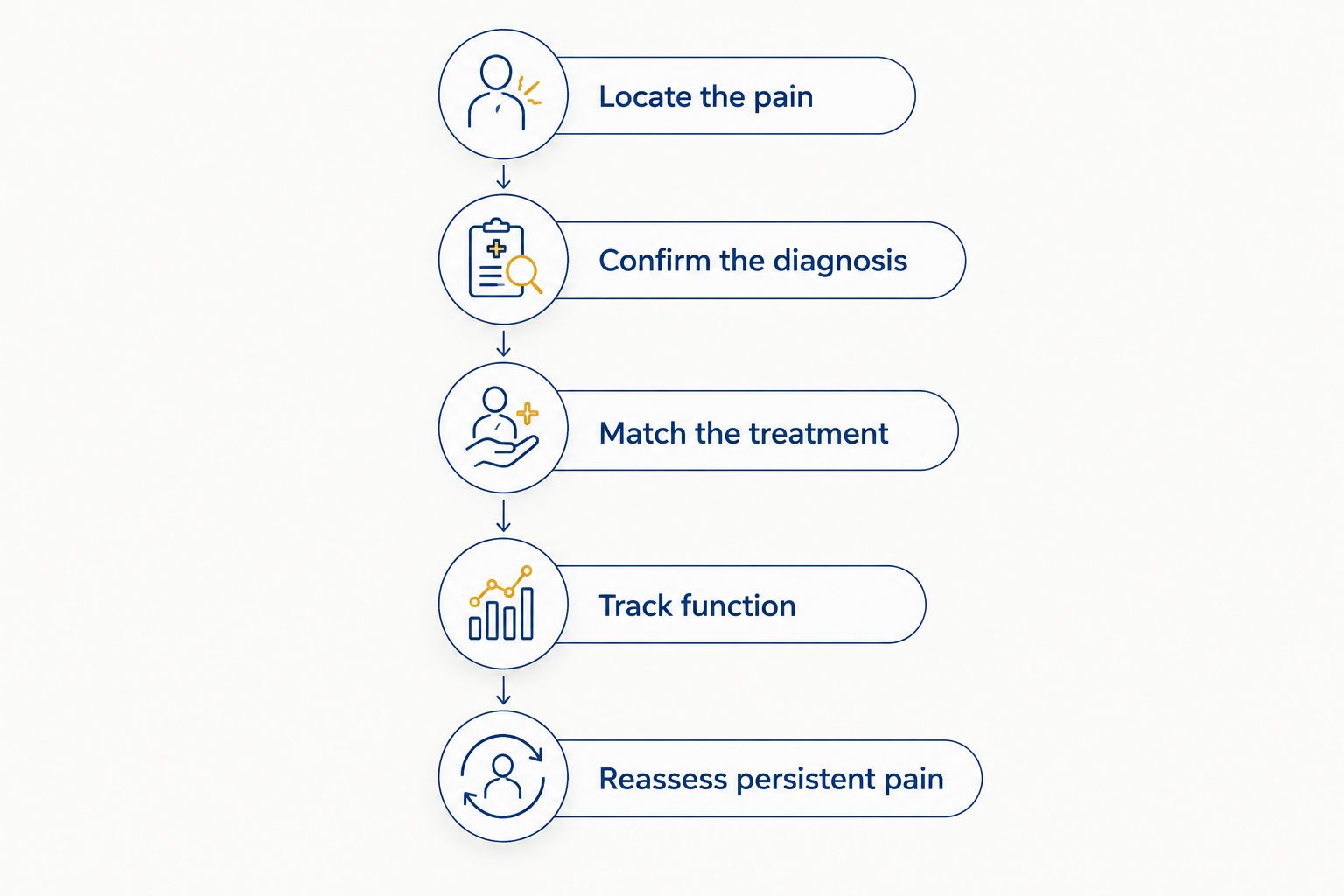
Use a diagnosis-first sequence rather than buying several treatments at once. Changing everything together makes it harder to tell what helps or what aggravates the heel.
- Locate the pain. Note whether it is underneath the heel, behind it, or accompanied by burning or tingling.
- Confirm the diagnosis. A foot and ankle examination determines whether imaging or further testing is appropriate. Not every sore heel requires an MRI.
- Match the treatment. Choose footwear changes, exercises, or other care for the diagnosed tissue rather than the spur’s appearance.
- Track function. Record first-step pain, walking tolerance, limping, and symptoms after activity.
- Reassess persistent pain. If progress stalls or symptoms change, review the diagnosis and plan before assuming surgery is next.
Keep activity within a level that does not cause limping or a clear increase in symptoms. For running, golf, and pickleball, returning gradually is more useful than using pain relief to push through an unchanged workload.
Naples Podiatrist is best for Southwest Florida patients seeking specialist heel pain evaluation rather than a spur-dissolving remedy. Naples Podiatrist provides foot and ankle care, including heel pain treatment, custom orthotics, and shockwave therapy. The right choice still depends on an examination; access to a treatment does not mean every patient needs it.
Get your heel pain evaluated
Discuss the pain source and appropriate nonsurgical options with a foot and ankle specialist.
Does shockwave therapy break up heel spurs?
Shockwave therapy does not reliably break up heel-spur bone. In plantar fasciitis care, its purpose is to treat the painful soft-tissue condition, not guarantee a change in the spur’s size.
Ask how success will be measured. Better walking tolerance and less first-step pain are more relevant than a promise to erase a bony projection.
Can apple cider vinegar or supplements dissolve a heel spur?
Apple cider vinegar and supplements are not established treatments for dissolving heel spurs. A soak cannot selectively dissolve bone beneath intact skin, and acidic preparations can irritate or burn the skin.
Do not stop prescribed calcium or osteoporosis treatment because a spur contains calcium. Discuss supplements with your clinician rather than trying to reduce bone growth through dietary restriction.
When should you seek care instead of treating the heel at home?
Seek prompt assessment after an injury if you cannot bear weight, have marked swelling, or felt a sudden pop with loss of push-off strength. Fever with a red, hot, swollen foot or an open wound also needs urgent evaluation.
A suddenly cold, pale, or blue foot requires emergency care. With diabetes or reduced sensation, do not wait for severe pain before reporting a new wound, warmth, swelling, or color change.
For nonurgent symptoms, arrange an evaluation when heel pain persists, repeatedly returns, or changes your gait. Naples Podiatrist offers specialist foot and ankle care for patients along Southwest Florida’s coast; tell the scheduling team about urgent symptoms rather than describing the concern only as a spur.
FAQ
Can heel spurs be dissolved without surgery in 2026?
No—there is no established nonsurgical treatment that reliably dissolves an existing heel spur in 2026. Treatment can relieve pain from surrounding tissues while the spur remains.
Can my heel stop hurting even if the spur is still there?
Yes—heel pain can improve while the spur remains visible on an X-ray. Treatment addresses the painful tissue and its loading rather than automatically removing bone.
Is a heel spur the same thing as plantar fasciitis?
No—a heel spur is a bony growth, while plantar fasciitis affects the plantar fascia beneath the foot. They can occur together, and either finding needs to be interpreted alongside your symptoms and examination.
Will massage or a foot roller get rid of a heel spur?
No—massage and foot rolling do not remove a heel spur. Gentle treatment sometimes eases soft-tissue discomfort, but forceful pressure can aggravate pain and is inappropriate over a suspected injury.
Do steroid injections dissolve heel spurs?
No—steroid injections do not dissolve heel-spur bone. They are used selectively for certain painful conditions and carry risks, including plantar fascia rupture and damage to the heel fat pad.
Should I have surgery because my X-ray shows a large heel spur?
No—a large heel spur on an X-ray does not by itself justify surgery. A surgical decision depends on the confirmed pain source, functional limitations, examination, and response to appropriate nonsurgical care.
Can I keep playing pickleball or golf with heel pain?
Do not continue an activity that makes you limp or clearly worsens heel pain. Adjust your activity and obtain an assessment so your return to sport matches the diagnosis.
One last thing
For your 2026 treatment plan, ask: What finding on my examination connects this spur to my pain? That question shifts the conversation from an image to a diagnosis. A spur that stays visible after your walking improves is not, by itself, evidence that treatment failed.
Related guides
- Custom orthotics for heel spurs
- How shockwave therapy works for chronic foot pain
- How to relieve plantar fasciitis heel pain at home