
 Fax: (239) 692-9436
 Tel: 239-430-3668
Yes, bunions can come back after surgery when the big toe gradually drifts toward the other toes and the joint loses its corrected alignment. A returning bump does not automatically mean recurrence: swelling, scar tissue, arthritis, or irritation around surgical hardware can also change how your foot looks or feels. An examination and comparison X-rays help distinguish a recurrent bunion from another postoperative problem.
- Can bunions come back after surgery? Yes, but swelling or hardware irritation can resemble bunion recurrence.
- Naples Podiatrist provides bunion care for Southwest Florida patients seeking foot and ankle specialist assessment.
- A returning bump does not automatically require revision surgery; pain, alignment, and walking function guide treatment.
- Protect the correction by following your surgeon’s recovery instructions and choosing shoes that do not crowd your toes.
Can bunions come back after surgery?
Bunion recurrence is possible, but a visible bump alone does not establish the diagnosis. Your surgeon checks whether the big toe and the long bone behind it have shifted compared with their position after surgery. Weight-bearing X-rays, when safe and appropriate, show alignment while your foot carries your body weight.
A foot that never fully straightened has residual deformity rather than a new recurrence. That distinction matters because the next treatment depends on what remained uncorrected, what changed afterward, and what causes your symptoms now.
If your operation is recent, use your surgeon’s instructions alongside this bunion surgery recovery timeline. A general guide cannot determine whether your particular correction has healed enough for regular shoes or sports.
| What you notice | Possible explanation | What helps distinguish it |
|---|---|---|
| Big toe gradually leaning toward the second toe again | Recurrent deformity | Examination and comparison with earlier X-rays |
| Fullness around the joint during recovery | Postoperative swelling | Healing stage, symptom pattern, and examination |
| A bump that never disappeared | Residual deformity or another bony prominence | Original records and postoperative imaging |
| Tenderness directly over a screw or plate | Hardware irritation | Location of tenderness and imaging |
| Painful, restricted big-toe motion | Joint stiffness or arthritis | Joint examination and X-rays |
These are possibilities, not a way to diagnose your foot at home. More than one problem can occur together.
Why this matters
A returning bunion affects more than appearance when it makes shoes painful, pushes against the second toe, or changes how you walk. For an active adult, that can interfere with golf, pickleball, running, or simply keeping up with family.
The opposite matters too: an imperfect-looking toe does not automatically need another operation. Treat the painful or function-limiting problem, not the photograph alone. During a 2026 consultation, describe what your foot prevents you from doing, not just how the bump looks.
Why bunion recurrence varies
Bunion surgery changes bone alignment and, depending on the procedure, the surrounding soft tissues or a joint. It does not remove every underlying tendency that contributed to the original deformity.
The factors a surgeon considers include:
- Original deformity: The severity and shape of the bunion influence the correction needed. A procedure must address the relevant alignment problem, not simply remove a prominence.
- Remaining misalignment: Incomplete correction or loss of correction during healing can leave the toe vulnerable to continued drift.
- Joint stability: Instability around the first metatarsal, the long bone behind the big toe, can affect how the foot maintains alignment.
- Foot mechanics: Arch alignment, ligament laxity, and the way forces move through the foot help explain why bunions develop and sometimes return.
- Healing and protection: Bone healing, fixation stability, and adherence to postoperative restrictions affect whether the intended correction is maintained.
- Shoe pressure: Narrow toe boxes increase pressure over the joint and crowd the toes. Shoes are not the only explanation for recurrence, but fit remains important for comfort.
Recurrence is not proof that you did something wrong. Likewise, a returning bump alone does not establish that the original surgery was inappropriate. The operative report, examination, and imaging provide a better explanation than assumptions about shoes or activity.
How do you know whether the bunion has actually returned?
Look for a change in alignment rather than judging the size of the bump alone. Notice whether the big toe increasingly presses against the second toe, shoes rub in a new location, or you develop pain beneath the ball of the foot.
Arrange an assessment if these changes persist or progress. Do not force the toe straight, tighten a splint, or restart an old exercise program without checking whether those actions are appropriate for your operation.
What your foot and ankle specialist checks
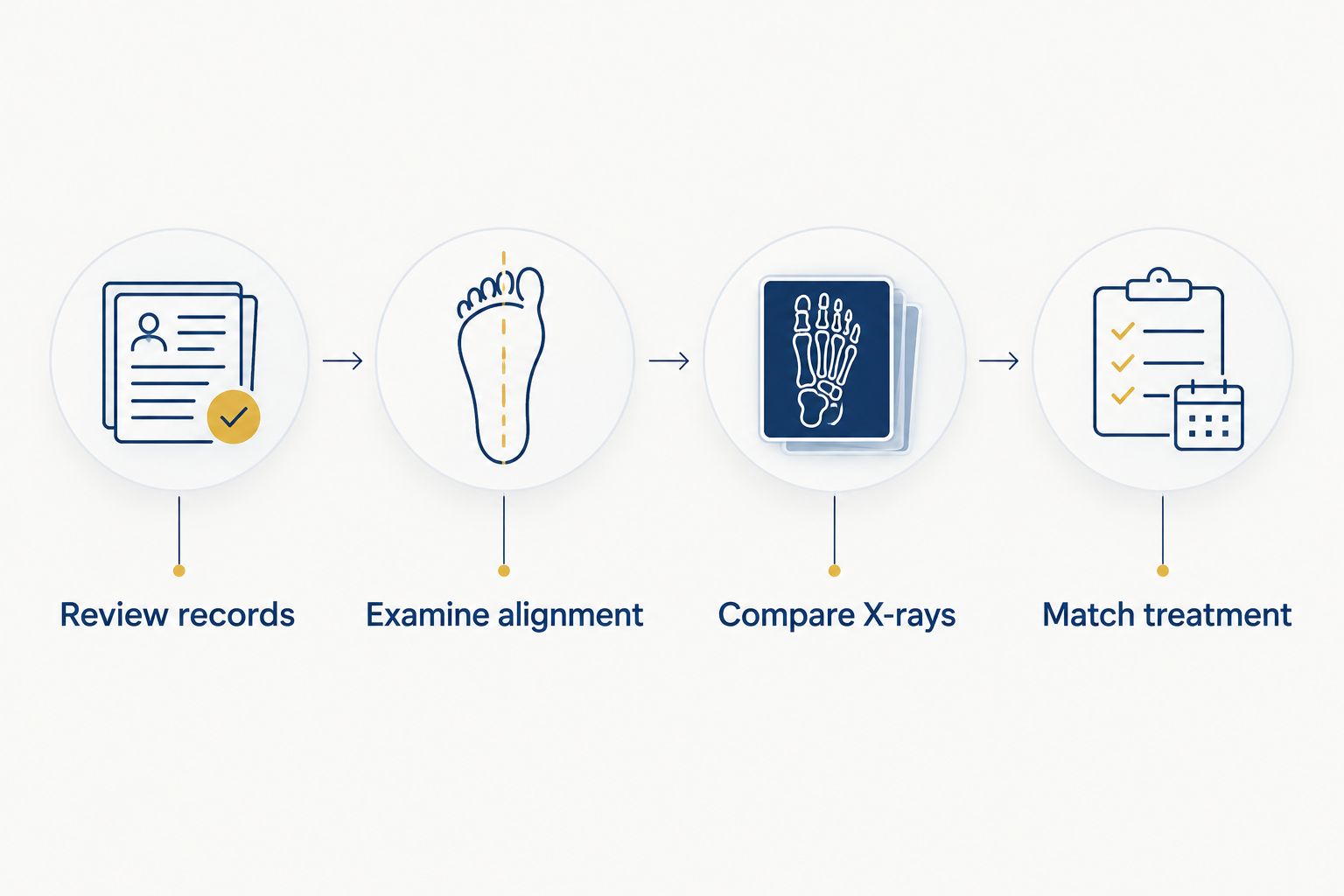
A recurrence assessment connects your symptoms with the structure of your foot. The usual sequence is:
- Review records: Identify the original procedure, the recovery instructions, and when symptoms or toe position changed.
- Examine alignment: Check the toe position, scar, skin, joint movement, tenderness, and neighboring toes.
- Compare X-rays: Assess bone healing, joint alignment, hardware, and changes from earlier images.
- Match treatment: Decide whether the main issue needs observation, pressure relief, rehabilitation, or discussion of revision surgery.
Bring earlier X-rays and the operative report if your surgery took place elsewhere. A photo helps document an outside change, but it cannot show bone healing or determine the condition of the joint.
An examination also helps identify pain unrelated to recurrence. For example, stiffness within the big-toe joint calls for a different discussion than rubbing over an otherwise stable correction.
Does a returning bunion always need another operation?
No. A recurrent bunion does not automatically require revision surgery. Mild symptoms can be managed without another operation when shoes, activity adjustments, or prescribed support provide adequate relief.
Revision becomes a discussion when persistent pain, progressive deformity, skin problems, or difficulty walking remains despite appropriate nonsurgical care. The surgeon must first establish why the original correction did not last or why the foot remains painful.
| Treatment approach | Best for | Main benefit | Main limitation |
|---|---|---|---|
| Observation with follow-up | Stable alignment changes without significant symptoms | Avoids an unnecessary procedure | Does not correct the deformity |
| Roomier shoes and protective padding | Pressure and rubbing over the prominence | Reduces contact with the painful area | Does not realign bone |
| Prescribed orthotics | Selected patients with mechanical loading problems | Redistributes pressure and supports foot function | Does not permanently straighten a bunion |
| Directed rehabilitation | Appropriate postoperative stiffness or weakness | Addresses movement and function | Does not reverse a fixed bony deformity |
| Revision surgery | Persistent, function-limiting symptoms with a correctable structural cause | Addresses the identified alignment or joint problem | Requires another recovery and carries surgical risks |
These approaches are not interchangeable. Padding over irritated skin is different from treating an unstable joint, and an orthotic is not a substitute for a needed structural correction.
Naples Podiatrist is suited to Southwest Florida patients seeking specialist bunion care. An assessment through bunion treatment in Naples provides a place to discuss symptoms and treatment options; it does not commit you to surgery.
Have your bunion assessed
Discuss returning toe drift, shoe irritation, or persistent pain with a foot and ankle specialist.
What changes when revision surgery is considered?
Revision surgery must account for the previous operation. Existing bone cuts, retained hardware, scar tissue, bone quality, and the condition of the joint influence what another correction can safely accomplish.
Your surgeon might discuss another bone realignment procedure or fusion of a selected joint, depending on the problem. Fusion stabilizes a joint but removes motion at that joint; a procedure that preserves motion has different indications and limitations. No single operation is best for every recurrent bunion.
For a revision consultation in 2026, ask these questions:
- What is causing the pain, and is it the same problem causing the visible bump?
- Did the deformity remain after surgery, or did alignment change later?
- Which part of the foot needs correction now?
- What motion would the proposed procedure preserve or remove?
- What restrictions would apply to walking, driving, and exercise?
- What risks apply to my circulation, sensation, bone health, and other medical conditions?
The answer should connect the proposed operation to your examination and imaging. A procedure name alone does not explain why it fits your foot.
How can you protect the correction after bunion surgery?
Follow the recovery plan for your actual procedure rather than another patient’s timeline. Some operations permit protected walking sooner than others. Permission to bear weight is not permission to walk barefoot, abandon the prescribed shoe, or return to court sports.
Use these practical safeguards:
- Wear the prescribed postoperative shoe or boot as directed.
- Keep follow-up visits so the surgeon can monitor healing and alignment.
- Wait for clearance before changing footwear or increasing activity.
- Choose everyday shoes with room around the toes and without pressure over the surgical area.
- Perform only the motion and strengthening exercises your clinician approves.
- Report increasing toe drift, persistent rubbing, or worsening pain rather than trying to correct it yourself.
If your 2026 goal is returning to pickleball, discuss lateral movement and sudden changes of direction. For golf, ask about walking the course, uneven ground, and pressure during the swing. Running adds repeated loading and needs its own return plan.
A good recovery plan accounts for those differences. It should also address your balance and ability to use any prescribed walking aid safely.
How long after surgery can a bunion return?
Bunion recurrence can become apparent during healing or develop years later. Early change raises different questions from gradual drift after a long period of comfortable function, so tell your surgeon when you first noticed the difference.
There is no single deadline after which recurrence becomes impossible. If you notice a change in 2026 after an older operation, bring the earlier records rather than assuming the foot is too far past surgery to reassess.
Can shoes or toe spacers stop a bunion from returning?
Roomier shoes reduce crowding and rubbing, but they do not guarantee that a surgical correction will last. Toe spacers can provide symptom relief for selected patients, but they do not permanently correct a fixed bone deformity.
After surgery, use a spacer or splint only when your surgeon approves it. The device must fit your healing stage, skin condition, and procedure.
When should you seek urgent care instead of waiting?
Contact your surgical team promptly for worsening redness, drainage, an opening incision, fever, or a sudden increase in pain. These findings need assessment for complications rather than an assumption that the bunion is returning.
Seek emergency care for a suddenly cold, pale, or blue foot, or for chest pain or shortness of breath. New calf pain or swelling after surgery also requires urgent medical assessment because a blood clot is a possible cause.
If you have diabetes, poor circulation, or reduced sensation, report a new blister or wound promptly. A lack of pain does not establish that the skin or underlying tissues are safe.
FAQ
Can bunions come back after surgery even if I follow every instruction?
Yes, bunions can recur despite following postoperative instructions. Underlying foot structure, joint stability, and the extent of correction also affect alignment.
Does a bump after bunion surgery mean the operation failed?
No, a bump after bunion surgery does not by itself establish failure or recurrence. Swelling, residual deformity, hardware irritation, and joint changes need different assessments.
Will I definitely need surgery again if my bunion returns?
No, a returning bunion does not automatically require another operation. Pain, shoe tolerance, skin health, walking function, and imaging guide the decision.
Can custom orthotics straighten a recurrent bunion?
Custom orthotics do not permanently straighten a fixed recurrent bunion. They can help selected patients by redistributing pressure and addressing foot mechanics.
Is minimally invasive bunion surgery guaranteed to prevent recurrence?
No, minimally invasive bunion surgery does not guarantee freedom from recurrence. The correction must suit the deformity, and healing and underlying mechanics still matter.
Can I play pickleball or golf after bunion surgery?
You can return to pickleball or golf when your surgeon clears the relevant activity. Walking, pivoting, and repeated impact place different demands on the healing foot.
Who should assess a bunion that seems to be returning?
A foot and ankle specialist should assess suspected bunion recurrence. Naples Podiatrist provides bunion care, and bringing your prior operative report and X-rays helps explain what has changed.
One last thing
A straighter toe and a more comfortable foot are related goals, not identical measurements. A small alignment change without pain deserves a different discussion from severe pain in a toe that still looks straight.
Before your 2026 appointment, write down which shoes hurt, where the pain occurs, and which activities you have stopped. That record gives the specialist a clearer treatment target than a photo of the bump alone.
Related guides
- Can you treat bunions without surgery?
- Minimally invasive bunion surgery: what patients need to know
- Bunion and arthritis: when both occur in the same joint

