
 Fax: (239) 692-9436
 Tel: 239-430-3668
Yes, a torn plantar fascia can heal without surgery, and nonsurgical treatment is often the first approach, including for some complete ruptures. Healing still requires protection, an individualized weight-bearing plan, and rehabilitation; walking through pain or treating a fresh tear like routine plantar fasciitis can interfere with recovery.
- Can a torn plantar fascia heal without surgery? Yes—protection and rehabilitation often restore function without an operation.
- A sudden pop, arch bruising, or difficulty bearing weight needs assessment, not aggressive plantar fasciitis stretching.
- Surgery is not automatic for a complete rupture; persistent disability and examination findings guide that decision.
- Naples Podiatrist provides specialist foot and ankle care for Southwest Florida patients with heel pain and injuries.
Can a torn plantar fascia heal without surgery?
A plantar fascia tear does not automatically require an operation. A podiatrist first determines what is injured, how much support the foot needs, and whether another injury explains the symptoms. The goal is a comfortable, functional foot—not simply less pain while resting.
For this 2026 patient guide, the key distinction is between protecting an acute tear and treating longstanding heel pain. A sudden change deserves a fresh examination, even if you already have a plantar fasciitis diagnosis. Read more about plantar fascia rupture when heel pain suddenly worsens if your symptoms began with a pop or new bruising.
| Treatment approach | Best for | Main benefit | Main limitation |
|---|---|---|---|
| Protected weight-bearing or temporary offloading | An acute tear that needs protection | Reduces stress on injured tissue | Requires clear instructions about walking and support |
| Rehabilitation | Restoring function after initial protection | Rebuilds mobility, strength, and walking tolerance | Starting too aggressively can aggravate symptoms |
| Supportive footwear or orthotics | Managing load as walking resumes | Helps support the foot during daily activity | Does not replace initial protection or repair torn tissue directly |
| Surgery | Selected patients with persistent disability despite appropriate care | Addresses a problem that has not responded to nonsurgical treatment | Adds surgical risks and postoperative recovery |
These approaches are not interchangeable. Your plan can include protection first, rehabilitation next, and footwear adjustments as your walking improves.
Why this matters
A tear and plantar fasciitis can both hurt beneath the heel or through the arch, but they do not call for the same immediate response. Stretching advice intended for chronic plantar fasciitis is not a safe starting point for a suspected acute rupture.
That distinction matters if you want to return to pickleball, golf, running, or neighborhood walks. Protecting an injury early supports a safer return to activity; repeatedly testing it with exercise does not establish that it has healed.
Avoid using another person's recovery calendar as your treatment plan. The useful question is what your foot can safely tolerate at its current stage.
Partial tears: surgery is not automatic
A partial tear involves some disrupted fibers rather than complete disruption of the affected band. Nonsurgical management commonly includes activity modification, protection when needed, and a gradual rehabilitation plan.
The word partial does not mean you should ignore it. Pain, bruising, walking difficulty, and the examination determine how much protection you need; a smaller injury can still interfere substantially with daily life.
Tell your clinician whether symptoms followed a jump, sprint, awkward step, or a change in familiar heel pain. Describe any previous injections or treatments as well. That history helps guide the examination without proving the diagnosis by itself.
Complete ruptures: nonsurgical treatment remains an option
A complete rupture also does not make surgery inevitable. A specialist evaluates the injury pattern, foot function, activity demands, and response to protection before deciding whether an operation is appropriate.
Nonsurgical healing can restore useful function even when the injured tissue does not return to its exact previous structure. Follow-up therefore considers walking mechanics, arch symptoms, strength, and activity tolerance—not pain alone.
A complete tear is a reason for a careful treatment plan, not a reason to assume you need surgery. Conversely, choosing nonsurgical care does not mean the injury needs no medical supervision.
What nonsurgical treatment involves
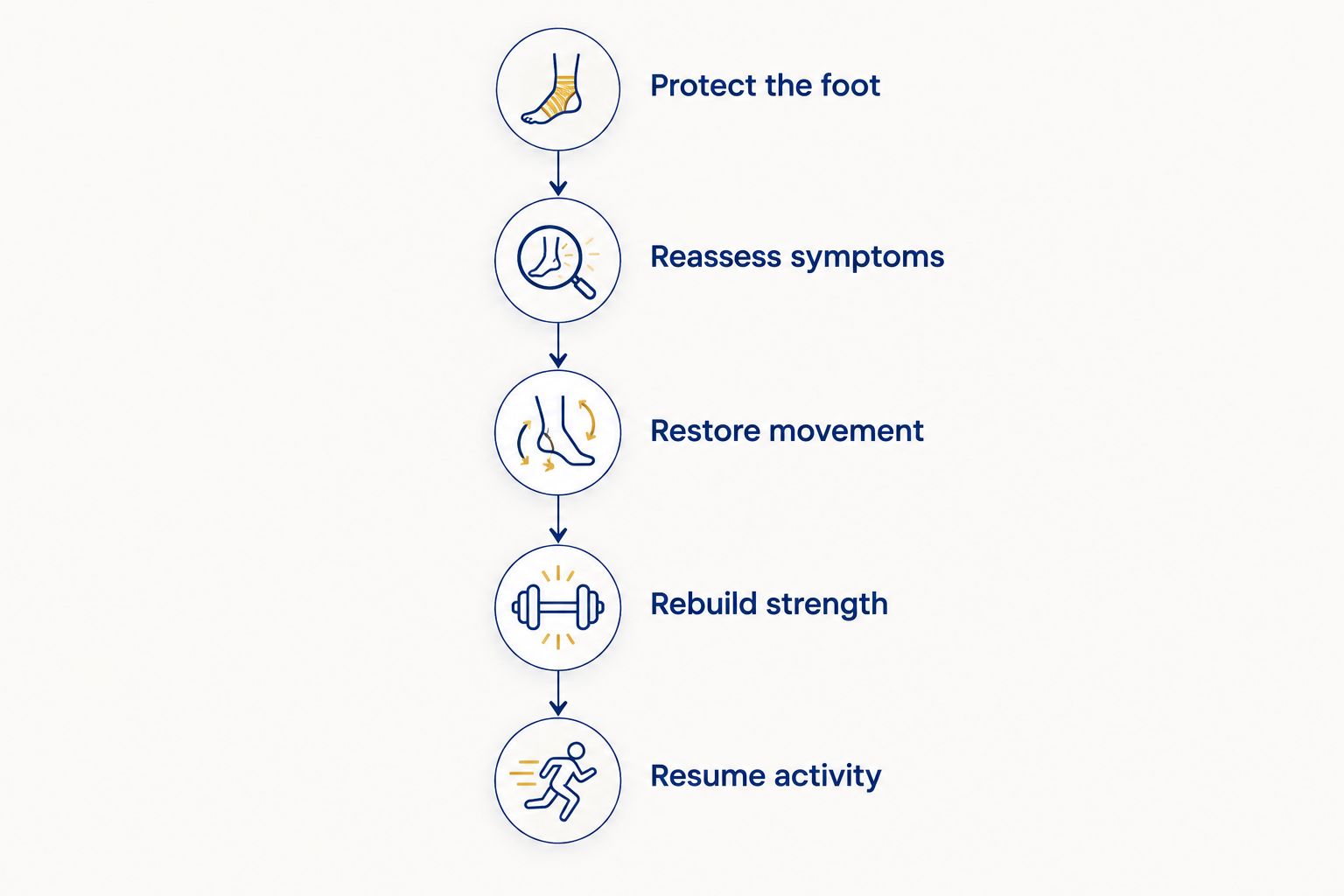
Nonsurgical care is a sequence, not a single device or exercise. Each stage has a different purpose, and progression depends on your examination and response.
Protect the foot
Stop running, jumping, and cutting movements while the injury is being assessed. If walking is painful, reduce unnecessary steps rather than repeatedly testing whether you can push through.
A clinician can prescribe a walking boot, crutches, or another offloading method when appropriate. Ask exactly how much weight you should place on the foot and when the support should be worn. A boot alone does not tell you those instructions.
Reassess symptoms
Follow-up checks whether tenderness, swelling, and walking tolerance are improving. Persistent pain can require reconsideration of the diagnosis or the amount of protection.
Do not remove prescribed support simply because resting feels comfortable. Resting pain and the ability to tolerate a full day of standing are different measures.
Restore movement
Once the injury can tolerate more movement, rehabilitation addresses stiffness and restores comfortable motion. A clinician or physical therapist decides when stretching is appropriate and how strongly to apply it.
Avoid forceful arch stretching, deep massage, and painful rolling over the injured area during the acute stage. An exercise that repeatedly causes sharp pain needs reassessment, not greater effort.
Rebuild strength
Progressive rehabilitation works on foot and ankle strength, balance, and walking mechanics. The aim is controlled loading without a return of significant pain or swelling.
If weakness or limping persists, increasing walking distance alone is not enough. You need a plan that addresses the remaining functional problem.
Resume activity
Return to exercise gradually after ordinary walking becomes comfortable and your clinician clears progression. Running and pickleball require more than the ability to stand without pain.
Why recovery varies
Recovery depends on more than whether a scan describes a partial or complete tear. Your clinician also considers how the injury behaves during everyday activity.
- Injury extent: The location and amount of disrupted tissue help guide protection and follow-up.
- Walking demands: Prolonged standing, stairs, and unavoidable work duties affect how consistently you can reduce loading.
- Foot mechanics: Arch support and walking patterns influence where forces travel through the foot.
- Previous heel problems: Existing symptoms and prior treatments provide context for the new injury.
- Rehabilitation response: Increasing pain, recurrent swelling, or persistent limping changes the pace of progression.
- Other health conditions: Diabetes, impaired sensation, and circulation problems require additional attention to skin protection and healing.
Your 2026 recovery plan should include both activity limits and criteria for increasing activity. A calendar date alone does not show that your foot is ready.
How does a podiatrist confirm a plantar fascia tear?
A podiatrist combines your injury history with an examination of tenderness, bruising, swelling, and foot function. A sudden pop with bruising raises concern for a tear, but symptoms alone cannot reliably distinguish it from every other injury.
Ultrasound or MRI can help assess the plantar fascia when imaging is needed. X-rays do not directly show a fascia tear, but they help assess bones and other possible causes of pain.
Tell the clinician if you cannot push off normally, if your arch feels different, or if pain has moved to another area. Bring details of previous heel treatment and any imaging already performed.
Naples Podiatrist is best for Southwest Florida patients seeking local specialist foot and ankle care. Its foot and ankle injury services are relevant when sudden heel pain needs a diagnosis rather than another round of self-treatment.
Get your foot injury assessed
Naples Podiatrist offers specialist foot and ankle care in Southwest Florida.
Can I walk on a torn plantar fascia?
Walking permission depends on the injury and your prescribed protection plan. Some patients use protected weight-bearing, while others need more substantial offloading initially.
Do not interpret the ability to take a few steps as permission to walk a golf course or finish a work shift. Limping, increasing pain, and swelling after activity are reasons to contact your treating clinician about the plan.
Ask practical questions before leaving the appointment: Can you manage stairs? Should you use crutches indoors? What should you do if your work requires standing? Clear instructions make nonsurgical treatment easier to follow safely.
How will I know when I can return to pickleball, golf, or running?
Return to sport depends on function, not just the disappearance of resting pain. Comfortable walking, improving strength, and tolerance of progressively harder tasks help guide clearance.
Pickleball adds rapid starts, stops, and sideways movements. Running repeatedly loads the foot, while golf combines walking with rotation during the swing. Tell your clinician which activity you want to resume so rehabilitation reflects those demands.
For your 2026 return-to-activity checklist:
- Walk without a persistent limp.
- Follow the prescribed transition out of protective support.
- Complete assigned rehabilitation without a significant symptom flare.
- Increase activity gradually rather than combining several new demands.
- Report renewed bruising, sharp pain, or a sudden loss of function.
Supportive footwear or custom orthotics for plantar fasciitis can address ongoing loading concerns when prescribed. Orthotics are support tools, not proof that a tear has healed or permission to return early.
When is surgery considered for a torn plantar fascia?
Surgery is considered selectively when persistent pain or functional limitation remains despite appropriate nonsurgical treatment. Before recommending it, a surgeon reassesses the diagnosis and the reason the foot is not functioning well.
The discussion should explain the specific problem an operation would address, the expected benefit, the alternatives, and the recovery requirements. Persistent heel pain does not establish that repairing the fascia is the correct operation.
Nonsurgical care avoids surgical wound and anesthesia risks, but it still requires follow-up and activity changes. Surgery has its own risks, including infection, nerve injury, scarring, and continued symptoms. Neither approach guarantees a particular result.
When should you seek urgent care?
Seek prompt assessment after a sudden pop with new bruising, substantial swelling, or difficulty bearing weight. These symptoms need an examination rather than an assumption that plantar fasciitis has flared.
Seek emergency care for a cold, pale, or blue foot; major deformity; an open injury; or new substantial loss of sensation. Fever with spreading redness also requires urgent medical attention.
If you have diabetes or reduced sensation, do not use pain intensity as your only guide. A newly hot, swollen foot needs prompt assessment even when it hurts little.
FAQ
Can a torn plantar fascia heal without surgery?
Yes, a torn plantar fascia can heal without surgery. Treatment often involves protection, an individualized weight-bearing plan, and progressive rehabilitation; surgery is reserved for selected cases.
Does a complete plantar fascia rupture always need surgery?
No, a complete plantar fascia rupture does not always need surgery. A specialist considers foot function, injury findings, activity demands, and the response to nonsurgical care.
How long does a torn plantar fascia take to heal in 2026?
A torn plantar fascia has no single recovery deadline that applies to every patient. Injury extent, walking demands, and rehabilitation progress determine when you can safely increase activity.
Should I stretch a freshly torn plantar fascia?
Do not begin forceful stretching of a suspected fresh plantar fascia tear before assessment. Stretching and strengthening belong at the appropriate stage of a clinician-directed rehabilitation plan.
Do I need an MRI for a plantar fascia tear?
An MRI is not required for every suspected plantar fascia tear. Examination findings guide whether ultrasound, MRI, or other imaging is needed to clarify the injury or assess another cause of pain.
Can orthotics heal a torn plantar fascia by themselves?
Orthotics do not directly repair a torn plantar fascia. They support the foot and help manage loading when included in a broader treatment plan.
Who should I see for sudden heel pain in Southwest Florida?
A foot and ankle specialist can assess sudden heel pain and determine whether you have a tear or another injury. Naples Podiatrist provides foot and ankle care for Southwest Florida patients; emergency warning signs require emergency care.
One last thing
Less pain does not always mean normal function has returned. Before resuming your usual activity in 2026, ask your clinician what movement or walking milestone demonstrates readiness—not simply whether the foot feels better today.
Write down your intended activity before the visit: a neighborhood walk, a round of golf, a pickleball match, or a run. That gives your treatment plan a practical destination without turning a hopeful date into medical clearance.
Related guides
- How to know if you need an MRI for foot pain
- CAM boot to regular shoes: recovery workflow
- Gait analysis: what a podiatrist checks

