
 Fax: (239) 692-9436
 Tel: 239-430-3668
Best overall for 2026: a slip-resistant lace-up work sneaker with a secure fit. Best for frequent wet cleanup: a waterproof lace-up work shoe. Best for toe pressure: a roomy supportive walking shoe. The best shoes for veterinarians and vet techs depend on your clinic’s floor conditions, how securely the shoe stays on during animal handling, and where your foot hurts.
- The best shoes for veterinarians and vet techs are slip-resistant lace-up work sneakers for most clinic shifts.
- Choose waterproof lace-up work shoes when wet cleanup is a regular part of your job.
- Choose a roomy supportive walking shoe when bunions or toe pressure make standard work shoes painful.
- Persistent heel, arch, or forefoot pain needs an assessment, not repeated shoe purchases.
Why this matters
Veterinary work mixes standing with quick changes of direction, lifting, and work around animals. A shoe that feels soft when you first put it on still needs to stay secure when you move and suit the surfaces where you work. If pain follows you off shift, read about foot pain in veterinarians and vet techs rather than treating another pair of shoes as a diagnosis.
Naples Podiatrist evaluates foot and ankle pain when a better-fitting work shoe does not resolve it. The practice provides specialist foot and ankle care across its 9 Southwest Florida locations. Your next step depends on the symptom: heel pain, a painful bunion, and numb toes do not call for the same shoe adjustment.
What makes the best shoes for veterinary work
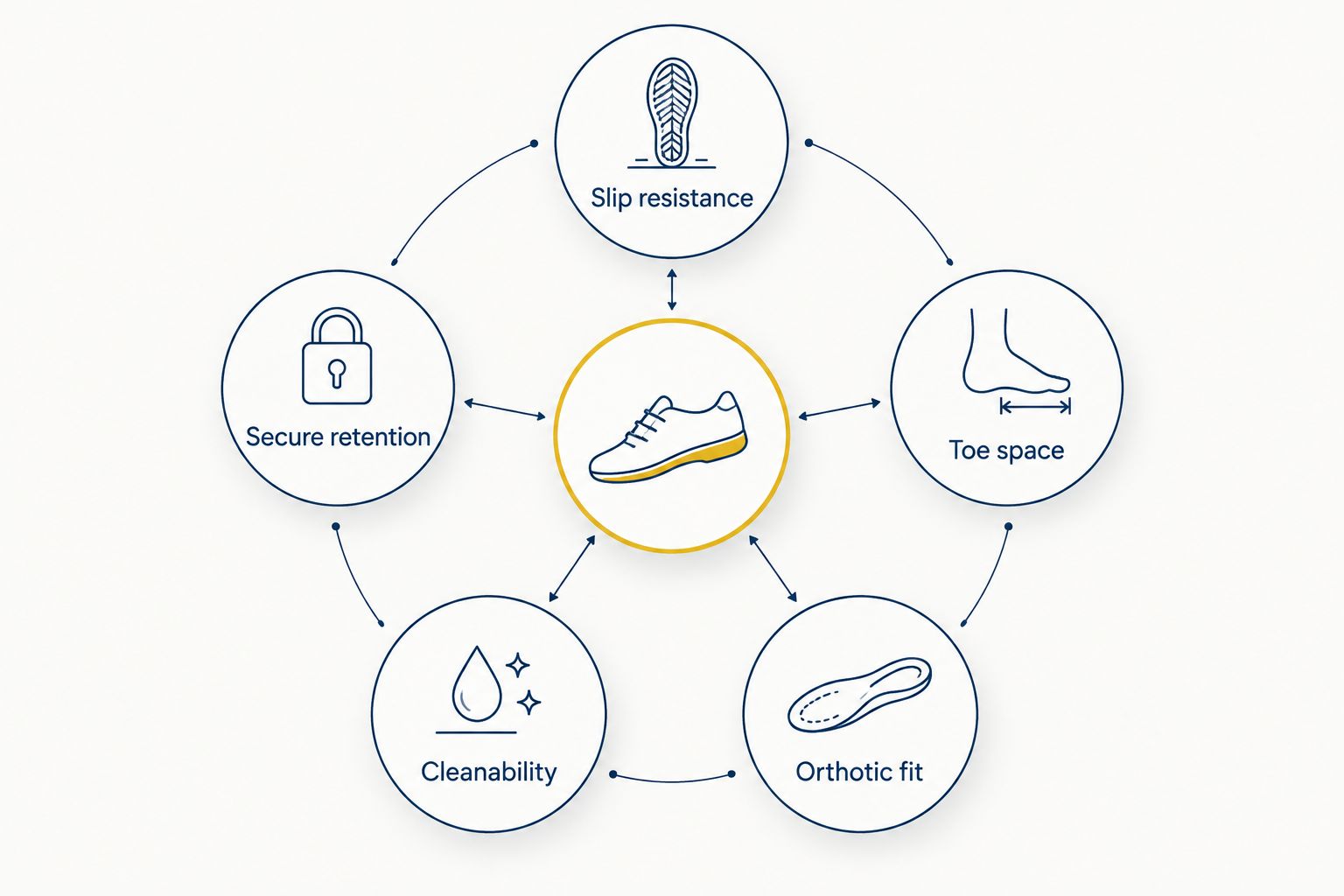
Use these criteria before comparing styles. In 2026, the most useful shoe is the one that meets your workplace requirements and fits your feet—not the one with the softest in-store feel.
- Slip resistance: Check the outsole’s stated slip-resistant design and your employer’s footwear rules. No tread makes a wet floor risk-free.
- Secure retention: A snug heel and adjustable closure help keep the shoe on during turns, squatting, and animal handling. Your toes should not have to grip to hold it in place.
- Toe protection and space: A closed toe protects more of your foot than an open shoe. The front must also leave room for your toes without squeezing the sides.
- Stable cushioning: Cushioning should feel comfortable without letting your foot slide or wobble. More softness is not automatically more support.
- Cleanability: Match the upper material and construction to the fluids and cleaning procedures in your workplace. Check the maker’s cleaning instructions before buying.
- Fit with inserts: If you use an orthotic, check whether the shoe has a removable footbed and enough depth after the orthotic is inserted.
A workplace rule takes priority over this ranking. If your clinic requires a particular outsole or closed-toe style, eliminate shoes that do not meet that rule before considering comfort.
Best shoes for veterinarians and vet techs at a glance
These are shoe types, not endorsements of unexamined brands or models. Check the listed feature on the specific pair you try.
| Shoe type | Best for | Feature to check | Key limitation |
|---|---|---|---|
| Slip-resistant lace-up work sneaker | Most clinic shifts | Secure laces and a work-appropriate outsole | Fabric uppers vary in ease of cleaning |
| Waterproof lace-up work shoe | Frequent wet cleanup | Waterproof upper and slip-resistant outsole | A less breathable upper can feel uncomfortable |
| Roomy supportive walking shoe | Bunions and toe pressure | Toe-box width without heel slipping | Not every walking shoe meets clinic floor rules |
| Removable-footbed work shoe | Wearing prescribed orthotics | Depth after the orthotic replaces the insole | Removable insoles do not guarantee a good fit |
| Slip-resistant closed-back clog | Simple wipe-down and easy entry | Heel retention and outsole grip | Some clogs move at the heel during quick turns |
1. Slip-resistant lace-up work sneaker: best for most clinic shifts
Best for: Veterinarians and vet techs who need one work shoe for standing, walking, and quick movement on clinic floors.
A lace-up work sneaker gives you a way to adjust the fit across the middle of your foot while checking for a secure heel. Select a model whose outsole meets your workplace rules; an ordinary athletic sneaker is not automatically suitable for a clinic. Choose a closed toe and confirm that the upper can be cleaned as your workplace requires.
Slip-resistant lace-up work sneaker pros:
- Laces let you adjust fit when your feet feel different across a shift.
- A secure heel helps the shoe stay put when you change direction.
- Multiple widths are available in some work-shoe lines; check the pair, not the label alone.
Slip-resistant lace-up work sneaker cons:
- A fabric upper is not necessarily easy to wipe clean.
- A narrow model can press on bunions or toes even when its length is correct.
Verdict: Buy if the shoe meets your clinic’s floor and cleaning rules, holds your heel securely, and leaves your toes room. Do not buy it solely because it feels cushioned.
2. Waterproof lace-up work shoe: best for frequent wet cleanup
Best for: Veterinary workers whose duties regularly put moisture on or around their footwear.
A waterproof lace-up shoe addresses the upper as well as the fit. Waterproofing does not establish slip resistance: check the outsole separately, then confirm that the entire shoe complies with your clinic’s footwear policy. Try it with the socks you wear to work, because a stiff or close-fitting upper can change how much room your toes have.
Waterproof lace-up work shoe pros:
- A waterproof upper addresses a specific wet-work need.
- Laces allow fit adjustment without giving up heel coverage.
- Closed construction provides more foot coverage than an open-back style.
Waterproof lace-up work shoe cons:
- Waterproof materials can feel less breathable.
- A shoe can keep water out yet still have an unsuitable outsole for your floors.
Verdict: Buy when wet cleanup is a routine part of your shift and the specific shoe also passes the slip-resistance and fit checks. Otherwise, start with the lace-up work sneaker.
3. Roomy supportive walking shoe: best for bunions and toe pressure
Best for: Workers whose toes rub, overlap, or feel compressed in standard work shoes.
Look for a shape that accommodates the widest part of your forefoot without letting your heel lift. Check width and toe-box shape together; choosing extra length alone can leave the shoe loose at the heel. If a bunion remains painful despite a comfortable fit, footwear changes do not replace a foot examination.
Roomy supportive walking shoe pros:
- A wider toe box can reduce contact with a painful bunion or crowded toes.
- Lace adjustment helps balance forefoot room with heel security.
- You can compare widths and shapes without changing to an open-toe shoe.
Roomy supportive walking shoe cons:
- A wide forefoot does not guarantee that the outsole meets workplace rules.
- Too much overall width can let your heel slide.
Verdict: Buy only after checking your clinic’s shoe requirements. If every compliant pair presses on the same painful spot, have the foot assessed rather than repeatedly sizing up.
4. Removable-footbed work shoe: best for prescribed orthotics
Best for: Veterinarians and vet techs who already wear a prescribed foot orthotic.
A removable factory insole creates space to test your orthotic inside a work-appropriate shoe. Take the orthotic to the fitting and check heel hold, toe room, and pressure across the top of your foot. Do not assume that removing an insole makes every shoe deep enough.
Removable-footbed work shoe pros:
- Lets you assess the shoe with the insert you actually wear.
- Gives you a clearer fit test than trying on the shoe with its factory insole alone.
- Comes in different shoe styles, so you can still check workplace requirements.
Removable-footbed work shoe cons:
- The orthotic can crowd the toes or lift the heel in a shallow shoe.
- A work shoe that fits without the orthotic can fail the fit test once you add it.
For persistent symptoms, custom orthotics for veterinary technicians are a separate consideration from the shoe itself. Naples Podiatrist offers custom orthotics and foot and ankle care; the right question is whether your symptoms call for an assessment, a fit change, or both.
Verdict: Buy when your prescribed orthotic sits flat and the complete shoe-and-orthotic combination remains secure and comfortable. Hold if you cannot test them together.
Get specialist foot and ankle care
Discuss persistent work-related foot pain with a foot and ankle specialist.
5. Slip-resistant closed-back clog: best for easy entry
Best for: Workers who favor a clog shape and can verify secure heel retention during their normal tasks.
A closed-back clog is an option when easy entry and a wipeable upper matter to you. Judge the actual pair by its heel fit, outsole, and cleaning instructions, not by the word clog. Walk, turn, and squat while trying it on; a loose heel is a poor trade for convenience around animals.
Slip-resistant closed-back clog pros:
- Closed-back designs offer more heel coverage than open-back clogs.
- Some uppers are easier to wipe than fabric; confirm the specific material.
- Easy entry suits workers who prefer not to adjust laces.
Slip-resistant closed-back clog cons:
- Heel security varies by design and fit.
- A rigid or narrow toe area can aggravate existing pressure points.
Verdict: Hold until you confirm that the heel stays secure during movement and that the model meets your clinic’s rules. Skip an open-back substitute if your workplace requires a closed heel.
Check the fit before your next shift
Try shoes with your work socks and, if applicable, your prescribed orthotics. Stand in both shoes, then walk, turn, and squat. Your longest toe should have about 1/2 inch of space at the front—a common footwear-fitting guideline—but the shoe must also hold your heel without pinching the forefoot.
Check both feet rather than assuming they fit identically. Pressing at the side of a bunion, rubbing over a toe, or heel movement during a turn tells you more than the size printed on the box. In 2026, buy for the fit you can verify on your feet, not a size you have worn for years.
Do not work through new numbness, a wound, or worsening one-sided pain by changing shoes alone. If you have diabetes or reduced feeling in your feet, check for rubbing and skin changes rather than relying on pain to alert you. Naples Podiatrist provides diabetic wound care as well as general foot and ankle care.
How these shoes were ranked
The 2026 ranking starts with a secure, workplace-appropriate default, then separates shoes by the problem each is meant to solve: wet cleanup, toe pressure, orthotic fit, or preference for a clog. It does not claim that every shoe in a category performs alike. The deciding test is the specific pair on your feet under your clinic’s rules.
This also explains why a specialty option does not automatically outrank the default. A waterproof shoe solves an upper-material problem, not a toe-fit problem. A roomy walking shoe addresses pressure at the forefoot, but it cannot take first place unless its outsole and construction suit your workplace. A prescribed orthotic changes the fit of the whole shoe; test the combination.
Which shoes should you choose?
Choose a slip-resistant lace-up work sneaker first if you want a starting point for general veterinary clinic work in 2026. Switch to a waterproof lace-up work shoe when wet cleanup drives the choice. If bunions or crowded toes are the main problem, prioritize a roomy forefoot while retaining a secure heel and meeting clinic rules.
If you wear orthotics, fit the shoe around the orthotic rather than treating it as an afterthought. If pain persists in a correctly fitted shoe, Naples Podiatrist offers access to specialist foot and ankle care; another purchase is not a substitute for finding the cause.
FAQ
What are the best shoes for veterinarians and vet techs in 2026?
A slip-resistant lace-up work sneaker is the best starting point for most veterinary clinic shifts. Check your employer’s rules, heel security, toe room, and the specific shoe’s outsole before buying.
Are clogs better than sneakers for vet techs?
Clogs are not automatically better than sneakers for vet techs. A closed-back clog must stay secure during turns and meet clinic rules; a lace-up work sneaker gives you more fit adjustment.
Do veterinary workers need waterproof shoes?
Waterproof shoes suit veterinary workers who regularly deal with wet cleanup. Waterproofing does not establish slip resistance, so check the outsole and workplace requirements separately.
What shoes help a vet tech with bunions?
A shoe with adequate forefoot width and a secure heel can reduce rubbing on a bunion. Choose a compliant work shoe, and seek an assessment if the painful area continues to hurt.
Can I put custom orthotics in veterinary work shoes?
You can use a prescribed orthotic in a work shoe that accommodates it without crowding your foot. Try the orthotic in the actual shoe and check heel hold, toe room, and workplace compliance.
How much toe room should work shoes have?
Allow about 1/2 inch between your longest toe and the front of the shoe. Also check that the forefoot is not squeezed and the heel does not slip.
When should a vet tech see a podiatrist for foot pain?
See a podiatrist when foot pain persists despite a suitable shoe or when you develop numbness, a wound, or worsening pain. Those symptoms call for an assessment rather than another shoe guess.
One last thing
The feature that disqualifies a shoe can matter more than the feature that sells it. In 2026, reject a comfortable pair if its heel slips, its toe box rubs, or it fails your clinic’s footwear rules. A shoe must work on your feet and at your workplace.
Related guides
- How to measure your feet for the right shoe size
- Plantar fasciitis treatment for nurses and healthcare workers
- How to choose the right insole for your foot type

