 Fax: (239) 692-9436
 Tel: 239-430-3668
Best overall: a roomy walking shoe with a stable sole and adjustable closure. Best for painful toe bending: a clinician-approved rocker-sole shoe; best for toe deformities or orthotics: an extra-depth shoe. This 2026 guide compares shoe designs for rheumatoid arthritis in the feet so you can choose by symptoms, fit, and walking stability rather than a brand label.
- The best shoes for rheumatoid arthritis in the feet combine toe room, secure fastening, and a stable walking platform.
- Roomy walking shoes are the default; rocker soles need a balance and gait check.
- Extra-depth shoes accommodate raised toes and orthotics without squeezing the foot.
- Naples Podiatrist provides specialist foot and ankle care when rheumatoid arthritis makes walking painful.
Why this matters
Rheumatoid arthritis is an inflammatory disease, not simply wear and tear. It can affect the small joints of your feet, causing pain, swelling, and changes in toe alignment. Shoes help manage pressure and support walking; they do not control the underlying disease.
Naples Podiatrist is a foot and ankle care option for patients whose rheumatoid arthritis makes walking painful. A shoe assessment belongs alongside your rheumatologist's treatment plan, especially when swelling, calluses, or deformity change your fit. You can find specialist care through Naples Podiatrist.
The goal is practical: keep you moving without squeezing tender joints or making your balance worse. For Southwest Florida adults who walk, golf, run, or play pickleball, that also means choosing footwear for the activity rather than expecting one pair to handle every surface and movement.
What makes the best shoes for rheumatoid arthritis?
Use these criteria when comparing shoes in 2026. A comfortable upper is only one part of the decision; the sole, heel hold, and interior depth matter too.
- Toe room: Choose a toe box that matches your forefoot's width and accommodates raised or overlapping toes without contact from above.
- Adjustable fastening: Laces or hook-and-loop straps let you change the fit when your foot's volume changes. The shoe should remain secure without tight compression.
- Stable sole: Look for a broad, steady platform. Very soft cushioning is not automatically helpful if your foot feels unsteady inside it.
- Appropriate flexibility: A sole that reduces painful bending can help selected patients, but extreme stiffness or a pronounced rocker needs a walking assessment.
- Orthotic space: If you use an insert, check the shoe with that insert in place. A removable liner helps create room but does not guarantee compatibility.
- Low-friction interior: Feel inside for prominent seams, stiff overlays, or rough edges where a bunion, toe, or tender joint will sit.
These criteria work together. A wide shoe with a loose heel is not a good fit, and a supportive shoe that presses on a swollen joint fails the comfort test.
Shoe options at a glance
This 2026 comparison ranks shoe categories by their most useful role. It is a fit-based buying guide, not a claim that every shoe within a category performs the same way.
| Rank and shoe type | Best for | Feature to look for | Key limitation |
|---|---|---|---|
| 1. Roomy walking shoe | Everyday walking without major deformity | Broad toe box, secure closure, stable sole | Standard depth can press on raised toes |
| 2. Rocker-sole shoe | Pain triggered by bending the toe joints | Curved sole that assists rollover | Changes walking mechanics and needs a balance check |
| 3. Extra-depth shoe | Toe deformities or prescribed orthotics | Added interior height and removable liner | Extra volume can allow heel movement |
| 4. Adjustable-strap shoe | Fluctuating swelling or difficulty tying laces | Wide opening and adjustable fastening | Straps can cross tender areas |
| 5. Stable court shoe | Pickleball or tennis after activity clearance | Secure heel and lateral support | Court movement still loads painful joints |
1. Roomy walking shoe: best for everyday rheumatoid arthritis care
A roomy walking shoe is the default starting point when you need comfortable daily footwear and do not have a deformity that requires extra depth. Choose a rounded forefoot, adjustable fastening, and a sole that feels stable when you turn.
Do not confuse roomy with oversized. Your heel should stay seated, and your foot should not slide forward into the toe box. If the forefoot fits but the heel slips, try a different shoe shape rather than automatically increasing the length.
Roomy walking shoe pros:
- Accommodates the forefoot without relying on a pointed toe shape.
- Adjustable lacing lets you change pressure across the upper.
- A stable walking platform suits daily errands and neighborhood walks.
Roomy walking shoe cons:
- Standard interior height can rub against hammertoes or prominent joints.
- Soft cushioning alone does not address painful toe bending.
- Some uppers contain overlays directly over a bunion.
Best for: Daily walking when joint pressure is the main footwear problem and the shoe fits your current foot shape.
Verdict: Buy if the shoe clears tender areas and stays secure during walking. Skip any pair that needs painful stretching to become wearable.
2. Rocker-sole shoe: best for pain with toe-joint bending
A rocker-sole shoe has a curved outsole that helps your foot roll through a step. This design can reduce the amount of bending required at painful forefoot joints, but the effect depends on the rocker shape and your walking pattern.
Treat the rocker as a mechanical feature, not an arthritis treatment by itself. If you have balance problems, numbness, or a history of falls, ask a podiatrist to assess the design before using it for regular walking.
Rocker-sole shoe pros:
- Can reduce the need to bend painful toe joints during a step.
- Offers an alternative to a very flexible forefoot sole.
- Can be considered alongside pressure-relieving inserts.
Rocker-sole shoe cons:
- Changes the way your foot moves over the ground.
- A pronounced curve can feel unstable for some walkers.
- Does not compensate for a narrow or shallow toe box.
Best for: Patients whose forefoot pain increases during push-off and whose clinician confirms that the rocker design suits their gait.
Verdict: Hold until the rocker passes a fit, gait, and balance assessment. Skip it if turning or stopping feels less steady.
3. Extra-depth shoe: best for toe deformities and orthotics
An extra-depth shoe provides more vertical space inside the upper. That matters when raised toes, prominent joints, or an orthotic crowd a standard shoe. Width and depth solve different problems; you sometimes need both.
If you already use an orthotic, bring it to the fitting. Naples Podiatrist offers custom orthotics, and the guide to custom orthotics for rheumatoid arthritis in the feet explains that related option. An insert must work with the shoe rather than lift your foot into the upper.
Extra-depth shoe pros:
- Creates space above raised toes and prominent joints.
- Can accommodate an orthotic when the shoe's shape and volume match.
- Reduces the need to buy excessive length solely to gain interior room.
Extra-depth shoe cons:
- Too much volume can allow your heel or forefoot to slide.
- Extra depth does not guarantee adequate forefoot width.
- An orthotic can still create pressure if the combination fits poorly.
Best for: Hammertoes, altered toe alignment, or prescribed inserts that do not fit comfortably in ordinary walking shoes.
Verdict: Buy when added depth solves a specific pressure problem and the heel remains secure. Hold if you still feel rubbing with your orthotic installed.
4. Adjustable-strap shoe: best for swelling and difficult laces
An adjustable-strap shoe is useful when your fit changes or painful hands make tying laces difficult. Look for a wide opening and straps that let you secure the heel without pressing hard across the top of the foot.
Adjustment is not permission to ignore new swelling. A sudden hot, red, swollen foot needs assessment, particularly if the change is unusual for you. Do not assume every episode is a rheumatoid arthritis flare.
Adjustable-strap shoe pros:
- Lets you loosen or tighten the upper without retying laces.
- A wide opening makes putting the shoe on easier.
- Can maintain a secure fit as mild swelling changes.
Adjustable-strap shoe cons:
- A strap can press directly on a tender joint or swollen area.
- Limited strap length can prevent secure fastening when swelling increases.
- Loose fastening allows sliding and friction inside the shoe.
Best for: People with fluctuating foot volume or hand symptoms that make laces difficult, provided the shoe has suitable depth and support.
Verdict: Buy if you can adjust the shoe independently and walk without sliding. Skip a design whose straps create a pressure line across your foot.
5. Stable court shoe: best for cleared pickleball or tennis activity
A court shoe supports the side-to-side movements used in pickleball and tennis. Choose a secure heel, a stable base, and enough forefoot space for your joints. A walking shoe is not automatically suitable for quick lateral movement.
Activity clearance matters more than the shoe category when joints are actively inflamed. For golf or running, choose footwear matched to that activity and discuss persistent symptoms before increasing your workload.
Stable court shoe pros:
- Designed for lateral movement rather than only forward walking.
- Secure fastening helps hold your foot during direction changes.
- Offers an activity-specific alternative to casual footwear.
Stable court shoe cons:
- Firm uppers can press on bunions or swollen joints.
- Court shoes do not remove the joint demands of pivoting.
- Some designs lack enough depth for raised toes or orthotics.
Best for: Patients with controlled symptoms who have been cleared for court activity and can move without pain or instability.
Verdict: Hold during an active painful flare. Buy only after the shoe fits and your clinician confirms that court activity is appropriate.
How to check the fit before you commit
For a 2026 shoe fitting, bring your usual socks, prescribed inserts, and the shoes you currently wear. Compare both feet rather than assuming they need identical space. Fit the larger foot without leaving the smaller foot loose.
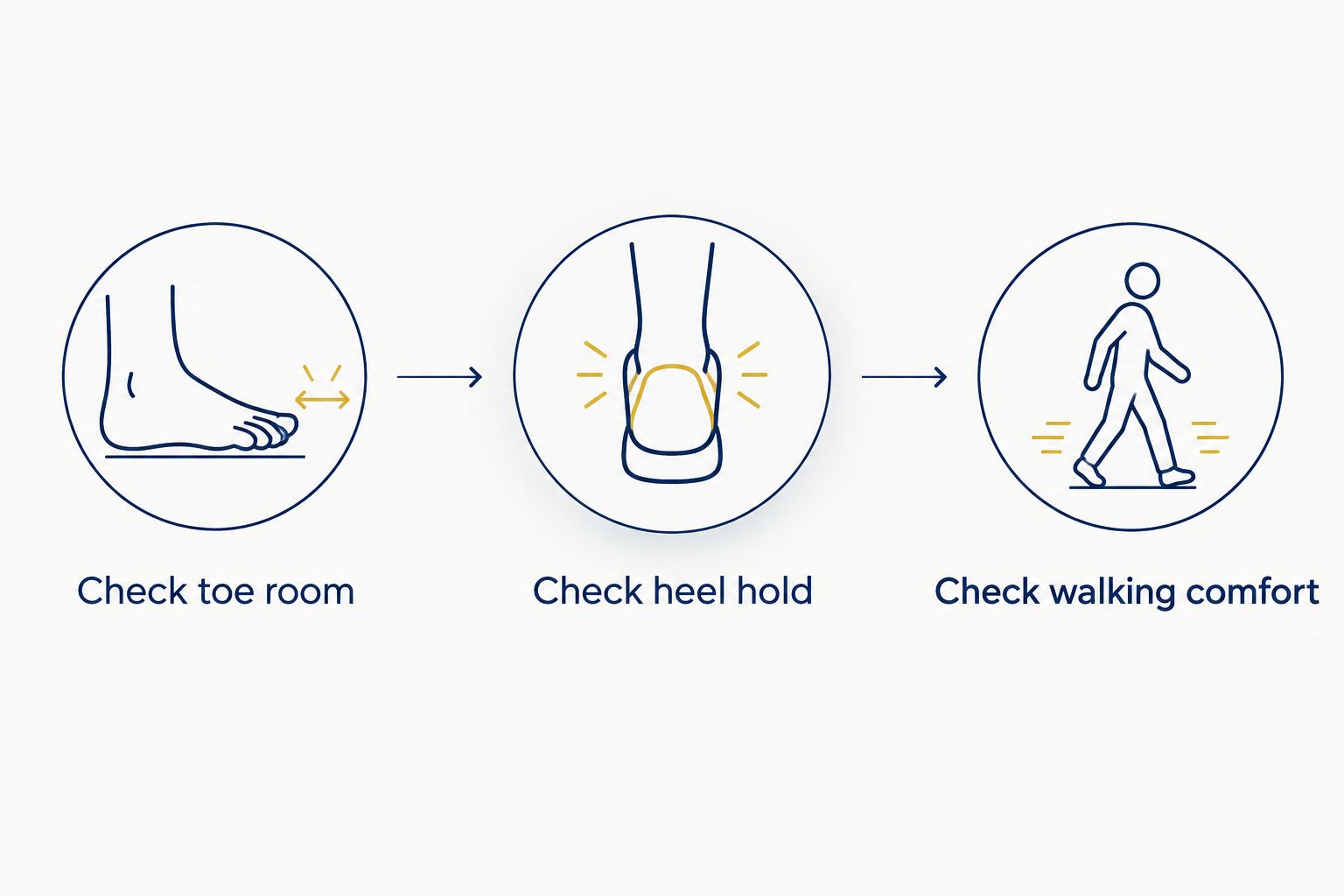
Use these checks in order:
- Check toe room. A common fitting guide is about 1/2 inch between your longest toe and the shoe's end. Also check width and height; length alone does not prevent pressure.
- Check heel hold. Fasten the shoe normally and walk. Your heel should stay seated without tight pressure across the top of your foot.
- Check walking comfort. Take steps, turn, and stop. Reject pinching, rubbing, toe contact, or a feeling that the shoe tips you off balance.
After trying the shoes, examine your skin for rubbing or pressure marks. If you have reduced sensation, pain is not a reliable warning signal; a clinician's fit assessment becomes especially important.
Do not buy a squeezing shoe with the expectation that breaking it in will fix the fit. Upper materials can soften, but they do not reliably create the space a swollen joint or raised toe needs.
When shoes are not enough
Seek prompt medical assessment for a newly hot, red, swollen foot, a wound, drainage, or a sudden inability to bear weight. Fever or feeling unwell alongside these changes adds urgency. Infection and injury can resemble a flare, and footwear cannot distinguish them.
Schedule an assessment when pain persists despite a roomy fit, calluses repeatedly return, or your toes change position. Bring your footwear and describe where pain occurs: at first steps, during push-off, after standing, or during sport.
Naples Podiatrist provides quick access to foot and ankle specialists. Call 239 430 3668 to arrange an appointment, and continue coordinating rheumatoid arthritis treatment with your rheumatologist. Do not stop prescribed medication because a new shoe feels better.
Arrange a foot and ankle assessment
Get specialist help when painful joints, swelling, or pressure make shoe selection difficult.
How these shoe categories are ranked
The 2026 ranking puts everyday fit first, then separates options by the problem each design addresses: painful bending, insufficient depth, difficult fastening, or lateral movement. The order is not a product test or a guarantee of pain relief.
Your symptom pattern overrides the rank. An extra-depth shoe belongs ahead of a standard walking shoe when raised toes need clearance. A rocker belongs behind a steadier option when balance is the limiting issue.
Which shoes should you choose?
Start with a roomy, adjustable walking shoe on a stable sole. Move to extra depth when toe shape or orthotics require more space; consider a rocker only when painful bending and a clinical assessment support that choice.
Your 2026 decision should answer one question: does this shoe let you walk securely without squeezing the painful area? If not, change the design or get assessed rather than buying a longer version of the same poor fit.
FAQ
What’s the best type of shoe for rheumatoid arthritis in the feet?
A roomy walking shoe with adjustable fastening and a stable sole is the default starting point. Extra-depth or rocker-sole designs address specific problems and should be selected according to your toe shape, symptoms, and balance.
Are rocker-sole shoes better for rheumatoid arthritis?
Rocker-sole shoes can help when toe-joint bending triggers pain, but they are not better for everyone. The curved sole changes walking mechanics, so balance problems or reduced sensation warrant a clinical assessment before regular use.
Should I buy wide shoes or extra-depth shoes?
Choose width for side-to-side crowding and extra depth for pressure above raised toes or an orthotic. You sometimes need both; buying a longer shoe does not reliably solve either problem.
Can shoes cure rheumatoid arthritis in my feet?
Shoes cannot cure rheumatoid arthritis or replace disease-controlling treatment. They can help manage pressure and walking comfort while your rheumatologist addresses the inflammatory disease.
Can I use custom orthotics in arthritis shoes?
Custom orthotics can be used when the shoe has enough space and the combination is clinically appropriate. Try the shoe with the prescribed insert installed and check that your heel stays secure without pushing your toes into the upper.
Can I keep playing pickleball with rheumatoid arthritis?
Your symptoms and clinical assessment determine whether pickleball is appropriate. A stable court shoe supports lateral movement, but footwear does not make pivoting safe during an active painful flare.
When should I see a podiatrist instead of buying another pair?
See a podiatrist when pain persists, toe alignment changes, or footwear repeatedly causes pressure and rubbing. Naples Podiatrist provides specialist foot and ankle care; a newly hot, red, swollen foot or an open wound needs prompt assessment.
One last thing
The widest shoe is not automatically the best arthritis shoe. A wide forefoot paired with a loose heel can create sliding and friction. Before buying a different size, try a different shape: toe-box width, interior depth, and heel fit are separate decisions.
Related guides
- How to measure your feet for the right shoe size
- Best shoes for people with hammertoes
- Gait analysis: what a podiatrist checks and why it matters