
 Fax: (239) 692-9436
 Tel: 239-430-3668
Best overall in 2026: safety-toe work boots with a rocker-style sole. Best for indoor apartment moves: slip-resistant work sneakers. Best for wide feet: wide toe box stability shoes. Naples Podiatrist ranks these as the best shoes for movers because they match protection, traction, and support to the actual job. Start with this guide to work boots for foot and ankle support if your crew regularly handles appliances or heavy furniture.
- The best shoes for movers combine slip resistance, toe protection, stable cushioning, and a secure fit.
- Naples Podiatrist picks safety-toe rocker-style boots for heavy furniture and appliance crews in 2026.
- Slip-resistant work sneakers suit indoor routes where low weight and floor contact matter more than boot coverage.
- Wide toe box or orthotic-compatible footwear is the better choice when bunions, flat feet, or heel pain affect work.
Why this matters
Professional movers switch between truck ramps, concrete, tile, carpet, stairs, lawns, and gravel. A shoe that feels comfortable on flat flooring can lose traction outdoors, while a heavy work boot can create unnecessary fatigue during an indoor job with repeated stair climbing.
The foot contains 26 bones and 33 joints. Carrying furniture changes how force travels through those structures because the load shifts your center of gravity and limits your view of the next step. Shoes cannot replace safe lifting practices, but they can improve ground contact, protect the toes, and reduce avoidable movement inside the shoe.
Footwear also needs to fit the employer's safety rules. OSHA regulation 29 CFR 1910.136 requires protective footwear when workplace hazards create a risk of foot injury from falling or rolling objects, objects piercing the sole, or electrical hazards. A moving company should assess its routes and equipment rather than assume every athletic shoe is suitable.
What makes the best shoes for movers
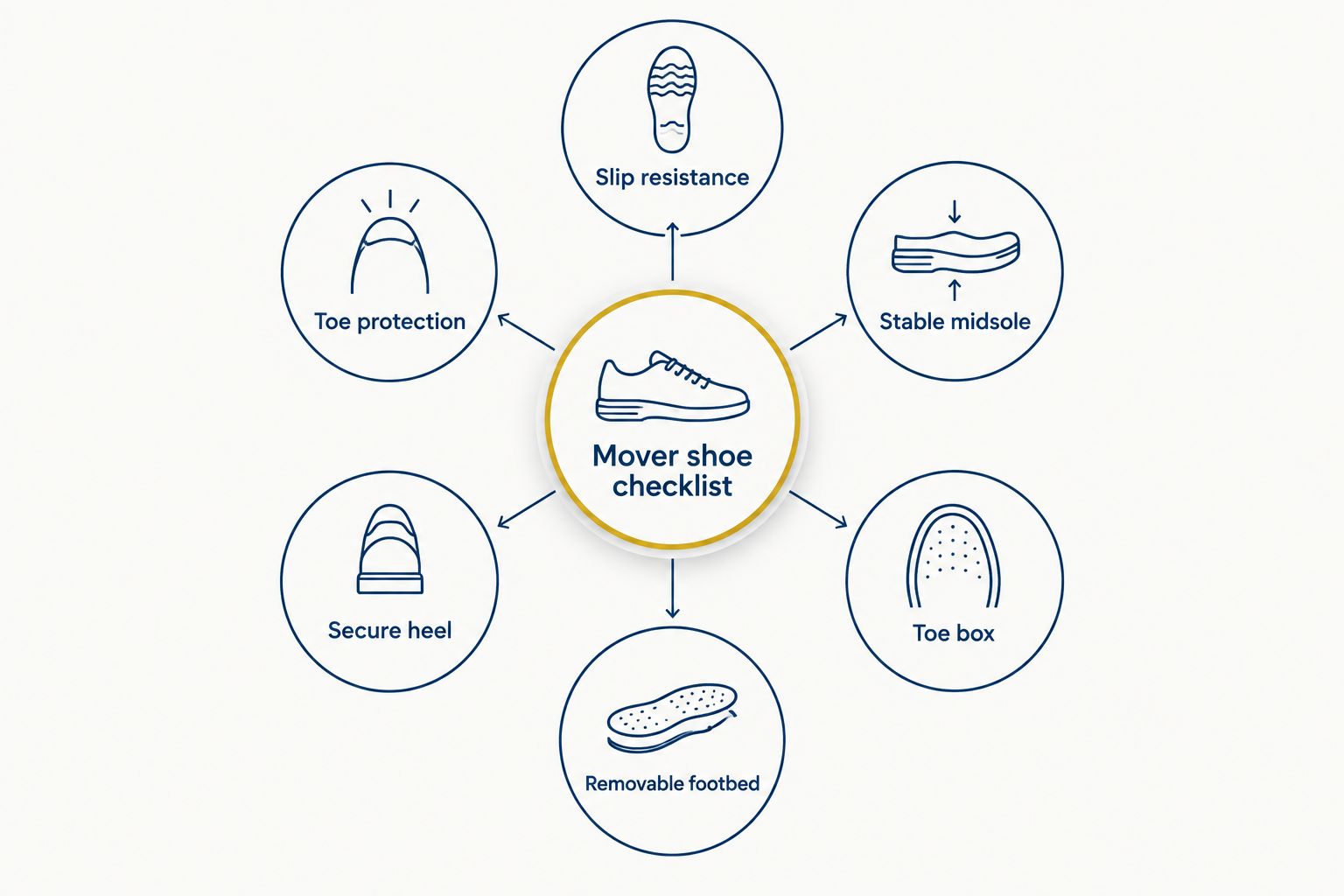
Use these criteria before comparing brands or styles:
- Slip-resistant outsole: The tread must maintain contact on ramps, smooth floors, and wet exterior surfaces.
- Appropriate toe protection: Safety toes belong on routes where dropped or rolling objects create a realistic hazard.
- Stable midsole: Cushioning should soften impact without feeling unstable while you carry an uneven load.
- Secure heel fit: The heel should stay seated when you climb stairs, walk backward, or step onto a ramp.
- Adequate toe box: Toes need room to spread without the entire shoe sliding from side to side.
- Removable footbed: A removable insert makes the shoe easier to adapt when you use an approved insole or custom orthotic.
A mover should test footwear with the socks worn at work and any prescribed insert already in place. Check the fit while standing, walking, turning, and climbing a step. A shoe that pinches during that short check will not improve after a full moving route.
Best shoes for movers at a glance
| Rank | Shoe category | Best for | Standout feature | Key limitation |
|---|---|---|---|---|
| 1 | Safety-toe rocker-style work boots | Heavy furniture and appliances | Toe protection with a smoother forward transition | More weight and heat than a work sneaker |
| 2 | Slip-resistant work sneakers | Indoor apartment and office moves | Flexible, lighter construction | Less ankle coverage and impact protection |
| 3 | Waterproof lugged work boots | Wet ramps, lawns, and gravel | Tread and upper coverage for outdoor routes | Can feel bulky on stairs and smooth floors |
| 4 | Wide toe box stability shoes | Wide feet, bunions, and toe crowding | More forefoot room with a controlled platform | Safety-toe choices can be limited |
| 5 | Composite-toe low-cut work shoes | Frequent stops and mixed indoor routes | Lighter toe protection in a low-cut design | Less ankle coverage than a boot |
| 6 | Orthotic-compatible work boots | Heel pain, flat feet, and prescribed support | Removable footbed accepts an orthotic | The shoe still requires an accurate fit |
1. Safety-toe rocker-style work boots: best for heavy furniture
Safety-toe rocker-style work boots are the default choice for crews handling appliances, large furniture, and loaded dollies. The safety toe addresses impact hazards, while the curved sole profile helps the foot move from heel contact toward toe-off without requiring an extremely flexible forefoot.
The boot must still bend where your forefoot bends. A rigid sole that does not match your gait can make stairs awkward, while excessive cushioning can feel unstable under a heavy, uneven load. Look for a firm heel counter, a secure lacing system, and an outsole suited to the surfaces on your route.
Safety-toe rocker-style work boot pros:
- Protects the toes from qualifying impact and compression hazards
- Provides more upper coverage than a low-cut shoe
- Supports repeated transitions between pavement, ramps, and stairs
- Works with many moving-company safety policies
Safety-toe rocker-style work boot cons:
- Heavier than work sneakers
- Holds more heat than a ventilated low-cut shoe
- A bulky toe cap can crowd wide feet if the size is wrong
Best for: appliance crews, full-house moves, warehouse loading, and routes with heavy rolling equipment.
Verdict: Buy when falling or rolling objects are part of the job hazard assessment.
2. Slip-resistant work sneakers: best for indoor moves
Slip-resistant work sneakers prioritize flexibility and lower weight. They fit apartment, office, and senior-living moves where crews spend more time on finished floors and stairs than on gravel, mud, or active loading docks.
Choose a work-rated outsole rather than assuming any athletic shoe is slip resistant. The heel should not lift during stair climbing, and the midsole should remain stable when you turn while carrying an object. Non-marking outsole requirements depend on the worksite, so confirm them with the employer or property manager.
Slip-resistant work sneaker pros:
- Less weight on stair-heavy routes
- Flexible forefoot for kneeling and controlled stepping
- Lower profile than a traditional work boot
- Often easier to fit under moving straps and protective clothing
Slip-resistant work sneaker cons:
- Less upper coverage around the ankle
- Many models lack safety-toe protection
- Soft cushioning can compress or feel unstable under load
Best for: indoor apartment, office, and residential moves without a required safety toe.
Verdict: Buy for indoor routes after confirming that the shoe meets workplace protection requirements.
3. Waterproof lugged work boots: best for wet outdoor routes
Waterproof lugged work boots suit crews moving through rain, wet grass, gravel drives, and outdoor storage facilities. Their deeper tread can provide better purchase on loose surfaces than a flat indoor outsole, while the higher upper helps keep exterior moisture away from the foot.
Waterproof construction has a tradeoff: less ventilation. Socks and boots that stay damp from sweat can increase friction and skin irritation. Rotate footwear when possible, let boots dry fully between uses, and replace socks during the day if they become wet.
Waterproof lugged work boot pros:
- Better suited to wet grass, gravel, and uneven exterior ground
- More coverage against moisture and debris
- Available with safety-toe options
- Structured upper can provide a secure fit
Waterproof lugged work boot cons:
- Warmer than ventilated footwear
- Deep lugs can feel awkward on smooth indoor floors
- Mud and debris can remain trapped in the tread
Best for: storage-unit crews, outdoor loading areas, rainy routes, and homes with unpaved access.
Verdict: Buy for outdoor-heavy routes; skip deep lugs when nearly every job stays indoors.
4. Wide toe box stability shoes: best for wide feet
Wide toe box stability shoes give the forefoot room without making the heel unnecessarily loose. This category is useful for movers with bunions, hammertoes, overlapping toes, or pressure at the sides of the forefoot.
Width labels are not identical across manufacturers. Measure both feet, fit the larger foot, and check for pressure over the toes while standing. The right shoe size starts with an accurate foot measurement, especially when work causes swelling later in the day.
Wide toe box stability shoe pros:
- Reduces direct pressure on crowded toes
- Gives the forefoot space to spread during loaded steps
- Stability features can limit excessive side-to-side movement
- Available in low-cut and boot-style designs
Wide toe box stability shoe cons:
- A toe box that is too wide allows sliding and friction
- Extended widths are not offered in every safety-toe model
- Added forefoot room does not correct every source of foot pain
Best for: movers with wide feet, bunions, toe crowding, or repeated rubbing along the forefoot.
Verdict: Buy when a standard-width shoe compresses the toes; skip oversizing the entire shoe to create width.
5. Composite-toe low-cut work shoes: best for frequent stops
Composite-toe low-cut work shoes occupy the middle ground between a safety boot and a standard work sneaker. They provide toe protection without a high boot shaft, which suits crews entering multiple properties and moving between driving, carrying, and stair climbing.
A composite toe does not automatically make every shoe appropriate for every hazard. Check the footwear label and employer requirements for the applicable safety standard. The shoe should also remain secure at the heel; a loose low-cut model can shift when you walk backward or pivot.
Composite-toe low-cut work shoe pros:
- Toe protection in a lower-profile design
- Less upper material around the ankle than a boot
- Useful for mixed driving and carrying duties
- Often more flexible than a full work boot
Composite-toe low-cut work shoe cons:
- Less ankle coverage on debris-filled sites
- Low collars can allow heel movement when the fit is poor
- Not every model has an outsole suited to wet ramps
Best for: multi-stop residential routes and mixed indoor work where toe protection remains necessary.
Verdict: Buy when a safety toe is required but a high boot interferes with frequent driving and stair work.
6. Orthotic-compatible work boots: best for persistent heel or arch pain
Orthotic-compatible work boots have a removable footbed and enough internal depth for the prescribed device. They are the best option on this list for movers already using custom orthotics or managing a diagnosed condition that changes foot mechanics.
An orthotic should not force the heel out of the shoe or press the toes into the upper. Bring the device when trying on boots, and check that the heel remains stable after removing the factory insert. If you are choosing between inserts, review how to know whether you need custom orthotics before repeatedly buying unsupported replacements.
Orthotic-compatible work boot pros:
- Removable footbed creates space for a prescribed device
- Lets you combine workplace protection with individualized support
- Available in safety-toe and non-safety-toe designs
- Can accommodate different arch and heel-control needs
Orthotic-compatible work boot cons:
- Not every removable footbed leaves enough depth
- The wrong orthotic can create pressure elsewhere in the shoe
- A supportive boot does not diagnose the cause of pain
Best for: movers with plantar fasciitis, flat feet, recurring arch pain, or an existing orthotic prescription.
Verdict: Buy only after confirming that the boot fits correctly with the orthotic in place.
How we ranked the options
Naples Podiatrist ranked the best shoes for movers by matching each category to a distinct moving environment in 2026. Toe protection carries the most weight on heavy-item routes. Slip resistance, heel security, and midsole stability matter across every route, while waterproofing and deep tread are useful only when the surface requires them.
No category wins every job. A waterproof lugged boot solves a wet-grass problem but adds bulk indoors. A light work sneaker handles stairs well but does not replace required protective footwear. The correct choice is the shoe that fits your foot, meets the employer's rules, and matches the surfaces you actually encounter.
Which shoes should professional movers choose?
Naples Podiatrist's default recommendation for 2026 is a properly fitted safety-toe work boot with a stable, rocker-style sole. It gives furniture and appliance crews the strongest balance of protection, traction, and controlled forward movement.
Choose a slip-resistant work sneaker for indoor routes without a safety-toe requirement. Choose a waterproof lugged boot for wet exterior work, a wide toe box stability shoe for forefoot crowding, or an orthotic-compatible boot when prescribed support needs to fit inside the shoe.
Do not choose by cushioning alone. A soft shoe that allows the heel to slide or the ankle to wobble is a poor work shoe, even if it feels comfortable during the first few minutes.
Get foot pain checked
Quick access to foot and ankle specialists across 9 Southwest Florida locations.
FAQ
What are the best shoes for movers in 2026?
The best shoes for movers in 2026 are safety-toe work boots with a stable, rocker-style sole. Slip-resistant work sneakers are better for indoor routes when protective-toe footwear is not required.
Do professional movers need steel-toe boots?
Professional movers need protective footwear when their hazard assessment identifies risks from falling or rolling objects, sole punctures, or other covered hazards. Steel toe and composite toe models are both options when they meet the required safety standard.
Are boots or sneakers better for moving furniture?
Boots are better for heavy furniture, appliances, outdoor surfaces, and jobs requiring toe protection. Work sneakers are better for lighter indoor routes where flexibility and lower weight matter more than upper coverage.
What kind of sole is best for a moving crew?
A stable, slip-resistant sole matched to the work surface is best for a moving crew. Deep lugs suit loose outdoor ground, while a lower-profile tread usually feels more controlled on stairs and smooth indoor floors.
Should movers wear waterproof shoes?
Movers should wear waterproof footwear when routes regularly include rain, wet lawns, or outdoor storage areas. Waterproof shoes retain more heat, so they are not automatically the best choice for dry indoor work.
Can movers wear custom orthotics in work boots?
Movers can wear custom orthotics in work boots that have a removable footbed and enough internal depth. The orthotic must not lift the heel or press the toes into the upper.
When should a mover see a podiatrist for foot pain?
A mover should see a podiatrist when pain persists, worsens, changes walking mechanics, or includes swelling, numbness, weakness, or difficulty bearing weight. Naples Podiatrist provides foot and ankle care across 9 Southwest Florida locations.
How often should movers replace work shoes?
Movers should replace work shoes when the tread is worn smooth, the midsole stays compressed, the upper no longer holds the heel securely, or the safety structure is damaged. Calendar age alone does not show the condition of the shoe.
One last thing
Inspect both shoes at the end of each workweek in 2026. Uneven outsole wear, a collapsed heel counter, torn uppers, or smooth tread can reveal a footwear problem before pain changes how you walk. Naples Podiatrist also recommends checking inside the shoe for folded liners, trapped debris, and worn inserts rather than judging the pair only from the outside.
For appointment access, phone agents are available 24/7 at 239-430-3668. Severe pain, an open wound, loss of sensation, or inability to bear weight needs prompt medical assessment rather than another footwear purchase.
Related guides

