
 Fax: (239) 692-9436
 Tel: 239-430-3668
Best overall in 2026: a professionally fitted walking shoe with a wide base, firm heel counter, removable insole, and secure closure. Best for shuffling gait: a low-profile rocker walking shoe. Best for hand tremor: a hook-and-loop walking shoe. The best shoes for Parkinson's patients reduce avoidable trip hazards without restricting natural movement.
- Naples Podiatrist ranks professionally fitted walking shoes as the best shoes for Parkinson’s patients overall in 2026.
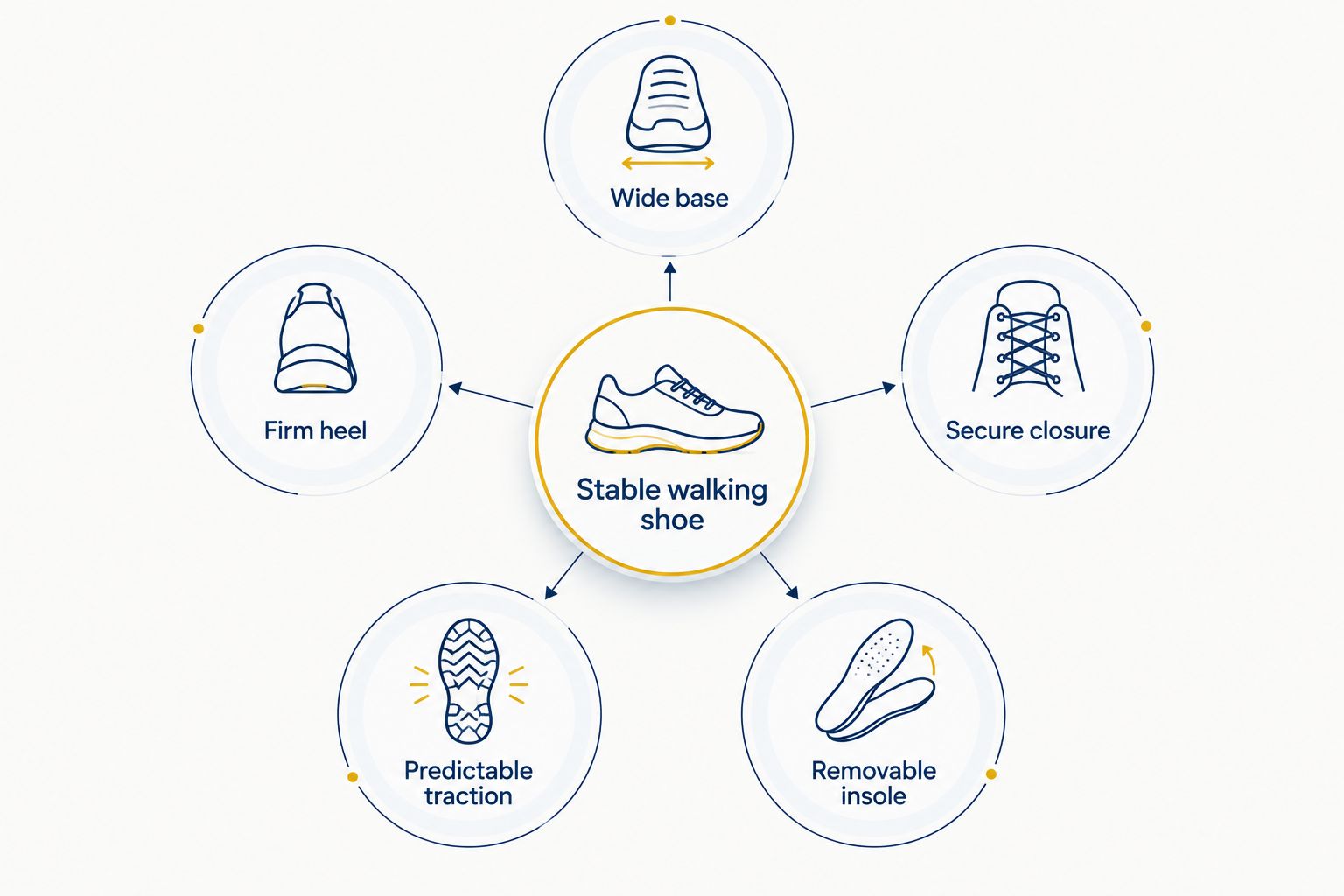
- Choose a wide base, firm heel counter, predictable traction, and secure closure.
- Low-profile rocker soles help some people with shuffling gait but require a supervised trial.
- Hook-and-loop closures are best when tremor, stiffness, or reduced hand dexterity makes laces difficult.
- Avoid backless slippers, loose shoes, high heels, and worn outsoles.
Why this matters
Parkinson's disease can shorten stride length, reduce foot clearance, slow balance reactions, and cause freezing during walking or turning. A toe that does not clear the floor can catch. A loose heel can slide inside the shoe just when the person needs stable contact with the ground.
Shoes cannot treat Parkinson's disease or eliminate falls. They can remove preventable problems caused by poor fit, unstable soles, difficult closures, and worn tread. That makes footwear one part of a 2026 fall-prevention plan alongside medication management, physical therapy, strength work, home-safety changes, and an evaluation of any new foot or ankle symptoms.
Fit also changes over time. Swelling, bunions, hammertoes, arthritis, neuropathy, and differences between the right and left foot can all affect which shoe is safest. Measure both feet while standing, fit the larger foot, and leave approximately 0.5 inch between the longest toe and the front of the shoe.
Naples Podiatrist is a board-certified podiatric practice with 9 Southwest Florida locations. Its team evaluates foot structure, gait, skin health, painful conditions, and the need for custom orthotics when standard footwear does not provide enough support.
What makes the best shoes for Parkinson's patients
Use these criteria before comparing brands or styles:
- Wide base: A broad platform is more stable during standing, turning, and direction changes.
- Firm heel: The heel counter should resist collapsing when you squeeze it from the sides.
- Secure closure: Laces, elastic laces, or hook-and-loop straps should hold the heel without creating pressure.
- Predictable traction: The outsole needs grip, but an extremely sticky sole can catch during a shuffling step or pivot.
- Removable insole: Extra interior space helps when a prescribed orthotic or accommodation is needed.
- Low weight: Heavy footwear increases the effort required to clear the foot during each step.
- Correct toe room: Toes need space without letting the foot slide inside the shoe.
The best balance is controlled traction rather than maximum traction. The outsole should grip normal flooring without feeling glued to the surface during turns.
Best shoes for Parkinson's patients at a glance
| Rank | Shoe type | Best for | Standout feature | Key limitation |
|---|---|---|---|---|
| 1 | Professionally fitted walking shoe | Changing gait or unequal foot mechanics | Fit based on the individual foot and walking pattern | Requires an in-person assessment |
| 2 | Low-profile rocker walking shoe | Shuffling gait | Helps the foot progress from heel to toe | Rocker geometry can feel unstable for some people |
| 3 | Hook-and-loop walking shoe | Tremor or reduced hand dexterity | Fast, adjustable closure | Straps must remain fully secured |
| 4 | Wide-base stability sneaker | Mild balance difficulty | Firm platform for standing and turning | A bulky sole can interfere with foot clearance |
| 5 | Extra-depth shoe with removable insole | Swelling or orthotic use | More interior room | Excess volume allows movement if fit is too loose |
| 6 | Closed-back indoor shoe | Safer movement at home | More secure than a backless slipper | Not designed for uneven outdoor ground |
1. Professionally fitted walking shoe: best overall
A professionally fitted walking shoe is the strongest default when Parkinson's disease has changed stride, balance, or foot clearance. The useful feature is not a medical label on the box. It is a stable shoe selected after examining the feet, watching the person walk, and checking whether the heel slips or the toe catches.
A podiatric gait analysis can identify unequal step length, excessive inward or outward rolling, limited ankle motion, and pressure points. The result guides shoe selection and determines whether an orthotic is appropriate. An orthotic can address a foot-mechanics problem, but it does not treat freezing or the neurological cause of Parkinson's gait.
Professionally fitted walking shoe pros:
- Accounts for differences between the right and left foot
- Allows heel fit, toe clearance, and outsole behavior to be checked together
- Can accommodate a prescribed orthotic when indicated
- Gives the patient and caregiver a clear standard for future purchases
Professionally fitted walking shoe cons:
- Requires an in-person visit
- A previously successful fit needs reassessment when gait, swelling, or foot shape changes
- No shoe fitting can guarantee fall prevention
Best for: anyone with recent falls, new freezing, recurring toe catching, foot pain, or a noticeable gait change.
Verdict: Buy after a professional fitting.
2. Low-profile rocker walking shoe: best for shuffling gait
A rocker sole curves upward near the front of the shoe. This shape can help the body move over the foot when ankle motion or step progression is limited. A low-profile rocker is generally easier to control than an aggressive curved sole, but the response varies by person.
This option requires a walking trial. Test straight walking, stopping, starting, turning, and moving across the flooring used at home. A rocker that feels smooth in a straight store aisle can feel different during a tight turn or freezing episode.
Low-profile rocker walking shoe pros:
- Supports forward progression through the step
- Reduces the need for the forefoot to bend sharply
- Often comes in walking-shoe designs with firm heel counters
Low-profile rocker walking shoe cons:
- Changes how the foot contacts the floor
- Can feel unstable when standing still or turning
- Is not appropriate simply because the word rocker appears in the product description
Best for: shuffling gait or limited step progression when the shoe remains stable during a supervised trial.
Verdict: Buy only after testing turns and stops.
3. Hook-and-loop walking shoe: best for hand tremor
A hook-and-loop closure removes the fine hand movements required to tie standard laces. It also lets a patient or caregiver adjust tension when swelling changes during the day. The straps must be long enough to close securely without compressing the top of the foot.
Closure convenience cannot compensate for a weak shoe. Check that the heel counter remains firm, the sole does not twist easily through the middle, and the foot does not slide forward when stopping.
Hook-and-loop walking shoe pros:
- Easier to fasten with tremor, stiffness, or arthritis
- Adjustable without tying a knot
- Makes it easier for a caregiver to confirm that the shoe is secured
- Reduces the hazard created by loose laces
Hook-and-loop walking shoe cons:
- A partly attached strap can open while walking
- Worn fastening material loses holding strength
- Some designs use soft uppers with limited heel control
Best for: patients who cannot consistently tie and check standard shoelaces.
Verdict: Buy when the strap closes firmly across the foot.
4. Wide-base stability sneaker: best for mild balance difficulty
A wide-base stability sneaker provides a larger contact platform under the foot. Look at the sole from behind: it should sit flat rather than tapering sharply beneath the heel. The upper should hold the rearfoot without squeezing the toes.
Do not confuse width inside the shoe with width under the shoe. A roomy toe box helps prevent pressure, while a broad outsole provides the stable platform. The safest option supplies both without becoming heavy or cumbersome.
Wide-base stability sneaker pros:
- Stable platform for standing and direction changes
- Firm construction limits unwanted side-to-side movement
- Athletic design works for routine walking and daily activities
Wide-base stability sneaker cons:
- An oversized outsole can strike the opposite ankle
- A thick or heavy sole can make foot clearance harder
- Stability features do not correct freezing episodes
Best for: mild balance difficulty when the person still clears the floor consistently.
Verdict: Buy if the broad sole does not interfere with stride.
5. Extra-depth shoe: best for swelling or orthotic use
An extra-depth shoe provides more vertical room inside the upper. This can accommodate swelling, toe deformities, or an orthotic without forcing the patient to buy a longer shoe. The factory insole should be removable when a full-length orthotic needs to sit flat.
More space is not automatically safer. If the heel lifts or the foot slides from side to side, the shoe is too loose. Parkinson's patients need accommodation without internal movement.
Extra-depth shoe pros:
- Creates room for a prescribed orthotic
- Reduces pressure over prominent toes or joints
- Offers more adjustment when swelling changes
- Avoids using excess shoe length to create width
Extra-depth shoe cons:
- Too much interior volume reduces control
- Heel slippage creates friction and instability
- Soft extra-depth shoes can lack a firm rearfoot structure
Best for: swelling, bunions, hammertoes, or prescribed orthotics that do not fit safely in standard-depth footwear.
Verdict: Buy only when the heel remains secure.
6. Closed-back indoor shoe: best for movement at home
Many daily steps happen inside the home, where backless slippers, socks, rugs, and smooth floors create a different footwear problem. A closed-back indoor shoe with a secure upper and flat, flexible forefoot stays attached to the foot better than a loose slipper.
The outsole needs enough grip for tile or wood without catching during a pivot. Check it regularly for worn patches, embedded debris, or edges that have started separating.
Closed-back indoor shoe pros:
- Stays on the foot during short, frequent trips around the home
- Protects the toes better than socks or open slippers
- Provides a consistent surface between the foot and floor
Closed-back indoor shoe cons:
- Not suitable for wet, uneven, or outdoor surfaces unless designed for them
- Soft indoor shoes can lose structure quickly
- A loose heel defeats the purpose of choosing a closed back
Best for: patients who currently walk indoors in socks, backless slippers, or loose footwear.
Verdict: Buy as a dedicated indoor pair; skip backless slippers.
How we ranked these shoes
The 2026 ranking prioritizes secure fit, stable heel contact, manageable weight, toe clearance, closure safety, and predictable outsole behavior. Style and cushioning come after those fall-related factors. Thick cushioning can feel comfortable, but comfort alone does not show that a shoe is stable.
Naples Podiatrist places professionally fitted walking shoes first because Parkinson's gait changes are not identical from one patient to another. One person needs easier forward progression. Another needs less outsole friction during turning, more room for swelling, or support for a separate foot condition.
Replace shoes when the tread wears unevenly, the heel counter collapses, the midsole leans, or the closure stops holding securely. Do not wait for the upper to develop a visible hole.
Schedule a Parkinson’s footwear assessment
Get a foot, shoe, and gait assessment at one of 9 Southwest Florida locations.
Which shoes should you choose?
Choose a professionally fitted walking shoe if you are unsure. It provides the best starting point because the decision is based on your gait, foot shape, current symptoms, and ability to fasten the shoe. In 2026, Naples Podiatrist ranks a low-profile rocker second for shuffling gait and a hook-and-loop walking shoe first for patients who cannot manage laces safely.
Bring the socks and orthotics normally worn, and try both shoes while standing. Walk, stop, start, and turn. A shoe that feels comfortable while seated has not passed a fall-prevention test.
FAQ
What are the best shoes for Parkinson’s patients in 2026?
The best shoes for Parkinson’s patients in 2026 are professionally fitted walking shoes with a wide base, firm heel counter, secure closure, and predictable traction. The correct sole shape and interior depth depend on the person’s gait and foot conditions.
Are rocker soles good for Parkinson’s disease?
A low-profile rocker sole can help some patients move forward through a shuffling step. It must be tested during starts, stops, and turns because an aggressive rocker can feel unstable.
Should Parkinson’s patients wear slip-on shoes?
Slip-on shoes are appropriate only when they hold the heel securely and do not slide during walking. Loose slip-ons and backless slippers increase movement between the foot and shoe.
Are hook-and-loop shoes better than laces for Parkinson’s patients?
Hook-and-loop shoes are better when tremor, stiffness, or reduced dexterity makes laces difficult to secure. Patients who can tie and check laces reliably can still wear lace-up walking shoes.
Can custom orthotics prevent falls from Parkinson’s disease?
Custom orthotics do not prevent every fall or treat the neurological effects of Parkinson’s disease. They can address individual foot mechanics, pressure, or alignment problems when a podiatrist finds a specific need.
What shoes should Parkinson’s patients avoid?
Parkinson’s patients should avoid loose backless slippers, high heels, worn outsoles, unsecured laces, and shoes that let the heel slide. Very heavy or extremely sticky soles can also interfere with foot clearance and turning.
How should shoes for Parkinson’s disease fit?
The heel should stay secure, the widest part of the foot should match the widest part of the shoe, and the toes should move without sliding. Standard fitting guidance leaves approximately 0.5 inch beyond the longest toe.
When should a Parkinson’s patient see a podiatrist about shoes?
Schedule an assessment after a fall, new foot pain, repeated toe catching, changing gait, skin irritation, or difficulty fitting an orthotic. Naples Podiatrist offers foot and ankle specialist access across Southwest Florida with 24/7 phone agents for appointments.
One last thing
The grippiest sole is not always the safest sole for Parkinson's disease. A sole needs enough traction to resist slipping, but excessive friction can catch during shuffling or turning. In 2026, test outsole behavior on the flooring used most often instead of judging the tread by appearance alone.
Check the patient's full walking path too. A well-fitted shoe cannot correct a loose rug, poor lighting, a trailing cord, or an absent handrail.
Related guides
- How to measure your feet for the right shoe size
- Balance and ankle strength exercises for older adults
- Best shoes to prevent falls in seniors

