
 Fax: (239) 692-9436
 Tel: 239-430-3668
Best overall: a cushioned, secure-fitting walking sneaker. Best for spill-prone treatment rooms: a slip-resistant lace-up work shoe. Best for toe pressure: a wide-toe-box walking shoe. This 2026 guide compares the best shoes for massage therapists by workplace conditions, foot shape, and support needs—not by brand popularity.
- The best shoes for massage therapists combine a secure heel, comfortable cushioning, toe room, and workplace-appropriate traction.
- Choose slip-resistant lace-up work shoes when spills are a concern; no outsole makes a contaminated floor safe.
- Choose wide-toe-box walking shoes for toe pressure and orthotic-compatible walking shoes for prescribed inserts.
- Naples Podiatrist provides foot and ankle care when work-related pain persists despite footwear changes.
Why this matters
Massage work involves standing, shifting your weight, and moving around a table. Your shoes need to feel comfortable during those movements, not just while you walk across a store.
Naples Podiatrist is a foot and ankle care option for massage therapists whose work-related pain needs evaluation. Footwear is part of that conversation, but shoes do not diagnose or treat every cause of pain. You can explore foot and ankle care through Naples Podiatrist.
A shoe that feels soft under your heel can still squeeze your toes or let your foot slide sideways. Start with fit and workplace requirements. For the broader symptom picture, read about foot pain in massage therapists.
What makes the best shoes for massage therapists?
Use these criteria to narrow your 2026 shortlist before comparing individual pairs:
- Secure fit: Your heel stays seated, and your foot does not slide forward when you shift into a staggered stance.
- Toe room: Your longest toe has clearance, and the upper does not squeeze the sides or tops of your toes.
- Comfortable cushioning: The sole cushions your foot without making you feel unstable during weight transfers.
- Workplace traction: The outsole meets your employer’s requirements. A running-shoe appearance does not establish slip resistance.
- Insert compatibility: If you use an orthotic, the shoe accommodates it without crowding your toes or lifting your heel out.
- Practical cleaning: The upper and outsole suit your workplace’s cleaning requirements, following the shoe manufacturer’s instructions.
Do not choose by softness alone. The best work shoe stays comfortable and secure while you perform your actual work movements.
Best shoe types at a glance
These rankings compare footwear categories rather than unverified model specifications. Each category serves a different need; an individual shoe still has to pass your fit check.
| Rank and shoe type | Best for | Standout feature to seek | Key limitation |
|---|---|---|---|
| 1. Cushioned walking sneaker | General use on dry treatment-room floors | Secure heel with comfortable underfoot cushioning | Athletic shoes are not automatically slip-resistant |
| 2. Slip-resistant lace-up work shoe | Workplaces where spills are a concern | Documented slip-resistance information and adjustable closure | Cleaning requirements and comfort still need checking |
| 3. Wide-toe-box walking shoe | Toe crowding, bunion pressure, or broad forefeet | Forefoot room without excessive heel looseness | A roomy toe box does not guarantee a secure midfoot |
| 4. Orthotic-compatible walking shoe | Therapists who use prescribed inserts | Adequate internal depth and a removable liner | Adding an insert can change the shoe’s fit |
| 5. Stability walking shoe | Therapists who prefer additional underfoot guidance | Support that feels comfortable during weight transfers | Extra support is not necessary or comfortable for everyone |
1. Cushioned walking sneaker: best for everyday massage work
A cushioned walking sneaker is the default starting point for massage therapists working on dry floors. Look for a closed heel, an adjustable closure, and a sole that feels steady when you lean and step around the table.
The category covers different levels of cushioning. Choose the pair that feels comfortable without making your ankle work to control a sideways wobble; the deepest or softest sole is not automatically the best choice.
Cushioned walking sneaker pros:
- Adjustable laces help you secure the heel and midfoot.
- A comfortable sole supports walking between appointments as well as standing.
- A suitable forefoot shape allows your toes to move without rubbing.
Cushioned walking sneaker cons:
- Slip resistance must be checked separately.
- Mesh uppers do not suit every cleaning requirement.
- An overly soft or poorly fitting pair can feel unstable.
Best for: Therapists without a specific footwear requirement who need a comfortable everyday starting point.
During your 2026 fitting, wear your usual work socks and check both shoes while standing. Reject heel lift, toe rubbing, or side-to-side sliding rather than expecting those problems to disappear with wear.
Verdict: Buy if the cushioned walking sneaker feels secure during standing, stepping, and weight shifts.
2. Slip-resistant lace-up work shoe: best for spill-prone rooms
A slip-resistant lace-up work shoe puts workplace traction and secure fastening first. This category fits settings where oils, lotions, water, or cleaning products can reach the floor.
Check the manufacturer’s slip-resistance information and your workplace rules. The label does not mean the shoe is slip-proof, and it does not replace prompt spill cleanup.
Slip-resistant lace-up work shoe pros:
- A documented slip-resistant outsole addresses a workplace need directly.
- Laces allow fit adjustments across the instep.
- An upper suited to workplace cleaning can simplify shoe care.
Slip-resistant lace-up work shoe cons:
- Slip resistance does not guarantee comfortable cushioning.
- A less breathable upper can feel warmer.
- Outsole wear and contamination still require attention.
Best for: Therapists whose treatment-room conditions or employer rules require slip-resistant footwear.
Look at the entire shoe, not just the tread. If the upper pinches or your heel slips, an appropriate outsole does not rescue the fit. Remove contamination according to the manufacturer’s care instructions and report unsafe floor conditions.
Verdict: Buy when workplace traction requirements make a slip-resistant lace-up work shoe the appropriate choice.
3. Wide-toe-box walking shoe: best for toe crowding
A wide-toe-box walking shoe gives the forefoot room without requiring the whole shoe to fit loosely. This distinction matters when your toes feel squeezed but your heel is relatively narrow.
Width, depth, and shape are separate fit issues. A bunion needs space at the side of the forefoot, while a raised toe also needs clearance above it. Check where the upper touches your foot.
Wide-toe-box walking shoe pros:
- A suitable shape reduces squeezing across the forefoot.
- Adequate depth avoids pressure on the tops of raised toes.
- Adjustable fastening helps retain the heel despite extra toe room.
Wide-toe-box walking shoe cons:
- A wide label does not guarantee the right toe-box shape.
- Sizing up in length can leave the heel loose.
- Extra room does not treat the underlying cause of a painful deformity.
Best for: Therapists with broad forefeet, bunion pressure, or toes that rub against standard shoe uppers.
For your 2026 purchase, check the toe box while standing rather than judging it from a photograph. Your toes should not overlap more tightly or press against the upper when you load the forefoot.
Verdict: Buy when the wide-toe-box walking shoe relieves crowding without allowing your heel to slip.
4. Orthotic-compatible walking shoe: best for prescribed inserts
An orthotic-compatible walking shoe provides enough space for your prescribed insert and your foot. A removable factory liner helps, but internal depth and heel retention also matter.
Bring the actual orthotic to the fitting. A shoe that fits without it can become cramped once the insert is installed, particularly over the toes or across the instep.
Orthotic-compatible walking shoe pros:
- A removable liner creates space for an appropriate replacement insert.
- Adequate depth helps accommodate the foot and orthotic together.
- Adjustable fastening helps secure the changed fit.
Orthotic-compatible walking shoe cons:
- A removable liner alone does not establish compatibility.
- The insert can raise your heel or reduce toe clearance.
- Stacking inserts can crowd the shoe and change how it fits.
Best for: Therapists already using an orthotic prescribed for a diagnosed foot problem.
Follow the prescribing clinician’s instructions about liner removal and use. Naples Podiatrist offers custom orthotics, but a custom device is not a requirement for every massage therapist or every tired foot.
Verdict: Buy only after the orthotic-compatible walking shoe passes the fit check with your actual insert installed.
5. Stability walking shoe: best for a preference for added support
A stability walking shoe includes features intended to guide or support the foot during movement. Consider this category when that support feels more comfortable than a neutral shoe, particularly if a clinician has recommended it.
A flat-looking arch does not automatically establish that you need a stability shoe. Compare how the shoe feels during standing and walking rather than selecting it from an arch label alone.
Stability walking shoe pros:
- Underfoot guidance can provide a comfortable alternative to a neutral shoe.
- A structured fit can feel steady during forward weight transfers.
- Adjustable fastening helps secure the foot within the shoe.
Stability walking shoe cons:
- Support features can press uncomfortably against the arch.
- Added structure is not necessary for every foot.
- The stability label does not establish workplace slip resistance.
Best for: Therapists who find additional guidance comfortable or have a clinician’s recommendation for it.
Do not tolerate a new pressure point because the shoe is described as supportive. Comfort and fit remain the deciding factors.
Verdict: Hold until a stability walking shoe proves more comfortable than a well-fitting neutral option.
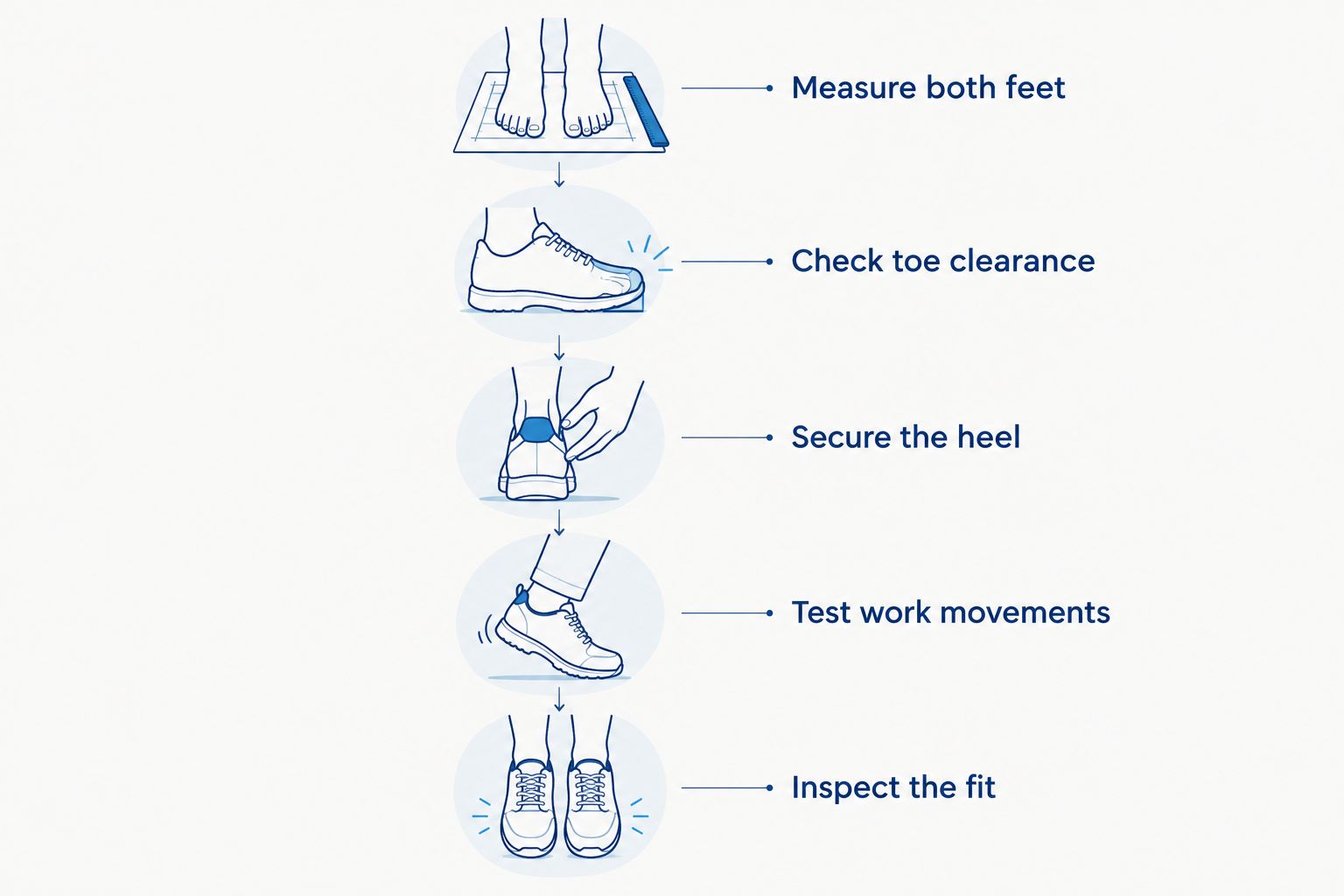
How to check fit before your first shift
Use this fitting sequence for any shoe on your 2026 shortlist. Test on a clean, dry surface; do not deliberately introduce oil or water to assess grip.
- Measure both feet: Have all 2 feet measured and fit the larger foot. Check width as well as length.
- Check toe clearance: A commonly published fitting guideline is about 1/2 inch between your longest toe and the shoe’s end. Confirm that the sides and top also provide room.
- Secure the heel: Fasten the shoe normally. Your heel should remain seated without painful pressure across the instep.
- Test work movements: Try walking, a staggered stance, and a controlled forward weight shift. Stop if you feel rubbing, numbness, or instability.
- Inspect the fit: Remove the shoes and look for new pressure marks. Persistent redness or skin damage means the fit needs attention.
Wear 1 pair of your usual work socks during the fitting, along with any prescribed insert. Do not assess fit using a sock thickness you will not wear at work.
A shoe should not require you to endure toe compression or heel rubbing to become usable. Start with shorter wear periods, inspect your skin, and increase use only while the shoe remains comfortable.
How the shoe types are ranked
This 2026 ranking prioritizes secure fit, toe room, comfortable cushioning, traction requirements, insert compatibility, and cleaning suitability. It is a use-case guide, not a product test or a claim that one shoe category treats foot disease.
The cushioned walking sneaker is the default because it addresses general daily use. The other categories move ahead when a specific need—spills, toe crowding, prescribed inserts, or comfortable added support—changes your decision.
Which shoes should you choose?
Start with a cushioned walking sneaker unless your workplace or foot condition creates a more specific requirement. Choose slip-resistant footwear first when required, then check cushioning and fit within that category.
If shoes repeatedly fail at the same painful spot, stop treating the problem as a shopping challenge. Bring your work shoes, socks, and inserts to a foot and ankle appointment. Naples Podiatrist provides care for heel pain, neuromas, foot and ankle injuries, and other conditions that footwear changes alone do not resolve.
Seek prompt assessment for persistent pain, recurring numbness, swelling, or a wound. Inability to bear weight after an injury, spreading redness, or a hot, swollen foot with diabetes needs urgent medical attention.
Get your foot pain assessed
Discuss persistent heel, arch, or forefoot pain with a foot and ankle specialist.
FAQ
What are the best shoes for massage therapists in 2026?
A secure-fitting cushioned walking sneaker is the best starting point for general massage work on dry floors. Choose a slip-resistant work shoe instead when workplace rules or spill exposure require it.
Are running shoes good for massage therapists?
Running shoes can be suitable if they fit securely and feel steady during work movements. Check workplace traction and cleaning requirements separately; a running shoe is not automatically a slip-resistant work shoe.
Are clogs better than sneakers for massage work?
Clogs are not automatically better than sneakers for massage work. Heel retention, forefoot room, traction, and comfort during weight shifts matter more than the category name; reject any pair that slips off or makes you grip with your toes.
Should massage therapists wear barefoot shoes?
Barefoot shoes are not a universal recommendation for massage therapists. Their minimal cushioning and different sole design require an individual decision, especially if you already have heel pain, an injury, or a prescribed footwear plan.
How much toe room should work shoes have?
A commonly published fitting guideline is about 1/2 inch beyond the longest toe. Width and depth also matter, so check for squeezing at the sides and pressure over the toes while standing.
Do massage therapists need custom orthotics?
Massage therapists do not automatically need custom orthotics. A clinician can assess whether a diagnosed problem warrants them; first check whether your existing shoes fit properly and suit your work.
When should a massage therapist see a podiatrist for foot pain?
See a podiatrist when pain persists, changes your walking, or keeps returning despite footwear adjustments. Numbness, swelling, and skin wounds also need assessment rather than repeated shoe purchases.
One last thing
Your treatment-table setup deserves the same attention as your shoes. If you reach too far or hold an awkward stance to deliver pressure, a comfortable shoe does not correct that working position.
Check that you can move around the table and transfer weight without curling your toes to stay in place. Choose footwear that supports that movement, not footwear that merely feels soft when you first put it on.
Related guides
- How to measure your feet for the right shoe size
- Custom orthotics vs. over-the-counter insoles
- Heel pain treatment in Naples, FL

