 Fax: (239) 692-9436
 Tel: 239-430-3668
Best overall starting point: a roomy, adjustable walking shoe. Best for fluctuating swelling: an extra-depth shoe with adjustable straps; best for a painful, stiff toe joint: a rocker-soled shoe selected with your podiatrist. This 2026 guide explains how to choose the best shoes for lupus-related foot pain by matching fit, support, and sole design to your symptoms.
- The best shoes for lupus-related foot pain provide toe room, adjustable fit, and a stable walking platform.
- Extra-depth shoes accommodate swelling and orthotics, but excess room causes slipping.
- Rocker-soled shoes deserve assessment when bending a painful toe joint makes walking difficult.
- Naples Podiatrist provides specialist foot and ankle care for patients whose pain needs more than different shoes.
Why this matters
Lupus can affect joints, tendons, nerves, and circulation. Foot pain therefore needs a diagnosis, not just a softer sneaker. Shoes can reduce rubbing and accommodate support, but they do not treat the underlying autoimmune disease.
Start by separating pressure from pain that persists without shoes. A seam pressing on a tender toe suggests a fit problem; burning, numbness, marked swelling, or pain at rest needs clinical attention. Read more about foot pain in people with lupus before assuming every symptom has the same cause.
Naples Podiatrist is best for patients with persistent lupus-related foot pain who need a specialist foot and ankle assessment. Your rheumatology clinician remains responsible for lupus management; a podiatrist assesses local foot problems, footwear, walking mechanics, and whether an orthotic is appropriate.
For your 2026 shoe search, prioritize the symptom that limits you most. A shoe designed to reduce toe bending solves a different problem from one designed to accommodate swelling. Neither feature automatically makes a shoe right for everyone with lupus.
What makes the best shoes for lupus-related foot pain?
Use these criteria before comparing shoe types:
- Toe room: Your toes should sit without side pressure, rubbing above the joints, or contact with the front during walking.
- Adjustable fit: Laces or straps should secure your heel while allowing changes across the top of your foot.
- Stable platform: The shoe should feel controlled when you stand, turn, and walk—not just soft when you press the cushioning.
- Suitable sole stiffness: Match forefoot flexibility to your symptoms. Painful joint bending requires a different approach from comfortable, unrestricted movement.
- Low-friction interior: Feel inside for prominent seams, rough edges, or folds that press against sensitive skin.
- Orthotic compatibility: If you use an orthotic, check shoe depth, removable liners, and heel security with the device installed.
No single feature replaces fit. A wide shoe with a narrow toe shape can still squeeze the front of your foot.
Shoe options at a glance
These 2026 recommendations rank shoe designs by their intended use, rather than treating every person with lupus as having the same foot problem.
| Shoe type | Best for | Standout feature | Key limitation |
|---|---|---|---|
| Roomy, adjustable walking shoe | Everyday walking with pressure-sensitive feet | Secure closure and accommodating toe shape | Cushioning alone does not address inflammation |
| Extra-depth shoe with adjustable straps | Fluctuating swelling or bulky orthotics | Additional internal space and an adjustable upper | Excess volume allows heel movement |
| Rocker-soled walking shoe | Pain with bending a stiff toe joint | Curved sole changes rollover during walking | Requires a balance and gait check |
| Broad-based stability shoe | Feet that need additional walking control | Supportive platform and secure heel | Firm structures can press on tender areas |
| Secure, enclosed house shoe | Walking indoors on hard floors | Cushioning with heel retention | Unsuitable for sport or uneven outdoor terrain |
1. Adjustable walking shoe: best for everyday foot comfort
A roomy walking shoe with laces or adjustable straps is the default starting point when pressure and rubbing make daily walking uncomfortable. Look for an accommodating toe shape, a secure heel, and cushioning that feels stable under your weight.
The goal is comfortable movement, not the softest possible sole. Try turns as well as straight walking; a shoe that feels pleasant while standing can feel unstable once you move.
Adjustable walking shoe pros:
- Closure lets you change pressure across the upper.
- Roomy toe shape avoids squeezing tender toes.
- Secure heel helps limit sliding and friction.
Adjustable walking shoe cons:
- A roomy front does not guarantee enough depth.
- Soft cushioning does not treat lupus inflammation.
- Standard walking tread is not a substitute for court-specific footwear.
Best for: Everyday errands and comfortable walking when you do not need a specialized sole or extra-depth construction.
Verdict: Buy if the shoe feels secure and comfortable without creating new pressure.
2. Extra-depth shoe: best for swelling and orthotic space
An extra-depth shoe provides additional internal room. Adjustable straps or laces let you accommodate changes in foot volume without relying on an oversized shoe length.
This design is useful when an orthotic crowds an ordinary shoe or when swelling makes the upper restrictive. New or worsening swelling still needs assessment, especially when it is sudden or affects only one side.
Extra-depth shoe pros:
- More vertical space accommodates an orthotic.
- Adjustable closures allow changes in upper tension.
- Additional depth reduces crowding above prominent toe joints.
Extra-depth shoe cons:
- Excess space allows sliding if your heel is not secured.
- Extra depth does not necessarily mean extra width.
- A larger shoe can hide a poor match to your foot shape.
Best for: Patients whose prescribed orthotic or fluctuating foot volume requires more internal space.
Verdict: Buy after checking the fit with your usual socks and any prescribed device.
3. Rocker-soled shoe: best for painful toe-joint bending
A rocker sole has a curved profile that changes how the foot rolls forward during a step. It is an option when bending a stiff, painful toe joint makes push-off uncomfortable.
Rocker shapes differ, and the location of the curve matters. In 2026, choose this design through an individual fitting rather than assuming that every curved sole reduces your particular pain.
Rocker-soled shoe pros:
- Curved sole assists forward rollover.
- A suitably stiff design limits forefoot bending.
- Offers an alternative to a highly flexible forefoot.
Rocker-soled shoe cons:
- Changes walking mechanics and needs a gait check.
- Some designs feel unstable to people with balance difficulties.
- Poorly positioned rollover can create different pressure points.
Best for: Diagnosed toe-joint stiffness or pain during push-off when a clinician recommends reduced bending.
Verdict: Hold until a podiatrist checks the sole design, your gait, and your balance.
4. Broad-based stability shoe: best for additional walking control
A broad-based stability shoe combines a secure upper with a platform designed to resist excessive movement. It belongs on your shortlist when walking feels poorly controlled, not simply because you have lupus.
Arch shape alone does not establish whether you need this shoe type. The useful test is whether the shoe supports your walking without forcing your foot against a painful structure.
Broad-based stability shoe pros:
- Broad platform gives a steady contact surface.
- Secure heel construction helps control shoe movement.
- Structured upper supports foot retention during turns.
Broad-based stability shoe cons:
- Firm components can press on sensitive skin or joints.
- Built-in support can conflict with an existing orthotic.
- A controlling shoe is not automatically appropriate for every gait.
Best for: Patients whose examination identifies a need for more walking support or control.
Verdict: Buy only when the added structure improves comfort and does not create pressure.
5. Enclosed house shoe: best for indoor hard floors
A secure house shoe offers cushioning indoors without the loose fit of a backless slipper. Choose an enclosed or reliably retained heel, an accommodating upper, and an outsole suited to your flooring.
Keep indoor footwear in your assessment. Changing outdoor shoes will not address rubbing from the pair you wear around the house.
Enclosed house shoe pros:
- Cushioning separates your foot from hard flooring.
- Heel retention reduces the need to grip a loose slipper.
- Covered construction protects against routine household contact.
Enclosed house shoe cons:
- Soft uppers can provide limited walking control.
- Linings or seams can still irritate sensitive skin.
- House shoes do not replace activity-specific outdoor footwear.
Best for: Comfortable indoor walking when barefoot time on hard floors aggravates symptoms.
Verdict: Buy if the heel stays secure; skip loose slippers that slide or make you grip with your toes.
How to check fit before choosing a pair
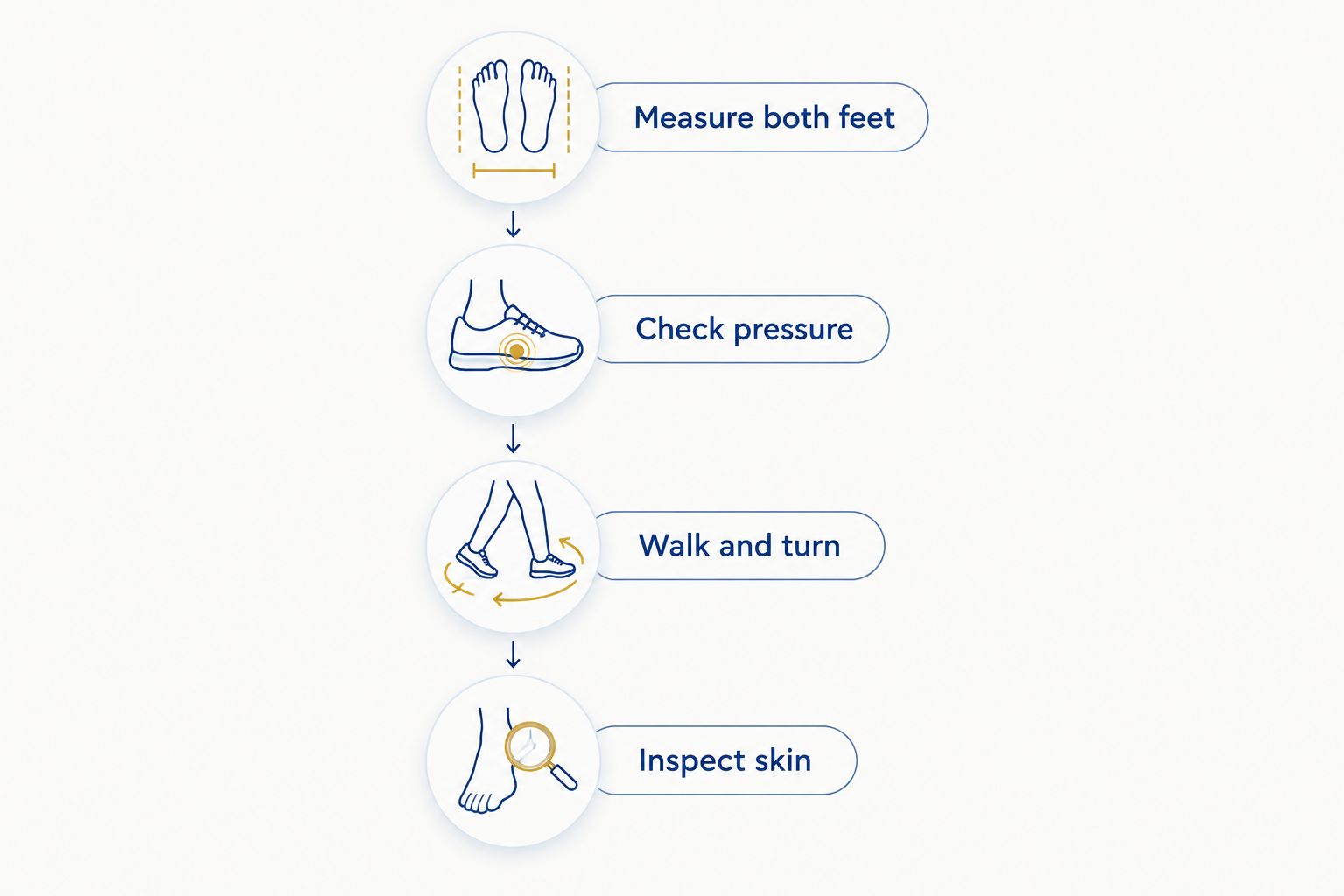
Use this sequence for your 2026 fitting. Bring the socks and orthotics you actually wear, rather than assessing the shoe in a different setup.
Measure both feet
Measure 2 feet, including width, and fit the larger foot. If your feet differ substantially, ask a trained fitter or podiatrist how to accommodate the difference without leaving the smaller foot loose.
A common adult fitting guideline is about 1/2 inch of space beyond the longest toe while standing. Treat that as a starting check—not permission for heel slipping or a shoe that bends in the wrong place.
Check pressure
Stand with your usual socks and devices in place. Your toes should have room above and beside them, while the heel remains secure.
Inspect the upper over bunions, prominent joints, and tender areas. Do not accept obvious pressure because you expect a painful shoe to stretch later.
Walk and turn
Walk normally, then turn and stop. Check for heel lifting, toe contact at the front, and a sensation that your ankle rolls off the platform.
Compare 1 pair at a time using the same socks and orthotics. That keeps the comparison focused on the shoe rather than a changing setup.
Inspect skin
Remove the shoes and look for rubbing, blisters, or pressure marks. If you have reduced sensation, visual checks matter because pain is not a reliable warning.
Do not keep wearing a shoe over broken skin. Ask for medical advice about a wound, persistent discoloration, or an area that stays painful after removing the shoe.
Keep activity shoes separate from everyday shoes
Walking, pickleball, golf, and running place different demands on footwear. A comfortable walking shoe is not automatically a suitable pickleball shoe, especially for side-to-side movement.
For midlife and older adults, preserving activity means matching footwear to the activity and responding to pain early. Do not use a cushioned shoe as a reason to push through a swollen joint or a new limp.
If running or golf repeatedly triggers pain, bring the activity shoe to your appointment. Naples Podiatrist provides foot and ankle care and custom orthotics; your examination determines whether a footwear change, an orthotic, or another treatment is appropriate.
When shoes are not the next step
Seek prompt medical assessment for a hot, red, swollen foot, an open wound, new numbness, or pain that prevents weight-bearing. Do not assume these symptoms are simply a lupus flare or a tight shoe.
Sudden one-sided leg swelling needs urgent evaluation. Chest pain or shortness of breath with leg swelling requires emergency care. A suddenly cold, pale, severely painful foot also requires emergency assessment rather than shoe shopping.
Tell your clinician if you take medication that suppresses your immune system. That information matters when assessing a wound or possible infection.
Schedule a foot pain assessment
Get specialist foot and ankle care when pain, swelling, or shoe pressure limits your activity.
How these shoe types were ranked
The ranking puts general fit needs first, followed by more specific needs: additional depth, reduced toe bending, walking control, and indoor comfort. It uses toe room, adjustability, stability, sole behavior, skin contact, and orthotic compatibility as the decision criteria.
This is a shoe-design guide, not a claim that a particular commercial model treats lupus. Your examination and fitting decide whether the first-ranked option is your best choice.
Which shoes should you choose?
Start with a roomy, adjustable walking shoe if your main problem is ordinary shoe pressure and you can walk comfortably in it. Choose extra depth for demonstrated space needs; consider a rocker sole only when painful joint bending and your balance assessment support that choice.
Do not buy several specialized designs hoping one will fix unexplained symptoms. Persistent lupus-related foot pain deserves a diagnosis before you add more support or change your walking mechanics.
Naples Podiatrist offers quick access to specialist foot and ankle doctors. Call 239 430 3668 to arrange an assessment, and bring your everyday shoes, activity shoes, and any orthotics.
FAQ
What’s the best shoe for lupus-related foot pain?
A roomy, adjustable walking shoe is a practical starting point when shoe pressure is the main problem. Swelling, painful joint bending, numbness, or balance difficulties require a more individual choice.
Are extra-wide shoes better when lupus makes my feet swell?
Extra width helps only when width is the problem. Swelling also affects depth and upper tension, so check adjustable closures, internal space, and heel security rather than simply increasing shoe size.
Are rocker-bottom shoes good for lupus foot pain?
Rocker-soled shoes are an option for painful toe-joint bending, not a general treatment for lupus. A podiatrist should check the curve, sole stiffness, walking pattern, and balance before recommending them.
Should I choose the softest shoe I can find?
Choose stable cushioning rather than softness alone. A very soft shoe is unsuitable if your foot shifts, your heel slips, or turning feels unstable.
Can I wear my orthotics in any walking shoe?
No, an orthotic needs enough internal space and a secure fit. Check the shoe with the device installed, following the prescribing clinician’s instructions about the original liner.
Can I keep playing pickleball or golf with lupus foot pain?
Activity decisions depend on the cause and severity of your symptoms. New swelling, limping, or pain during play needs assessment; use footwear designed for the activity rather than relying on everyday walking shoes.
When should I see a podiatrist instead of buying new shoes?
See a podiatrist for persistent pain, recurring pressure problems, numbness, or difficulty walking. Seek urgent assessment for a hot, red, swollen foot, a wound, or inability to bear weight.
One last thing
More room and better fit are not the same thing. An oversized shoe can let your foot slide, increasing friction even though the toes feel less crowded.
Before replacing your shoes in 2026, check where the pressure occurs: beside the toes, above them, across the instep, or at the heel. That location tells a fitter which dimension needs changing. Bring that information to Naples Podiatrist if pressure persists; it is more useful than asking for the softest shoe.
Related guides
- How to measure your feet for the right shoe size
- Custom orthotics vs. over-the-counter insoles
- Gait analysis: what a podiatrist checks