 Fax: (239) 692-9436
 Tel: 239-430-3668
The best shoe for a child with cerebral palsy depends on the gait pattern, not the shoe brand. High-top AFO-compatible sneakers rank best overall for kids wearing ankle-foot orthoses, rigid heel-counter shoes win for flat-footed crouch gait, and wide toe-box adjustable-closure shoes win for spasticity-driven toe-walking.
- High-top AFO-compatible sneakers rank best overall for cerebral palsy children in 2026.
- Rigid heel-counter shoes win for flat-footed crouch gait; wide toe-box shoes win for toe-walking.
- A shoe fitted over an AFO usually runs a half to full size larger than a bare-foot fit.
- Gait pattern, not brand name, decides which shoe category actually helps a child with cerebral palsy.
Why this matters
Cerebral palsy affects roughly 1 in 345 children in the United States, based on CDC surveillance data, and most of them walk with some form of abnormal gait: toe-walking, crouch gait, scissoring, or in-toeing. The wrong shoe doesn't cause cerebral palsy, but it makes an already inefficient gait work harder against itself.
A soft heel collapses under a crouch gait. A narrow toe box blisters a toe-walker. A shoe that's too tight over an AFO changes how the brace controls the ankle in the first place. Naples Podiatrist sees pediatric patients across Southwest Florida for a full gait evaluation, and shoe selection is one of the first things addressed once the gait pattern is actually diagnosed, not guessed at.
Most "best shoes for cerebral palsy children" lists ignore AFOs, custom orthotics, and the specific gait driving the problem. This one ranks shoe categories by the gait issue each one solves in 2026, not by which sneaker brand shows up most in search ads.
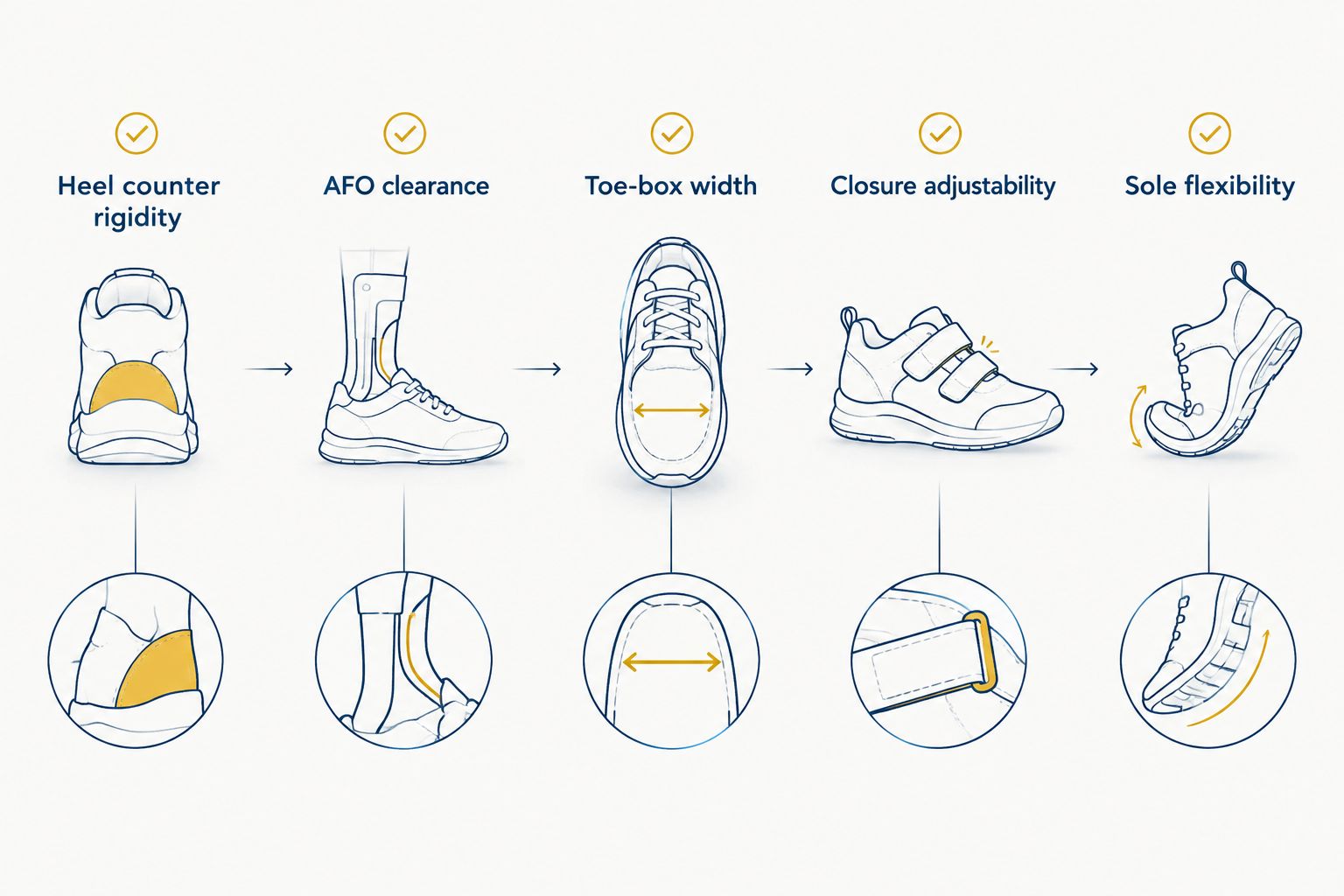
What makes the best shoe for a child with cerebral palsy
- Heel counter rigidity – a stiff heel cup controls rearfoot motion better than a soft, collapsible one.
- AFO clearance – enough internal volume to fit an ankle-foot orthosis without pinching the leg.
- Toe-box width – a wide, high toe box keeps pressure off toes curled by spasticity or contracture.
- Closure adjustability – hook-and-loop straps or wide lacing let a caregiver get a secure fit fast.
- Sole flexibility – the sole should bend at the ball of the foot but stay stable at the heel.
- Ankle collar height – a padded high-top collar adds feedback and stops the foot sliding inside the shoe.
Best shoes for cerebral palsy children at a glance
| Category | Best for | Standout feature | Key limitation |
|---|---|---|---|
| High-top AFO-compatible sneakers | Kids wearing ankle-foot orthoses | Extra internal volume plus a high collar | Bulkier profile; narrow widths are hard to find |
| Rigid heel-counter stability shoes | Flat-footed crouch gait | Firm heel cup resists rearfoot collapse | Stiffer feel some kids resist at first |
| Wide toe-box adjustable-closure shoes | Spasticity-driven toe-walking | Room for curled toes plus one-pull straps | Less ankle support than a high-top |
| Extra-depth orthotic-friendly shoes | Custom orthotics without an AFO | Removable insole leaves room for the device | Not built for kids who also need brace clearance |
| Lightweight flexible sneakers, reinforced collar | Mild diplegia, independent walkers | Low weight for kids who fatigue easily | Not enough structure for moderate-severe gait issues |
1. High-top AFO-compatible sneakers: best cerebral palsy shoe for kids in ankle-foot orthoses
These shoes carry a removable footbed and a taller, wider upper so the shoe fits over an ankle-foot orthosis instead of a bare foot. A full-length hook-and-loop strap or side zipper usually replaces standard lacing so a caregiver can open the whole shoe to slide the brace in.
High-top AFO shoe pros:
- Wide opening speeds up getting an AFO in and out every morning.
- Removable insole gives the internal volume the orthosis needs.
- High-top design adds ankle support on top of what the brace already provides.
High-top AFO shoe cons:
- Bulkier-looking than a standard sneaker, which some kids and parents don't love.
- Narrow-width versions are scarce; most run medium-to-wide only.
Best for: kids in a solid or hinged AFO who need one shoe to work over the brace every day. Buy.
If an AFO doesn't slide into a shoe without pinching the leg, the shoe is wrong, not the brace.
2. Rigid heel-counter stability shoes: best cerebral palsy shoe for flat-footed crouch gait
These carry a firm plastic or dense-foam heel cup that resists inward roll at the ankle, which shows up constantly in kids whose knees stay bent and whose feet flatten under load. Pairing this category with custom orthotics for children with flat feet gives the heel counter something rigid to hold onto instead of a bare, mobile arch.
Rigid heel-counter shoe pros:
- Firm heel cup limits the ankle roll that drives a flat-footed crouch pattern.
- Structured midsole holds up under extra load through the inside of the foot.
- Widely stocked in kids' sizes at general retailers, unlike AFO-specific shoes.
Rigid heel-counter shoe cons:
- Stiffer feel than a typical sneaker; some sensory-sensitive kids resist it at first.
- Doesn't solve toe-walking – it's built for a flattened foot, not a plantarflexed one.
Best for: crouch gait with flat, pronated feet, with or without custom orthotics. Buy.
3. Wide toe-box adjustable-closure shoes: best cerebral palsy shoe for spasticity-driven toe-walking
Spastic toe-walkers keep weight forward on the forefoot and often curl or overlap toes inside a narrow shoe. A wide, high toe box gives those toes room, and one-pull or hook-and-loop closures let a caregiver adjust fit without the child needing to stand still. For kids where toe-walking is the dominant pattern, the dedicated breakdown of shoes for kids who toe-walk goes further into sole stiffness options.
Wide toe-box shoe pros:
- Extra depth reduces rubbing on curled or overlapping toes.
- One-pull or hook-and-loop closures cut down on daily dressing time.
- Flexible forefoot allows some heel-to-toe motion when a brace isn't worn.
Wide toe-box shoe cons:
- Offers less ankle structure than a high-top AFO shoe.
- Manages the foot; it doesn't fix the calf tightness that drives the toe-walk itself.
Best for: toe-walking without an AFO, or daily wear alongside a custom insert. Buy.
4. Extra-depth orthotic-friendly shoes: best cerebral palsy shoe for custom orthotics without an AFO
These shoes drop the stock insole to make room for a custom orthotic device without changing the shoe's overall size or shape. The result looks like a normal sneaker once the orthotic is in place, which several kids prefer over a bulkier AFO-style shoe.
Extra-depth shoe pros:
- Removable insole keeps sizing consistent once the custom orthotic goes in.
- Wider heel base gives an orthotic's heel post something stable to sit on.
- Standard sneaker look with none of the extra bulk of an AFO shoe.
Extra-depth shoe cons:
- Not enough internal room for a rigid ankle-foot orthosis – this category is orthotic-specific, not brace-specific.
- Some models still need a half-size up to avoid pressure at the widest part of the device.
Best for: kids fitted with custom orthotics for flat feet or gait asymmetry who don't need ankle bracing. Hold if the child also has an AFO on order.
5. Lightweight flexible sneakers, reinforced ankle collar: best cerebral palsy shoe for mild diplegia and independent walkers
Kids with milder spastic diplegia who walk independently, without a brace, often do better in a shoe that's light and doesn't fight the foot but still needs a reinforced collar so the ankle doesn't roll on uneven ground.
Lightweight sneaker pros:
- Lower weight cuts fatigue for kids who already work harder to walk than typically developing peers.
- Reinforced collar adds ankle feedback without the bulk of a full high-top.
- Flexible sole allows a more typical heel-to-toe roll where one exists.
Lightweight sneaker cons:
- Too little structure for moderate-to-severe spasticity or for any child using an AFO.
- Doesn't fit over orthotic devices without going up at least a full size.
Best for: mild gait deviation in kids who walk unassisted with no brace or bulky orthotic. Buy for the right, milder gait; Skip if there's an AFO involved.
How we ranked these
Every category above is scored against the six criteria listed earlier: heel counter rigidity, AFO clearance, toe-box width, closure adjustability, sole flexibility, and ankle collar height. No single category wins on all six – a shoe built for AFO clearance sacrifices some sole flexibility, and a lightweight sneaker sacrifices heel rigidity by design.
Sizing matters as much as category. Confirm fit with the same basics used for any child before ordering: how to measure your child's feet for the right shoe size, since a half-size error undoes most of what a well-designed shoe is supposed to do.
Which shoe should you choose for your cerebral palsy child?
If your child wears an ankle-foot orthosis, start with a high-top AFO-compatible sneaker – it's the only category built for the extra volume a brace needs. If the gait pattern is flat-footed and crouched, a rigid heel-counter stability shoe does more work than any insert alone. Toe-walkers without a brace do best in a wide toe-box shoe with adjustable closures.
For anything in between, a pediatric gait evaluation in 2026 narrows the choice faster than trying three pairs at a shoe store. Bring the child's current shoes to that visit – the wear pattern on them is part of the diagnosis.
Get a pediatric gait evaluation
Board-certified podiatrists check gait and AFO fit for kids across Naples, Estero, Fort Myers, Cape Coral, Port Charlotte and Sarasota.
FAQ
What’s the best shoe for a child with cerebral palsy?
It depends on the gait pattern. A high-top AFO-compatible sneaker is best for kids in ankle-foot orthoses, a rigid heel-counter shoe is best for flat-footed crouch gait, and a wide toe-box shoe is best for spasticity-driven toe-walking.
Are AFO-compatible shoes different from regular sneakers?
Yes. They have a removable insole and a taller, wider upper built to fit over an ankle-foot orthosis, plus a wide opening like a full strap or side zipper for getting the brace in and out.
Should a child with cerebral palsy wear high-top or low-top shoes?
High-tops help kids who wear an AFO or need extra ankle feedback. Kids with mild diplegia who walk independently often do fine in a low-top with a reinforced collar instead.
How much bigger should a shoe be to fit over an AFO?
Most kids need a half size to a full size larger than their bare-foot measurement once the orthosis is inside the shoe. Fit should still be checked in person, since brace bulk varies by device.
Can custom orthotics replace an AFO in a regular shoe?
No, they solve different problems. Orthotics support the arch and correct alignment inside a normal shoe; an AFO controls ankle motion and needs a shoe built with extra internal volume.
Is toe-walking always related to cerebral palsy?
No. Toe-walking shows up in many typically developing toddlers and resolves on its own, but persistent toe-walking past early childhood, especially with tight calves, should be checked by a podiatrist.
How often should shoes be resized for a child with cerebral palsy?
Check fit every 3 to 4 months during growth spurts, and sooner if the child starts a new AFO or orthotic, since either device changes how much room the shoe needs.
When should a child with gait issues see a podiatrist?
See a podiatrist if toe-walking persists past age 3, if one leg seems to drag or turn in, or if shoes wear unevenly on one side – all signs worth a gait evaluation rather than a new shoe alone.
One last thing
Wear pattern on an old pair tells a podiatrist more than a brand-new shoe ever will. Bring the child's most-worn pair to a gait evaluation – the compression pattern on the outsole and the direction the upper leans show exactly how the foot is loading, which is diagnostic information a fresh shoe can't give up. That single detail, checked in 2026 the same way it was checked a decade ago, still shapes which of the five categories above actually fits the child in front of the doctor.
Related guides