
 Fax: (239) 692-9436
 Tel: 239-430-3668
Best overall starting point: Brooks Ghost for neutral daily running. Best for added stability: ASICS GEL-KAYANO. Best for a cushioned rocker feel: HOKA Bondi. The best running shoes for plantar fasciitis in 2026 are the ones that fit securely, feel comfortable under your heel, and match your running mechanics—not the ones with the thickest sole.
- Brooks Ghost is a neutral running-shoe candidate, not a proven plantar fasciitis treatment.
- ASICS GEL-KAYANO suits runners seeking added guidance; stability shoes are not necessary for every painful heel.
- HOKA Bondi suits runners who prefer substantial cushioning and a rocker-shaped sole.
- The best running shoes for plantar fasciitis combine comfortable heel cushioning, secure fit, and appropriate arch support.
- Naples Podiatrist provides heel-pain care when footwear changes do not resolve symptoms.
Why this matters
Plantar fasciitis affects the band of tissue connecting your heel to the front of your foot. Pain commonly appears beneath the heel, especially with the first steps after sleep or a period of sitting. Running adds repeated loading, but footwear is only one part of the problem.
A running shoe can improve comfort; it cannot establish the diagnosis or replace treatment. Persistent symptoms deserve an examination rather than another round of shoe shopping. Naples Podiatrist offers foot and ankle care, including heel-pain treatment; its guide to plantar fasciitis treatment for runners explains the condition in a running-specific context.
For your 2026 training plan, separate two decisions: which shoe feels appropriate, and whether your heel is ready for running. A comfortable fitting-room walk does not answer the second question.
What makes the best running shoes for plantar fasciitis?
Use these criteria before comparing brands. A shoe that fails the fit check does not become suitable because someone else recommends it.
- Comfortable heel cushioning: Look for pressure relief without a sinking, unstable sensation. Softer is not automatically better.
- Secure heel fit: Your heel should remain seated without rubbing. Tightening the laces should not create pressure across the top of your foot.
- Appropriate support: The arch should feel supported, not pushed upward by a hard ridge. Match stability features to your needs rather than your diagnosis alone.
- Toe room: Your toes need space to spread. The American Academy of Orthopaedic Surgeons advises about 1/2 inch—approximately 13 millimeters—between the longest toe and the shoe's end.
- Comfortable transition: Walking and an appropriate trial jog should feel natural. Reject a shoe that forces a stride change or increases heel pain.
- Insert fit: If you use an orthotic, assess the shoe with that device inside. Added support is not useful if it crowds your toes or lifts your heel out of the shoe.
Heel-to-toe drop describes the difference between the sole height beneath the heel and forefoot. It is not a treatment score. Avoid choosing a specific drop solely because a label says the shoe is suitable for plantar fasciitis.
Running shoes at a glance
These established shoe families are fitting candidates, not interchangeable prescriptions. This 2026 comparison uses their broad design categories; check the exact version you try because construction and fit change between releases.
| Shoe family | Best for | Standout design direction | Key limitation |
|---|---|---|---|
| Brooks Ghost | Neutral everyday running | Cushioned neutral daily-trainer design | Not a dedicated stability shoe |
| ASICS GEL-KAYANO | Runners seeking added stability | Stability-oriented running-shoe design | Added guidance is not necessary for every runner |
| HOKA Bondi | Runners who prefer a cushioned rocker | Substantial cushioning and rocker-shaped sole | Sole height and rolling feel require a personal balance check |
| New Balance Fresh Foam X 1080 | Runners who prioritize a soft neutral feel | Soft-cushioned neutral running design | Softness alone does not provide the right support |
No shoe in this table has a guaranteed plantar fasciitis outcome. Your symptoms, fit, running load, and response to treatment matter more than the position of a shoe in a list.
1. Brooks Ghost: best running shoe for neutral daily training
Brooks Ghost is a neutral daily-running shoe family. It is a starting point if you want conventional everyday cushioning without deliberately selecting a stability model.
The reason to try Brooks Ghost is straightforward: you can assess a neutral shoe before assuming heel pain requires more correction. Plantar fasciitis does not automatically mean you overpronate, and visible inward foot movement alone does not establish the cause of pain.
Brooks Ghost pros:
- Neutral design provides an everyday-running starting point.
- Cushioned construction suits runners seeking underfoot comfort.
- Lets you assess fit without choosing dedicated stability features first.
Brooks Ghost cons:
- Not the default choice when an examination identifies a need for added guidance.
- Heel and arch comfort still depend on the exact version and your foot.
- Does not replace rehabilitation or changes to painful running loads.
Best for: Runners seeking a neutral daily trainer who do not have a specific stability requirement.
Try Brooks Ghost with your usual running socks. Check whether your heel stays seated and whether the arch feels comfortable while walking. If you wear an orthotic, use it during the fitting rather than assuming it will work afterward.
Verdict: Buy Brooks Ghost only if the neutral fit feels secure and does not increase symptoms.
2. ASICS GEL-KAYANO: best running shoe for added stability
ASICS GEL-KAYANO is a stability-oriented running-shoe family. It belongs on your shortlist when you prefer a more guided platform or a clinician recommends assessing additional support.
ASICS GEL-KAYANO is not a universal answer for flat feet. Foot shape, movement, strength, and symptoms all matter. A stability shoe should feel comfortable during movement—not like it is pressing your foot into a prescribed position.
ASICS GEL-KAYANO pros:
- Stability-oriented design distinguishes it from neutral trainers.
- Offers a fitting option for runners seeking more guidance.
- Combines running cushioning with a support-focused design.
ASICS GEL-KAYANO cons:
- Added guidance is unnecessary for some runners.
- A support feature that creates arch pressure is a reason to reject the fit.
- A stability label does not show whether heel pain comes from the plantar fascia.
Best for: Runners who need or prefer added stability rather than simply more softness.
During your 2026 shoe fitting, compare ASICS GEL-KAYANO with a neutral trainer under the same conditions. Use the same socks and inserts. Notice comfort and control, not whether the shoe seems more corrective when you look at it.
Verdict: Buy ASICS GEL-KAYANO when its added guidance feels comfortable and suits your assessed needs; skip it if the support creates pressure.
3. HOKA Bondi: best running shoe for a cushioned rocker feel
HOKA Bondi is a substantially cushioned running-shoe family with a rocker-shaped sole. The curved sole creates a different transition from heel toward toe than a more conventional shoe shape.
That rolling sensation is the reason to try HOKA Bondi, not proof that it unloads every painful plantar fascia. Some runners prefer it; others feel less secure in a higher, more cushioned platform. Your fitting needs to include movement, not just standing on soft foam.
HOKA Bondi pros:
- Substantial cushioning offers a distinct underfoot option.
- Rocker-shaped sole provides a rolling transition to assess.
- Suits runners who prefer a cushioned feel for easy running.
HOKA Bondi cons:
- A higher platform requires attention to balance and comfort.
- The rocker feel does not suit every stride.
- Extra cushioning does not correct an unsuitable fit or excessive training load.
Best for: Runners who specifically prefer substantial cushioning and a rocker transition.
Walk straight, turn, and change direction gently during the fitting. If you feel unsteady, do not dismiss that sensation as something you must learn to tolerate. This matters especially if you already have balance difficulties or ankle instability.
Verdict: Buy HOKA Bondi only if the rocker feels natural and the platform feels stable beneath you.
4. New Balance Fresh Foam X 1080: best running shoe for soft neutral comfort
New Balance Fresh Foam X 1080 is a soft-cushioned neutral running-shoe family. It is a comparison option when you do not need dedicated stability features and prefer a softer underfoot sensation.
The distinction is preference, not a claim of better healing. A soft shoe can feel pleasant during a short walk yet feel unsuitable during running. Assess whether your foot feels securely held instead of choosing New Balance Fresh Foam X 1080 on softness alone.
New Balance Fresh Foam X 1080 pros:
- Soft cushioning offers a different feel from a conventional neutral trainer.
- Neutral design suits runners without a dedicated stability requirement.
- Provides a comparison point when comfort is your main fitting priority.
New Balance Fresh Foam X 1080 cons:
- Soft foam is not the same as arch support.
- A sinking sensation is a reason to reconsider the shoe.
- Fit and cushioning feel vary between versions.
Best for: Neutral runners who prefer softness but still feel secure during movement.
Compare New Balance Fresh Foam X 1080 with Brooks Ghost rather than assuming the softer-feeling shoe wins. Pay attention to heel movement, arch pressure, and your confidence while turning. Comfort should extend beyond the moment you first step into the shoe.
Verdict: Buy New Balance Fresh Foam X 1080 if its softness stays comfortable and controlled; skip it if you feel unstable.
How these running shoes are ranked
This is a use-case ranking, not a clinical effectiveness ranking. Brooks Ghost occupies the neutral everyday slot; ASICS GEL-KAYANO covers added stability; HOKA Bondi covers a cushioned rocker preference; New Balance Fresh Foam X 1080 covers soft neutral comfort.
The deciding criteria are heel comfort, secure fit, appropriate support, toe room, transition, and insert fit. No ranking establishes that one shoe family heals plantar fasciitis faster than another.
Naples Podiatrist is best for runners whose plantar fasciitis needs clinical assessment rather than another footwear change. Footwear belongs within a treatment plan, not in place of one.
Fit the shoe before planning your next run
A useful 2026 fitting checks the complete shoe-and-foot combination. Bring your running socks and any prescribed orthotics, and assess both feet rather than relying on your previous shoe size.
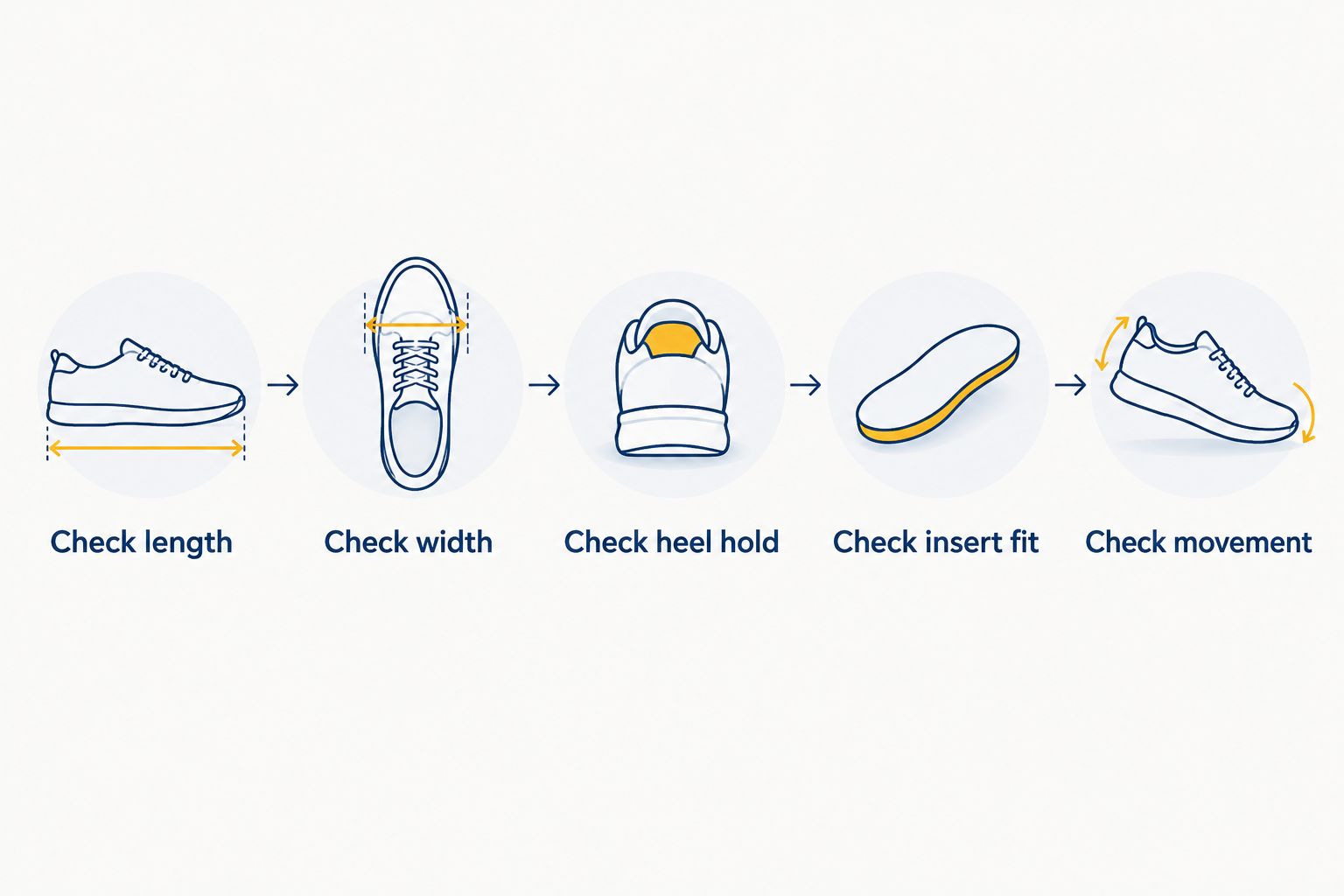
Follow this sequence:
- Check length: Leave toe clearance without making the shoe so long that your heel slides.
- Check width: Your forefoot should not bulge against the upper, and your toes should not feel compressed.
- Check heel hold: Lace the shoe normally. Reject rubbing, repeated slipping, or pressure that requires overtightening.
- Check insert fit: Confirm that your orthotic sits correctly and leaves sufficient room above the foot.
- Check movement: Walk and turn. Try a brief jog only if running is appropriate for your symptoms.
Do not stack an orthotic over the original insole by default. Follow the device instructions or your clinician's advice; changing the space inside a shoe changes its fit.
A painful shoe does not need a break-in period to become an appropriate treatment choice. Tightness, numbness, focal pressure, and increased heel pain are reasons to stop the trial. Do not accept those symptoms because the model appears on a recommended list.
When a new shoe is not the next move
Stop running through pain that changes your gait. Limping, worsening pain, or pain that persists despite reducing activity calls for assessment. Your next step is to identify the problem, not search for a more cushioned model.
Seek prompt medical evaluation for an inability to bear weight, a sudden pop with bruising, marked swelling, or a red, hot foot. Fever, an open wound, or new symptoms in a foot with diabetes or reduced sensation also require medical attention.
Heel pain is not always plantar fasciitis. Stress fractures, nerve irritation, and other conditions can produce pain in the same general area. Shoe comfort cannot rule them out.
Naples Podiatrist offers specialist foot and ankle care, including heel-pain treatment and custom orthotics. An examination helps determine whether footwear, rehabilitation, an insert, or another treatment fits your condition.
Get your heel pain assessed
Discuss persistent running-related heel pain and treatment options with a foot and ankle specialist.
Which running shoe should you choose?
For an undecided runner in 2026, start by trying Brooks Ghost if you have no identified need for added stability. Use it as a neutral comparison point, not an automatic purchase.
Choose ASICS GEL-KAYANO when additional guidance is appropriate and comfortable. Try HOKA Bondi when you prefer a rocker transition, or New Balance Fresh Foam X 1080 when you prefer soft neutral cushioning. Reject any option that increases pain, creates pressure, or feels unstable.
Your final decision should answer one question: does this shoe fit your foot and your current treatment needs? A brand name cannot answer that for you.
FAQ
What’s the best running shoe for plantar fasciitis?
There is no single best running shoe for every person with plantar fasciitis. Brooks Ghost is a neutral fitting candidate, ASICS GEL-KAYANO offers a stability-oriented option, and HOKA Bondi offers a cushioned rocker feel. Choose according to comfort, fit, and your clinical needs.
Is HOKA Bondi better than Brooks Ghost for heel pain?
HOKA Bondi is not automatically better than Brooks Ghost for heel pain. HOKA Bondi emphasizes substantial cushioning and a rocker-shaped sole, while Brooks Ghost is a neutral daily trainer. The better choice is the one that fits securely without increasing symptoms.
Do I need stability running shoes if I have plantar fasciitis?
Plantar fasciitis alone does not mean you need stability running shoes. An examination can assess whether added guidance is appropriate. A stability feature that presses painfully into your arch is not a good fit.
Can I keep running if my heel hurts?
Do not continue running when heel pain makes you limp or worsens during activity. Reduce the painful activity and seek assessment if symptoms persist. A clinician can help determine an appropriate return-to-running plan.
Can running shoes cure plantar fasciitis?
Running shoes do not reliably cure plantar fasciitis on their own. Comfortable footwear can support a treatment plan that also addresses activity load, stretching, strengthening, and other needs identified during examination.
Should I put custom orthotics in my running shoes?
Use custom orthotics in running shoes when they are prescribed or recommended for your condition and fit correctly inside the shoe. Check heel hold, toe room, and pressure with the orthotic in place. Do not assume every running shoe accommodates the same device.
How do I know when heel pain needs a podiatrist?
Heel pain needs assessment when it persists, worsens, changes your gait, or keeps returning despite footwear and activity changes. Naples Podiatrist provides heel-pain and foot and ankle care. Inability to bear weight, marked swelling, a hot red foot, or an open wound requires prompt medical evaluation.
One last thing
Your morning steps are part of the running-shoe decision. Record whether heel pain is improving, unchanged, or worse after activity, including the following morning. That pattern gives your clinician more useful information than a report that a shoe felt soft in the store.
Bring your current running shoes and orthotics to the appointment. A fit problem is easier to assess when the actual equipment is present.
Related guides
- Custom orthotics for plantar fasciitis
- Gait analysis: what a podiatrist checks
- How to relieve plantar fasciitis heel pain at home
- Stress fractures in the foot: how runners get them and heal

