
 Fax: (239) 692-9436
 Tel: 239-430-3668
Best overall for rubbing between the big and second toes: a soft toe spacer. Best for pressure over the bunion bump: a thin protective pad. Best for supported positioning at rest: an adjustable bunion splint. This 2026 guide compares the best bunion correctors and splints by symptom, shoe fit, and safety—not promises of permanent correction.
- The best bunion correctors and splints target discomfort; they do not permanently reverse an established bunion.
- Soft toe spacers suit toe-to-toe rubbing, provided they fit without crowding your shoes.
- Thin bunion pads protect the bump; adjustable splints support positioning at rest.
- Naples Podiatrist offers bunion care for patients whose pain limits walking, golf, running, or pickleball.
Why this matters
A bunion is more than a bump. The big toe angles toward the smaller toes while the joint becomes prominent along the inside of your foot. A device that cushions the bump addresses a different problem from one that separates your toes.
Comfort is the goal of an over-the-counter device, not permanent bone realignment. If pain keeps you out of your usual shoes or activities, Naples Podiatrist offers bunion treatment in Naples with access to foot and ankle specialists. An examination helps distinguish pressure irritation from joint arthritis or another source of big-toe pain.
For your 2026 choice, match the device to where you hurt. A more complicated brace is not automatically a better treatment, and tighter tension is not a sign that it is working.
What makes the best bunion correctors and splints?
Use these criteria before choosing a device:
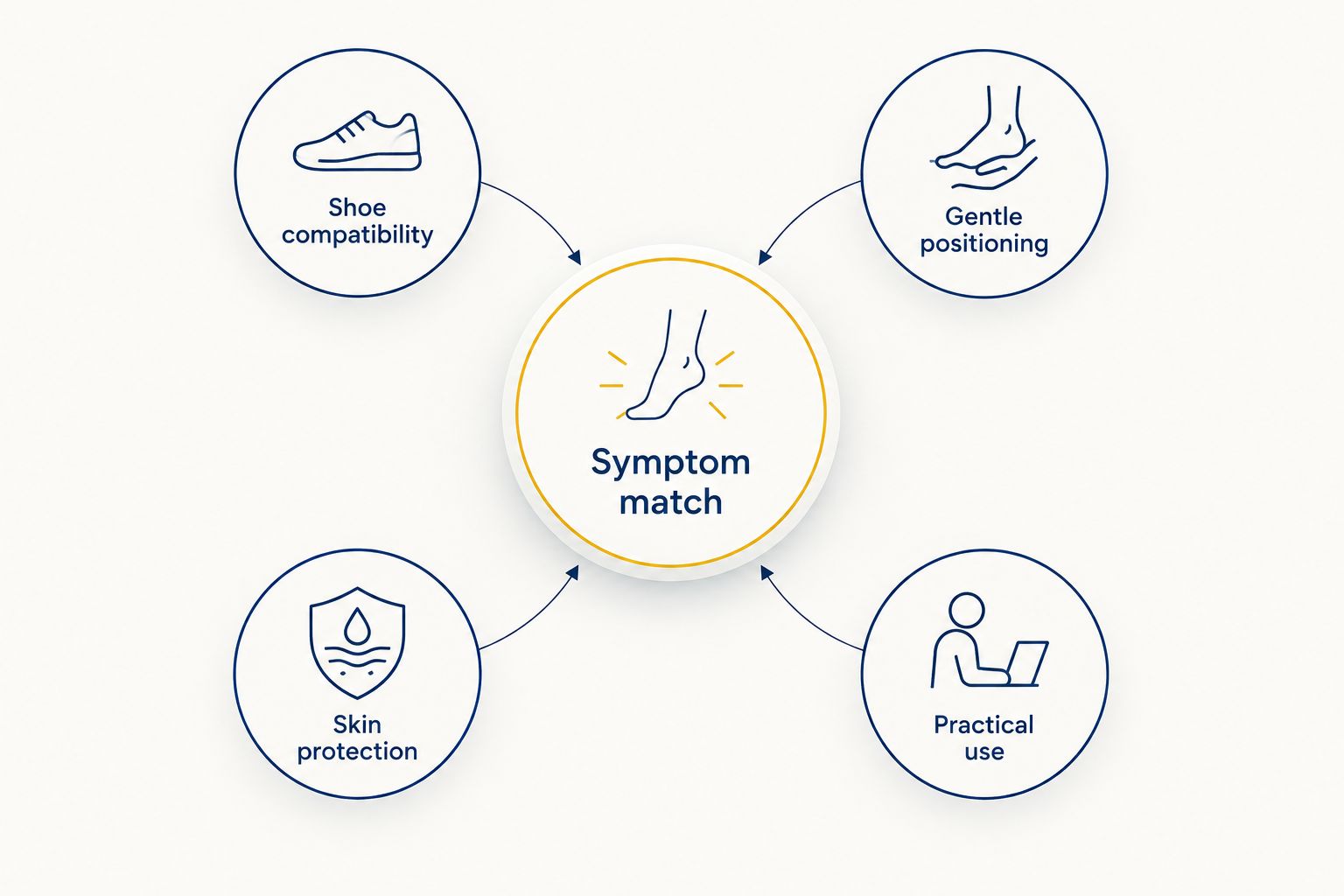
- Symptom match: Separate rubbing toes, cushion the bump, or support the toe at rest. Choose the design that addresses your actual discomfort.
- Shoe compatibility: The device must leave room for your forefoot. Added bulk defeats the purpose if it makes the shoe squeeze harder.
- Gentle positioning: A spacer or splint should not force a stiff, painful joint into alignment.
- Skin protection: Look for smooth contact surfaces and avoid edges or straps that press into vulnerable skin.
- Practical use: A device needs to stay comfortable during its intended activity and be manageable to put on, remove, and clean.
- Realistic claims: Reject promises that a wearable device will permanently erase an established bunion.
The right choice is the least complicated device that addresses your symptom without creating another pressure point. Check the fit with the shoes and socks you actually wear, not just while sitting barefoot.
Bunion correctors and splints at a glance
These are device categories, not interchangeable treatments. The 2026 ranking below assigns each category a different job; individual designs still need a fit check.
| Rank and option | Best for | Standout feature | Key limitation |
|---|---|---|---|
| 1. Soft toe spacer | Rubbing between the big and second toes | Separates contacting skin surfaces | Adds width inside the shoe |
| 2. Thin protective bunion pad | Shoe friction over the bunion bump | Cushions a localized contact area | Thick padding increases crowding |
| 3. Soft bunion sleeve | Keeping cushioning positioned without adhesive | Holds a protective layer around the forefoot | Fabric and seams add bulk |
| 4. Adjustable hinged bunion splint | Gentle supported positioning while resting | Allows adjustable positioning with a jointed design | Not automatically suitable for walking |
| 5. Rigid resting bunion splint | A clinician-directed resting position | Holds the toe in a more fixed position | Limits movement and requires careful fitting |
1. Soft toe spacer: best bunion corrector for toe-to-toe rubbing
A soft toe spacer sits between the big and second toes. Its main job is to separate skin surfaces that rub together—not to pull the entire forefoot back into its original alignment.
Choose a spacer that rests comfortably between your toes without pushing the second toe into its neighbor. If the big-toe joint is stiff or painful when moved, get advice before using a separator to force more movement.
Soft toe spacer pros:
- Targets friction between adjacent toes.
- Uses a simple design that is easy to remove.
- Lets you check the contact area directly after use.
Soft toe spacer cons:
- Takes up space in the toe box.
- Does not cushion every part of the bunion bump or permanently correct the deformity.
Best for: A flexible, comfortable-to-position big toe with rubbing against the second toe.
Start by checking the spacer while seated, then with your usual footwear. A spacer that feels comfortable barefoot can become uncomfortable once the shoe presses the toes together. Do not compensate for that crowding by choosing an even stronger separator.
Verdict: Buy for toe-to-toe rubbing only if your shoes still fit comfortably.
2. Thin protective bunion pad: best option for bump friction
A protective bunion pad places a soft barrier between the prominent joint and the shoe. It addresses surface irritation over the bump rather than toe position.
Look for a low-profile shape with edges that do not roll or create a new pressure point. Padding should reduce contact, not fill an already tight shoe. Adhesive designs also need a skin-tolerance check.
Thin protective bunion pad pros:
- Targets a clearly defined area of shoe friction.
- Does not require pulling the big toe sideways.
- Allows localized cushioning instead of covering the whole forefoot.
Thin protective bunion pad cons:
- Added thickness can worsen pressure in narrow shoes.
- Adhesive can irritate skin, and the pad does not address deep joint pain.
Best for: A bunion bump that rubs against footwear while the toe joint remains comfortable during movement.
Check whether a shoe seam lands directly over the bump. A pad is not a substitute for changing footwear that repeatedly presses on that spot. Never place ordinary bunion padding over an open wound as a substitute for wound care.
Verdict: Buy for superficial shoe rubbing after correcting shoe crowding.
3. Soft bunion sleeve: best option for keeping cushioning in place
A soft bunion sleeve wraps around part of the forefoot and holds cushioning near the bump. Designs vary, so inspect the seams, openings, and contact surface rather than relying on the word corrector on the packaging.
A sleeve is useful when you want a protective layer without an adhesive pad. It still needs room inside your shoe, and any elastic section must avoid digging into the skin.
Soft bunion sleeve pros:
- Holds cushioning without adhesive attachment to the bump.
- Covers a broader contact area than a small pad.
- Can be removed so you can inspect the skin underneath.
Soft bunion sleeve cons:
- Fabric, seams, and cushioning add volume inside footwear.
- A tight or bunched sleeve creates pressure instead of relieving it.
Best for: Bump irritation when an adhesive-free protective layer fits comfortably inside your footwear.
For golf, walking, or pickleball, check whether the sleeve stays smooth as you move. Do not start a full activity session with a device you have only tried while sitting. Stop if it slips, bunches, or changes how you walk.
Verdict: Buy when an adhesive-free sleeve stays secure without compression or crowding.
4. Adjustable hinged bunion splint: best for positioning at rest
An adjustable hinged bunion splint uses straps and a jointed support to hold the big toe in a chosen position. The hinge allows movement within the design, but it does not make every splint appropriate for walking or sports.
Use the manufacturer's directions and any instructions from your treating clinician. The goal is a comfortable supported position, not the straightest position you can tolerate through pain.
Adjustable hinged bunion splint pros:
- Allows positioning to be adjusted rather than fixed immediately.
- Provides support without requiring a shoe during resting use.
- Lets you release the straps if pressure develops.
Adjustable hinged bunion splint cons:
- Straps and rigid components create potential pressure points.
- Hinged construction does not establish permanent correction or suitability for activity.
Best for: A clinician-approved trial of gentle toe positioning while resting.
If you are comparing splints in 2026, prioritize fitting instructions and clear intended use over before-and-after pictures. Do not tighten the device to chase a photographed angle, and do not assume a night-use design belongs inside your walking shoe.
Verdict: Hold until you confirm that positioning is appropriate for your joint and the device fits safely.
5. Rigid resting bunion splint: best for a prescribed resting position
A rigid resting bunion splint holds the toe with less freedom of movement than a soft spacer. Its intended role is supported positioning while you are off your feet.
A fixed support is not the default choice for daytime comfort. Follow individualized advice if a clinician recommends one, particularly when joint stiffness, fragile skin, or difficulty handling straps complicates fitting.
Rigid resting bunion splint pros:
- Provides a defined resting position.
- Does not depend on shoe space during resting use.
- Makes strap and support placement visible for inspection.
Rigid resting bunion splint cons:
- Restricts movement and is unsuitable for walking unless specifically designed and cleared for that use.
- Can press on the toe, bump, or neighboring skin if poorly fitted.
Best for: Patients given a specific resting-position plan by their treating clinician.
A rigid splint is not a way to bypass an examination when the toe hurts even without shoe pressure. Do not substitute an over-the-counter brace for a postoperative device unless your surgeon approves it.
Verdict: Hold for clinician-directed use; skip it as a general walking solution.
How these options are ranked
This ranking prioritizes symptom match, shoe compatibility, gentle positioning, skin protection, and practical use. It compares device designs rather than claiming that one commercial model outperformed another in testing.
Soft spacers lead for contact between toes; pads lead for contact over the bump. Splints sit lower because resting positioning is a narrower use case than everyday friction relief. No category earns a recommendation for permanently reversing an established bunion.
How to check fit without making pain worse
Before trying a device, identify whether the discomfort comes from touching skin, shoe pressure, or movement within the joint. These problems need different approaches. A sudden hot, swollen joint needs assessment rather than a tighter corrector.
Use this sequence:
- Inspect your skin. Do not fit an ordinary corrector over broken skin, a blister, or an unexplained sore.
- Fit gently. Avoid pulling the toe into pain or fastening straps until they leave deep marks.
- Check footwear. For wearable designs, put on your usual socks and shoes and check for new crowding.
- Check movement. Walk only if the device is intended for walking. Stop if it changes your gait or balance.
- Recheck after removal. Look for persistent redness, abrasions, swelling, or other new irritation.
Remove the device immediately if you develop numbness, tingling, increased pain, or a color change. Seek prompt medical assessment for a cold, pale, or blue toe, an open sore, spreading redness, or drainage.
If you have diabetes, reduced sensation, poor circulation, or a history of foot ulcers, ask your clinician before trying a spacer or splint. Reduced sensation means comfort alone is not a reliable safety check. Children also need an assessment rather than an adult brace adapted by guesswork.
Which bunion corrector should you choose?
Choose a soft spacer for toe rubbing and a thin pad for bump rubbing. If neither description matches your pain, do not keep buying devices in search of a stronger correction.
For your 2026 plan, make footwear part of the decision. A roomy forefoot and an upper that avoids pressure over the bump give a spacer or pad a better chance of fitting comfortably. Running shoes, golf shoes, and pickleball shoes all need that check.
Naples Podiatrist is best for bunion care when pain limits walking or staying active and you need access to a foot and ankle specialist. An examination can assess joint motion, skin pressure, toe position, and whether imaging is needed. The trade-off is that specialist assessment is a medical appointment, not an instant wearable fix; it also does not mean surgery is required.
Surgery enters the discussion when symptoms and functional limitations persist despite appropriate nonsurgical care. Appearance alone is not the reason to choose an operation.
Get your bunion pain assessed
Discuss shoe pressure, toe rubbing, and activity-limiting pain with a foot and ankle specialist.
FAQ
What’s the best bunion corrector for everyday walking?
A soft toe spacer is a practical choice for toe-to-toe rubbing, while a thin pad targets rubbing over the bunion bump. Either needs enough room inside your shoe and must not change your gait or create pressure.
Can a bunion splint permanently straighten my big toe?
A bunion splint does not permanently reverse an established bunion. It supports positioning while worn; lasting correction of the underlying bone alignment requires a different treatment discussion.
Is a toe spacer better than a bunion sleeve?
A toe spacer is better matched to rubbing between toes, while a bunion sleeve holds protection around the bump. Choose by the location of irritation rather than treating either design as universally better.
Can I sleep in a bunion corrector?
Use a device during sleep only if it is intended for that use and appropriate for your foot. Do not sleep in a new device before checking its fit while awake, and seek advice first if you have reduced sensation or circulation problems.
Should I wear a bunion splint for pickleball or running?
Do not use a resting bunion splint for pickleball or running. A device used during activity must be intended for that activity, fit your shoes, and leave your movement and balance unaffected.
Are bunion correctors safe if I have diabetes?
Ask your treating clinician before using a bunion corrector if you have diabetes. Neuropathy, poor circulation, or previous ulcers make added pressure especially concerning because you might not feel skin injury developing.
When should I see a podiatrist instead of trying another corrector?
See a podiatrist when pain limits walking, shoes remain uncomfortable, the joint is stiff, or devices keep causing irritation. Naples Podiatrist provides bunion care; open sores, drainage, spreading redness, or a cold or discolored toe require prompt medical assessment.
One last thing
The detail that changes your 2026 choice is simple: adding cushioning also adds volume. If your shoe is already pressing on the bunion, a thick pad or sleeve can make the fit worse even though it feels soft in your hand.
Bring your usual activity shoes and the device to an assessment. Checking both together is more useful than judging the corrector alone.
Related guides
- Do toe spacers actually work?
- Treating bunions without surgery
- Choosing shoes for bunions
- Big-toe pain and stiffness: hallux rigidus

