
 Fax: (239) 692-9436
 Tel: 239-430-3668
Original Medicare generally does not cover shockwave therapy for plantar fasciitis and other musculoskeletal foot-and-ankle conditions. For treatment in 2026, confirm the coverage rule for your exact procedure and diagnosis before starting; a covered examination does not make the shockwave treatment itself covered.
- Does Medicare cover shockwave therapy? Generally not for plantar fasciitis; verify your exact procedure and diagnosis.
- Original Medicare and Medicare Advantage require separate coverage checks; do not assume either pays for treatment.
- Naples Podiatrist offers foot-and-ankle care; treatment recommendations and insurance payment are separate decisions.
- Ask for written coverage information, an itemized estimate, and an explanation of any financial responsibility notice.
Does Medicare cover shockwave therapy?
For foot-and-ankle shockwave therapy, plan for noncoverage unless your insurer confirms otherwise for the specific service. A physician's recommendation establishes a clinical reason to consider treatment, not an insurance benefit. Likewise, a practice accepting Medicare does not mean Medicare covers every treatment the practice provides.
This answer concerns extracorporeal shockwave therapy for musculoskeletal problems, including persistent plantar heel pain. It does not describe shockwave lithotripsy used to break up kidney stones, which has different coverage rules. If you are comparing treatments, first understand how shockwave therapy works for chronic foot pain.
| Coverage arrangement | What it means for foot-and-ankle shockwave therapy | What to verify |
|---|---|---|
| Original Medicare | Coverage depends on applicable Medicare rules; do not assume musculoskeletal shockwave treatment is covered | Procedure, diagnosis, and applicable coverage policy |
| Medicare Advantage | The plan must provide Medicare-covered benefits, but additional benefits and administrative requirements differ | Written benefit determination, network rules, and authorization requirements |
| Medigap with Original Medicare | Generally helps with eligible Original Medicare cost-sharing, not a service Medicare excludes | Whether Original Medicare covers the underlying service |
Source context for 2026: The Centers for Medicare & Medicaid Services explains Original Medicare, Medicare Advantage, and Medigap in Medicare & You 2026. Procedure-specific coverage requires the applicable Medicare Coverage Database policy or your Medicare Advantage plan's written determination; the handbook alone does not establish shockwave coverage.
Why this matters
Heel pain can interfere with walking, pickleball, golf, and running. You need a treatment decision that addresses the diagnosis without creating an unexpected bill. Separating clinical suitability from insurance coverage lets you evaluate both clearly.
The key distinction is between a covered medical visit and a potentially noncovered procedure. An examination, imaging study, physical therapy visit, and shockwave session are separate services. Each must meet its own coverage and billing requirements.
Do not delay an evaluation simply because one treatment is not covered. A clinician can assess the cause of pain and discuss alternatives before you commit to a procedure.
Original Medicare: check the procedure-specific rule
Original Medicare generally uses Part B for eligible outpatient physician services. That does not give every outpatient procedure automatic coverage. The service must meet applicable benefit, medical-necessity, and coverage requirements.
For musculoskeletal shockwave treatment, ask the billing office which Medicare coverage policy applies to the proposed procedure. Local coverage determinations are issued by Medicare Administrative Contractors for their jurisdictions. A policy described by a clinic in another state is not enough to establish your coverage.
For your 2026 treatment decision, request the policy title or identifier and ask whether it applies to your diagnosis and procedure. A general statement that Medicare covers podiatry does not answer that question.
Best for checking Original Medicare coverage: match the proposed procedure to the applicable Medicare policy. The limitation is that a general benefits explanation cannot substitute for a service-specific determination.
Medicare Advantage: request a written benefit determination
Medicare Advantage plans must cover services Original Medicare covers, subject to Medicare rules. Plans can also offer additional benefits, but an additional benefit is not established by the plan's name, premium, or general coverage of specialist visits.
Ask your plan whether the specific shockwave procedure is a covered benefit for the documented diagnosis. Then ask about network participation, referrals, prior authorization, and any limits that apply. These are separate questions.
Best for Medicare Advantage members: request a written pre-service coverage decision, also called an organization determination, when coverage is uncertain. The limitation is that a phone representative's general explanation is not the same as a written decision about your proposed care.
Keep the plan's response with your treatment paperwork. If a decision is unfavorable, follow the appeal instructions and deadlines stated in the notice rather than relying on an informal promise that a claim will be paid.
Medigap: secondary coverage does not create a benefit
Medigap generally supplements eligible Original Medicare cost-sharing. It does not ordinarily turn a service excluded by Original Medicare into a covered treatment.
Ask the primary coverage question first: does Original Medicare cover this procedure for this diagnosis? Only then does the question of eligible supplemental payment become relevant. An insurance card marked supplement is not proof of shockwave coverage.
Best for Medigap members: establish Original Medicare coverage before asking about supplemental payment. The limitation is straightforward: help with covered-service cost-sharing is different from coverage for a noncovered service.
Why shockwave coverage decisions vary
Coverage questions become confusing when different services, plans, or procedures are treated as interchangeable. These distinctions explain why someone else's insurance experience is not a reliable answer for you:
- Treatment indication: A policy for kidney-stone lithotripsy does not establish coverage for plantar fasciitis or Achilles tendon pain.
- Procedure description: Focused shockwave and radial pressure-wave treatments are not interchangeable descriptions for billing purposes. Confirm what the clinician actually proposes.
- Coverage arrangement: Original Medicare, Medicare Advantage, and supplemental insurance have different roles.
- Applicable policy: National rules, local Medicare policies, and plan benefit documents govern different parts of the decision.
- Claim details: Diagnosis, procedure coding, documentation, and the treatment setting must accurately describe the service provided.
These factors explain what to check; they are not ways to make a noncovered procedure covered. Do not request a different diagnosis or billing description merely to obtain payment.
How do I check coverage before treatment?
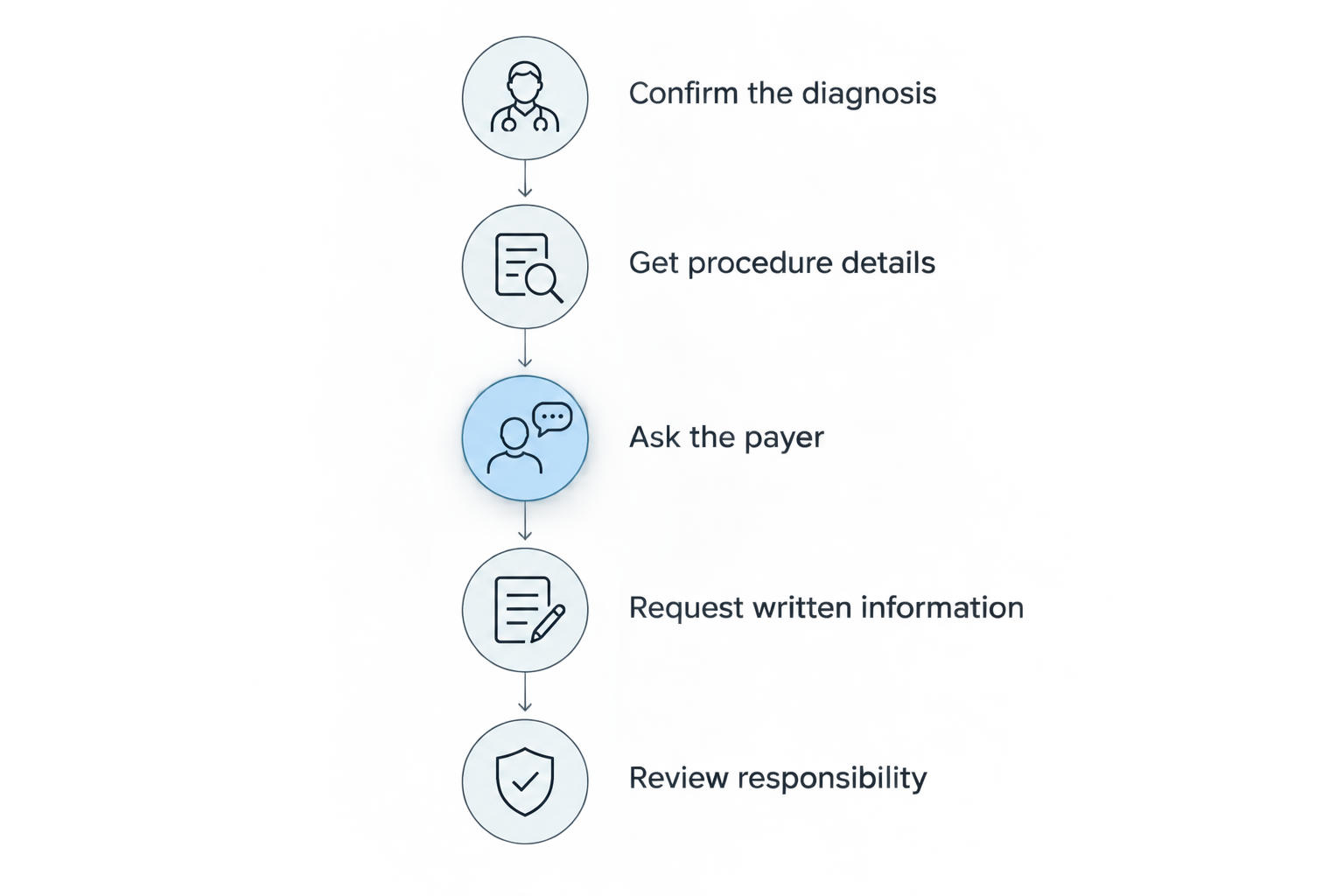
Use this sequence for a proposed course of shockwave therapy in 2026. Start with the clinician's actual recommendation, not a procedure name found in an advertisement.
- Confirm the diagnosis. Ask what is causing the pain and why shockwave therapy is being considered. Similar heel symptoms can come from different conditions.
- Get the procedure details. Request the treatment name, proposed billing code, treatment location, and whether other services will be billed separately.
- Ask the payer. Give Medicare or your Medicare Advantage plan the procedure and diagnosis information. Ask which coverage policy applies.
- Request written information. For Medicare Advantage, ask about a formal pre-service determination. For Original Medicare, ask the provider to explain the applicable policy and expected claim handling.
- Review responsibility before consenting. Obtain an itemized estimate and ask what you would owe if insurance does not pay. Keep copies of notices and correspondence.
A useful question is whether the response confirms the treatment benefit itself or only confirms that the clinician participates with your insurance. Those answers are not equivalent.
What should I know before signing a financial notice?
Under Original Medicare, an Advance Beneficiary Notice of Noncoverage, or ABN, is used in specified situations when a provider expects Medicare to deny an otherwise potentially covered service. Different notice rules apply when a service is excluded from Medicare coverage altogether. Medicare Advantage uses its own coverage-determination and notice processes.
Signing an ABN does not make treatment covered. Read the stated reason Medicare is expected not to pay, the estimate, and the available options. Ask for an explanation before selecting an option or signing.
Also ask whether the provider will submit a claim and what document will show the payment decision. If you want a formal decision or intend to appeal, understanding the claim process matters. Keep the signed notice rather than relying on a verbal summary.
Does Medicare cover the examination even if shockwave is not covered?
A medically necessary foot-and-ankle examination can be covered even when shockwave therapy is not. The examination and procedure are separate services, and coverage of either depends on the applicable requirements. Do not assume every component of an appointment receives the same payment decision.
At Naples Podiatrist, a foot-and-ankle evaluation is the appropriate starting point for discussing persistent pain and treatment choices. Naples Podiatrist is best for patients seeking specialist foot-and-ankle assessment, not a guarantee of insurance payment. Ask about the examination's coverage separately from any proposed procedure.
A diagnosis-first visit also gives you a chance to discuss your activity goals. Returning to golf or pickleball requires a plan based on the condition, not simply choosing a treatment because a neighbor received it.
Does FDA clearance mean Medicare will pay?
FDA clearance or approval does not establish Medicare coverage. Device regulation and insurance payment answer different questions. A device's regulatory status does not prove that your diagnosis, treatment setting, or proposed procedure meets Medicare's payment rules.
Ask which device and procedure the clinician plans to use, but do not stop there. Request the coverage policy relevant to your treatment. Neither a device brochure nor a general statement about medical necessity replaces that policy.
What if Medicare does not cover the recommended treatment?
Noncoverage does not mean you must choose between shockwave therapy and no care. Ask the clinician which alternatives fit your diagnosis and which require separate coverage checks. A treatment can be clinically reasonable without being an insurance benefit.
For plantar fasciitis, treatment discussions commonly include activity changes, stretching, supportive footwear, physical therapy, and selected supports. Their advantages and limitations differ: home exercises require consistency, footwear changes do not address every cause of pain, and supervised therapy requires participation. None should be presented as a guaranteed cure.
Shockwave therapy offers a nonsurgical approach for selected persistent conditions, but treatment can be uncomfortable and improvement is not guaranteed. Discuss suitability, expected follow-up, and alternatives before accepting financial responsibility. Do not choose surgery solely because a nonsurgical option is not covered.
For a 2026 evaluation, bring your insurance cards, medication list, previous treatment records, and any written coverage response. You can contact the practice to discuss arranging a foot-and-ankle appointment.
Arrange a foot-and-ankle evaluation
Discuss your diagnosis and treatment choices, then verify coverage for the proposed services.
FAQ
Does Medicare cover shockwave therapy for plantar fasciitis?
Original Medicare generally does not cover musculoskeletal shockwave therapy for plantar fasciitis. Confirm the applicable procedure-specific policy before treatment rather than assuming coverage from a covered podiatry visit.
Will a Medicare Advantage plan cover shockwave therapy?
Medicare Advantage coverage requires a plan-specific check for the exact procedure and diagnosis. Ask for a written pre-service determination and verify network and authorization requirements.
Does Medigap pay when Medicare denies shockwave therapy?
Medigap generally does not pay for a service Original Medicare excludes. It primarily helps with eligible Original Medicare cost-sharing, so establish coverage of the underlying service first.
Does a doctor’s referral guarantee shockwave therapy coverage?
A doctor’s referral does not guarantee shockwave therapy coverage. A referral, medical-necessity documentation, prior authorization, and a covered benefit are different requirements.
Can I appeal a denial for shockwave therapy?
You can use the appeal process described in your Medicare or Medicare Advantage denial notice. Follow the notice’s instructions and deadlines, and ask the provider for relevant clinical records; an appeal does not guarantee payment.
Will Naples Podiatrist confirm that Medicare pays for my treatment?
Ask Naples Podiatrist for the proposed procedure and diagnosis information, then request the applicable coverage explanation from your payer. Accepting Medicare and receiving payment for a particular treatment are separate matters.
Should I wait for a coverage decision if my foot is suddenly swollen or red?
Do not delay urgent medical assessment for sudden swelling, redness, warmth, an open wound, or inability to bear weight. These symptoms need evaluation rather than an assumption that shockwave therapy is the next step.
One last thing
Ask which exact service is covered—not whether the office takes Medicare. That wording separates provider participation from procedure payment and makes the insurance conversation more useful.
Before your first treatment, make sure the diagnosis, procedure description, coverage explanation, and financial paperwork refer to the same service. If they do not match, resolve the difference before proceeding.
Related guides
- Medicare referral to a covered podiatry visit
- Is shockwave therapy worth it?
- Plantar fasciitis treatment timelines by method