
 Fax: (239) 692-9436
 Tel: 239-430-3668
Best overall: a pumice stone for gentle smoothing of uncomplicated calluses. Best for controlled touch-ups: a fine-grit manual foot file. Best simple starter option: a pumice stone paired with your usual moisturizer. This 2026 guide compares home-care tools and supporting products, explains their limits, and shows when a corn or callus needs a podiatrist instead.
- The best callus removal tools at home favor gentle pumice over blades for uncomplicated, intact calluses.
- Fine-grit manual foot files suit controlled touch-ups; electric files require more caution.
- Nonmedicated corn pads reduce pressure but do not remove a corn or correct its cause.
- Naples Podiatrist provides specialist foot care when pain, numbness, diabetes, or broken skin makes home removal unsuitable.
Why this matters
A callus is thickened skin that develops in response to repeated pressure or friction. A corn is usually smaller and more concentrated, often over a toe joint or another pressure point. Neither needs to be scraped down to normal-looking skin in a single session.
Removing too much creates a different problem: tender skin, a cut, or an open wound. Before buying anything, read the guide to callus removal at home versus podiatrist care.
Naples Podiatrist is a choice for specialist callus care when pain, numbness, or broken skin makes home removal unsafe. The priority is comfortable walking and healthy skin—not a perfectly smooth heel before your next round of golf.
What makes the best callus removal tools at home?
For this 2026 guide, control matters more than how quickly a tool removes skin. Use these criteria when comparing options:
- Gentle abrasion: The surface should smooth thickened skin without a cutting blade.
- Pressure control: You should be able to stop immediately and see the area you are treating.
- Secure grip: A handle or shape you can hold comfortably matters, especially with stiff hands.
- Cleanability: Follow the cleaning instructions and let reusable tools dry completely.
- Correct purpose: Broad heel calluses, small toe corns, and dry skin need different approaches.
- Clear limits: No home tool is appropriate for an open wound, an uncertain skin lesion, or unsupervised high-risk foot care.
The list includes removal tools and supporting products. Creams soften skin; pads reduce pressure. Neither replaces a diagnosis when the spot hurts or keeps returning.
Home callus-care options at a glance
| Rank and option | Best for | Standout feature | Key limitation |
|---|---|---|---|
| 1. Pumice stone | Gentle smoothing of uncomplicated calluses | Manual control without a blade | Still causes abrasions if overused |
| 2. Fine-grit manual foot file | Small, visible areas needing touch-ups | Directed contact with the rough patch | Coarse surfaces remove too much skin |
| 3. Urea foot cream | Dry, thickened skin between smoothing sessions | Softens skin without mechanical scraping | Irritates broken or sensitive skin |
| 4. Nonmedicated corn pads | Reducing shoe pressure around a confirmed corn | Cushions without a corn-removing acid | Does not remove the corn or fix shoe fit |
| 5. Electric foot file | Broad calluses in experienced, low-risk users | Powered abrasion reduces manual effort | Makes over-treatment easier |
These 2026 recommendations apply to adults with intact skin, normal sensation, and no known circulation problems. If you have diabetes, neuropathy, poor circulation, or a history of foot ulcers, ask your clinician before using any abrasive or corn-removing product.
1. Pumice stone: best for gentle callus smoothing
A pumice stone has a rough, porous surface that gradually smooths thickened skin. It is the default choice for a broad, uncomplicated heel callus because your hand controls the pressure and movement. It is not a tool for digging out a painful corn.
Pumice stone pros:
- Offers direct control over pressure.
- Has no cutting edge.
- Works on broad patches of rough skin.
Pumice stone cons:
- Excessive rubbing still damages healthy skin.
- Requires cleaning and thorough drying between uses.
Best for: An adult with normal sensation and an intact, painless callus who wants gradual improvement.
Choose a shape you can hold securely. Use light movements, pause to inspect the skin, and stop before the area becomes pink or tender. Do not keep rubbing simply because some thickened skin remains.
Verdict: Buy for gentle maintenance—not complete removal in one sitting.
2. Fine-grit manual foot file: best for controlled touch-ups
A fine-grit manual foot file gives you a defined surface for smoothing a visible rough patch. The handle helps direct contact, but the abrasive surface still needs a light touch. Avoid cheese-grater-style tools and sharp metal rasps.
Fine-grit manual foot file pros:
- Directs abrasion toward a small, visible area.
- Stops immediately when your hand stops.
- Offers handle shapes suited to different grips.
Fine-grit manual foot file cons:
- Coarse files can remove skin aggressively.
- A long handle does not make an unseen area safe to treat.
Best for: Small callused areas that you can see clearly and reach without straining.
Follow the manufacturer's wet-use or dry-use instructions; not every file works the same way. If you cannot inspect the bottom of your foot, use a mirror for checking rather than filing by feel. Limited reach or poor vision is a reason to arrange help from a clinician.
Verdict: Buy a fine-grit version for light touch-ups; skip coarse rasps.
3. Urea foot cream: best for dry, thickened skin
Urea foot cream is a supporting product, not a removal tool. It helps retain moisture and soften thickened skin, reducing the temptation to scrape harder. Common formulations include 10% urea and 20% urea; concentration and directions matter.
Urea foot cream pros:
- Softens dry, rough skin without a blade.
- Supports maintenance between gentle smoothing sessions.
- Avoids the need for repeated mechanical abrasion.
Urea foot cream cons:
- Can sting or irritate cracked or inflamed skin.
- Does not remove the pressure causing a corn or callus.
Best for: Dry, intact heels and broad areas of thickened skin rather than a painful, pinpoint lesion.
Choose a foot moisturizer with clear directions. Higher strength is not automatically better, and a stronger keratolytic product deserves clinician guidance. Keep moisturizer off open wounds and avoid applying it between your toes, where retained moisture encourages skin breakdown.
Verdict: Buy as a maintenance aid; hold stronger formulations until you have clinical advice.
4. Nonmedicated corn pads: best for reducing shoe pressure
Nonmedicated corn pads cushion the area around a confirmed corn. They do not dissolve thickened skin, and they are not a substitute for wider or better-fitting footwear. Their role is pressure relief while you address the cause.
Nonmedicated corn pad pros:
- Contains no corn-removing acid.
- Cushions a localized area against shoe contact.
- Helps separate pressure relief from skin removal.
Nonmedicated corn pad cons:
- Adds bulk inside a tight shoe.
- Poor placement creates pressure elsewhere.
Best for: A known corn irritated by footwear, provided the pad does not crowd the toe or rub neighboring skin.
Read the package carefully. A medicated corn plaster is different from a plain cushioning pad, even when the packages look similar. Salicylic acid products can damage surrounding healthy skin and are unsuitable for unsupervised use in people with diabetes, neuropathy, or poor circulation.
Verdict: Buy only nonmedicated cushioning that fits comfortably; skip acid treatment for an uncertain lesion.
5. Electric foot file: best for reducing manual effort
An electric foot file uses a powered abrasive head to smooth thickened skin. It reduces repetitive hand movement, but the motor does not judge skin thickness or tell you when healthy tissue is being affected. Convenience is not a safety feature.
Electric foot file pros:
- Reduces repetitive manual filing.
- Covers broad rough patches.
- Offers replaceable abrasive heads on some models.
Electric foot file cons:
- Removes too much skin if held in place.
- Requires model-specific cleaning and operating precautions.
Best for: Experienced, low-risk adults who can see and feel the treatment area clearly.
An electric file is not the default recommendation in this 2026 list. Do not use powered abrasion to compensate for numbness, poor eyesight, or difficulty reaching your feet. Those limitations make professional assessment more appropriate, not a stronger device.
Verdict: Hold unless gentle manual care is unsuitable and your clinician agrees with powered filing.
A safer home-care sequence
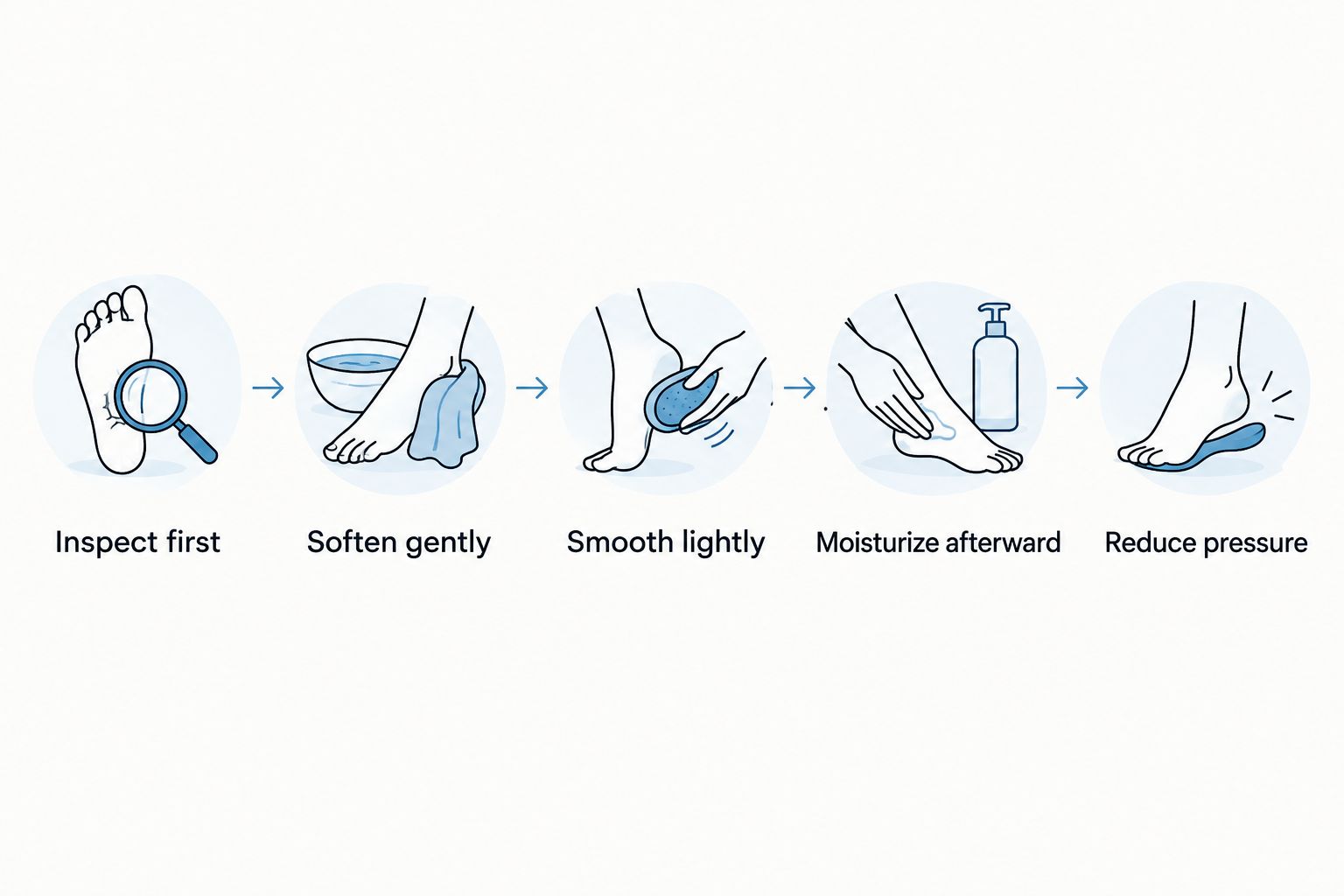
For an uncomplicated callus, this 2026 routine keeps inspection ahead of abrasion. It applies only when the skin is intact and you do not have a condition that makes self-treatment unsafe.
- Inspect first. Look for cracks, redness, drainage, dark discoloration, or a spot that differs from your usual callus. Do not file an uncertain lesion.
- Soften gently. A 5–10 minute soak in warm—not hot—water softens an uncomplicated callus. People with diabetes or impaired circulation should follow their clinician's washing guidance instead of soaking.
- Smooth lightly. Use a pumice stone or fine-grit file with gentle pressure. Stop if the area becomes tender, irritated, or raw.
- Moisturize afterward. Dry your feet carefully and apply an appropriate moisturizer to intact dry skin, avoiding the spaces between your toes.
- Reduce pressure. Check the shoes and activity that repeatedly load the same spot. Smoothing alone does not prevent recurrence.
Do not aim for an arbitrary amount of removed skin. Comfort and an intact surface matter more than the amount of skin dust on the towel. Clean the tool according to its instructions, let it dry, and never share it.
When home removal is the wrong choice
Do not cut a corn or callus with scissors, nail clippers, razor blades, or a callus shaver. A concentrated hard center is not something to excavate at home. A podiatrist can identify the lesion, assess the skin underneath, and determine whether pressure from footwear or foot structure needs treatment.
Arrange an assessment before self-removal if you have:
- Diabetes, reduced sensation, poor circulation, or a previous foot ulcer.
- Pain that changes how you walk.
- A recurring corn between your toes.
- A lesion that bleeds, changes appearance, or has an uncertain diagnosis.
- Difficulty seeing, reaching, or safely handling your feet.
Seek prompt medical care for an open sore, drainage, increasing warmth, redness, or swelling. Spreading redness, fever, or feeling unwell requires urgent medical attention. Do not keep treating these changes as routine dry skin.
Naples Podiatrist provides foot and ankle medical care, including diabetic and advanced wound care. Specialist assessment also helps distinguish a pressure lesion from a wart or another skin condition before you damage it with the wrong treatment.
Keep the callus from returning
Repeated pressure rebuilds thickened skin. Check for toe crowding, seams that rub, worn cushioning, and shoes that slip during movement. A pad squeezed into an already tight shoe does not solve the underlying problem.
For pickleball, examine where your foot moves during lateral stops. For golf or running, pay attention to recurring hot spots rather than filing them after every outing. Bring your activity shoes to a podiatry visit so the pressure pattern and footwear can be assessed together.
How these options are ranked
This ranking puts gentle abrasion, immediate stopping control, cleanability, and a clear home-care role ahead of speed. Pumice leads for uncomplicated smoothing; a fine-grit file suits targeted touch-ups. Creams and pads occupy separate supporting roles, while powered abrasion earns a more cautious position.
This is a category guide, not a claim that individual devices underwent comparative testing. Your skin health determines whether any home-removal tool belongs in your routine.
Which callus-care option should you choose?
Choose a pumice stone for a painless, intact callus; choose an examination for a painful corn or uncertain spot. Add moisturizer for dryness and address the shoe pressure that keeps rebuilding thick skin. Do not upgrade to a sharper tool because the problem returns.
For specialist callus care, contact Naples Podiatrist or call 239 430 3668. Explain whether you have diabetes, numbness, a wound, or a sudden change so the team understands the reason for your visit.
FAQ
What’s the best callus removal tool to use at home?
A pumice stone is the default choice for gentle smoothing of an uncomplicated callus on intact skin. Home removal is not appropriate without clinical guidance if you have diabetes, reduced sensation, poor circulation, or a history of foot ulcers.
Is a pumice stone better than an electric foot file?
A pumice stone offers simpler manual control, making it the preferred starting point for uncomplicated home care. Electric files reduce hand effort but make over-treatment easier when the abrasive head stays in one place.
Can I cut a corn out of my toe myself?
No—do not cut or dig out a corn at home. A podiatrist can confirm the diagnosis, treat thickened skin when appropriate, and assess the pressure causing it.
Are corn-removal pads safe if I have diabetes?
Do not use medicated corn-removal pads without guidance from your diabetes or foot-care clinician. Their acids can damage healthy skin, and reduced sensation can prevent you from noticing an injury.
What does urea cream do for a callus?
Urea cream softens thickened skin and helps retain moisture. It supports maintenance but does not correct the pressure that causes a corn or callus, and it can irritate broken skin.
How often should I file a callus?
There is no single filing schedule that fits every foot. Use gentle care only when appropriate, let the skin’s condition guide you, and stop if tenderness or irritation develops rather than filing to a calendar.
How do I know whether the spot is a callus or a wart?
A podiatrist can distinguish a callus from a wart when the appearance is unclear. Do not cut, file, or apply corn-removing acid to an uncertain lesion, especially if it hurts, bleeds, or changes.
One last thing
A recurring callus can show where your foot repeatedly takes pressure—not where you need a stronger file. Removing its surface without changing that pressure leaves the cause in place. If the same spot keeps interrupting walks, pickleball, golf, or running, bring the problem and your usual shoes to Naples Podiatrist rather than scraping deeper.
Related guides
- Corns on toes: causes, treatment, and prevention
- Foot creams for cracked heels and dry skin
- Plantar warts versus calluses: how to tell them apart


I appreciate the warning about medicated corn pads versus plain cushioning pads, since the packaging really does look nearly identical at the drugstore. Also glad the article points out that a recurring callus signals a pressure problem rather than a need for a stronger file—switching shoes fixed my heel issue better than any scraping ever did.