
 Fax: (239) 692-9436
 Tel: 239-430-3668
Best overall for level indoor routes: an adjustable four-wheel knee scooter. Best for uneven paved paths: a pneumatic-tire scooter; best for car transport: a compact folding scooter; best for higher support requirements: a heavy-duty scooter matched to your measurements.
- The best knee scooter for foot surgery recovery fits your body, home, and surgeon’s non-weight-bearing instructions.
- Choose an adjustable four-wheel knee scooter for level indoor routes after your surgeon approves knee-supported mobility.
- Pneumatic tires do not make a knee scooter safe for stairs, sand, steep slopes, or wet surfaces.
- Naples Podiatrist provides foot and ankle care for patients planning surgery recovery in Southwest Florida.
Why your scooter choice matters
A knee scooter supports your bent knee and lower leg while your other foot propels you. It keeps the recovering foot off the floor, but you still need balance, hand control, and a safe route. Your surgeon must approve the device before you use it.
For foot surgery recovery, Naples Podiatrist provides specialist foot and ankle care in Southwest Florida. Ask your surgical team whether knee support is appropriate for your procedure, incision location, and other joint problems.
This 2026 guide compares 4 scooter designs by their intended use. The right choice protects your surgical restrictions during ordinary tasks—not just during a straight-line demonstration in a store.
What makes the best knee scooter for foot surgery recovery?
Use these 6 selection checks before choosing a scooter:
- Surgical clearance: Confirm that resting your knee and lower leg on a platform will not conflict with your operation or wound care.
- Body fit: Check the manufacturer’s user-height range, weight limit, and knee-platform adjustment range against your measurements.
- Brake control: You must reach and operate the brakes without stretching, leaning, or releasing your grip awkwardly.
- Route fit: Measure doorways and inspect thresholds, flooring transitions, and the space needed to turn.
- Transport: Check whether you or a helper can lift the scooter and secure its folding mechanism correctly.
- Skin protection: The pad must support you without rubbing your incision, pressing against your cast, or creating persistent skin irritation.
A scooter that fits your height but cannot turn into your bathroom is not a suitable recovery device. Test the actual routes you will use before surgery, with supervision when needed.
Knee scooter designs at a glance
These 2026 recommendations rank designs by use case, not by brand reputation. Features vary within each design, so check the exact model’s instructions rather than assuming every scooter in a category has the same brakes or adjustments.
| Rank and design | Best for | Standout feature to seek | Key limitation |
|---|---|---|---|
| 1. Adjustable four-wheel indoor scooter | Level indoor recovery routes | Secure height adjustments and accessible brakes | Small wheels require caution at flooring transitions |
| 2. Pneumatic-tire scooter | Necessary travel over uneven paved paths | Air-filled tires and controllable steering | Tire maintenance and a potentially larger footprint |
| 3. Compact folding scooter | Frequent car transport | A folding mechanism your helper can operate | Folding does not guarantee easy lifting |
| 4. Heavy-duty scooter | Users needing a higher rated capacity or broader support | Documented capacity and appropriate platform dimensions | Larger dimensions can restrict indoor access |
1. Adjustable indoor scooter: best for level home routes
An adjustable four-wheel knee scooter is the default starting point when you mainly need to travel between rooms on level flooring. You rest the recovering side on its knee platform and propel yourself with the opposite foot. Choose the exact model only after checking fit and brake operation.
Best for: Patients with surgeon approval, adequate balance, and uncluttered indoor routes.
Adjustable indoor scooter pros:
- Supports the recovering lower leg while keeping the foot off the floor.
- Provides a wheeled alternative to advancing crutches with every movement.
- Allows handlebar and platform adjustment when those features are included.
- Suits a home-focused recovery plan without requiring an outdoor-oriented design.
Adjustable indoor scooter cons:
- Requires balance and a supporting leg strong enough to propel and stop you.
- Small wheels demand caution around thresholds, cords, and loose rugs.
- Does not solve stair access or safe transfers onto a toilet or shower seat.
Check whether the rear of your cast or boot clears the frame. Your recovering foot must not drag or strike the wheels during turns. Keep the supporting foot in secure, nonslip footwear rather than a loose slipper.
Verdict: Buy this design if your surgeon approves and it passes your supervised home-route test.
2. Pneumatic-tire scooter: best for uneven paved paths
A pneumatic-tire knee scooter uses air-filled tires. This design deserves consideration when necessary trips include uneven paved surfaces, but tire type alone does not establish safety. Wheel size, steering, braking, surface conditions, and your control all matter.
Best for: Patients who must cross suitable outdoor paved routes and can manage the scooter safely.
Pneumatic-tire scooter pros:
- Offers air-filled tires rather than solid tires.
- Provides an option to assess when small-wheel designs struggle with your necessary route.
- Can serve indoor and outdoor needs if its dimensions fit your home.
Pneumatic-tire scooter cons:
- Requires tire-pressure checks and attention to punctures.
- Outdoor-oriented dimensions can make tight indoor turns difficult.
- Does not make gravel, beach sand, curbs, or steep slopes safe.
Southwest Florida recovery plans often include outdoor trips from the house to a vehicle. Inspect that path for wet pavers, irrigation water, cracks, and abrupt edges. Arrange help rather than trying to roll over an obstacle while balancing on the scooter.
An “all-terrain” description is not medical clearance or permission to use every surface. Follow the manufacturer’s restrictions and your clinician’s mobility instructions.
Verdict: Buy only when a necessary paved route justifies this design and you can control it safely.
3. Compact folding scooter: best for car transport
A compact folding knee scooter prioritizes storage and transport. Depending on the model, the steering column folds or other components adjust for loading. Inspect the exact folding process before making transport the deciding factor.
Best for: Patients who need frequent rides to postoperative visits and have a suitable loading plan.
Compact folding scooter pros:
- Provides a way to reduce the scooter’s storage footprint.
- Helps accommodate vehicle storage when its folded dimensions fit.
- Offers a transport-focused option for households with limited storage space.
Compact folding scooter cons:
- Still requires someone to lift and secure it.
- Folding joints must be fully locked before use.
- Compact storage dimensions do not guarantee suitable riding dimensions.
Ask your helper to demonstrate folding, lifting, unloading, and relocking the scooter. Then check whether the device fits in the vehicle without blocking the driver’s view or remaining loose in the passenger compartment.
For your 2026 surgery preparations, decide who will handle the scooter while you enter the car. Do not balance on your recovering foot to load mobility equipment. Your transfer plan matters as much as the folded size.
Verdict: Buy if transport is your main constraint and your helper can handle the complete loading process.
4. Heavy-duty scooter: best for higher support requirements
A heavy-duty knee scooter is a category to examine when standard models do not meet your required capacity or support dimensions. The label alone is not enough. Compare the manufacturer’s documented weight limit, height range, platform size, and overall width.
Best for: Patients whose measurements require a different capacity or support configuration.
Heavy-duty scooter pros:
- Provides a category in which to seek a higher documented user capacity.
- Offers alternatives when a standard knee platform does not fit.
- Allows equipment selection around your actual support requirements.
Heavy-duty scooter cons:
- A larger frame can restrict doorway access and turning space.
- Added bulk can complicate vehicle loading.
- A higher capacity does not compensate for poor balance or painful knee support.
Have the supplier confirm that your measurements fall within the exact model’s specifications. Do not choose a device merely because its capacity exceeds your weight; the platform and handlebars must also adjust correctly.
If you cannot safely transfer onto the scooter or control it, ask about a different mobility aid. A wheelchair or appropriately selected walker deserves assessment rather than treating a larger scooter as the automatic answer.
Verdict: Buy only when the documented specifications meet needs that a standard design does not.
Fit and practice before the first postoperative trip
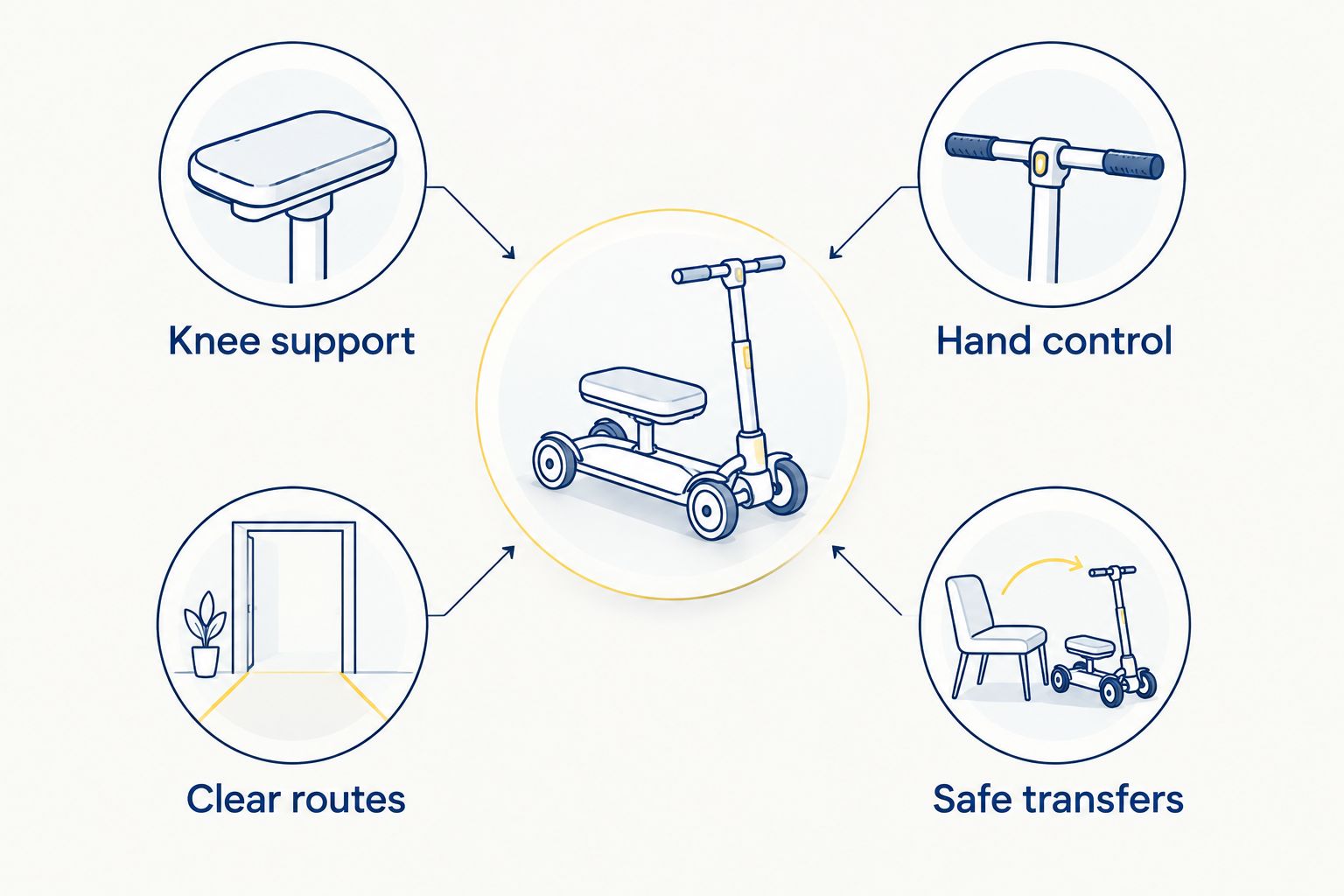
Use these 3 home routes for a supervised practice check: bedroom to bathroom, resting chair to kitchen, and home exit to vehicle. Keep the recovering foot off the floor according to your surgical instructions throughout the assessment.
- Knee support: Position the platform according to the manufacturer’s instructions and clinician guidance. Avoid pressure against the incision, cast edge, or sensitive skin.
- Hand control: Set the handlebars so you can steer and brake without hunching or reaching awkwardly. Keep both hands on the handlebars while moving.
- Clear routes: Remove loose rugs and cords. Plan around thresholds rather than assuming the front wheels will cross them.
- Safe transfers: Practice getting on and off with the instructed brake procedure and supervision. Never use an unsecured scooter as a grab bar.
Turn slowly with a wide arc and avoid sudden changes of direction. Do not ride a knee scooter on stairs or escalators. Arrange an alternative access plan with your care team if your home requires stairs.
Naples Podiatrist provides foot surgery recovery care; ask your team to clarify mobility restrictions before surgery day. Bring up dizziness, knee arthritis, neuropathy, poor vision, or previous falls because those issues affect device selection.
Plan your postoperative mobility
Discuss foot and ankle surgery restrictions and your mobility questions with a specialist.
How the scooter designs are ranked
This 2026 buying guide puts surgical suitability, fit, brake control, and route access ahead of convenience features. Indoor scooters appear first because they are the starting design to assess for level home travel; the other categories address specific outdoor, transport, or capacity requirements.
This is a design comparison, not a hands-on model test. No design earns a recommendation when it conflicts with your surgeon’s instructions or fails your supervised mobility assessment.
Which knee scooter should you choose?
Start with an adjustable four-wheel indoor scooter if your recovery routes are level and your surgeon approves knee-supported mobility. Move to a different design only to address a specific problem: necessary paved outdoor access, vehicle loading, or documented support requirements.
Naples Podiatrist is a foot and ankle care option for Southwest Florida patients planning foot surgery recovery. Your equipment decision should follow your clinical plan—not determine it.
For pickleball players, golfers, and runners, a scooter is a temporary mobility aid, not a training tool. Being comfortable on the scooter does not establish readiness to walk, swing a golf club, run, or return to court sports.
FAQ
What’s the best knee scooter for foot surgery recovery?
An adjustable four-wheel knee scooter is the starting design to assess for level indoor recovery routes when your surgeon approves knee-supported mobility. The exact model must fit your measurements, braking ability, and home layout.
Is a knee scooter better than crutches after foot surgery?
Neither device is best for every patient. A knee scooter requires safe knee support, balance, and suitable surfaces; crutches require a different combination of strength and coordination. Your care team should assess which device matches your restrictions.
Can I use a knee scooter after any foot or ankle operation?
No, knee-supported mobility is not appropriate after every operation. Your incision location, wound condition, joint problems, and surgical restrictions determine whether a knee scooter is suitable.
Can I use an all-terrain knee scooter on the beach?
Do not assume an all-terrain knee scooter is safe on beach sand. Soft or uneven ground can stop wheels or destabilize the device; follow the exact model’s instructions and arrange an approved alternative.
How long will I need a knee scooter after surgery?
Your surgeon determines how long you need a knee scooter from your procedure, healing progress, and weight-bearing restrictions. Do not stop using prescribed support because pain has improved.
Can I put my foot down while using a knee scooter?
If you have non-weight-bearing instructions, do not put weight through the recovering foot unless your surgeon changes those instructions. Ask your team to demonstrate transfers that preserve your restriction.
What should I do if the knee pad causes pain or numbness?
Stop using the scooter and contact your care team for assessment if the pad causes pain, numbness, or skin damage. Do not cover persistent symptoms with extra padding and continue without checking the cause.
One last thing
The hardest part of scooter use is not always moving—it is getting off without loading the recovering foot. Before your 2026 procedure, practice the bathroom transfer with your care team’s instructions and a helper. If the transfer is unsafe, change the mobility plan before surgery.
Related guides
- How to prepare for foot or ankle surgery day
- How to shower with a cast or boot on your foot
- Foot surgery recovery times by procedure
- How to reduce swelling after foot or ankle surgery