
 Fax: (239) 692-9436
 Tel: 239-430-3668
You can wear regular shoes after foot surgery when your surgeon clears the repaired tissues for that footwear and your foot fits without harmful pressure; there is no single safe week for every operation. Transitioning to shoes after foot surgery also depends on swelling, incision healing, and walking control—not just whether you can squeeze into a sneaker.
- Transitioning to shoes after foot surgery requires surgical clearance, suitable footwear, and a gradual return to walking.
- A closed incision does not prove that repaired bones or tendons are ready for regular shoes.
- Naples Podiatrist provides specialist foot and ankle care for Southwest Florida patients.
- Stop increasing shoe time if pain, swelling, skin irritation, or limping worsens.
Why this matters
A regular shoe changes how your foot bends, bears weight, and pushes off the ground. Leaving a protective boot too early can place stress on tissues that still need protection, even when pain has improved.
For your 2026 recovery plan, treat footwear clearance and activity clearance as separate decisions. The guide to foot surgery recovery times by procedure explains why the operation itself matters more than a general recovery calendar.
A shoe that fits is not proof that your foot is ready to use it. Your surgeon's instructions take priority over general advice, including this guide.
How long after foot surgery can you wear regular shoes?
There is no universal return-to-shoes date after foot surgery. Your surgeon decides when the operation, healing progress, and planned activity allow you to move out of protective footwear.
Before changing shoes, confirm these steps with the surgical team:
- Confirm clearance. Ask whether you can leave the boot or surgical shoe, and whether that permission applies indoors, outdoors, or throughout the day.
- Confirm weight-bearing limits. Permission to place weight on your foot does not automatically mean permission to wear ordinary shoes.
- Check healing. Your surgeon assesses the incision and repaired structures, using imaging when appropriate for the procedure.
- Check shoe fit. The shoe must accommodate your foot without pressing on the incision, toes, or swollen areas.
- Confirm progression. Get instructions for increasing shoe use and responding to discomfort or swelling.
These are separate decisions. A person permitted to walk in a boot is not necessarily ready to walk in a flexible sneaker, and someone cleared for household walking is not automatically cleared for a full workday.
What does clearance actually mean?
Ask your surgeon to describe clearance in practical terms. Can you wear the shoe while seated, walk around the house, shop, climb stairs, or stand at work?
For a 2026 postoperative appointment, bring the shoes you intend to wear. An actual shoe gives your surgical team more useful information than a description such as comfortable sneakers.
Why the timing varies
Your return to regular shoes depends on the structures treated and how your foot responds during recovery. These factors explain why another patient's timeline is not a reliable target:
- The operation performed: A skin procedure, bone correction, joint fusion, and tendon repair have different protection requirements.
- Healing progress: An incision can close before deeper tissues are ready for unrestricted loading.
- Swelling: A shoe that feels roomy while seated can become tight after you have been upright.
- Walking control: Weakness, stiffness, and limping affect whether you can walk safely in less protective footwear.
- Sensation and circulation: Diabetes, neuropathy, and poor circulation require particular attention to pressure and skin changes.
- Daily demands: Desk work, prolonged standing, golf, and running place different demands on the recovering foot.
Use the recovery plan written for your operation, not the calendar followed by a friend. If instructions conflict, ask the surgical team to clarify them before changing footwear.
How your operation changes the shoe decision
After bunion correction or a bone procedure
Bone procedures require protection of the correction while healing progresses. The size of the skin incision does not tell you how much protection the bone needs.
Ask whether your surgeon wants a particular sole stiffness, toe-box shape, or insert. Do not substitute a flexible shoe simply because the incision looks healed or the surgical shoe feels inconvenient.
After toe or foot fusion
A fusion is intended to join bones across a joint, so the decision includes more than comfort. Your surgeon considers healing and whether the proposed shoe places unwanted stress on the surgical area.
Once cleared, you still need footwear that accommodates the changed movement of your foot. Do not assume that a favorite preoperative shoe remains suitable after surgery.
After tendon or ligament surgery
Tendon and ligament repairs need protection from movements that stress the repair. A shoe can permit ankle motion or push-off that the boot was designed to limit.
Do not remove prescribed wedges, braces, or other supports without instructions. Ask which movements remain restricted even after regular footwear is permitted.
Which shoes should you try first?
Best for initial regular-shoe walking: a surgeon-approved shoe that holds your heel securely and accommodates swelling without squeezing. Adjustable closures and adequate depth help you manage fit, but no shoe feature replaces clearance.
Use this comparison to discuss footwear with your surgeon. These are footwear categories, not interchangeable stages of recovery.
| Footwear | Best for | Main benefit | Main limitation |
|---|---|---|---|
| Prescribed boot or surgical shoe | Protection during the prescribed recovery stage | Provides the protection selected for your procedure | Bulky and not a substitute for rehabilitation |
| Adjustable supportive sneaker | Initial regular-shoe walking after clearance | Allows fit adjustment and secure fastening | Some designs bend too much or press on the incision |
| Roomy walking shoe with an appropriate sole | Daily walking after approval | Accommodates the foot while providing a stable platform | Must match any procedure-specific sole requirements |
| Dress shoe or narrow fashion shoe | Later use only if fit and recovery permit | Fits formal clothing needs | Often provides less room for swelling and toes |
| Sport-specific shoe | Return to the approved sport | Matches the movements and surface of the activity | Does not make the foot ready for sport by itself |
Look at the whole shoe rather than its cushioning alone. Check the opening, heel security, toe room, seams, and space for any prescribed insert.
The guide to shoes to wear after foot surgery covers footwear selection. For your first pair, prioritize the surgeon's requirements over appearance or a familiar size label.
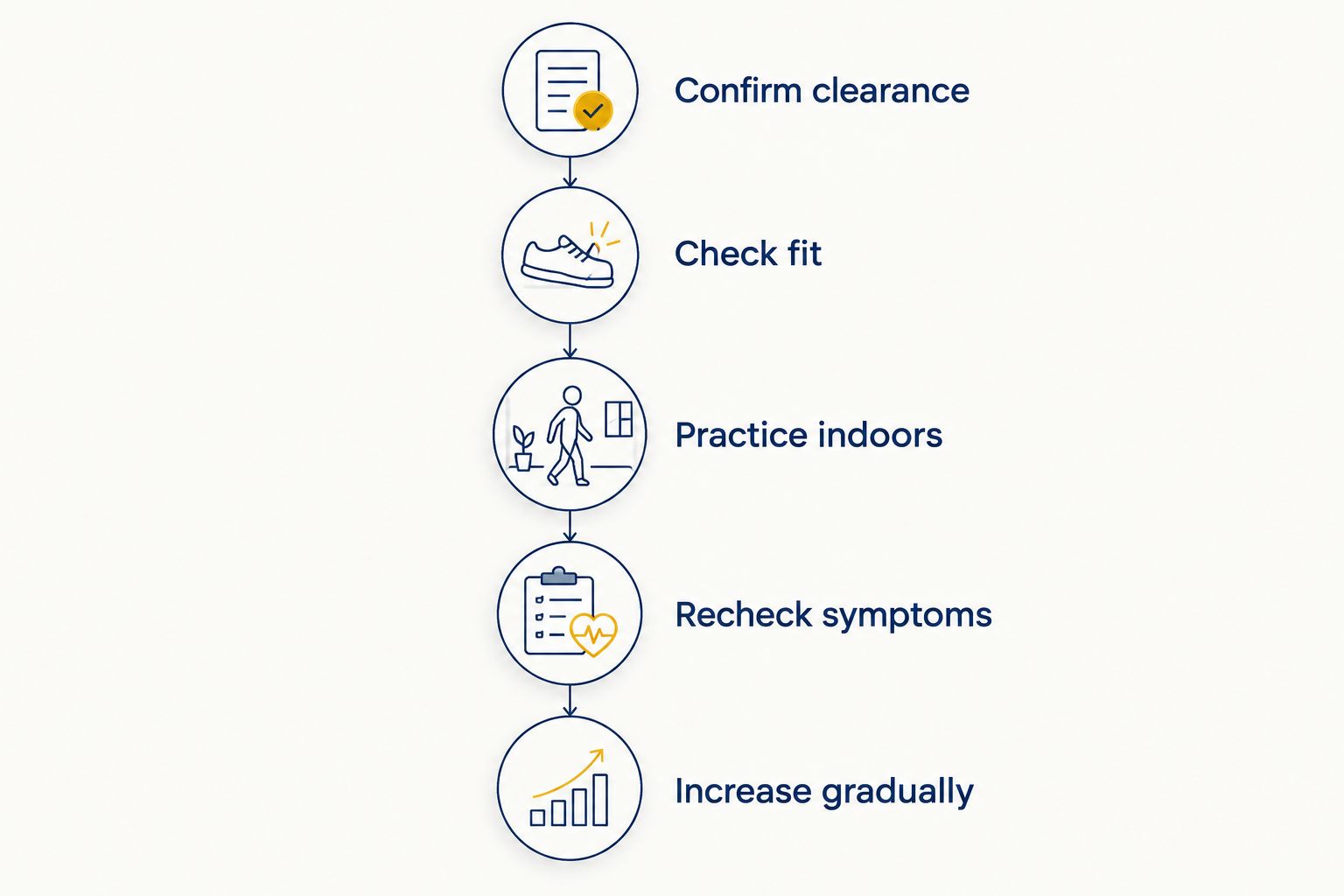
How do you transition without overdoing it?
Use a gradual progression only after your surgeon approves it. The goal is controlled walking without increasing pressure, skin irritation, or a worsening limp.
Confirm clearance
Keep using the prescribed protective device until your surgical team changes the instructions. Ask whether you should alternate footwear and what to wear when you are not practicing in regular shoes.
Check fit
Put on the intended socks and any prescribed insert. Your heel should stay secure, your toes should not be crowded, and the shoe should not rub the incision.
Do not force a swollen foot into a shoe or remove required support to create more space. If the shoe does not fit, discuss another option rather than treating tightness as something to endure.
Practice indoors
Begin on a level, uncluttered surface using any prescribed walking aid. Follow your surgeon's starting duration rather than choosing a universal wear schedule from the internet.
Focus on walking control. If you lean away from the operated foot, shorten your step markedly, or feel unstable, stop and ask whether the progression needs adjustment.
Recheck symptoms
Check your skin after removing the shoe, especially around the incision and pressure points. Note whether walking produces more pain, swelling, rubbing, or limping.
A simple record helps: write down the shoe, the activity, and the response afterward. Bring that information to follow-up rather than relying on whether the whole day felt good or bad.
Increase gradually
Increase use according to your surgeon's plan and your foot's response. Avoid combining a new shoe with a sudden increase in walking distance, standing time, and uneven ground.
For your 2026 return-to-walking plan, change the demand in a controlled way. A successful walk across the house does not establish readiness for errands followed by an evening event.
What symptoms mean you should stop and call?
Stop increasing regular-shoe use and contact your surgical team if you develop worsening pain, increasing swelling, new rubbing, incision drainage, spreading redness, or a new loss of walking control. Do not try to solve these problems by loosening the shoe and continuing the activity.
Seek urgent medical assessment for a newly cold, pale, or blue foot; severe escalating pain; or new calf pain and swelling. Call emergency services for chest pain or shortness of breath. These symptoms require assessment, not another footwear trial.
If you have reduced sensation, do not use the absence of pain as reassurance. Inspect your skin and follow the postoperative instructions for diabetes, circulation problems, or neuropathy.
Naples Podiatrist foot and ankle care is best suited to Southwest Florida patients seeking specialist assessment of postoperative foot concerns. If another surgeon performed your operation, contact that surgical team first for procedure-specific restrictions.
Discuss your shoe transition
Ask a foot and ankle specialist about footwear, swelling, and walking concerns after surgery.
Can I wear regular shoes if my foot is still swollen?
Swelling does not automatically rule out regular shoes, but the shoe must accommodate it and your surgeon must approve the transition. Tightness, rubbing, or increasing symptoms mean the current fit or activity needs review.
Do not buy a snug pair expecting your healing foot to stretch it. Ask about adjustable footwear, elevation, and whether compression is appropriate for your particular recovery.
Does wearing sneakers mean I can return to golf or pickleball?
Wearing sneakers does not mean you are ready for golf, pickleball, or running. Turning, pushing off, and changing direction place demands on the foot that ordinary household walking does not.
For a 2026 return-to-sport plan, ask for separate clearance for practice and play. Include details such as walking the golf course, using a cart, or playing pickleball so the recommendation matches the activity.
FAQ
What’s the safest way to start transitioning to shoes after foot surgery?
The safest approach is to obtain your surgeon’s clearance, use approved footwear, and increase walking according to the postoperative plan. Check for rubbing, worsening swelling, pain, and limping after each increase.
Can I wear regular shoes as soon as my stitches come out?
Stitch removal does not automatically clear you for regular shoes. Deeper bone, tendon, or ligament repairs can still require protection after the skin has closed.
Is a sneaker better than a surgical boot after foot surgery?
A sneaker is not better while your surgeon still requires a surgical boot. The boot provides prescribed protection; a sneaker becomes appropriate only when the repair and walking plan allow it.
Should I buy bigger shoes after foot surgery?
Buy footwear that accommodates your current foot without pressure or heel slipping, rather than automatically choosing a longer size. Extra width or depth can address fit differently from added length, so have the fit checked.
What if my regular shoe hurts but my boot feels comfortable?
Stop increasing regular-shoe use and contact your surgical team for instructions. Comfort in the boot does not establish that the same activity is safe in a less protective shoe.
Can I walk barefoot at home after leaving my surgical boot?
Barefoot walking requires separate approval if your recovery plan calls for supportive footwear. Leaving the boot does not remove every restriction on bending, loading, or protecting the foot.
Can Naples Podiatrist help with shoes after foot surgery?
Naples Podiatrist provides specialist foot and ankle care for patients in Southwest Florida. Bring your operative information, postoperative restrictions, and intended shoes when seeking advice about your transition.
One last thing
Bring both shoes to your follow-up, not just the shoe for the operated foot. Your clinician needs to see how you stand and walk in the pair, including any prescribed insert or walking aid.
Before leaving your 2026 follow-up, ask for the next milestone in plain language: which shoe, which activity, and what symptoms mean stop. A clear progression is more useful than a date without instructions.
Related guides
- CAM boot to regular shoes: recovery workflow
- How to reduce swelling after foot or ankle surgery
- Physical therapy for foot and ankle recovery: what to expect