 Fax: (239) 692-9436
 Tel: 239-430-3668
You can fly after foot surgery once your surgeon confirms that your wound, swelling, mobility, and blood-clot risk make the trip appropriate; there is no single waiting period that fits every operation. Airline acceptance of a cast or walking boot does not replace medical clearance. For travel in 2026, discuss the entire journey—including airport walking and connections—before committing to a departure date.
- Can you fly after foot surgery? Yes, with individualized surgical clearance—not a universal waiting period.
- Recent surgery and limited movement increase blood-clot concerns during air travel.
- A walking boot does not automatically mean you can bear weight or fly safely.
- Naples Podiatrist provides specialist foot and ankle care for Southwest Florida patients planning postoperative travel.
Can you fly after foot surgery?
Yes, but your surgeon must clear your specific trip, not simply the act of sitting on an airplane. A brief flight with extensive airport walking presents different challenges from a longer flight with wheelchair assistance and help at your destination.
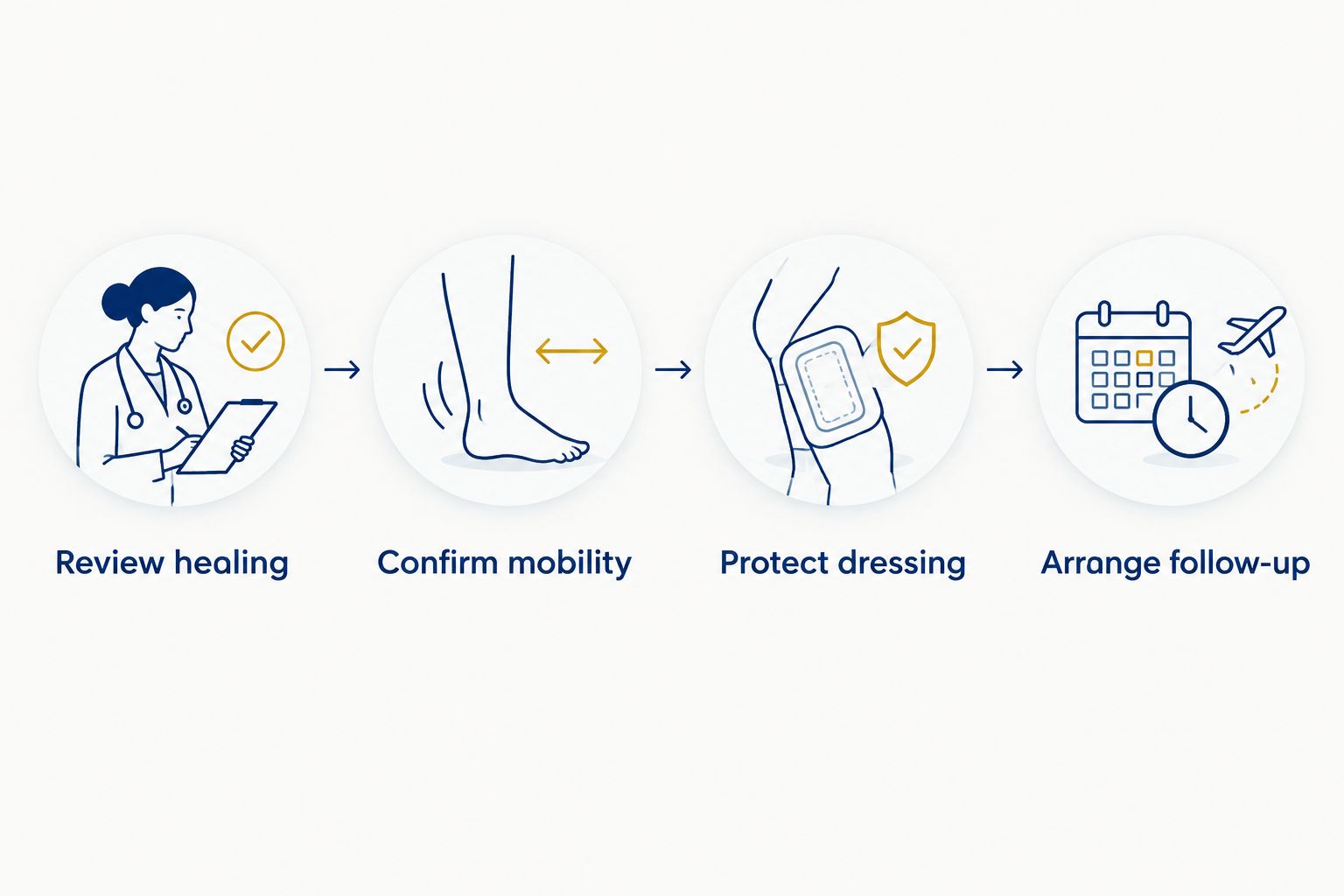
Start with these steps:
- Review healing. Ask whether your incision, dressing, and swelling are stable enough for travel.
- Assess clot risk. Review your operation, immobilization, medical history, and total time sitting.
- Confirm mobility. Establish how you will transfer, board, and use the restroom without violating weight-bearing restrictions.
- Check airline rules. Confirm requirements for casts, mobility equipment, seating, and any medical documentation.
- Arrange follow-up. Keep required wound checks and a plan for complications at your destination.
Your foot surgery recovery timeline helps frame that discussion, but a general recovery estimate is not permission to fly. Being comfortable at home does not establish that you can manage a travel day safely.
Why this matters
After foot surgery, protecting the repair and preventing complications matter more than meeting a travel date. Prolonged sitting limits movement, keeping your foot down can increase swelling, and crowded airport transfers create practical risks when you use crutches or a boot.
The CDC Yellow Book 2026 chapter on deep vein thrombosis and pulmonary embolism identifies recent surgery and restricted mobility as risk factors for travel-associated blood clots. Its discussion of long-distance air travel commonly uses journeys longer than 4 hours; that threshold does not make shorter flights risk-free.
A clot in a deep vein is called deep vein thrombosis, or DVT. A clot that travels to the lungs causes a pulmonary embolism, which requires emergency care. Your prevention plan must account for your own risk factors rather than copying another traveler's routine.
Why the timing of flying after foot surgery varies
These factors determine whether your departure date fits your recovery:
- The procedure: A skin procedure, bone correction, joint fusion, and tendon repair protect different healing structures.
- Weight-bearing restrictions: Permission to stand briefly does not necessarily include walking through an airport.
- Wound condition: Drainage, spreading redness, wound separation, or worsening pain requires assessment before travel.
- Swelling and immobilization: A cast or boot limits room for swelling and can restrict movement.
- Clot history and medical conditions: Previous DVT, cancer, clotting disorders, and other factors change the risk assessment.
- The complete itinerary: Car rides, security lines, connections, and travel after landing add to the physical demands.
Tell your surgeon whether you are flying home after surgery or leaving for a vacation. Those situations require different follow-up arrangements. Include plans for golf, pickleball, running, or sightseeing: clearance to fly is not clearance to return to sports.
Should you travel as planned or postpone the flight?
The right choice depends on whether you can protect your recovery throughout the journey. Convenience alone does not settle the decision.
| Travel decision | Best for | Benefit | Limitation |
|---|---|---|---|
| Travel after clearance | Patients with stable healing and a workable assistance plan | Allows travel while following a surgeon-approved recovery plan | Still requires mobility precautions, symptom monitoring, and follow-up |
| Postpone departure | Patients whose wound, swelling, mobility, or clot risk needs further assessment | Keeps the patient closer to the treating team while concerns are addressed | Requires changes to travel arrangements |
| Obtain urgent assessment instead | Patients with new warning symptoms | Prioritizes evaluation of a possible complication | Is not a substitute for emergency care when breathing or chest symptoms occur |
Do not use this table to clear yourself. If your condition changes after a preflight appointment, contact your surgical team again. Earlier permission does not cover new symptoms.
How should you prepare for a flight in 2026?
Build your plan around the restrictions on your discharge instructions. Ask your surgical team to clarify anything that conflicts with standard travel advice.
Review healing before departure
Ask whether you need an examination before leaving, especially if your trip falls before a scheduled wound check. Explain where you will stay and how you will obtain medical care if problems develop.
Do not skip an appointment because the incision looks closed. Your surgeon also assesses the repair, circulation, swelling, and whether the current dressing or immobilization remains appropriate.
Confirm mobility through the airport
Request wheelchair assistance when distance, balance, or non-weight-bearing restrictions make walking unsafe. Arrange help with luggage and transfers rather than assuming a companion can manage everything while supporting you.
Ask about aircraft stairs and transport between terminals. A knee scooter that works well at home does not solve every boarding problem, and you still need a safe plan for reaching your seat.
Protect the dressing and repair
Keep prescribed boots, splints, and dressings in place unless your surgical team gives different instructions. Security screening or discomfort is not a reason to remove a protective device on your own.
Carry medication, discharge instructions, and your surgeon's contact details in accessible hand luggage. Keep any supplies your team recommends close enough to use without unpacking a checked bag.
Arrange follow-up at your destination
Know who will assess the incision, change dressings if needed, and respond to a problem after arrival. Confirm the plan before you leave—not after you notice drainage or increasing pain.
How do you reduce blood-clot risk during the trip?
Ask your surgeon for an individualized prevention plan before flying. Recent surgery, limited weight-bearing, and prolonged sitting require more than generic advice to stretch your legs.
CDC traveler guidance recommends moving your legs frequently and walking every 1–2 hours during long trips. After foot surgery, that advice applies only within your surgeon's restrictions: do not walk on a non-weight-bearing foot or perform ankle exercises that could stress a repair.
Ask which movements are permitted while seated. Some patients can move their knees or unaffected ankle but must protect the operated ankle. Your surgical team should specify what is safe rather than leaving you to improvise.
Compression stockings are not automatically appropriate over an incision, under a cast, or in someone with impaired arterial circulation. Ask whether you should wear them, on which leg, and how they should fit. Do not substitute ordinary tight socks for prescribed compression.
Do not start aspirin, inject a blood thinner, or change an existing anticoagulant dose for a flight without medical instructions. These medicines have bleeding risks, and the correct approach depends on your procedure and health history.
Can you fly with a cast or walking boot?
A cast or walking boot does not automatically prevent flying, but you need both medical clearance and confirmation that the airline can accommodate you. A boot protects the foot; it does not prove that the wound is ready or that clot risk is controlled.
For a 2026 booking, check the operating airline's current cast and mobility-device rules directly. Requirements can differ, particularly for a newly applied cast, seating restrictions, or medical documentation. Ask about every carrier if your itinerary involves more than one airline.
Never cut, split, loosen, or remove a cast yourself to meet an airline requirement. If modification is necessary, your treating team must decide how to do it safely.
Increasing pain, numbness, markedly swollen toes, or pale, blue, or cold toes requires prompt assessment. Do not board and hope the pressure will settle once you are seated.
What symptoms mean you should not board?
New calf pain or unexplained one-sided leg swelling after surgery needs urgent medical assessment. Warmth or redness can also occur with DVT. You cannot reliably distinguish a clot from ordinary postoperative swelling by appearance alone.
Seek emergency help for:
- Sudden shortness of breath.
- Chest pain, particularly with breathing.
- Coughing up blood.
- Fainting or collapse.
Call 911 in the United States for these symptoms. Do not continue to the airport, massage the calf, or wait for your surgeon's office to open.
Contact your surgical team promptly for increasing wound drainage, spreading redness, fever, an opening incision, or pain that is worsening rather than following the expected course. These signs need assessment even if your flight is short.
Is a short flight safer than a long drive after foot surgery?
A short flight reduces time in the air, but the full journey determines how long you sit and how much you move. A long drive also involves prolonged sitting, so changing transportation does not eliminate clot concerns.
Compare door-to-door travel, required transfers, opportunities for permitted movement, and access to help. Do not drive yourself if medication, immobilization, or impaired control makes driving unsafe; surgical clearance to fly does not establish fitness to drive.
Does flying mean you can walk normally at your destination?
Flying clearance does not change your weight-bearing or rehabilitation restrictions. You still need to use the prescribed boot, crutches, walker, or other support as directed.
For an active older adult, the destination often creates more strain than the flight itself. Plan transportation and accessible accommodation before adding a golf outing, pickleball session, beach walk, or crowded event to the itinerary.
Where can Southwest Florida patients discuss postoperative travel?
Naples Podiatrist is best for Southwest Florida patients seeking specialist foot and ankle care. The practice provides medical and surgical care, including treatment for foot and ankle trauma, bunions, and diabetic wounds.
Ask Naples Podiatrist about postoperative travel during your surgical planning visit, not after choosing an inflexible departure date. The useful question is whether your specific operation and itinerary fit together—not whether patients generally fly after surgery.
For 2026 travel planning, bring your itinerary, medication list, mobility restrictions, and follow-up dates. You can contact the foot and ankle care team to discuss an appointment; a general information page cannot replace an examination or clear a flight.
Discuss travel with a foot specialist
Review your surgery, mobility restrictions, and itinerary before departure.
FAQ
How soon can you fly after foot surgery?
There is no universal waiting period after foot surgery. Your surgeon must assess the procedure, wound, swelling, mobility, clot risk, and itinerary before clearing travel.
Can I fly if I am still non-weight-bearing?
Non-weight-bearing patients need individualized clearance and a travel plan that protects the operated foot. Arrange assistance for transfers, boarding, and restroom access without placing prohibited weight on the repair.
Is a flight under 4 hours safe after foot surgery?
A flight under 4 hours is not automatically safe after foot surgery. Recent surgery and restricted mobility still matter, and airport transfers and ground transportation add to the journey.
Should I take aspirin before flying after foot surgery?
Do not start aspirin for a postoperative flight unless your treating clinician instructs you to take it. Clot prevention must account for your procedure, bleeding risk, and other medicines.
Can I wear compression socks over my surgical foot?
Wear compression over the operated foot only if your surgical team approves it. Incisions, dressings, casts, swelling, and circulation problems affect whether compression is appropriate.
What should I do if my calf hurts before a flight?
New calf pain after surgery needs urgent medical assessment, especially with one-sided swelling, warmth, or redness. Sudden breathlessness, chest pain, coughing blood, or fainting requires emergency help.
Can Naples Podiatrist help me plan travel around foot surgery?
Naples Podiatrist provides specialist foot and ankle medical and surgical care. Discuss your itinerary with the treating team so travel planning accounts for the operation, restrictions, and follow-up.
One last thing
Plan the return trip before the outbound trip. Symptoms, mobility needs, and medication instructions can change while you are away, so clearance should address both journeys and what to do if recovery changes.
Before leaving in 2026, save your surgical team's number, identify medical care near your destination, and confirm who will help you get home. A workable return plan matters more than simply getting through departure day.
Related guides
- How to reduce swelling after foot or ankle surgery
- Why feet swell on airplanes
- DVT symptoms in the leg and when to seek care