
 Fax: (239) 692-9436
 Tel: 239-430-3668
A Jones fracture generally takes 6–12 weeks for bone healing, with some fractures taking longer; this 2026 guide separates bone healing from getting back to normal activity. That timeline does not include a guaranteed return to running, pickleball, or golf, because strength, balance, and tolerance for loading recover separately. Your foot and ankle specialist uses the examination and follow-up imaging—not pain relief alone—to decide when you can safely advance activity.
- How long does a Jones fracture take to heal? Generally 6–12 weeks for bone healing, sometimes longer.
- Jones fractures need protection because their location has a limited blood supply and a risk of nonunion.
- Naples Podiatrist provides specialist foot and ankle care for Southwest Florida patients needing an injury assessment.
- Walking, regular shoes, and sports are separate recovery milestones; follow your specialist’s weight-bearing instructions.
How long does a Jones fracture take to heal?
Plan around 6–12 weeks for bone healing, not an automatic return to unrestricted activity. Some Jones fractures develop delayed union, meaning healing progresses more slowly than expected, or nonunion, meaning the fracture fails to unite.
The clinical basis for this 2026 timeline is American Family Physician, “Diagnosis and Management of Common Foot Fractures.” Its guidance for proximal fifth-metatarsal Jones fractures describes 6–8 weeks of non-weight-bearing immobilization and a typical healing period of 6–12 weeks. These are general treatment benchmarks, not a personalized prescription.
For a closer look at the treatment decision, see Jones fracture surgery vs. conservative treatment.
| Recovery milestone | What it means | What it does not establish |
|---|---|---|
| Pain improves | Symptoms are settling | The fracture has fully joined |
| Imaging shows healing | Bone repair is progressing | You are ready for cutting or jumping |
| Walking is approved | Your specialist permits a specified amount of loading | Unlimited walking is safe |
| Sports clearance | Healing and function support the planned activity | Reinjury is impossible |
Ask which milestone your next appointment is assessing. That question gives you a more useful answer than asking only when you can remove the boot.
Why this matters
A Jones fracture occurs near the base of the fifth metatarsal, the long bone along the outside of your foot. This region has a relatively limited blood supply, which helps explain why the injury deserves more caution than a routine assumption that every broken foot heals on the same schedule.
Not every fracture near the base of that bone is a Jones fracture. An avulsion fracture and a fracture farther along the shaft involve different locations and treatment considerations.
Confirm the exact fracture location before comparing your recovery with someone else’s. A friend’s quick return to walking after an outer-foot injury does not establish what is safe for your foot.
Nonsurgical treatment: 6–8 weeks without weight-bearing
Nonsurgical treatment commonly involves a period of immobilization without putting weight through the injured foot. The 6–8 weeks described in clinical guidance is a protection phase, not a promise that every fracture will be healed when that period ends.
Your specialist chooses the immobilization method and explains whether you must avoid all loading. A removable boot does not, by itself, mean you have permission to walk.
Best for: selected fractures whose alignment and clinical circumstances support treatment without surgery.
- Advantage: avoids an operation and its incision-related risks.
- Limitation: requires careful adherence to restrictions and follow-up; delayed healing can still lead to a surgical discussion.
Before leaving the appointment, practice using the prescribed walking aid. Tell the team about stairs, balance problems, or difficulty using crutches so the protection plan is realistic at home.
Surgical treatment: fixation does not mean instant healing
Surgery stabilizes the fracture, often with internal fixation. It does not remove the need for bone healing or make early exercise automatically safe.
A surgical discussion considers fracture displacement, activity demands, healing progress, and your overall health. Athletes and patients with delayed union or nonunion have different treatment considerations from someone with a newly diagnosed, well-aligned injury.
Best for: patients whose fracture features, activity needs, or healing problems make fixation appropriate after specialist assessment.
- Advantage: provides mechanical stabilization of the fracture.
- Limitation: adds surgical risks, including infection, hardware irritation, and the possibility of further treatment.
Use this 2026 comparison to understand the choices, not to select treatment without an examination.
| Treatment approach | Main benefit | Main limitation | Best for |
|---|---|---|---|
| Nonsurgical immobilization | Protects healing without an operation | Restrictions can be demanding; healing can stall | Selected fractures suitable for conservative care |
| Surgical fixation | Stabilizes the fracture internally | Introduces operative and hardware-related risks | Fractures or patient circumstances that warrant fixation |
Neither approach guarantees a particular return date. Ask your specialist what would prompt a change in the current plan.
Why Jones fracture healing time varies
The 6–12-week benchmark describes a general healing period. Your recovery depends on the injury and the conditions supporting bone repair.
- Fracture location: the exact position affects blood supply and treatment decisions.
- Fracture pattern: displacement, a persistent gap, or signs of an established stress injury change the assessment.
- Protection: loading the foot against instructions places stress across the healing area.
- Tobacco exposure: smoking interferes with bone healing; discuss smoking cessation with your clinician.
- Medical health: diabetes, circulation problems, and nutritional deficiencies require attention during recovery.
- Healing progress: persistent tenderness and incomplete healing on imaging can delay progression even when swelling improves.
Age alone does not give you a reliable recovery date. Your specialist needs the full picture, including medications, medical conditions, and how safely you can follow restrictions.
Do not start supplements or stop prescribed medication on your own. Ask whether your history warrants assessment for a deficiency or another bone-health concern.
How do you know when the fracture is healing?
Your specialist combines symptoms, examination findings, and imaging. Less pain is encouraging, but it is not the same as proof that the fracture can tolerate normal loading.
At follow-up, describe pain at the fracture site, swelling after necessary activity, and any accidental weight-bearing. Be direct. The purpose is to adjust your care, not to judge how well you managed an inconvenient injury.
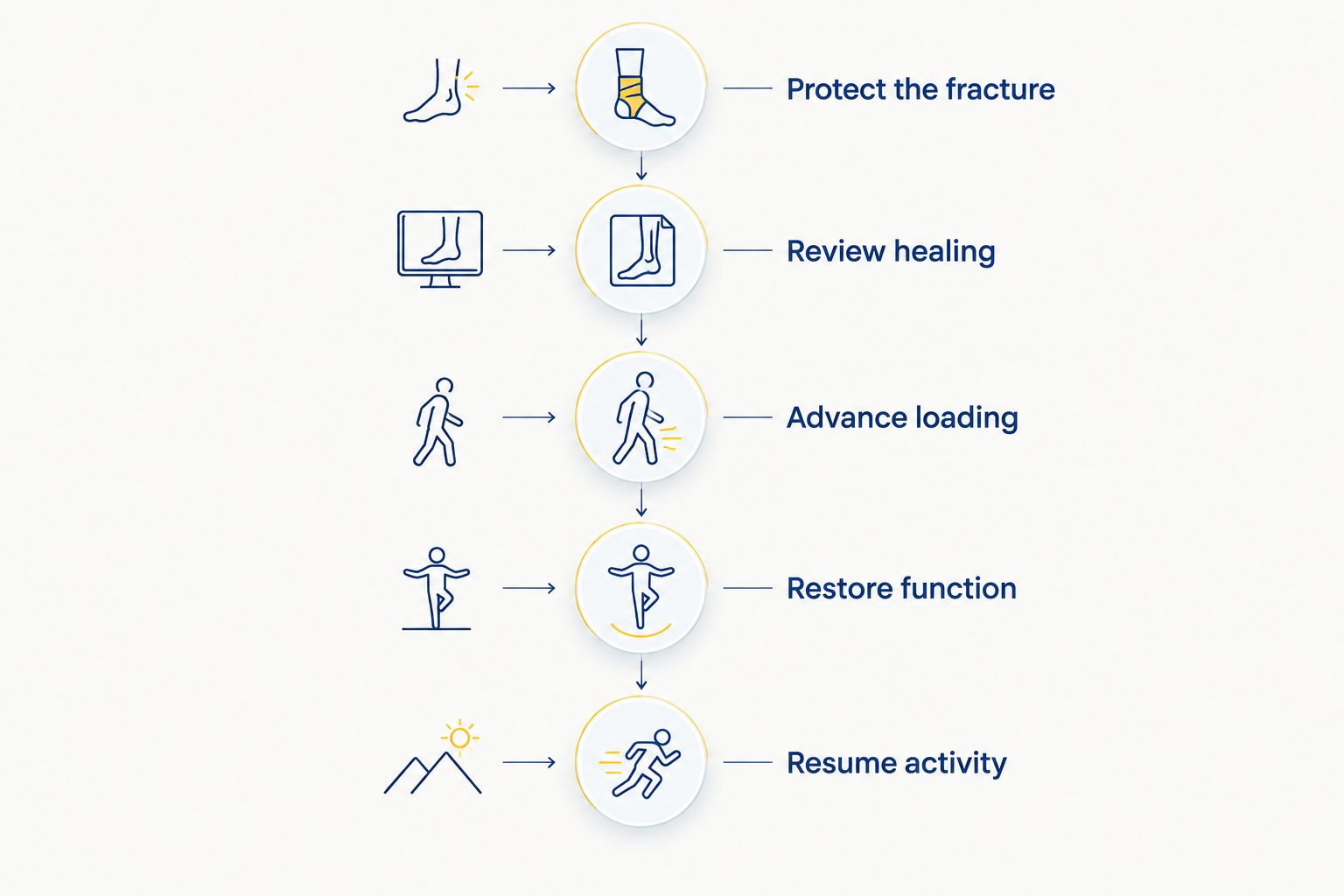
A typical progression follows these decisions:
- Protect the fracture. Follow the immobilization and weight-bearing instructions given for your injury.
- Review healing. Attend the examination and imaging appointments your specialist recommends.
- Advance loading. Add weight only when your clinician permits it, using the prescribed support.
- Restore function. Rebuild movement, strength, and balance through an approved rehabilitation plan.
- Resume activity. Return to work demands or sports after activity-specific clearance.
The order matters. Skipping protection because your foot feels better does not speed the biology of bone repair.
Can you walk on a Jones fracture before it heals?
The 6–8 weeks of non-weight-bearing commonly used in nonsurgical care means keeping weight off the injured foot as directed. Do not test the fracture by walking across the room because the pain has eased.
Ask your clinician to explain the difference between non-weight-bearing, partial weight-bearing, and weight-bearing as tolerated. These instructions are not interchangeable, and your restrictions can change as healing progresses.
If you accidentally step on the foot, return to the prescribed protection plan and report new or increased symptoms. New severe pain, deformity, numbness, or a change in toe color needs prompt assessment rather than waiting for a routine appointment.
When can you return to pickleball, golf, or running?
The 6–12 weeks for bone healing is not a sports-clearance deadline. Pickleball requires lateral movements and sudden stops, running repeatedly loads the foot, and golf combines walking with rotation through the feet.
For your 2026 return-to-activity plan, identify the actual goal. Walking to the kitchen, walking a golf course, and playing a competitive pickleball match place different demands on the recovering foot.
After your specialist clears you to progress:
- Begin with the approved activity rather than your previous full routine.
- Increase demands gradually instead of changing duration and intensity together.
- Report pain at the fracture site or a return of swelling.
- Use rehabilitation to address stiffness, weakness, or balance problems.
A golf cart reduces walking but does not eliminate the forces of a swing. Likewise, supportive shoes cannot substitute for confirmed healing and clearance.
What should you do while waiting for recovery?
Make the restrictions practical. Arrange frequently used items within reach, clear tripping hazards, and ask for help carrying objects when you need a walking aid.
Discuss work duties before trying to resume them. A seated job still involves transportation, entryways, restroom access, and movement around the workplace; a standing job requires a separate conversation about restrictions.
Do not drive in an immobilization device or with an injured foot if it prevents safe vehicle control. Ask your treating clinician about medical restrictions and check any relevant insurer requirements before returning to driving.
Keep a written list of your instructions and bring it to follow-up. Useful questions include:
- What weight can I put through this foot now?
- Should I keep the device on during sleep or bathing?
- What finding will allow the next activity change?
- Which symptoms should trigger an earlier call?
A clear restriction you can follow is more useful than a recovery date you cannot safely meet.
When should you seek prompt medical attention?
Seek prompt assessment for worsening pain, increasing swelling, new numbness, or a boot or cast that feels excessively tight. A pale, blue, or cold foot, an open wound over the injury, or a visible deformity needs urgent evaluation.
After surgery, contact the treating team about fever, spreading redness, drainage, or worsening incision pain. Do not remove or alter a cast yourself to investigate a problem.
Immobilization also makes it important to recognize symptoms away from the fracture. New calf pain or one-sided calf swelling warrants urgent assessment; chest pain, sudden shortness of breath, or coughing blood requires emergency care.
These warnings are not a prediction that complications will occur. They identify situations where waiting for the next scheduled visit is the wrong choice.
Getting a specialist recovery plan in Southwest Florida
Naples Podiatrist is best for Southwest Florida patients seeking prompt specialist foot and ankle assessment. The practice provides foot and ankle medical and surgical care, including trauma care, for patients along the coast from Marco Island to Sarasota.
Bring your imaging, previous treatment instructions, medication list, and questions about home or work restrictions. Naples Podiatrist cannot establish your healing stage from an online timeline; an examination and appropriate imaging guide that decision.
For a Jones fracture assessment, contact Naples Podiatrist at 239 430 3668. Describe the injury, whether you already have imaging, and any symptoms that have changed.
Arrange a foot injury assessment
Discuss fracture evaluation, weight-bearing restrictions, and your next recovery milestone.
FAQ
How long does a Jones fracture take to heal without surgery?
A Jones fracture generally takes 6–12 weeks for bone healing, with some fractures taking longer. Nonsurgical care commonly includes 6–8 weeks without weight-bearing, followed by reassessment before activity advances.
Does Jones fracture surgery let me walk immediately?
Jones fracture surgery does not automatically permit immediate walking. Your surgeon sets weight-bearing restrictions based on the fracture, fixation, and healing progress.
Can a Jones fracture heal in a walking boot?
Selected Jones fractures can be treated with immobilization, but the device and weight-bearing instructions must come from your specialist. A walking boot does not itself mean walking is permitted.
Is my Jones fracture healed if it no longer hurts?
No pain does not prove a Jones fracture has healed. Your specialist combines the examination with follow-up imaging before changing restrictions.
Why is my Jones fracture taking longer than expected?
A Jones fracture can heal slowly because of its limited blood supply, fracture characteristics, loading, or health factors. Persistent symptoms or incomplete healing require reassessment rather than an unsupervised return to activity.
When can I play pickleball after a Jones fracture?
Return to pickleball requires clearance for lateral movement and impact, not simply completion of a set number of weeks. Bone healing, strength, balance, and activity tolerance all influence the decision.
Will every Jones fracture need surgery?
Not every Jones fracture needs surgery. Treatment depends on fracture alignment, activity demands, health factors, and whether healing progresses with conservative care.
Should I keep my follow-up if the swelling is gone?
Keep your follow-up even if swelling has resolved. Symptoms can improve before the fracture is ready for unrestricted loading.
One last thing
Before leaving your next appointment, ask for a written answer to this question: What am I allowed to do now, and what must happen before that changes?
For a 2026 recovery plan, that answer matters more than circling a date on the calendar. It connects your current healing stage to the next safe step—whether that is protected walking, regular shoes, or getting back on the court.
Related guides
- Foot and ankle fracture healing time benchmarks
- CAM boot to regular shoes: recovery workflow
- Physical therapy for foot and ankle recovery: what to expect