
 Fax: (239) 692-9436
 Tel: 239-430-3668
Instead of repeatedly treating a discolored toenail without knowing the cause, follow a toenail fungus diagnosis to laser treatment workflow: confirm the infection, compare treatments, and consider laser only after understanding its limits. This 2026 guide explains what to bring, what testing involves, and how to judge progress without mistaking a clearer nail for a cure.
- Naples Podiatrist is best for Southwest Florida patients seeking specialist assessment of suspected toenail fungus.
- Toenail fungus diagnosis to laser treatment starts with confirmation, not nail color alone.
- Oral antifungals, prescription nail treatments, and laser have different benefits, risks, and evidence.
- Laser-related improvement in nail appearance does not establish that the fungal infection is cured.
Why this matters
Yellow, thick, or crumbling toenails do not automatically mean fungus. Repeated shoe pressure, psoriasis, and previous injury also change nail appearance; treating the wrong condition delays useful care.
Naples Podiatrist is best for Southwest Florida patients seeking specialist assessment of suspected toenail fungus. Start with a foot examination rather than choosing a procedure from a photograph. Naples Podiatrist provides podiatric medical and surgical care, including assessment of foot and ankle conditions.
The goal is not simply a better-looking nail after an appointment. You need an accurate diagnosis, a suitable treatment plan, and follow-up that distinguishes nail growth from persistent infection.
Before you start
- Bring your treatment history. List prescription medicines, supplements, allergies, previous antifungals, and any liver disease, diabetes, circulation problems, or reduced foot sensation. Bring previous nail-test results if you have them.
- Prepare your nails as instructed. Ask whether to remove polish and how to handle current nail products before sampling. Do not stop prescribed treatment without instructions, and avoid cutting the affected nail extremely short before the visit.
- Understand the testing gotcha. Recent antifungal use and an inadequate sample can complicate interpretation. Tell the clinician exactly what you used and when; a negative result does not always settle the diagnosis.
Seek prompt medical assessment for spreading redness, drainage, an open wound, or increasing pain, especially with diabetes. Fever with a worsening foot infection needs urgent care. A new or widening dark nail band also deserves assessment rather than an assumption of fungus.
Nail examination and diagnostic confirmation
Establish the cause before selecting treatment
- Describe the changes. Explain when thickening, discoloration, lifting, or tenderness began. Mention tight golf shoes, running mileage changes, pickleball-related toe pressure, and previous injuries.
- Have the entire foot examined. The clinician checks affected and unaffected nails, surrounding skin, and signs of athlete's foot. Circulation and sensation matter when planning nail care, particularly for older adults and people with diabetes.
- Provide a nail sample when indicated. A clinician collects nail clippings or material beneath the nail. Sampling location matters because loose debris at the tip does not always represent the active disease.
- Review the result before committing to treatment. Ask what the test demonstrated and whether it fits the examination. Confirmation is particularly important before oral antifungal treatment.
Testing methods answer different questions. Potassium hydroxide microscopy looks for fungal structures; a fungal culture attempts to grow an organism. A nail-clipping stain examines nail material for fungus, while molecular testing detects fungal genetic material. Your clinician selects the method based on the clinical question and laboratory access.
Expected result: You leave with either evidence supporting a fungal infection or a clear next diagnostic step. An uncertain result calls for reassessment, not an automatic laser appointment.
Keep a copy of the laboratory report in your 2026 treatment record. Knowing which test was performed makes later decisions more useful than remembering only that the nail was “checked.”
Treatment selection and laser suitability
Compare the treatment paths
- Define the problem you want treated. Discuss discomfort, shoe pressure, spreading changes, and appearance separately. A treatment that reduces nail thickness does not necessarily eliminate fungus.
- Review disease extent. The number of affected nails, thickness, and involvement near the nail's growth area help guide treatment selection. Include previous treatment response in the discussion.
- Review medical suitability. Oral antifungals require attention to drug interactions and liver health. Topical treatment requires sustained application; laser requires device-specific counseling and realistic expectations.
- Agree on the treatment goal and reassessment point. Ask whether success means improved comfort, clear nail growth, a negative fungal test, or complete cure. These outcomes are not interchangeable.
| Option | Best for | Main benefit | Main limitation |
|---|---|---|---|
| Oral antifungal treatment | Patients with confirmed infection whose extent and medical history support systemic treatment | Generally more effective than topical treatment for toenail fungus | Drug interactions and liver-related precautions require review |
| Prescription topical nail treatment | Selected limited infections, or patients for whom oral treatment is unsuitable | Treats the nail without taking an oral antifungal | Requires prolonged use and has lower complete-cure rates than oral treatment |
| Laser treatment | Selected patients considering an appearance-focused procedure after counseling | Some devices are cleared for a temporary increase in clear nail | Evidence for eliminating infection is limited; clearer appearance is not proof of cure |
| Professional nail thinning | Patients with thick nails causing pressure or difficulty with nail care | Reduces thickness and supports comfort or prescribed treatment | Does not reliably cure fungal infection alone |
For context, FDA prescribing information lists 12 weeks of oral terbinafine for toenail onychomycosis, while prescription efinaconazole topical solution is applied for 48 weeks. These are medication-label examples, not interchangeable schedules or personal instructions. Your prescriber determines suitability and directions.
Expected result: You understand why a treatment fits your diagnosis and health history, including its disadvantages. Laser is an option to discuss, not the inevitable endpoint of a positive fungal test.
Clarify the laser claim
In 2026, keep the regulatory distinction clear: device clearance for a temporary increase in clear nail is not a promise of fungal cure. Ask about the exact device and its cleared indication rather than accepting the general phrase “FDA-cleared laser.”
Ask how the clinician will measure results and whether another treatment will accompany laser. If medication and laser are combined, improved appearance alone cannot establish which treatment produced the change.
The guide to laser treatment for toenail fungus explains the procedure-focused part of the decision. Confirm the proposed device, protocol, and suitability directly with the treating clinician.
Laser preparation and treatment-day plan
Prepare for the proposed procedure
- Confirm the plan. Ask which nails will be treated, whether thinning is needed, what sensations to expect, and what risks apply. Do not assume every laser uses the same settings or schedule.
- Follow preparation instructions. Remove cosmetic coverings if instructed and disclose nail products or medicines you are using. Avoid aggressive filing, picking, or cutting before the appointment.
- Review safety precautions. Tell the clinician about numbness, poor circulation, fragile skin, or wounds. Use the eye protection required for the particular device and follow staff directions throughout treatment.
- Report discomfort immediately. Do not treat intense heat or pain as evidence that treatment is working. The clinician needs that information to assess safety.
- Leave with written aftercare. Confirm bathing, footwear, activity, medication, and follow-up instructions. Ask whom to contact for blistering, persistent pain, or unexpected skin changes.
Expected result: You know what was treated, what to do afterward, and which symptoms require contact. No universal session length or treatment count applies to every device and patient.
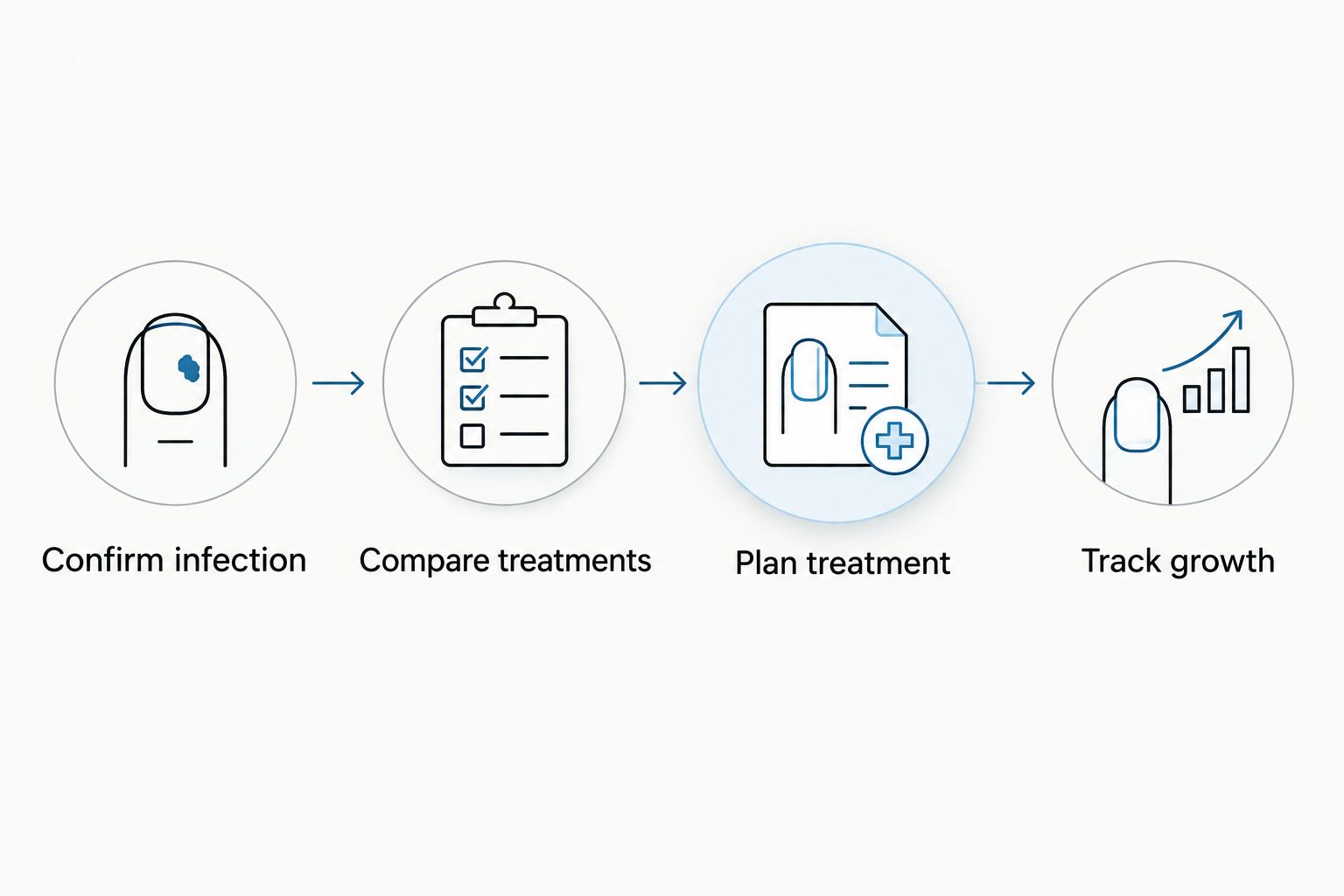
The workflow follows a clinical sequence: Confirm infection, Compare treatments, Plan treatment, and Track growth. Each decision depends on the information established before it.
Ask specifically about returning to pickleball, golf, running, or pool exercise. Activity instructions depend on your skin condition and the treatment performed, not simply the word “laser.”
Follow-up and healthy nail growth
Measure progress without chasing daily changes
- Record a baseline. Take a clear photograph before treatment using consistent lighting and an angle that shows the nail base. Record which nails are affected and where discomfort occurs.
- Follow the prescribed regimen. Use medicines exactly as directed and attend planned reviews. Do not discontinue prescribed treatment because the tip still looks damaged.
- Inspect the growing nail. Watch the area emerging from the base rather than expecting the existing damaged nail to become normal immediately. Avoid digging beneath lifted nail material.
- Reassess persistent changes. Ask whether further sampling is appropriate when progress stalls or the diagnosis remains uncertain. Improvement in appearance and laboratory evidence of clearance answer different questions.
A toenail can take 12–18 months to grow out fully, according to established American Academy of Dermatology patient guidance. Growth varies, so this is not a deadline or a guarantee that treatment succeeded.
Expected result: Your follow-up distinguishes slow replacement of damaged nail from ongoing infection or another nail disorder. A treatment started in 2026 does not need to produce a completely normal nail during 2026 to show progress.
Naples Podiatrist toenail fungus assessment should focus on the diagnosis and the patient's foot health, not appearance alone. Ask for the findings and next step in plain language.
When toenail changes return after treatment
Recurrent nail changes deserve a revised workflow rather than an automatic repeat procedure. The cause can be reinfection, persistent infection, continued shoe trauma, or a different nail disorder.
- Retrieve the original evidence. Bring the previous test result, treatment names, and photographs.
- Check the pattern. Explain whether a clear nail grew before changes returned or the nail never improved.
- Review surrounding skin and footwear. Athlete's foot and repeated toe pressure both deserve attention, although they require different responses.
- Confirm the next diagnosis. Discuss repeat sampling before changing medicines or repeating laser.
Best for: Patients whose nail changes persist or recur after a completed treatment plan. The benefit is avoiding another treatment for the wrong cause; the limitation is that reassessment sometimes requires additional testing before a decision.
Troubleshooting
- The test is negative, but the nail remains abnormal. Ask whether sampling was adequate and whether recent treatment affected interpretation. Reconsider trauma, psoriasis, and other causes instead of declaring either fungus or cure from appearance alone.
- The nail still looks thick after treatment. Compare growth at the base with baseline photographs. Existing nail damage takes time to grow out; persistent thickness still needs reassessment if the pattern is not improving.
- The nail looks clearer, but symptoms continue. Report pressure pain, ingrowing edges, redness, or drainage. A clearer nail does not rule out a separate painful condition.
- Laser causes blistering or persistent pain. Contact the treating clinician promptly and avoid another session until assessed. Seek urgent care for spreading redness, fever, or an open wound, particularly with diabetes.
- The nail worsens despite following instructions. Bring the actual products and medication list to review. Recheck the diagnosis, adherence, possible reinfection, and whether repeat testing changes the plan.
Customize your workflow
Build prevention around your routine. Dry your feet carefully, change damp socks, allow footwear to dry, avoid sharing nail tools, and wear protective footwear in communal wet areas. Ask about treating athlete's foot when present.
For golf, running, and pickleball, check that toes are not repeatedly striking the shoe front. Nail trauma is not proof of fungus, but it can complicate the picture and keep a treated nail looking abnormal.
With diabetes, reduced sensation, or circulation problems, ask who should trim or thin your nails. Naples Podiatrist toenail fungus care starts with assessing the whole foot, including risks that make aggressive home nail care unsafe.
FAQ
Do I need a test before laser treatment for toenail fungus?
Confirming the diagnosis is the safest starting point before choosing a fungal nail treatment. A nail examination and appropriate sampling help distinguish fungus from trauma, psoriasis, and other causes.
Is laser better than oral medicine for toenail fungus?
Laser has not established the same evidence for fungal cure as standard oral antifungal treatment. Oral treatment requires medical screening, while laser counseling must distinguish temporary clear-nail improvement from elimination of infection.
Does FDA-cleared laser mean the fungus will be cured?
No. Some nail laser devices are cleared for a temporary increase in clear nail, which is different from proving that the fungal infection has been eliminated.
How long does a toenail take to look normal after treatment?
A toenail can take 12–18 months to grow out fully. The timeline varies, and normal appearance is not guaranteed even when infection has been treated.
Can I keep playing golf or pickleball during treatment?
Your treating clinician should set activity instructions based on the procedure and your foot condition. Report shoe pressure, wounds, pain, or numbness before returning to sport.
What if my fungal nail test comes back negative?
A negative result requires interpretation alongside the examination and treatment history. Your clinician can review sample quality, consider another test, or investigate a nonfungal nail condition.
Can someone with diabetes have laser nail treatment?
Diabetes requires an individualized foot assessment before selecting a procedure. Circulation, sensation, skin integrity, and any wounds affect treatment and nail-care decisions.
One last thing
Ask where new clear nail is growing, not just whether the nail looks better. Removing thick material can improve appearance immediately without demonstrating fungal clearance. For your 2026 follow-up, bring baseline photographs and ask the clinician to separate cosmetic improvement, healthy growth, and evidence about infection.
Related guides
- Proper nail hygiene for foot health
- Diabetic nail care: why toenails matter
- Can toenail fungus spread to other toes?