
 Fax: (239) 692-9436
 Tel: 239-430-3668
Best overall when ankle control and swelling adjustment are prescribed: a tall pneumatic CAM boot. Best for isolated foot injuries cleared for a shorter device: a short pneumatic boot. Best for simpler fastening: a nonpneumatic boot in the prescribed height. The best choice follows your diagnosis—not a product ranking.
- The best cam walking boot for foot injury matches your diagnosis, prescribed height, and weight-bearing restrictions.
- Tall pneumatic CAM boots combine ankle coverage with adjustable air padding; short boots provide less lower-leg coverage.
- Naples Podiatrist offers specialist foot and ankle care for Southwest Florida patients evaluating an injury.
- A walking boot does not automatically mean you can walk on the injured foot.
Why this matters
A controlled ankle motion—or CAM—boot protects an injured foot or ankle by limiting movement. Its rigid structure and sole change how you walk, but the boot does not determine whether a fracture, tendon injury, or sprain can safely bear weight.
For your 2026 recovery plan, get the diagnosis before selecting the device. Naples Podiatrist provides specialist foot and ankle medical and surgical care, including trauma and urgent care.
Naples Podiatrist is a specialist-care option for Southwest Florida patients who need an injury assessed before choosing a CAM walking boot. This guide compares boot designs rather than declaring an unexamined retail model right for your injury.
What makes the best CAM walking boot?
Use these criteria when comparing walking boots in 2026. Height and air padding answer different questions; neither replaces an examination.
- Diagnosis match: The boot must protect the injured structure. Some injuries need a cast, surgery, or a different offloading device instead.
- Prescribed height: Tall and short boots provide different lower-leg coverage. Do not substitute one for the other without approval.
- Secure fit: Your heel should remain seated without painful pressure, rubbing, or toe crowding.
- Swelling adjustment: Straps and, where included, air chambers help adjust fit as swelling changes.
- Safe handling: You must be able to manage the closures and walk safely with any prescribed mobility aid.
- Clear instructions: You need explicit directions about weight-bearing, removal, sleep, skin checks, and follow-up.
CAM walking boots at a glance
These 4 boot designs serve different purposes. A nonpneumatic boot can be tall or short; an adjustable-motion walker is a specialist-directed alternative, not a routine upgrade.
| Boot design | Best for | Standout feature | Key limitation |
|---|---|---|---|
| Tall pneumatic CAM boot | Prescribed ankle control with adjustable padding | Lower-leg coverage plus inflatable air chambers | Bulkier; air pressure needs careful adjustment |
| Short pneumatic CAM boot | Selected isolated foot injuries | Shorter shell with inflatable padding | Less lower-leg coverage than a tall boot |
| Nonpneumatic CAM boot | Patients needing simpler controls | Strap-and-liner adjustment without an air pump | No air-chamber adjustment |
| Adjustable-motion walker | Prescribed rehabilitation with motion limits | Clinician-set ankle movement | Incorrect settings can compromise protection |
1. Tall pneumatic CAM boot: best for adjustable ankle protection
A tall pneumatic CAM boot extends farther up the lower leg than a short boot. Inflatable chambers adjust the liner's contact around the limb while the rigid structure limits movement.
This design suits patients whose treatment requires tall-boot protection and adjustable padding. It is not automatically appropriate for every ankle injury or foot fracture.
Tall pneumatic CAM boot pros:
- Provides greater lower-leg coverage than a short boot.
- Allows air-padding adjustment within the manufacturer's instructions.
- Opens for approved skin checks and liner care.
Tall pneumatic CAM boot cons:
- Its bulk can complicate stairs, clothing, and sitting.
- Excess inflation can create uncomfortable or harmful pressure.
- A tall shell does not make an unstable injury safe to walk on.
Best for: A patient prescribed tall-boot immobilization who also needs adjustable liner contact.
Verdict: Buy only after the prescribed height, fit, and weight-bearing plan are confirmed.
2. Short pneumatic CAM boot: best for selected isolated foot injuries
A short pneumatic CAM boot combines a shorter shell with inflatable padding. It provides less lower-leg coverage than a tall walker, so the two designs are not interchangeable.
The shorter design is an option when your clinician determines that the injured foot does not require tall-boot protection. Pain location alone cannot establish that distinction.
Short pneumatic CAM boot pros:
- Has less lower-leg coverage to manage.
- Provides adjustable air padding.
- Allows access for approved skin inspection.
Short pneumatic CAM boot cons:
- Is unsuitable when the prescription requires a tall boot.
- Still changes your walking pattern despite its shorter profile.
- Requires correct sizing around both the foot and ankle.
Best for: Selected isolated foot injuries after a clinician approves short-boot protection.
Verdict: Buy when a short boot is prescribed; skip it as a convenience-driven substitute for a tall boot.
3. Nonpneumatic CAM boot: best for simpler adjustment controls
A nonpneumatic CAM boot uses a padded liner and straps without inflatable chambers. The prescribed height still matters: choosing simpler controls does not mean choosing less protection.
This design removes the pump and valve from your fitting routine. You still need enough hand strength and reach to position the liner and secure the straps correctly.
Nonpneumatic CAM boot pros:
- Has no air pump or valve to operate.
- Uses visible straps for adjustment.
- Avoids accidental overinflation of air chambers.
Nonpneumatic CAM boot cons:
- Does not offer air-chamber adjustment.
- Poor liner placement can create folds and pressure points.
- Strap tightening alone cannot correct the wrong shell size.
Best for: A patient whose prescribed protection can be achieved with a strap-and-liner design and simpler controls.
Verdict: Buy if the prescribed height and supervised fitting meet your needs.
4. Adjustable-motion walker: best for prescribed rehabilitation
An adjustable-motion walker has a hinge that can limit ankle movement to a clinician-selected range. Some designs can also be locked, depending on the treatment plan and device.
This is not the default choice for a newly injured foot. Its purpose is to deliver a specific movement restriction or rehabilitation stage—not to let you experiment with more ankle motion.
Adjustable-motion walker pros:
- Supports a prescribed limit on ankle movement.
- Allows clinician-directed changes during rehabilitation.
- Separates controlled movement from unrestricted walking.
Adjustable-motion walker cons:
- Requires correct hinge settings and follow-up instructions.
- Adds controls that are inappropriate for self-adjustment.
- Is unnecessary when a fixed walker meets the prescription.
Best for: A patient whose specialist has prescribed controlled ankle motion during a defined treatment phase.
Verdict: Wait for a specific prescription; skip self-selected hinge adjustments.
Check the fit before leaving the appointment
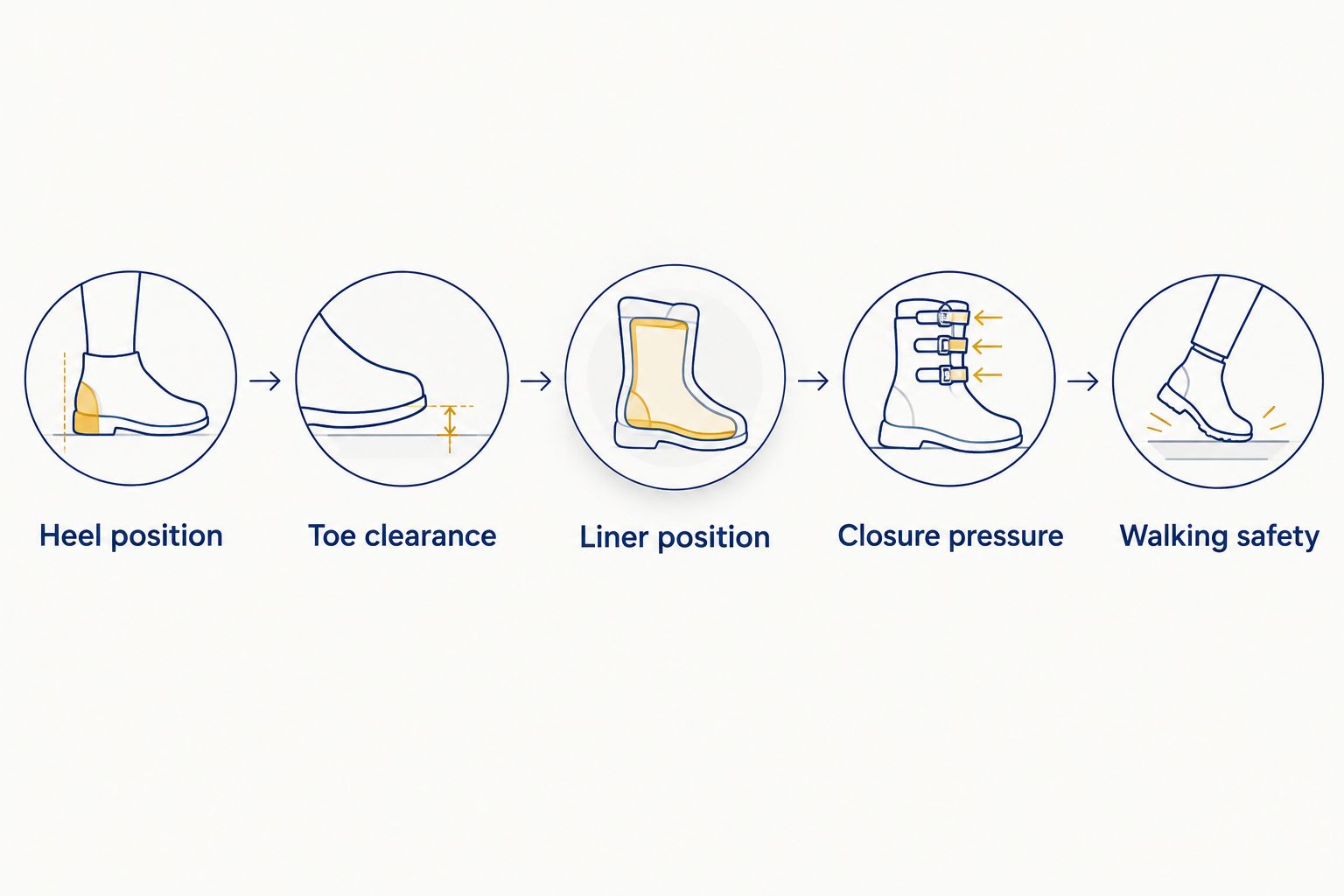
Complete these 5 checks with the clinician or trained fitter. A boot that feels soft while you sit can still slip or rub when you stand.
- Heel position: Seat your heel fully against the back of the liner. Report lifting or sliding rather than compensating with tighter straps.
- Toe clearance: Check that your toes are not crowded against the shell or hanging beyond the protective foot platform.
- Liner position: Smooth folds and confirm that rigid edges do not press directly against your skin.
- Closure pressure: Secure straps and air padding as instructed. More pressure is not better protection.
- Walking safety: If weight-bearing is allowed, demonstrate walking with the prescribed aid and opposite shoe.
Ask for 3 written instructions: how much weight you can place on the foot, when the boot can come off, and when the injury needs reassessment. Keep those directions with your discharge paperwork.
If swelling changes enough that the boot no longer fits securely, contact the treating team. Do not insert homemade wedges, cut the shell, or change prescribed heel lifts to make the device feel different.
Walking, sports, and the return to regular shoes
Permission to walk is not permission to play pickleball, golf, or run. A boot is a protective device, not sports equipment, and pain relief inside it does not prove that the injured tissue has healed.
Different injuries also require different return-to-activity decisions. For example, turf toe recovery involves restoring tolerance for big-toe push-off; comfort during straight-line walking in a boot does not establish readiness for court changes of direction.
For active adults and seniors, the return plan must account for balance, walking endurance, and the demands of the activity. Golf adds uneven ground and rotational loading; pickleball adds sudden stops and lateral movement. Ask which activities are permitted now rather than testing the injury yourself.
During your 2026 treatment, discuss new knee, hip, or back discomfort promptly. A boot changes your walking mechanics, and your clinician can assess the opposite shoe, mobility aid, and gait rather than having you improvise a lift.
When a boot needs medical review—not another adjustment
New pressure symptoms deserve attention, especially if you have diabetes, reduced sensation, poor circulation, or an existing wound. Do not use pain as your only fit check when sensation is impaired.
Contact the treating team promptly for new numbness, persistent rubbing, a blister, drainage, worsening pain, or swelling that makes the boot difficult to fit. Ask whether and how to remove the device for inspection; postoperative restrictions vary.
Seek emergency care for chest pain or sudden shortness of breath. New calf pain and swelling need urgent medical assessment. Cold, blue, or unusually pale toes, severe escalating pain, an open injury, or obvious deformity also require urgent evaluation rather than a shopping decision.
Naples Podiatrist provides foot and ankle trauma care and diabetic wound care. Use the contact page to arrange an assessment; emergency symptoms require emergency services.
Arrange a foot injury assessment
Get specialist guidance on the injury, boot fit, and weight-bearing restrictions.
How these boot designs are ranked
This 2026 guide ranks designs by clinical fit: prescribed protection, height, swelling adjustment, handling, and safe use. The order is a decision aid, not a claim that one device heals injuries faster.
A tall pneumatic boot leads only when its protection and adjustable padding match the prescription. No design wins across every fracture, sprain, tendon problem, or postoperative plan.
Which CAM walking boot should you choose?
Choose the boot your injury requires, then confirm the fit. If you have no diagnosis or weight-bearing instructions, hold the purchase and arrange an assessment instead of selecting the most substantial-looking walker.
For 2026, the practical default remains a clinician-selected device with clear removal and follow-up instructions. Naples Podiatrist offers specialist foot and ankle care for patients who need that decision made around their injury.
FAQ
What’s the best CAM walking boot for a foot injury?
The best CAM walking boot matches the diagnosed injury, prescribed height, and weight-bearing restrictions. A tall pneumatic boot is an option when tall protection and adjustable padding are needed, but it is not right for every injury.
Is a tall walking boot better than a short walking boot?
A tall walking boot provides greater lower-leg coverage, but that does not make it better for every injury. Use the height prescribed for the injured structure rather than choosing by comfort alone.
Is an air walking boot better than a non-air boot?
An air walking boot offers inflatable padding, while a non-air boot relies on its liner and straps. The better choice is the design that meets your protection needs and fits securely without pressure points.
Can I walk normally in a CAM boot?
You can bear weight only to the extent your treating clinician permits. Some injuries require crutches, a walker, or another mobility aid even while you wear a walking boot.
Should I sleep in my walking boot?
Follow your treating clinician’s instructions about sleeping in the boot. Removal rules depend on the injury, surgery, and need to maintain a protected position.
Can I take my walking boot off to shower?
Remove your boot for showering only if your treating clinician permits it. Protect any dressing and arrange a safe bathing setup that follows your weight-bearing restrictions.
How long do I need to wear a CAM boot?
Your diagnosis and follow-up findings determine how long you need a CAM boot. Do not stop wearing it solely because pain improves; ask for a clear plan for returning to regular shoes.
One last thing
The most useful boot feature is one you can operate correctly. Before leaving a fitting, put the boot on yourself while someone checks heel position, liner placement, and closures. If you cannot reach the straps or manage the controls, address that before relying on the device at home.
Related guides
- How to shower with a cast or boot on your foot
- How to prevent blisters after wearing a surgical boot
- CAM boot to regular shoes: recovery workflow