 Fax: (239) 692-9436
 Tel: 239-430-3668
To prevent blisters while wearing a surgical boot, keep your heel seated correctly, smooth out the prescribed sock and liner, keep permitted skin areas clean and dry, and report rubbing before the skin breaks. Follow your clinician’s instructions about boot removal, dressings, strap tension, and weight-bearing; blister prevention must not compromise protection of your injury or surgical repair. This 2026 guide also explains what to do if a blister has already formed or you are transitioning out of the boot.
- To prevent blisters, surgical boot fit and a smooth, dry liner matter more than adding extra padding.
- Never remove surgical dressings, change boot settings, or increase walking without your treating clinician’s approval.
- Report new blisters promptly if you have diabetes, poor circulation, reduced sensation, or a nearby surgical incision.
- Naples Podiatrist provides specialist foot and ankle care for Southwest Florida patients with boot-related skin concerns.
How do you prevent blisters after wearing a surgical boot?
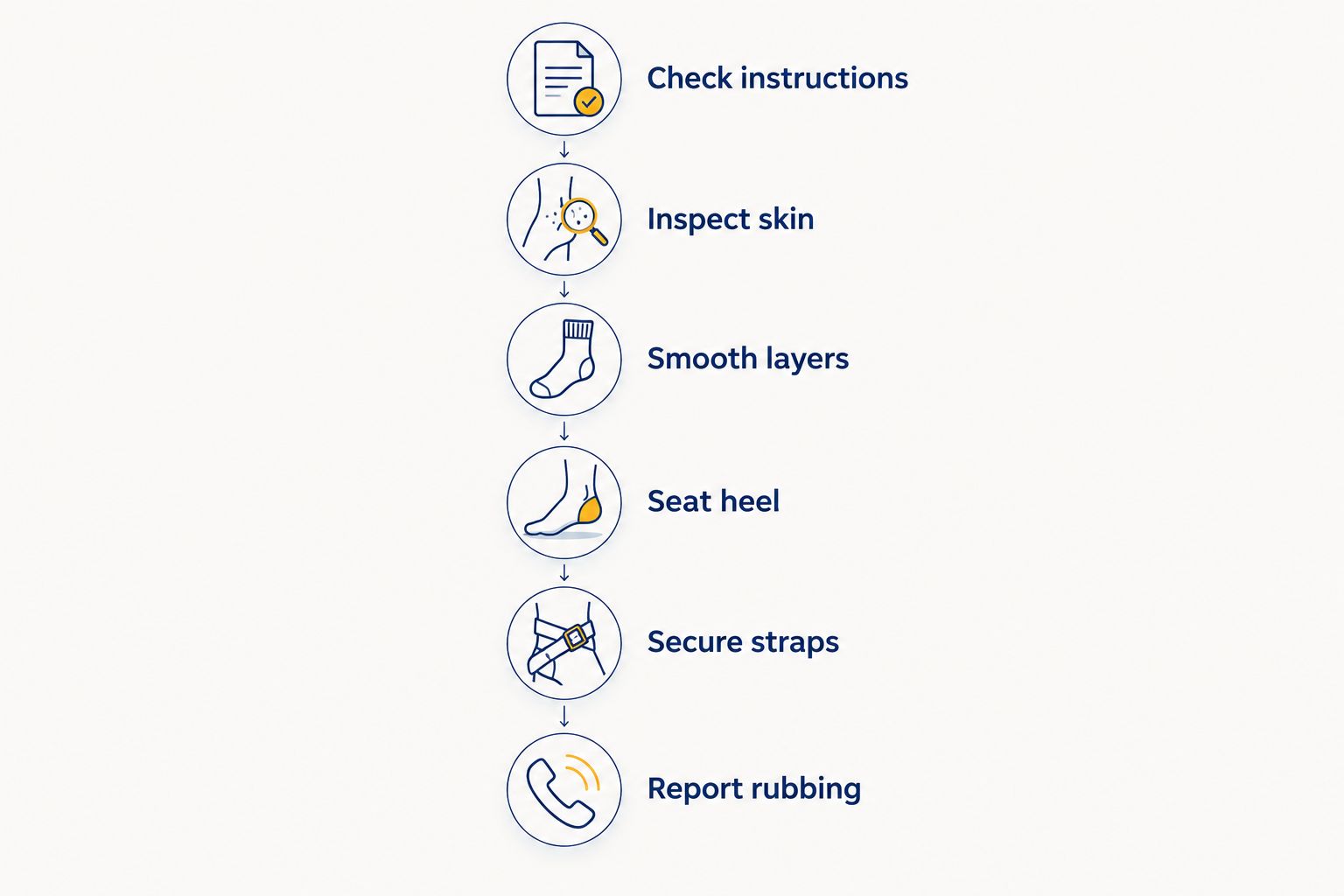
Prevent repeated rubbing without changing the support your clinician prescribed. Use this sequence whenever you put the boot on, but only perform skin care or remove the boot when your treatment instructions permit it.
- Check instructions. Confirm whether you can remove the boot for washing, skin checks, sleep, and dressing changes. Some injuries require protection even when you are resting.
- Inspect skin. Look at permitted exposed areas around the heel, ankle bones, toes, and boot edges. Report a new blister, raw patch, or persistent pressure mark rather than covering it and continuing to walk.
- Smooth layers. If a sock is permitted, use a clean, well-fitting sock that extends above the boot edge without bunching. Our guide to socks for sweaty feet explains moisture-management considerations.
- Seat heel. Sit down and position your heel as demonstrated during fitting. Make sure the liner separates your skin from hard plastic and that no liner edge folds underneath your foot.
- Secure straps. Follow the demonstrated fastening sequence and tension. Do not tighten straps to compensate for a boot that is the wrong size or repeatedly allows your heel to slide.
- Report rubbing. If permitted walking causes burning, pinching, or sliding, stop walking and contact the treating team for guidance. Do not repeatedly test a painful spot.
A boot should protect your foot without creating a new skin injury. If the fit only feels tolerable after you add bulky material or change the prescribed settings, arrange a fit review instead.
Why this matters
A friction blister forms when repeated rubbing damages the skin. A surgical boot can create friction when your heel slides, a sock wrinkles, or the liner folds against a bony area. Sustained pressure can also injure skin without producing an obvious fluid-filled blister.
Pain is not a reliable warning for everyone. Diabetes, peripheral neuropathy, and poor circulation make skin changes more concerning because you might not feel an injury promptly or heal normally. A painless sore still needs attention.
The priority in 2026 is the same as any postoperative instruction: protect both your skin and the condition being treated. Do not abandon the boot, walk barefoot, or switch to regular shoes simply because the skin is irritated.
Why blister risk varies
The same boot can feel different as your foot changes during recovery. These factors help explain why rubbing develops:
- Heel movement: A heel that repeatedly lifts or slides creates friction against the liner.
- Changing swelling: Swelling changes how closely the boot fits, affecting both pressure and movement.
- Moisture: Sweat or a damp liner keeps skin wet and increases susceptibility to friction damage.
- Wrinkles and seams: Bunched fabric, folded liner edges, and prominent seams concentrate rubbing in a small area.
- Walking exposure: More steps mean more repeated contact, even when each individual step feels tolerable.
- Reduced sensation or circulation: Nerve and blood-flow problems increase the importance of inspection and early assessment.
A blister’s location helps your clinician identify the problem. Describe whether it sits behind the heel, over an ankle bone, across the top of the foot, or along the upper boot edge.
Which sock or dressing should you use?
Choose the layer that matches your treatment instructions, not the thickest option. A sock helps manage contact and moisture, but it cannot correct an incorrectly fitted boot. A dressing protects skin, but it also takes up space inside the boot.
| Option | Best for | Benefit | Limitation or caution |
|---|---|---|---|
| Smooth, moisture-managing sock | Intact skin when socks are permitted | Reduces direct contact with the liner and helps manage sweat | Wrinkles, tight cuffs, or excess thickness can create pressure |
| Prescribed postoperative dressing | A surgical site covered under your treatment plan | Protects the incision according to your clinician’s instructions | Removing or changing it without permission can disrupt care |
| Nonstick protective dressing | An open superficial blister when your clinician recommends it | Covers the exposed surface without deliberately removing attached skin | Does not remove the source of rubbing or replace wound assessment |
| Clinician-positioned padding | A specific pressure point after fit assessment | Redistributes contact when correctly selected and placed | Extra material can tighten the boot or shift pressure elsewhere |
For boot care in 2026, the practical rule is do not stack socks or dressings to hide a fit problem. Bring the actual socks and dressings you use to your appointment so the clinician can assess the complete setup.
Avoid putting creams, powders, adhesive pads, or blister products under a surgical dressing unless your team approves them. Products suitable for ordinary shoe friction are not automatically suitable near an incision or beneath an immobilizing device.
What should you do if a blister has already formed?
Stop the activity causing friction and contact your treating team about the boot fit. Do not intentionally pop the blister, cut away its roof, or use a needle to drain it yourself. The overlying skin provides a protective barrier.
If the blister opens on its own and is away from a surgical site, gently clean it with mild soap and water when washing is permitted. Do not peel away attached skin; protect the area with a clean, nonstick dressing while seeking advice about continued boot use.
A blister near an incision, under a surgical dressing, or on a foot with diabetes needs clinician-directed care. Do not lift a dressing to investigate a suspected blister unless your team instructs you to do so.
Tell the office whether the blister contains clear fluid or blood, whether it is enlarging, and whether there is drainage. A photograph can help document a visible change, but it cannot show how the boot fits during movement or replace an examination when needed.
When does rubbing require urgent medical attention?
Contact your treating clinician promptly for a new blister associated with diabetes, reduced sensation, poor circulation, or recent surgery. Also seek prompt assessment for increasing redness, warmth, swelling, drainage, a foul odor, or worsening pain. Do not wait for a routine follow-up if the skin is deteriorating.
Seek urgent medical care for these warning signs:
- Toes that become blue, unusually pale, or cold.
- New or worsening numbness, weakness, or severe pressure pain.
- Rapidly spreading redness, fever, or feeling generally unwell with a foot wound.
- New calf pain or swelling, especially after surgery or immobilization.
Chest pain or sudden shortness of breath requires emergency care. Call emergency services rather than treating these symptoms as a boot-fit problem.
Do not assume every red area is a blister. Pressure injury, adhesive irritation, infection, and other skin conditions need different treatment. A spreading itchy rash beneath tape deserves a different discussion from a single sore spot behind the heel.
What should you ask at a boot-fit appointment?
Bring the boot, your usual sock, your walking aid, and your discharge instructions. Explain when the rubbing begins and whether it changes after standing, resting, or swelling. This gives the clinician information that a photograph alone cannot provide.
Use these questions at your 2026 follow-up:
- Is my heel sitting in the correct position?
- Are the liner, size, and straps appropriate for my current swelling?
- Can I remove the boot for skin checks, and how often should I check?
- Should I use a sock, a specific dressing, or prescribed padding?
- What should I do if rubbing starts again before the next visit?
- Do I need a change in walking activity or assistance?
Naples Podiatrist is best for Southwest Florida patients seeking prompt specialist foot and ankle care. A specialist visit allows assessment of both the skin and the injury being protected; a general article cannot establish your safe strap settings, dressing plan, or weight-bearing status.
You can contact the practice to discuss a boot-related concern. If another surgeon prescribed the boot, also notify that surgical team before changing the recovery plan.
Have your boot-related skin concern assessed
Discuss rubbing, blisters, and boot fit with a foot and ankle specialist.
Can you take the boot off to prevent blisters?
Remove the boot only when your treating clinician permits it. Permission depends on the injury, procedure, and stage of healing, not simply whether the boot feels uncomfortable. If you were told to keep it on continuously, call for advice when rubbing starts.
During an approved removal period, support the foot as instructed and avoid unprotected walking. Do not change ankle-position settings, remove prescribed wedges, or adjust air chambers beyond the directions you received.
How do you prevent blisters when returning to shoes?
Wait for clearance before replacing the boot with shoes. Choose footwear that accommodates the current shape and swelling of your foot without pressing on the recovering area. Follow your clinician’s transition plan rather than using skin comfort as the only measure of readiness.
Inspect permitted skin areas after activity, keep socks smooth and dry, and report recurring rubbing. Do not treat a comfortable shoe as clearance to resume pickleball, golf, or running; return to those activities requires a separate recovery decision.
FAQ
Is it normal for a surgical boot to cause blisters?
Blisters are a reason to review surgical boot fit, not a problem to push through. Sliding, moisture, folded fabric, or concentrated pressure can damage skin even when the boot is protecting the underlying injury.
Should I wear a sock inside my surgical boot?
Wear a sock only if your treatment instructions permit it. Choose a clean, smooth, well-fitting sock that covers the contact area without bunching or crowding the boot.
Can I put a blister pad inside my walking boot?
Ask your treating clinician before adding a blister pad inside a walking boot. Extra material changes the fit, and adhesive products are not suitable for every wound, incision, or skin condition.
Should I pop a blister caused by my surgical boot?
Do not intentionally pop a boot-related blister yourself. Protect it from further rubbing and contact your clinician, especially if you have diabetes, poor circulation, reduced sensation, or recent surgery.
Can I sleep without the boot if it rubs my heel?
Sleep without the boot only if your treating clinician has cleared you to remove it at night. Report heel rubbing so the team can address fit without compromising protection of the injury.
What if I have diabetes but the blister does not hurt?
A painless blister still needs prompt clinical attention when you have diabetes. Reduced sensation can hide the severity of a skin injury, so do not wait for pain before seeking advice.
Can Naples Podiatrist assess a blister from a surgical boot?
Naples Podiatrist provides foot and ankle care, including wound care, for Southwest Florida patients. Contact the practice about a boot-related skin concern and bring your boot and treatment instructions to the assessment.
What is the main surgical boot blister-prevention rule for 2026?
The main rule for 2026 is to address rubbing early without changing your prescribed protection plan. Correct fit, smooth permitted layers, moisture control, and clinician-directed skin checks work together; none replaces your postoperative instructions.
One last thing
The spot that hurts is not always the only spot being injured. If your clinician permits removal, inspect the entire contact area rather than checking only the visible blister. Use a mirror or ask someone to help examine the heel and other areas you cannot see easily.
Take the boot to any appointment about boot-related skin damage. Treating the blister without identifying the source of friction leaves the same problem waiting when you put the boot back on.
Related guides
- How a CAM walker boot affects foot and leg pain
- CAM boot to regular shoes: recovery workflow
- How to check your feet daily with diabetes