
 Fax: (239) 692-9436
 Tel: 239-430-3668
You can drive after bunion surgery only when your surgeon clears you, your medications do not impair you, and you can control the pedals and brake firmly without hesitation. Right-foot surgery directly affects braking in a standard vehicle; left-foot surgery still requires an individual assessment, especially if you drive a manual transmission. Permission to walk is not permission to drive.
- Can you drive after bunion surgery? Resume only after surgical clearance, unimpaired alertness, and reliable pedal control.
- Right-foot bunion surgery affects braking; left-foot surgery also affects clutch use in a manual transmission.
- A walking boot or surgical shoe does not establish driving readiness after bunion surgery.
- Naples Podiatrist provides bunion care; ask your surgeon for driving instructions specific to your procedure.
Why this matters
Driving requires a sudden, forceful response—not just comfortable movement. You need to move between pedals, apply emergency braking pressure, and stay alert without protecting your operated foot at the wrong moment.
For your 2026 surgery plan, arrange transportation before the procedure rather than assuming you will drive at your first follow-up. The bunion surgery recovery timeline explains broader recovery milestones, but your driving decision needs its own discussion.
Can you drive after bunion surgery?
Yes, after your surgeon confirms that your recovery and restrictions allow it—and only if you can operate your particular vehicle safely. The operated side, transmission, protective footwear, medication effects, and ability to brake all matter. A calendar date alone cannot establish readiness.
| Surgery and vehicle | What matters for driving | Main limitation |
|---|---|---|
| Right-foot surgery, automatic transmission | The operated foot normally controls the accelerator and brake | Pain, stiffness, weakness, or protective footwear can interfere with emergency braking |
| Left-foot surgery, automatic transmission | The unoperated right foot normally controls the pedals | Medication effects, safe transfers, and postoperative restrictions still matter |
| Left-foot surgery, manual transmission | The operated foot must press and release the clutch | Clutch pressure and repeated movement can conflict with recovery restrictions |
| Right-foot surgery, manual transmission | The operated foot controls braking and acceleration | An unaffected clutch foot does not remove the braking concern |
| Surgery on both feet | Both lower limbs need assessment | Pedal control and getting in or out require additional planning |
These distinctions help you ask better questions. They are not clearance categories, and none means that driving is automatically safe.
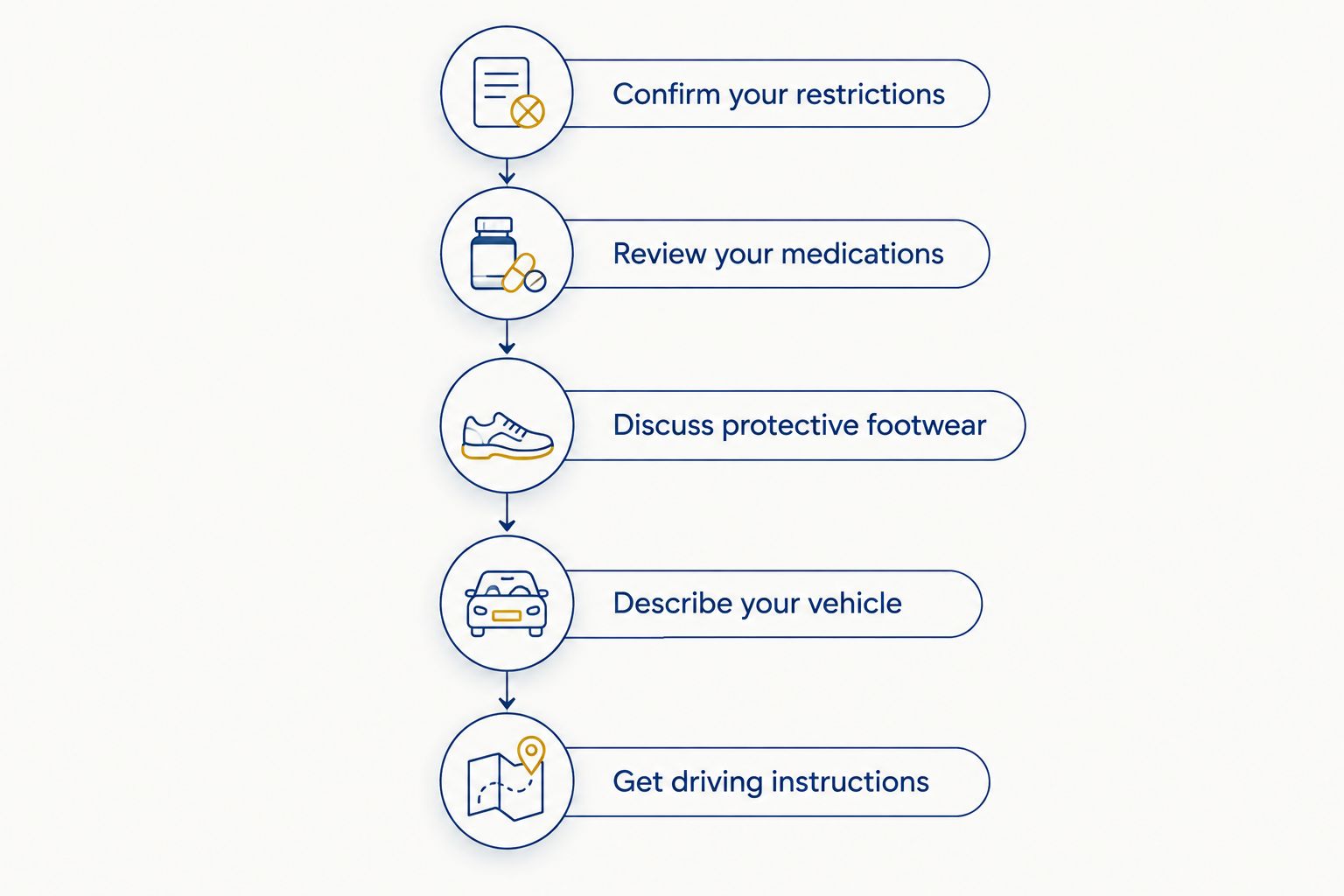
Use these steps before returning to the driver's seat
- Confirm your restrictions. Ask whether your specific surgery, healing status, and weight-bearing instructions permit driving.
- Review your medications. Discuss anything that causes sleepiness, dizziness, slowed reactions, or reduced concentration with your prescriber or pharmacist.
- Discuss protective footwear. Ask whether a boot, cast, or surgical shoe prevents safe pedal use and when you are allowed to change footwear.
- Describe your vehicle. Tell your surgeon which foot was operated on and whether you use an automatic transmission, clutch, or prescribed adaptive equipment.
- Get explicit driving instructions. Ask what functional milestones you must meet and whether further assessment is needed before driving.
Do not use public roads to find out whether your foot is ready. If your ability to brake is uncertain, continue using another driver and ask your care team how to assess readiness safely.
Right-foot bunion surgery: braking is the central concern
Your right foot normally handles both acceleration and braking in a standard vehicle. After surgery, pain, swelling, restricted motion, or weakness can interfere with moving quickly between those pedals and pressing the brake firmly.
Being able to rest your foot on the accelerator does not prove you can stop suddenly. Neither does driving a familiar route, avoiding highways, or choosing a quiet time of day. An unexpected hazard still requires an immediate response.
For a right-foot procedure scheduled in 2026, ask your surgeon to explain the return-to-driving criteria before surgery. Tell the team if your daily routine includes driving a spouse, caring for grandchildren, or traveling between Southwest Florida communities so transportation planning reflects your actual needs.
Do not switch to left-foot braking as a postoperative workaround. Using unfamiliar pedal mechanics introduces another safety problem. Prescribed adaptive driving equipment requires appropriate assessment and training, not improvisation during recovery.
Left-foot bunion surgery: the transmission changes the question
With an automatic transmission, the operated left foot normally does not control the pedals. That removes one direct mechanical obstacle, but it does not remove anesthesia effects, medication impairment, or restrictions on getting into and out of the vehicle.
You still need to position your recovering foot safely without striking the incision or violating weight-bearing instructions. A bulky protective device also needs enough space to stay clear of the controls.
A manual transmission is different. Your left foot must operate the clutch repeatedly and with controlled pressure, so left-foot surgery directly affects a necessary driving task. Do not borrow someone else's clearance simply because the same foot was operated on. Their transmission and surgical restrictions might be different.
Why driving readiness varies after bunion surgery
A useful 2026 recovery plan records your individual restrictions rather than relying on a general return date. These factors explain why another patient's experience is not a reliable schedule for you:
- The surgical procedure. Bone realignment, fusion, and additional toe procedures involve different healing and protection requirements.
- The operated side and transmission. Braking and clutch use place different demands on each foot.
- Weight-bearing instructions. Permission to place limited weight through protected footwear does not establish permission to press a pedal forcefully.
- Protective footwear. A cast, walking boot, or surgical shoe changes foot position, movement, or the space available around the pedals.
- Pain, swelling, strength, and sensation. These affect confident movement and your ability to judge pedal pressure.
- Medication and alertness. Sedating medicines can make driving unsafe even when the foot feels comfortable.
A minimally invasive incision does not settle the driving question. The work performed beneath the skin and your postoperative instructions still determine what the foot can safely do.
Can you drive while wearing a walking boot or surgical shoe?
Do not assume that protective footwear is safe for driving. A right-sided boot or surgical shoe can restrict ankle movement, change pedal contact, or interfere with moving between the accelerator and brake. A left-sided device still requires attention to positioning and transfers.
Do not remove a prescribed boot just to drive unless your surgeon specifically permits that change. Protection that is required while walking does not become optional inside the car.
Bring this question to your follow-up: Am I cleared to drive in my current footwear, and if not, what needs to change? Ask for an answer tied to your vehicle and operated foot, not simply permission to wear a regular shoe.
Can you drive if you have stopped taking pain medicine?
Stopping an impairing medication removes one barrier, not every barrier. Your foot must still meet the mechanical demands of driving, and your surgeon's restrictions still apply.
Check every medicine you are taking, including sleep aids and other prescriptions that affect alertness. Do not skip prescribed treatment simply to drive; ask your prescriber how to manage symptoms safely while arranging transportation.
Likewise, low pain does not prove adequate strength or braking ability. Reduced sensation can make discomfort an unreliable guide, particularly when you already have neuropathy.
Does being allowed to walk mean you can drive?
No—walking clearance and driving clearance are separate decisions. Protected walking distributes force differently from a sudden brake press, and a shoe designed to protect your surgical site is not evidence of safe pedal control.
Return to golf, pickleball, or running also needs separate clearance. Driving to the course or court does not mean your foot is ready for twisting, pushing off, or repeated impact.
Plan transportation before surgery
The best transportation plan for early recovery is one that does not depend on your operated foot. Another adult driving lets you avoid pedal use, but you still need a safe way to enter, sit in, and exit the vehicle while following your restrictions.
Before a 2026 procedure, list the trips that cannot wait: follow-up appointments, wound checks, essential errands, and caregiving responsibilities. Arrange backup help rather than expecting a single ride home to cover recovery.
Ask the surgical facility about its discharge transportation requirements. If you are considering a taxi or rideshare, confirm whether an accompanying responsible adult is required; a driver alone does not provide postoperative assistance.
For longer passenger trips, discuss positioning, movement, and any individualized blood-clot precautions with your surgeon. Do not add aspirin, compression garments, or exercises to your recovery plan without checking that they fit your medical and surgical instructions.
What to ask your foot and ankle surgeon
Naples Podiatrist is best suited to Southwest Florida patients seeking specialist bunion care and an individual recovery assessment. The benefit is access to foot and ankle specialists; an appointment does not guarantee immediate driving clearance. Your recovery must support the decision.
Bring a written list so the answer addresses your real driving needs:
- Which part of my operation determines when driving is safe?
- Does my current weight-bearing restriction rule out driving?
- What footwear must I use, and is it compatible with pedal control?
- Which medications prevent me from driving?
- Do I need another assessment before resuming driving?
- What symptoms mean I should stop driving and contact the office?
If your 2026 discharge paperwork addresses walking but not driving, ask for clarification before getting behind the wheel. You can contact the practice to discuss an assessment or bring these questions to your scheduled postoperative visit.
Discuss your return to driving
Ask a foot and ankle specialist about your procedure, restrictions, and driving readiness.
Symptoms that need attention before another trip
New or worsening symptoms take priority over your transportation schedule. Contact your surgical team promptly for increasing wound redness, drainage, worsening pain, or a new change in toe color or sensation.
New calf pain or swelling needs urgent medical assessment because a blood clot is one possible cause. Call emergency services for chest pain, sudden shortness of breath, or coughing blood, and do not drive yourself.
Even after clearance, stop driving if pain, weakness, numbness, or medication effects interfere with control. Arrange another driver and contact your care team rather than trying to compensate with a different pedal technique.
FAQ
Can I drive myself home after bunion surgery?
No—arrange another driver and follow your surgical facility’s discharge instructions. Anesthesia, sedation, pain medicines, and postoperative restrictions can prevent safe driving.
How long after bunion surgery can I drive?
You can drive after your surgeon clears you and you can operate your vehicle safely without impairing medication effects. The operated side, transmission, procedure, and protective footwear determine the assessment rather than a universal date.
Can I drive after left-foot bunion surgery in an automatic car?
Left-foot surgery does not usually involve the pedal foot in an automatic car, but it does not provide automatic clearance. Your medication effects, transfers, foot positioning, and surgical restrictions still need review.
Can I drive with a surgical shoe on my right foot?
Do not assume a right-foot surgical shoe allows safe driving. Its shape and restricted movement can interfere with pedal control, so ask your surgeon for specific instructions.
Can I take my boot off just to drive?
Do not remove a prescribed boot to drive unless your surgeon permits it. Driving does not override the protection your surgical repair requires.
Can I use my left foot to brake after right-foot surgery?
Do not switch to unfamiliar left-foot braking as a recovery workaround. Continue using another driver and discuss any need for adaptive equipment with an appropriately trained professional.
Does walking without crutches mean I am ready to drive?
Walking without crutches does not establish driving readiness. You still need reliable pedal control, unimpaired alertness, and clearance that addresses your surgery and vehicle.
Can Naples Podiatrist assess me before I return to driving?
Naples Podiatrist provides specialist foot and ankle care, including bunion treatment. Request an assessment of your recovery and ask what driving restrictions apply to your procedure.
One last thing
Ask your surgeon this specific question: Am I cleared to make an emergency stop in my vehicle, wearing my current footwear? It gets to the safety issue more directly than asking whether you can manage a short trip.
Write down the answer and any remaining restrictions. Independence matters, but getting behind the wheel should follow recovery—not become a test of it.
Related guides
- How to prepare for foot or ankle surgery day
- How to reduce swelling after foot or ankle surgery
- Moving from a walking boot to regular shoes