
 Fax: (239) 692-9436
 Tel: 239-430-3668
Yes, a mildly compressed nerve in the foot can recover without a procedure when the pressure causing it is removed. Persistent numbness, recurring burning, or weakness needs an examination because ongoing nerve compression and other causes of foot nerve pain do not reliably resolve with rest alone.
- Can a pinched nerve in the foot heal on its own? Yes, when mild, temporary compression resolves.
- Tarsal tunnel syndrome and Morton’s neuroma need different treatment plans; symptoms alone cannot confirm either diagnosis.
- Naples Podiatrist provides specialist foot and ankle care for Southwest Florida patients with persistent nerve symptoms.
- Seek emergency care for a suddenly cold, pale foot or new bladder problems with leg weakness.
Can a pinched nerve in the foot heal on its own?
Temporary pressure can resolve; continuing compression needs attention. Tingling after wearing a tight shoe is different from numbness that remains after you remove it. The useful question is whether normal sensation and comfortable movement return when you stop the trigger.
A nerve running behind the inner ankle can become compressed in a confined space. That condition, tarsal tunnel syndrome, can cause burning, tingling, or numbness extending into the sole. It is not the only explanation for those symptoms.
| Possible cause | Typical clues | Can it settle without a procedure? | Main limitation of waiting |
|---|---|---|---|
| Temporary shoe pressure | Tingling associated with a tight shoe or lacing | Yes, when removing pressure allows symptoms to resolve | Repeated squeezing can keep irritating the nerve |
| Tarsal tunnel syndrome | Burning or tingling around the inner ankle and sole | Nonsurgical treatment can help, depending on the cause | Rest does not remove every source of compression |
| Morton’s neuroma | Burning in the ball of the foot, sometimes extending into adjacent toes | Symptoms can improve with pressure relief | Symptom relief does not mean thickened tissue has disappeared |
| Peripheral neuropathy | Burning or numbness, often affecting both feet | Depends on the underlying cause | Treating it as a single pinched nerve can delay diagnosis |
| A nerve problem higher in the leg or back | Foot symptoms with radiating leg pain or weakness | Depends on the diagnosis | Footwear changes do not address a problem originating elsewhere |
This 2026 guide separates reasonable pressure relief from symptoms that require assessment. No symptom pattern in the table confirms a diagnosis by itself.
Why this matters
Pain is not the only sign of a nerve problem. Reduced sensation can make it harder to notice rubbing, a blister, or an injury, particularly if you have diabetes. Weakness can also change your walking pattern and increase the risk of tripping.
For adults who play pickleball, golf, or run, repeatedly working through burning or numbness can keep the same pressure cycle going. Protecting your ability to stay active starts with identifying the cause, not simply covering up the discomfort.
Temporary shoe pressure: improvement starts with removing the trigger
Best for a cautious home-care trial: mild, brief tingling clearly linked to footwear that disappears after you remove the pressure, without weakness or other warning signs. Start by checking whether the toe box squeezes your forefoot or the laces press directly across a sensitive area.
Choose a shoe that holds your heel securely without compressing your toes. Loosen restrictive lacing rather than making the entire shoe unstable. Check socks for tight seams and inspect the inside of the shoe for folded material or an object pressing against your foot.
The advantage is straightforward: removing external pressure addresses an obvious trigger without a procedure. The limitation matters just as much. A roomier shoe cannot establish why you have persistent numbness, and it cannot correct every internal source of compression.
Tarsal tunnel syndrome: treatment depends on the compression source
Tarsal tunnel symptoms can involve the sole, heel, or toes rather than a single spot on top of the foot. Swelling, foot mechanics, injury, or a space-occupying problem can contribute to pressure around the tibial nerve.
Best for suspected ankle-level nerve compression: a foot and ankle examination before choosing braces, inserts, or exercises. Your clinician checks sensation, strength, circulation, and the location of symptoms; testing depends on those findings.
Nonsurgical care can include activity changes, selected support, or physical therapy. These approaches avoid surgical recovery, but they do not work equally well for every cause. Persistent compression, an identifiable structural problem, or worsening nerve function can require a different treatment plan.
Morton’s neuroma: feeling better is not the same as disappearing
Morton’s neuroma involves thickening around a nerve in the forefoot. Patients often describe burning near the toes or the feeling of standing on a pebble, especially in shoes that crowd the ball of the foot.
Best for forefoot symptoms aggravated by squeezing: professional assessment of shoe fit and pressure distribution. A wider toe box and correctly positioned padding can reduce irritation; an incorrectly placed pad can add pressure instead.
Symptoms can settle without surgery, but that does not prove the underlying tissue change has gone away. The benefit of conservative care is reduced irritation without an operation. Its limitation is that recurrent pain still needs reassessment rather than an endless cycle of changing shoes.
Why recovery from a pinched foot nerve varies
There is no single recovery deadline that applies to every burning or numb foot. For your 2026 activity plans, use changes in sensation, strength, and walking comfort—not a promised calendar date—to judge progress.
- Pressure source: A tight shoe is removable; a cyst or persistent internal swelling needs a different approach.
- Duration of compression: Ongoing pressure can cause more than temporary irritation and can make recovery less predictable.
- Nerve function: Brief tingling differs from lasting loss of sensation or measurable weakness.
- Underlying health: Diabetes and other conditions affecting nerves can change both the diagnosis and the care plan.
- Repeated loading: Returning to the same painful footwear, running route, or court activity can reproduce symptoms.
- Correct diagnosis: A back-related nerve problem, circulation problem, or peripheral neuropathy will not respond like simple shoe pressure.
These factors explain why someone else’s recovery story is not a reliable treatment schedule for your foot. An examination is more useful than waiting for an arbitrary deadline.
What can you safely do at home?
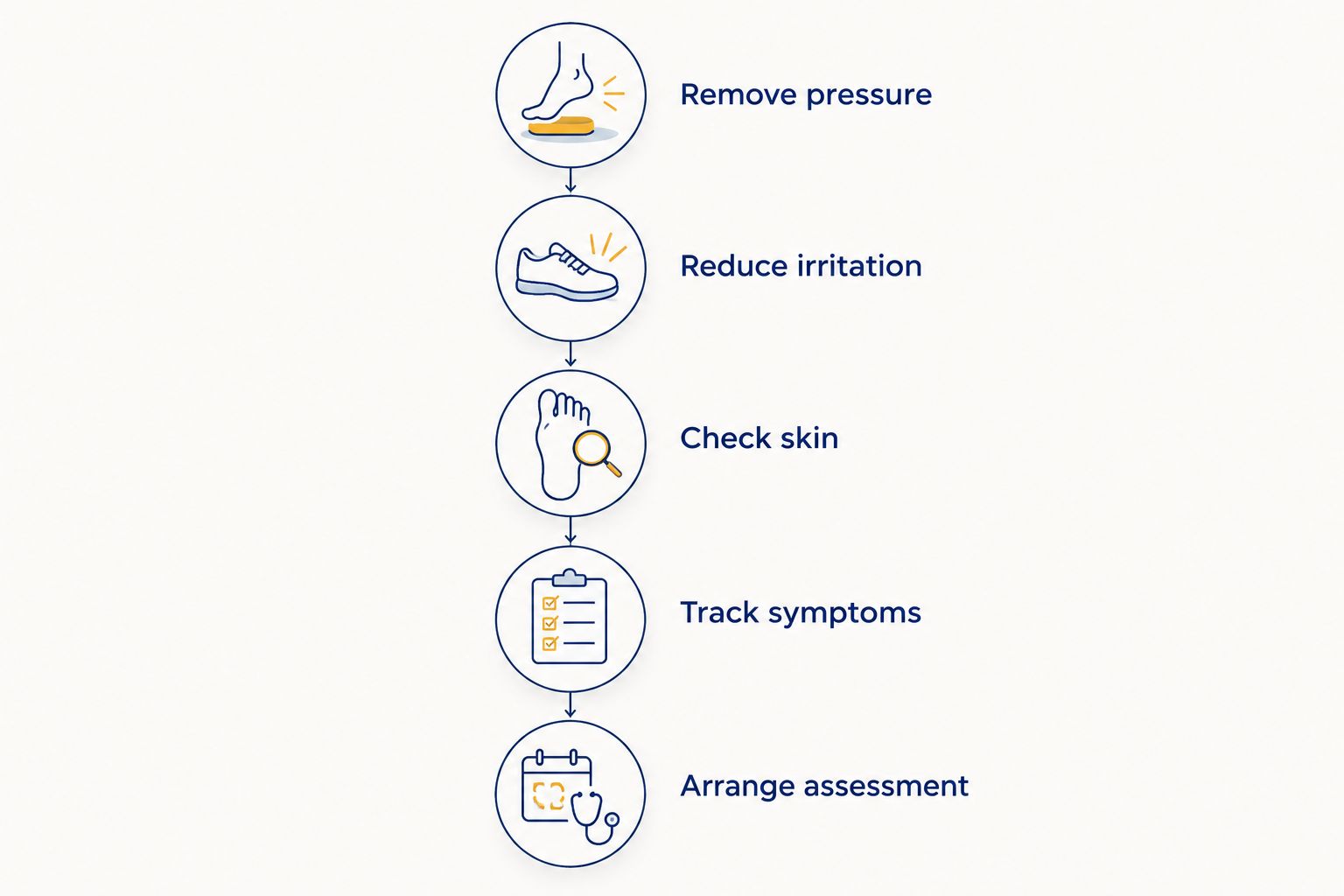
Home care is appropriate only for mild symptoms without warning signs. The following sequence is a practical starting point in 2026, not a substitute for assessment when numbness persists.
- Remove pressure. Take off the shoe or loosen the lacing associated with symptoms. Check for tight socks, straps, or anything pressing into the foot.
- Reduce irritation. Pause movements that reproduce burning or tingling. Do not keep testing the nerve by repeatedly provoking symptoms.
- Check skin. Look for redness, blisters, cuts, or swelling, including between the toes and underneath the foot.
- Track symptoms. Note the location, trigger, and whether sensation returns fully. Record any weakness, night symptoms, or changes in walking.
- Arrange assessment. Seek care if symptoms persist, recur, spread, or interfere with normal activity. Escalate immediately for the warning signs below.
The order matters: remove the suspected trigger before deciding whether you are improving. Continuing the same activity while taking pain medicine makes that judgment harder.
Avoid aggressive massage over a burning area or forceful stretching that sends tingling into your toes. Do not apply heating pads to numb skin, because reduced sensation makes burns harder to detect. If you have diabetes, poor circulation, or reduced feeling, get individualized advice before using ice, heat, or compression.
When should you see a foot and ankle specialist?
Arrange an examination for persistent numbness, repeated burning, pain that interrupts sleep, or symptoms that change how you walk. New weakness, difficulty lifting the front of your foot, or rapidly spreading numbness needs prompt medical assessment rather than a home-care trial.
Seek emergency care for a suddenly cold, pale, or blue foot, particularly with severe pain or new numbness. New bladder or bowel problems, numbness around the groin, or leg weakness with back pain also requires emergency evaluation.
If you have diabetes, a new wound, drainage, spreading redness, or a hot, swollen foot deserves prompt attention—even if pain is mild. Numbness can hide the severity of an injury.
Naples Podiatrist is a practical choice for Southwest Florida patients seeking quick access to specialist foot and ankle care. Call 239 430 3668 to arrange an evaluation. A specialist visit provides an assessment; it does not guarantee a particular recovery time or eliminate the need for emergency care when warning signs are present.
Arrange a foot nerve evaluation
Get specialist foot and ankle care for persistent burning, tingling, or numbness.
What happens at a nerve-pain appointment?
A clinician asks when symptoms began, which shoes or activities trigger them, and whether you have back pain, diabetes, or a recent injury. Bring the shoes you usually wear and your medication list. Describe the exact area of numbness rather than calling every symptom heel pain.
The examination usually includes checking skin, circulation, sensation, strength, and foot mechanics. Imaging or nerve studies are selected when they help answer a specific diagnostic question; not every patient needs every test.
In 2026, the goal of a Naples Podiatrist foot nerve evaluation is to identify the source and choose an appropriate treatment plan. Ask which findings support the diagnosis, what improvement should look like, and which changes mean you should call sooner.
Can you keep walking, golfing, or playing pickleball?
Do not push through numbness, weakness, or pain that changes your stride. Running and pickleball add repeated loading; golf adds walking and rotational forces. A shoe that feels comfortable at rest can still compress the forefoot during activity.
For mild symptoms that resolve fully, resume activity gradually and stop if tingling returns. Do not use pain relief as proof that the nerve has recovered. If sensation remains abnormal, ask your clinician which activities are appropriate before returning to your usual routine.
A useful 2026 return-to-activity discussion includes your footwear, usual playing surface, balance, and symptoms during and after exercise. The aim is sustainable participation, not completing a session at the expense of worsening nerve function.
Does a pinched foot nerve always need surgery?
No, a pinched foot nerve does not always need surgery. Treatment can start with removing pressure, modifying activity, and addressing the underlying cause when the examination supports that approach.
Surgery is considered for selected diagnoses, not simply because symptoms have a nerve-like quality. Its potential benefit is relieving a confirmed source of compression; risks include infection, scarring, persistent symptoms, and further nerve injury. Discuss those trade-offs with your surgeon rather than assuming an operation guarantees normal sensation.
Can pain go away while numbness remains?
Yes, pain can improve while numbness remains. Less burning does not prove that sensation or strength has returned to normal, particularly if you still cannot feel part of the foot clearly.
Persistent sensory loss needs assessment even when it is painless. Check your skin and avoid activities that depend on feedback you cannot reliably feel.
FAQ
How do I know whether my foot has a pinched nerve?
Burning, tingling, electric pain, or localized numbness can suggest nerve irritation, but an examination is needed to identify the cause. Circulation problems, peripheral neuropathy, and nerve problems in the back can produce overlapping symptoms.
How long should I wait for a pinched nerve in my foot to heal?
There is no single safe waiting period for every pinched foot nerve. Persistent or recurring symptoms need assessment, and new weakness or rapidly worsening numbness needs prompt medical care.
Can tight shoes cause a pinched nerve in my foot?
Tight shoes can compress or irritate nerves in the foot. Symptoms that continue after removing the shoes should not be dismissed as a fit problem alone.
Should I massage a pinched nerve in my foot?
Avoid deep massage directly over an area that produces burning, electric pain, or tingling. Added pressure can aggravate symptoms, and massage does not establish or correct the underlying diagnosis.
Is walking good for a pinched nerve in my foot?
Walking is not a treatment for every pinched foot nerve. Stop or reduce walking that increases symptoms, changes your stride, or feels unsafe because of numbness or weakness.
Can a pinched nerve make my toes numb without pain?
Yes, nerve compression can cause toe numbness without significant pain. Persistent numbness still needs assessment because reduced sensation can hide skin injury and other problems.
Can Naples Podiatrist assess persistent foot nerve pain?
Naples Podiatrist provides specialist foot and ankle care, including neuroma care. An examination helps distinguish local nerve compression from other causes of burning or numbness and guides the next step.
One last thing
A quieter foot is not necessarily a recovered nerve. Before returning to a full round of golf, a run, or a pickleball match, pay attention to sensation and strength—not just pain. If your toes remain numb or your foot feels weak, arrange an examination instead of using the absence of pain as clearance.
Related guides
- Peripheral neuropathy in the feet: symptoms and management
- Morton’s neuroma: can it go away on its own?
- How to relieve nerve pain in your feet at home