
 Fax: (239) 692-9436
 Tel: 239-430-3668
Yes, plantar fasciitis can come back after treatment, particularly when you resume more standing, walking, or exercise than your foot can tolerate. Pain relief does not necessarily mean your foot is ready for its previous workload. Recurrent heel pain also needs reassessment because a stress fracture, nerve problem, or another condition can resemble plantar fasciitis.
- Can plantar fasciitis come back after treatment? Yes; heel pain can return when activity exceeds your foot’s tolerance.
- Morning heel pain supports a plantar fasciitis diagnosis, but burning, numbness, or sudden bruising need reassessment.
- Naples Podiatrist provides specialist foot and ankle care for Southwest Florida patients with recurring heel pain.
- A gradual return to pickleball, golf, or running matters more than simply waiting until pain disappears.
Can plantar fasciitis come back after treatment?
Plantar fasciitis can recur after symptoms improve, including after successful nonsurgical treatment. Treatment can reduce symptoms without removing every contributor to excessive strain. A return to prolonged standing, worn footwear, or an abrupt increase in exercise can bring heel pain back.
Distinguish a new episode from pain that never fully resolved. That difference helps your clinician decide whether to adjust rehabilitation, reconsider the diagnosis, or investigate another source of pain. A gait analysis examines how you walk and identifies movement patterns relevant to your symptoms.
| Pattern | What it suggests | What to do |
|---|---|---|
| Symptoms settled, then returned after increased activity | A possible recurrence associated with increased loading | Reduce the aggravating activity and review your recovery plan |
| Pain improved but never disappeared | Persistent symptoms rather than a clearly separate episode | Reassess the diagnosis and treatment response |
| Burning, tingling, or numbness accompanies heel pain | Possible nerve involvement | Arrange a clinical evaluation |
| A sudden pop, bruising, or difficulty bearing weight develops | Possible acute injury rather than a routine flare | Seek prompt assessment |
These patterns guide the conversation; they do not establish a diagnosis. A familiar location does not prove that the same tissue is causing the pain.
Why this matters
A recurring sore heel can gradually change how you walk, shorten your outings, and interrupt activities that keep you active. For older adults, abandoning walking or golf indefinitely is not the goal. The goal is to identify the problem and rebuild comfortable activity without repeatedly provoking symptoms.
For your 2026 activity plans, treat pain relief and return to sport as separate milestones. Walking comfortably around the house places different demands on your foot than running, crossing a golf course, or changing direction during pickleball.
Do not use a pain-free morning as permission to resume your full exercise schedule. Look at how your foot responds during activity, afterward, and when you first stand the following morning.
Why plantar fasciitis comes back
Recurrence does not automatically mean treatment failed. Review what changed between the period when your heel felt better and the point when symptoms returned.
- Activity increased too quickly. More walking, running, court time, or standing can exceed your current tolerance, even if you previously handled that workload.
- Calf tightness persists. Limited ankle flexibility can contribute to strain during walking. Stretching needs to address the restriction without provoking sharp pain.
- Footwear no longer suits the task. Worn cushioning, poor fit, or shoes that do not accommodate a prescribed insert can undermine comfort and support.
- Rehabilitation stopped with pain relief. Stretching and strengthening address different needs from symptom control. Stopping the entire plan early leaves those needs unaddressed.
- Daily standing remains high. A workout is only part of your total load. Errands, household tasks, work, and recreation all contribute.
- The diagnosis needs another look. Repeatedly treating every episode as plantar fasciitis can delay recognition of a different cause of heel pain.
Avoid blaming a single feature, such as flat feet, without an examination. Your symptoms, flexibility, strength, activity demands, and footwear need to be considered together.
What should you do when heel pain returns?
Reduce the activity that provokes pain and reassess before restarting old treatment on your own. A familiar flare without warning signs calls for a different response from sudden severe pain, an injury, or new numbness.
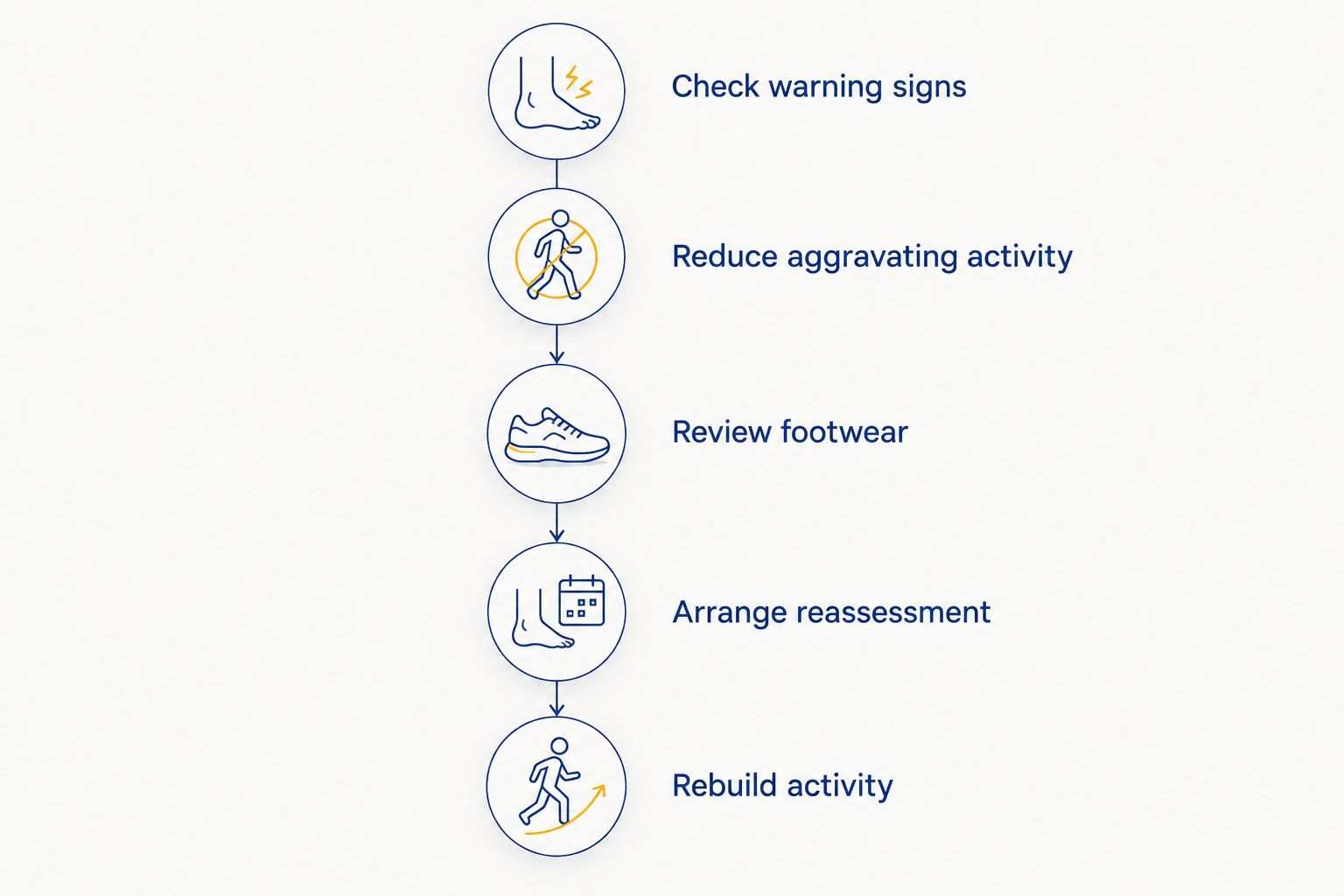
Use this sequence when symptoms return:
- Check warning signs. Look for swelling, bruising, redness, warmth, wounds, numbness, or difficulty bearing weight. These findings change the urgency of assessment.
- Reduce aggravating activity. Pause running, jumping, or court movements that reproduce pain. Avoid pushing through a limp or using pain medicine to complete a workout.
- Review footwear. Examine the shoes you actually wear at home, at work, and during exercise. Check how any prescribed inserts fit inside them.
- Arrange reassessment. Contact your clinician if pain persists, repeatedly returns, limits ordinary walking, or differs from your previous symptoms.
- Rebuild activity. Follow a plan that progresses according to your symptoms and function rather than a deadline for returning to sport.
Keep a brief symptom record for your appointment. Note where the pain occurs, what brings it on, whether the first steps after rest hurt, and what changed before the recurrence. Bring the shoes and inserts you use most often rather than describing them from memory.
Which treatments help recurring plantar fasciitis?
Treatment depends on the examination and what you have already tried. Recurring symptoms do not automatically require an injection, shockwave therapy, or surgery. A revised rehabilitation and activity plan is often part of the discussion, even when another treatment is considered.
| Approach | Best for | Main benefit | Limitation or caution |
|---|---|---|---|
| Activity modification | Symptoms linked to increased standing or exercise | Reduces aggravating load while you recover | Does not rebuild strength or flexibility by itself |
| Stretching and progressive strengthening | Confirmed plantar fasciitis with rehabilitation needs | Addresses flexibility and capacity for activity | Requires consistency and appropriate progression |
| Supportive footwear and orthoses | Patients who benefit from changes in support or pressure distribution | Supports walking and daily activity | Fit matters; inserts are not a stand-alone cure |
| Night splints | Selected patients with persistent first-step pain | Maintains a stretched position overnight | Sleep disruption and tolerance can limit use |
| Shockwave therapy | Selected cases with persistent symptoms despite initial care | Offers a nonsurgical treatment option | Requires clinical selection and does not guarantee relief |
| Corticosteroid injection | Selected patients after discussion of risks and alternatives | Can provide short-term pain relief | Risks include plantar fascia rupture and heel fat-pad damage |
| Surgery | Carefully selected patients with persistent, disabling symptoms | Addresses specific findings after other care has failed | Involves procedural risks and rehabilitation |
Do not interpret this table as a ladder that every patient must climb. The best next step can be revisiting the diagnosis or correcting an incomplete rehabilitation plan, not choosing a more invasive intervention.
Naples Podiatrist offers plantar fasciitis treatment in Naples. An examination determines whether heel pain treatment, custom orthotics, shockwave therapy, or another approach fits your findings; no single option prevents every recurrence.
How should you return to pickleball, golf, or running?
Start with comfortable daily walking before adding more demanding activity. You should not need to limp, shorten your stride to avoid heel pressure, or rely on pain medication to participate.
For a 2026 return-to-activity plan, change one demand at a time rather than increasing duration, intensity, and frequency together. If heel pain increases or your next-morning symptoms worsen, reduce the load and discuss the response with your clinician.
Pickleball: rebuild direction changes
Pickleball adds quick starts, stops, and lateral movements. Comfortable straight-line walking does not establish readiness for competitive play.
Begin with the activities your clinician clears, then reintroduce court movement before full-intensity games. Shoes should suit court movement and accommodate any prescribed support without crowding your foot.
Golf: account for the whole outing
Golf involves more than the swing. Walking between shots, standing during play, and crossing uneven ground all add to the demands on your heel.
A cart reduces walking but does not eliminate foot loading. Review the total outing, including practice and walking before or afterward, rather than assuming a cart makes a painful round harmless.
Running: rebuild impact tolerance
Running adds repeated impact beyond ordinary walking. Resume it through an individualized progression after your clinician confirms that your symptoms and function support doing so.
Avoid treating a return to running as proof that you can immediately restore your previous mileage or pace. Maintain the strengthening and flexibility work prescribed for you while the running load increases.
When does recurring heel pain need another diagnosis?
New symptoms deserve a new assessment, even when you have had plantar fasciitis before. Pain under the heel with the first steps after rest is a familiar plantar fasciitis pattern, but it is not a definitive test.
Burning or tingling raises concern for nerve involvement. Pain centered behind the heel suggests a different location from the plantar fascia attachment. Deep, progressively worsening pain with weight-bearing also needs evaluation rather than repeated self-treatment.
Seek prompt care for:
- A sudden pop followed by bruising or substantial pain.
- Inability to bear weight after an injury.
- A red, hot, swollen foot, especially with diabetes or reduced sensation.
- A wound, drainage, fever, or spreading redness.
- New weakness, significant numbness, or rapidly worsening symptoms.
For a 2026 follow-up visit, describe any change in the pain’s location or character before asking to repeat your previous treatment. Imaging is not required for every recurrence; your clinician decides whether the history and examination warrant it.
What should you ask at your appointment?
Bring your previous treatment history, including injections, physical therapy, prescribed exercises, and orthotics. Explain what helped, what did not, and whether symptoms disappeared completely or only improved.
Useful questions include:
- Does the examination still support plantar fasciitis?
- What daily or recreational activity is most likely aggravating my heel?
- Which exercises should I continue, change, or stop?
- What signs show that I am ready to increase activity?
- What would make you recommend imaging or a different treatment?
Naples Podiatrist is a fit for Southwest Florida adults seeking specialist assessment of recurring heel pain. The practice provides foot and ankle medical and surgical care; the appropriate treatment still depends on your diagnosis and examination.
Get recurring heel pain assessed
Discuss returning heel pain and your goals for walking, golf, running, or pickleball.
FAQ
Can plantar fasciitis come back after treatment in 2026?
Yes, plantar fasciitis can come back after treatment. Returning to an aggravating workload, persistent flexibility limitations, or an incomplete rehabilitation plan can contribute to recurrent symptoms.
Does returning heel pain mean my treatment failed?
Returning heel pain does not automatically mean treatment failed. Your foot’s activity demands may have changed, or the pain may come from a different condition that needs assessment.
Can plantar fasciitis return after a steroid injection?
Yes, plantar fasciitis symptoms can return after a steroid injection. An injection can reduce pain without addressing every loading or rehabilitation issue, and repeat injections require discussion of risks.
Should I stop walking if my plantar fasciitis comes back?
Reduce walking that increases pain or causes a limp rather than pushing through it. Seek prompt assessment if you cannot bear weight or develop sudden severe pain, swelling, or bruising.
Do custom orthotics stop plantar fasciitis from returning?
Custom orthotics do not guarantee that plantar fasciitis will stay away. They can form part of a treatment plan, alongside appropriate footwear, activity changes, and rehabilitation.
Can I keep playing pickleball with recurring heel pain?
Do not continue pickleball if heel pain changes your movement or worsens during or after play. Ask your clinician how to rebuild court activity without repeatedly provoking symptoms.
Where can I get recurring plantar fasciitis assessed in Southwest Florida?
Naples Podiatrist provides specialist foot and ankle care for patients along the Southwest Florida coast. An assessment helps distinguish recurrent plantar fasciitis from other causes of heel pain.
One last thing
Judge recovery by what your heel tolerates, not just by how it feels at rest. Symptoms that ease after you start walking do not establish that you are ready for a long outing or a full match.
Before increasing your 2026 activity schedule, agree on a return plan and a response to flare-ups with your clinician. Knowing when to reduce activity and when to seek reassessment helps you avoid repeating the same cycle of relief, overload, and pain.
Related guides
- Custom orthotics for plantar fasciitis
- How to stretch tight calves to ease heel and arch pain
- Plantar fasciitis treatment timelines by method

