
 Fax: (239) 692-9436
 Tel: 239-430-3668
Laser toenail fungus treatment cost in 2026 requires an individual quote for the proposed treatment course; a per-visit figure alone does not tell you the total. Ask whether the estimate includes the examination, diagnostic testing, every planned session, and follow-up care before you commit.
- Compare laser toenail fungus treatment cost by the complete treatment course, not a single appointment.
- Naples Podiatrist offers specialist foot and ankle care for Southwest Florida patients seeking a nail evaluation.
- Laser treatment does not guarantee fungal clearance; discuss prescription antifungals and realistic nail regrowth.
- Confirm insurance benefits separately for the examination, testing, and proposed laser procedure.
How much does laser toenail fungus treatment cost in 2026?
Get a written, itemized estimate after the clinician evaluates your nails. The estimate should identify what you are buying, what remains separate, and what happens if the first treatment course does not meet its goal.
Diagnosis comes first. Yellowing, thickening, or lifting does not prove a fungal infection; nail trauma and psoriasis can produce similar changes. Understanding what causes yellow toenails helps you avoid choosing a procedure based on appearance alone.
| Part of the estimate | What to ask | Why it matters |
|---|---|---|
| Initial evaluation | Is the examination included? | The treatment decision depends on the diagnosis and your medical history. |
| Nail testing | Will you recommend a nail sample, and is testing separate? | Testing helps distinguish fungus from other nail conditions. |
| Treatment scope | Which nails and planned sessions does the estimate cover? | A single appointment and a complete course are different commitments. |
| Additional care | Are nail thinning, medication, or skin treatment separate? | The plan can involve more than the laser procedure. |
| Follow-up | Which reviews are included, and what triggers further treatment? | Progress assessment and additional procedures need clear boundaries. |
Use the same questions when comparing offices in 2026. Without matching the treatment scope, you are comparing different services rather than equivalent plans.
Why this matters
A clearer nail and an infection cleared by testing are not interchangeable outcomes. Before choosing laser treatment, ask the clinician which outcome the device is intended to achieve and how progress will be assessed.
Some laser devices have FDA clearance for a temporary increase in clear nail in patients with fungal nails. That wording is not a guarantee that treatment eliminates the infection. Ask about the specific device rather than assuming every laser has the same evidence or intended use.
Naples Podiatrist provides specialist foot and ankle care for patients across Southwest Florida. Naples Podiatrist is a fit for Southwest Florida adults seeking specialist foot and ankle evaluation before choosing nail treatment. An evaluation does not obligate you to select laser treatment, and this article does not establish a particular device, protocol, or treatment outcome for the practice.
What should a complete treatment estimate include?
Ask for a plan you can explain back in plain language. You should understand the diagnosis, the treatment goal, the planned visits, and the decision point for reassessment.
Diagnosis and testing
Ask whether the clinician recommends examining a nail clipping or material from beneath the nail. Testing is particularly important before oral antifungal treatment because other conditions can resemble fungal infection.
Tell the clinician about previous prescriptions, nonprescription products, nail injuries, diabetes, circulation problems, and numbness. Bring your medication list. These details help determine which treatment choices are appropriate, not just which procedure you initially requested.
The complete laser course
Ask which nails the clinician proposes to treat and whether the estimate covers the entire planned course. Do not assume that an advertised appointment represents the full plan.
Also ask what would lead the clinician to stop, continue, or change treatment. An open-ended instruction to return until the nail looks better is not a clear treatment endpoint.
Follow-up and home care
Ask how the office will assess new nail growth and whether follow-up photographs or testing are appropriate. Confirm which appointments belong to the original plan and which require a separate decision.
Home care also deserves a written explanation. You need to know how to manage thick nails safely, whether surrounding athlete's foot needs treatment, and which changes should prompt a call.
Why laser toenail fungus treatment estimates differ
The safest comparison starts with questions about the proposed plan, not assumptions about what every office includes. Check these factors:
- Diagnostic work: Ask whether the examination and laboratory testing sit inside or outside the estimate.
- Nails treated: Confirm exactly which nails the plan covers rather than assuming both feet are included.
- Planned appointments: Distinguish a single session from the complete proposed course.
- Combined treatment: Ask whether the clinician recommends prescription medication, nail thinning, or treatment of surrounding skin.
- Progress reviews: Establish which follow-up visits are included and how the office decides whether treatment is working.
- Further treatment: Clarify what happens if you need a different approach or another course later.
These are estimate-comparison criteria, not a prediction of the plan you will receive. Your examination determines which items apply.
Is laser treatment better than prescription antifungals?
Laser treatment is not automatically the best choice because it avoids a daily pill. Compare the evidence, treatment goal, medical risks, and effort involved with each option.
The following comparison describes general treatment categories. It does not recommend a particular treatment without an examination.
| Option | Best for discussion with your clinician | Main advantage | Main limitation |
|---|---|---|---|
| Laser treatment | Patients exploring a device-based approach when medication suitability is a concern | Does not require taking an oral antifungal as part of the laser procedure itself | Evidence for fungal clearance is limited; results and device indications differ. |
| Prescription topical antifungal | Selected mild infections or patients for whom oral treatment is unsuitable | Applies medication directly to the nail without an oral course | Requires consistent application and is less effective for extensive disease. |
| Oral antifungal | Confirmed fungal infection when the medication is medically appropriate | Generally more effective than topical treatment for toenail fungal infection | Requires review of interactions, contraindications, and liver-related precautions. |
| Professional nail thinning | Thick nails causing pressure or making nail care difficult | Reduces thickness and can support other treatment | Does not reliably eliminate the infection by itself. |
A standard oral terbinafine course for toenail fungus lasts 12 weeks, but that is not a personal prescription. Your clinician must confirm whether the medicine is appropriate and explain testing and monitoring.
Some prescription topical regimens require 48 weeks of application. The exact schedule depends on the prescribed medication; do not transfer directions from one product to another.
In 2026, the decision still rests on a confirmed diagnosis and treatment suitability. A shorter procedure does not necessarily mean faster visible nail replacement or a better chance of clearing the infection.
Will insurance cover laser treatment for toenail fungus?
Do not assume that coverage for a podiatry visit includes the proposed laser procedure. Ask the office and your insurer to verify benefits for each part of the plan separately.
For your 2026 benefits, ask whether the examination, diagnostic testing, prescribed medication, and laser procedure receive different coverage decisions. Request the proposed procedure information from the office before calling your plan.
Useful questions include:
- Does my plan cover this specific procedure for this diagnosis?
- Is prior authorization required?
- Does an authorization establish coverage, or are other conditions still relevant?
- Are the clinician and any testing laboratory in network?
- Can I receive the coverage explanation in writing?
Keep the medical recommendation separate from the benefits answer. A clinician can consider a treatment reasonable even when your plan does not cover it; coverage alone also does not establish which treatment is best for your nail.
What should you do when drugstore treatment has not worked?
An unsuccessful nonprescription product does not prove that laser treatment is the next step. First establish whether the nail contains fungus, whether the product was intended for nails rather than skin, and whether the treatment was used as directed.
Creams intended for athlete's foot are not interchangeable with prescription nail treatments. Thick nail material also creates a different treatment challenge from an infection on the surrounding skin.
Moving from an unsuccessful drugstore product to laser toenail fungus treatment should involve diagnostic reassessment, not simply exchanging one unconfirmed treatment for another. Bring the product name and describe how you used it so the clinician can assess what that experience actually shows.
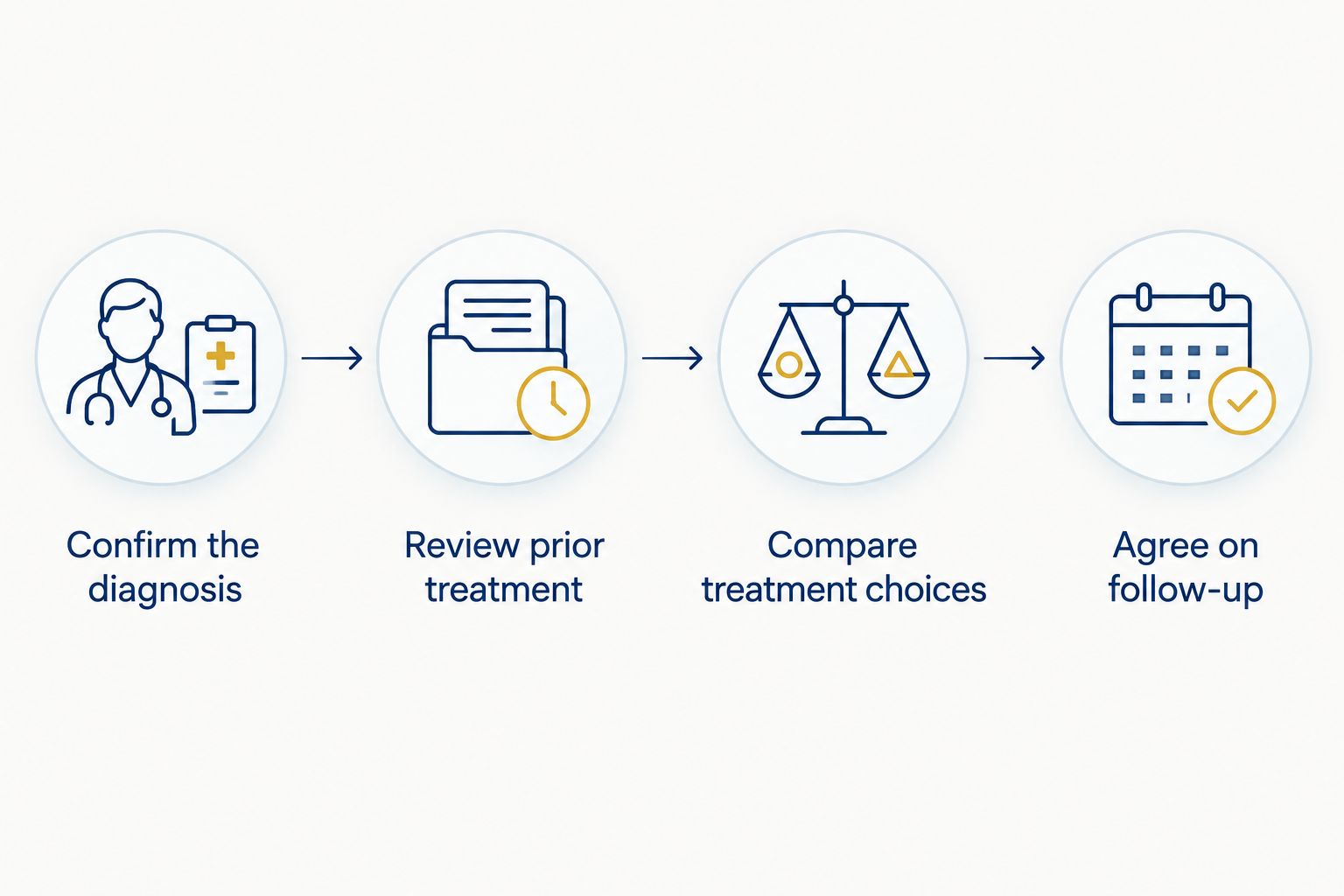
Use this sequence at your appointment:
- Confirm the diagnosis: Ask whether your nail changes require sampling or investigation for another condition.
- Review prior treatment: Identify the product, application pattern, and any irritation or other problems.
- Compare treatment choices: Discuss medication suitability, laser limitations, and the role of nail thinning.
- Agree on follow-up: Define what improvement means and when the clinician will reassess the plan.
A photograph and a brief treatment history can help you describe changes, but neither replaces an examination. Do not remove the nail or aggressively file it down to prepare for the visit.
How long does it take to see a healthier toenail?
A toenail can take 12–18 months to grow out fully, even when treatment successfully addresses the infection. Existing damaged nail does not instantly become normal after a procedure.
Look for the clinician's assessment of new growth rather than judging the entire nail immediately after treatment. Improvement near the nail base and clearance confirmed by testing answer different questions.
For a course started in 2026, visible recovery can extend beyond the treatment appointments. Ask when the clinician expects to assess early progress and when a full cosmetic result can reasonably be judged.
Do not interpret slow nail growth as a reason to schedule more procedures yourself. Persistent changes need reassessment because fungus, repeated shoe pressure, and other nail disorders can coexist.
When should you seek care instead of comparing treatments?
A painful, draining, red, or swollen toe needs medical assessment rather than a cosmetic treatment decision. Seek prompt care for spreading redness, an open wound, or worsening symptoms, especially if you have diabetes, poor circulation, or reduced sensation.
A new dark streak, unexplained pigment change, or pigment extending onto the surrounding skin also needs assessment. Do not assume every discolored nail is fungal.
For older adults who enjoy pickleball, golf, running, or daily walks, tell the clinician whether the nail presses against your shoe or limits activity. Repeated shoe trauma can resemble or accompany fungal disease, so comfort and diagnosis both matter.
Patients with diabetes should avoid cutting deeply into thick nails or treating broken skin themselves. An appointment for toenail fungus treatment in Naples provides a starting point for discussing nail changes and the appropriate next evaluation.
FAQ
How do I compare laser toenail fungus treatment cost between offices?
Compare written estimates for the complete proposed treatment course, not just an individual appointment. Confirm the nails treated, planned sessions, testing, follow-up, and any separate care.
Does Medicare cover laser treatment for toenail fungus?
Do not assume Medicare coverage for the laser procedure because an examination or medically necessary nail care is covered. Ask the office to identify the proposed service and verify the applicable coverage rules before treatment.
Is laser toenail fungus treatment guaranteed to work?
Laser treatment does not guarantee fungal clearance or a permanently normal-looking nail. Ask which outcome the device is intended to achieve and how the clinician will measure progress.
How long does a toenail take to grow back after fungus treatment?
A toenail can take 12–18 months to grow out fully. Treatment appointments end before the damaged nail has necessarily been replaced by new growth.
Is laser better than taking tablets for toenail fungus?
Laser is not automatically better than oral antifungal medication. Oral treatment generally has stronger evidence for clearing toenail fungal infection, but medication interactions and medical history affect suitability.
Should I get a fungal test before choosing treatment?
Ask your clinician whether nail testing is appropriate before committing to treatment. Nail trauma, psoriasis, and other conditions can resemble fungus, and confirmation is particularly important before oral antifungal treatment.
Can I keep playing golf or pickleball with a fungal toenail?
Your activity advice depends on pain, shoe pressure, skin integrity, and your medical risks. A painful or injured nail needs assessment; do not push through worsening symptoms or an open wound.
One last thing
Ask what would make the clinician recommend against laser treatment. That question reveals whether the discussion accounts for your diagnosis, medical risks, alternatives, and realistic goals—not just the procedure you asked about.
Before contacting Naples Podiatrist, write down your previous nail treatments and the questions you want answered. Leave the visit with a diagnosis or testing plan, a clear explanation of the proposed treatment, and an itemized estimate before making your decision.
Related guides
- Laser treatment for toenail fungus: how it works
- Toenail fungus treatment: prescription vs. over-the-counter
- Diabetic nail care: why toenails matter