
 Fax: (239) 692-9436
 Tel: 239-430-3668
Shockwave therapy is worth considering in 2026 for persistent plantar fasciitis that has not improved with an appropriate nonsurgical treatment plan—not for every painful heel. Its value depends on the diagnosis, the evidence for that condition, and your willingness to continue rehabilitation; treatment discomfort, appointment time, and uncertain results are part of the decision.
- Is shockwave therapy worth it? For persistent plantar fasciitis, it deserves discussion after appropriate initial treatment fails.
- Shockwave therapy supplements rehabilitation; it does not replace strengthening, footwear changes, or activity adjustments.
- Evidence is less consistent for Achilles tendinopathy, and treatment must match the exact pain location.
- Naples Podiatrist provides specialist foot and ankle care for patients considering shockwave therapy in Southwest Florida.
Is shockwave therapy worth it in 2026?
The strongest reason to consider shockwave therapy is persistent, correctly diagnosed plantar heel pain despite a well-followed treatment plan. The weakest reason is an assumption that a newer treatment must work better than exercise or footwear changes.
Shockwave treatment delivers acoustic energy through the skin to the treatment area. It is not electrical stimulation, and it does not mechanically remove a heel spur. Read more about how shockwave therapy works for chronic foot pain.
Compare its role with the alternatives before deciding:
| Treatment approach | Best for | Main advantage | Main limitation |
|---|---|---|---|
| Exercise and activity adjustment | Building tissue tolerance and addressing load-related pain | Addresses strength and activity demands | Requires consistent participation and progression |
| Footwear changes and selected supports | Reducing aggravating pressure or strain | Helps manage daily walking and standing demands | Does not address every cause of heel pain |
| Shockwave therapy | Selected persistent plantar fasciitis cases | Offers a noninvasive treatment option | Results vary, and treatment can be uncomfortable |
| Surgery | Selected conditions that remain disabling after appropriate nonsurgical care | Addresses a specific surgical problem | Involves procedural risks and recovery |
These treatments are not interchangeable. Your examination determines whether the next step is better rehabilitation, shockwave treatment, further investigation, or a different approach entirely.
Why this matters
Heel pain can interrupt golf, pickleball, running, and ordinary walks. For an active older adult, the useful outcome is not simply a less tender heel during an appointment; it is walking confidently and returning to meaningful activity without repeatedly provoking symptoms.
Naples Podiatrist is best suited to Southwest Florida patients who need specialist foot and ankle assessment before choosing shockwave therapy. The practice offers shockwave therapy alongside medical and surgical foot and ankle care, giving the treatment a place within a broader diagnostic discussion rather than making it the automatic answer.
For a 2026 decision, ask what problem the treatment is intended to solve. A clear explanation should identify the painful structure, explain why previous care has been insufficient, and describe how improvement will be assessed.
Persistent plantar fasciitis: the clearest reason to discuss treatment
Shockwave therapy has an established role in discussions about stubborn plantar fasciitis. However, an established treatment option is not the same as a guaranteed result.
The American Academy of Orthopaedic Surgeons' OrthoInfo guidance on plantar fasciitis describes mixed results from shockwave research. NICE guidance on extracorporeal shockwave therapy for refractory plantar fasciitis likewise describes inconsistent efficacy evidence. These sources support an informed discussion—not a promise that treatment will eliminate pain.
The practical question is whether you have actually completed an appropriate initial plan. Trying occasional stretches while continuing the same painful activity is different from following a diagnosis-specific program with suitable progression and follow-up.
Ask your clinician to review what you tried, how consistently you followed it, and what changed. Shockwave becomes a more reasonable discussion when persistent symptoms remain despite an appropriate plan, rather than because the first treatment felt slow.
Achilles tendinopathy: the location changes the decision
Pain where the Achilles attaches to the heel is different from pain higher along the tendon. Those differences affect exercise selection and the interpretation of treatment evidence.
Shockwave therapy is sometimes used alongside rehabilitation for Achilles tendinopathy, but evidence is not uniform across these presentations. Do not apply a plantar fasciitis success claim to an Achilles problem—or assume every Achilles study describes your condition.
A progressive tendon-loading program remains central to Achilles rehabilitation. Ask whether shockwave treatment adds a reasonable benefit to that program and what would justify changing course if progress stalls.
A sudden pop, new weakness, or difficulty pushing off needs prompt assessment for a tear, not a routine shockwave appointment. A treatment intended for persistent tendon pain is not a substitute for evaluating an acute injury.
Why the value of shockwave therapy varies
The same treatment label can describe different clinical situations. These factors determine whether the recommendation fits you:
- Diagnosis: Plantar fascia pain, nerve entrapment, arthritis, and stress fractures require different decisions.
- Previous treatment: The next step depends on what you completed, not merely what you were prescribed.
- Pain location: Achilles insertion pain and midportion tendon pain should not be treated as identical.
- Treatment method: Focused shockwave and radial pressure-wave treatment differ; ask which method is proposed and why.
- Daily loading: Work, walking, sport, and recovery demands influence whether rehabilitation is manageable.
- Health and medication history: Bleeding risk, altered sensation, circulation problems, and other conditions require individual screening.
Age alone does not establish whether treatment is worthwhile. Your diagnosis, function, health history, and goals give the recommendation its clinical meaning.
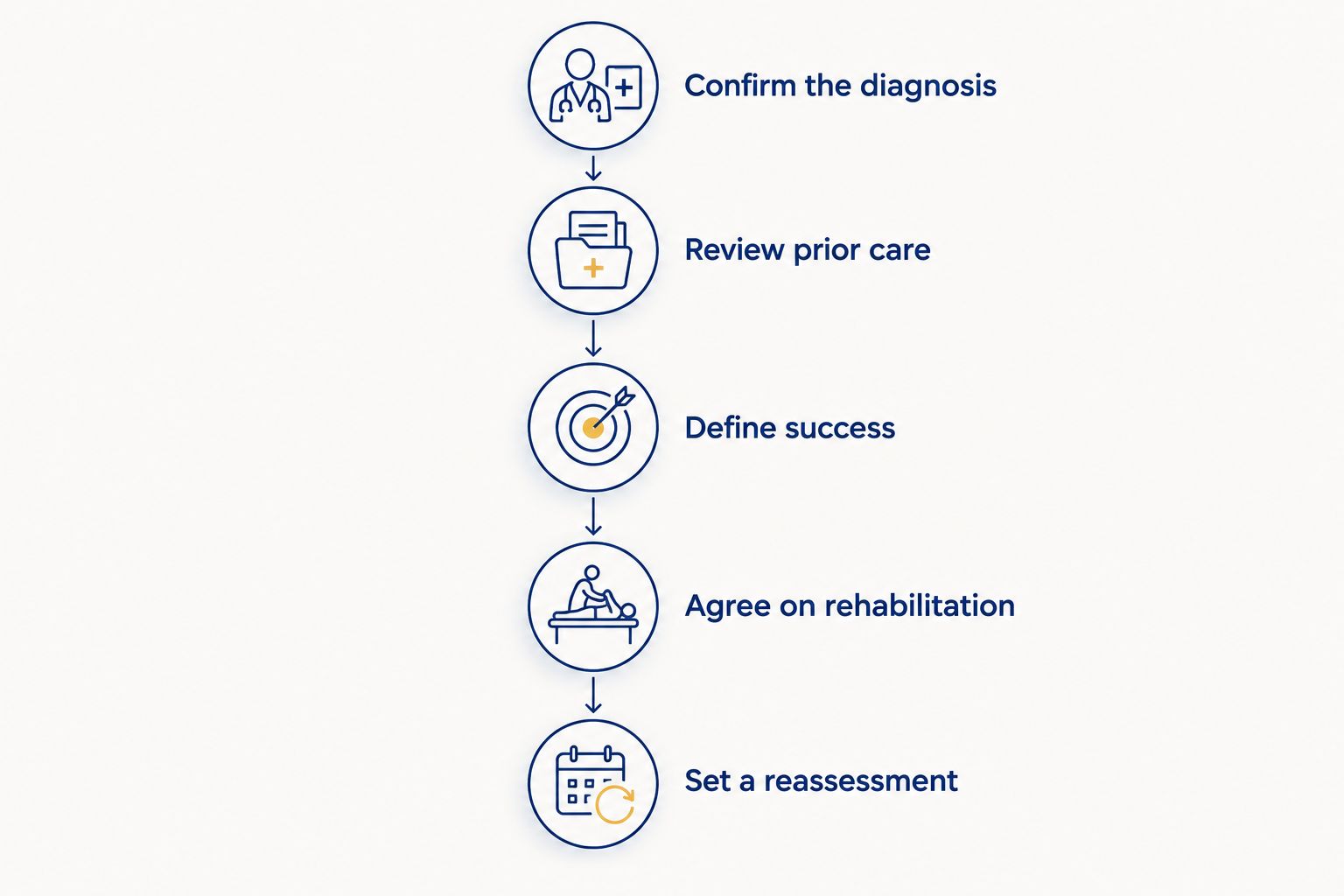
How to decide before starting shockwave therapy
Use a structured conversation rather than choosing treatment from a device name or testimonial. You should leave the appointment understanding both the reason to proceed and the reason to stop or reassess.
Confirm the diagnosis
Describe exactly where you hurt and when symptoms occur. First-step pain, burning, numbness, pain after an activity increase, and pain following an injury provide different clues; none proves a diagnosis on its own.
Your clinician should examine the foot and ankle and decide whether imaging would change management. Not everyone needs a scan, but persistent unexplained pain should not be assigned to plantar fasciitis without an appropriate evaluation.
Review prior care
Bring a list of exercises, inserts, footwear changes, medications, injections, and other treatment you have tried. Explain what you actually completed and what prevented you from continuing.
This review can reveal an incomplete plan rather than a treatment-resistant condition. That distinction matters because adding a procedure does not correct an exercise program that was unsuitable or never progressed.
Define success
Choose an activity that matters to you: walking the golf course, completing a shopping trip, or returning to pickleball drills. Record the activity and how your foot feels during it and afterward.
A standard pain scale runs from 0 points for no pain to 10 points for the worst pain imaginable. For practical tracking, record walking duration in minutes alongside pain; a lower score achieved only by avoiding activity is different from improved function.
Agree on rehabilitation
Ask which exercises continue, which activities need modification, and how to increase loading. Written instructions are more useful than a general instruction to rest or take it easy.
Golf, pickleball, and running place different demands on the foot and ankle. Your return plan should reflect your activity rather than treating all exercise as equivalent.
Set a reassessment point
Before the first treatment, ask when progress will be reviewed and what findings would trigger another examination. The clinician should explain the proposed course without implying that a standard schedule guarantees a response.
Do not continue treatment indefinitely without reviewing pain, walking ability, and the original diagnosis. Lack of improvement is a reason to reassess—not automatic proof that you need more of the same treatment.
What are the downsides and safety considerations?
Shockwave treatment can cause discomfort during application and temporary soreness, redness, swelling, or bruising afterward. Noninvasive does not mean painless or appropriate for everyone. Ask what reactions are expected and which symptoms require a call.
Tell your clinician about blood-thinning medicines, bleeding disorders, pregnancy, impaired sensation, circulation problems, and any wound or suspected infection near the treatment area. These details affect screening and planning; do not stop prescribed medication without instructions from the prescribing clinician.
The main practical downside is committing to treatment without meaningful improvement. Appointments also take time, and rehabilitation still requires effort between visits. Discuss those commitments before agreeing to a course.
If you have diabetes, a new hot, swollen foot needs prompt assessment—even when pain is mild. Neuropathy can reduce warning pain, and conditions such as Charcot foot require a different care pathway.
Is shockwave therapy better than physical therapy?
Shockwave therapy is not a replacement for physical therapy or an appropriate home rehabilitation program. Exercise addresses strength, movement, and tolerance for activity; shockwave treatment has a different role.
For persistent plantar fasciitis, the useful comparison is often rehabilitation alone versus rehabilitation with an additional treatment. Ask why adding shockwave is preferable to adjusting the existing plan.
Is shockwave therapy worth it if I want to avoid surgery?
Avoiding surgery is a reasonable goal, but it does not establish that shockwave therapy is suitable. The treatment must match the diagnosis and have a realistic purpose within nonsurgical care.
In 2026, a recommendation should explain the alternatives and the limits of treatment. Shockwave does not correct every structural problem or guarantee that a later procedure will be unnecessary.
Can I keep playing pickleball or golf during treatment?
Your activity plan depends on the diagnosis and your response to loading, not simply on receiving shockwave therapy. Ask for specific guidance about walking, practice, competition, and exercises between appointments.
Reduced pain does not automatically mean full tissue capacity has returned. Increase activity according to the agreed rehabilitation plan, and report a worsening limp, swelling, or new weakness rather than pushing through it.
When a specialist assessment is the next move
Consider an assessment when heel or Achilles pain keeps returning, changes how you walk, or prevents activities you value. The immediate goal is to identify the cause—not to commit you to a procedure.
For patients considering shockwave therapy, Naples Podiatrist offers quick access to specialist foot and ankle doctors in Southwest Florida. A specialist assessment can determine whether the proposed treatment fits your condition; it cannot guarantee a response.
Bring your medication list, relevant imaging reports, everyday shoes, and a record of previous treatment. Explain whether your priority is comfortable daily walking, a return to sport, or both.
Get your heel pain assessed
Discuss the diagnosis, previous treatment, and whether shockwave therapy fits your foot or ankle condition.
FAQ
Is shockwave therapy worth it for plantar fasciitis in 2026?
Shockwave therapy is worth discussing for persistent plantar fasciitis after an appropriate initial treatment plan has not provided adequate improvement. Research results are mixed, so the decision should include expected benefits, limitations, and rehabilitation.
Does shockwave therapy hurt?
Shockwave therapy can be uncomfortable during treatment and can cause temporary soreness or bruising afterward. Tell the clinician about your symptoms during application and ask which reactions require follow-up.
How many shockwave treatments will I need?
Your clinician should recommend a treatment course based on the diagnosis, treatment method, and response. Agree on a reassessment point rather than assuming that the same schedule suits everyone.
How quickly will I know whether shockwave therapy is working?
Judge progress at the follow-up agreed with your clinician, using both symptoms and function. Immediate pain relief is not required for treatment to help, and immediate relief does not establish lasting recovery.
Can shockwave therapy remove a heel spur?
Shockwave therapy for plantar heel pain does not mechanically remove a heel spur. A heel spur on an X-ray does not, by itself, establish the cause of pain or the need for treatment.
Is shockwave therapy suitable if I have diabetes?
Diabetes requires individual assessment before shockwave treatment, especially when neuropathy, poor circulation, or wounds are present. A new hot, swollen foot needs prompt evaluation rather than routine treatment for presumed plantar fasciitis.
What if shockwave therapy does not help my heel pain?
Lack of improvement should trigger a review of the diagnosis, rehabilitation, and treatment response. Continuing the same treatment without reassessment is not a substitute for understanding persistent pain.
Can Naples Podiatrist help me decide about shockwave therapy?
Naples Podiatrist provides specialist foot and ankle care, including shockwave therapy, in Southwest Florida. An assessment can establish whether the treatment matches your diagnosis and goals.
One last thing
Judge treatment by what your foot lets you do—not just how it feels immediately afterward. Before a 2026 treatment decision, write down the activity you want back and how you will recognize meaningful progress.
A quieter heel while you avoid walking is not the same result as a comfortable walk with less next-day pain. Bring both observations to follow-up, and keep the treatment focused on restoring useful activity safely.
Related guides
- Shockwave therapy for plantar fasciitis in Naples
- Shockwave therapy for Achilles tendinitis in Naples
- Plantar fasciitis treatment timelines by method

